

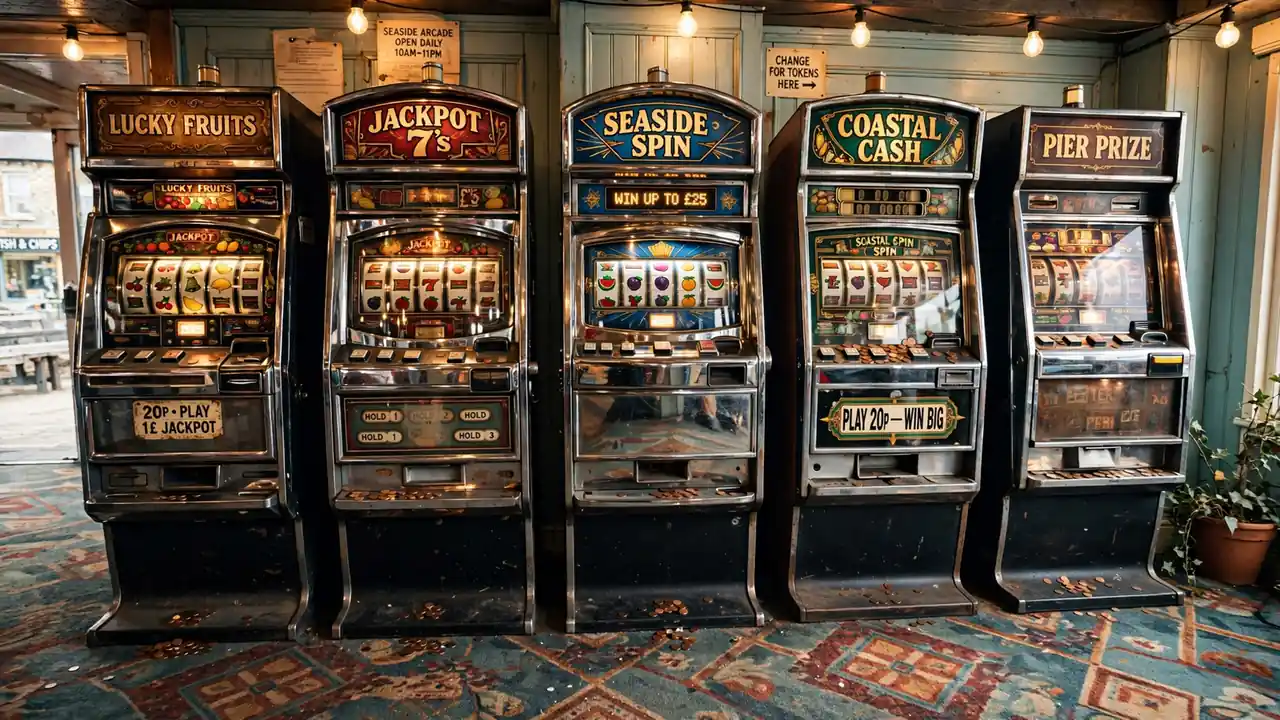
The reel count describes a game’s layout, while paylines, features and free-play terms shape how each slot plays.
Five Reels, and What the Number Changes
A five-reel slot is named for the vertical columns that carry its symbols across the screen. The reels turn, stop and leave a pattern to be read as a result. The name describes the machine’s visible structure, not a promise about what a spin will return. That distinction matters: the same format can contain very different games, while the number of reels alone says little about their character.
A three-reel slot uses a shorter horizontal arrangement. Its compactness often recalls the visual language of traditional fruit machines: a few columns, familiar symbols and an immediate sense of how the display is meant to be read. Five reels extend that field. There is more of the screen to scan, and a result can involve symbols appearing in a wider arrangement. Neither design is inherently better. They ask the eye to follow different shapes.
The contrast between 3 reel and 5 reel slots is therefore less a contest than a difference in scale and presentation. Three reels keep the image concentrated. Five spread it out. In a small display, the compact format may feel direct; on a larger screen, the longer arrangement can give a game room to establish a setting or visual theme. Those are qualities of presentation, not evidence that one format is more generous or more rewarding.
A bet can be applied across all five reels, so the columns are not merely decorative partitions. They form the area over which the game evaluates a spin. The player sees a field in which symbols can meet across the width of the display; the machine applies its own rules to determine whether the resulting pattern counts. Those rules belong to the individual game, not to the phrase “five reels” by itself.
This is where the format becomes easy to misread. A broad screen can suggest abundance: more visible positions, more possible arrangements, perhaps a busier experience. But a larger canvas does not, on its own, explain the terms of play. It does not state how a particular game treats symbols, what a result is worth or how often a winning combination appears. Those details cannot be inferred from the reel count. The layout is a frame, not a forecast.
Bonus Buy Slots in the UK: How the Feature Works
The older three-reel image has its own cultural weight. It carries the shorthand of the mechanical fruit machine, whose repeated symbols and compact display could be understood at a glance. Five-reel games inherited the basic spectacle of spinning columns but made the screen wider and the visual vocabulary more expansive. The change belongs partly to technology: digital displays can accommodate more elaborate scenes than a small mechanical cabinet. It also belongs to design, which learned to use the reels as a stage rather than only as a row of symbols.
That history can make “classic” seem like a label for three reels and “modern” a label for five, but the categories are not reliable descriptions of every game. A five-reel slot may borrow the plain look of an older machine; a three-reel game can be presented through digital effects. Reel count is a structural fact. Style is a choice layered over it.
The same caution applies to lists labelled best 5 reel slots in the UK. The format can identify a group of games, but it cannot settle what “best” means. One person may prefer a simple display; another may value a richer visual scene. Without knowing the rules and design of each individual title, the number of reels cannot do the judging.
Online, the basic distinction remains visible: three columns occupy less of the display, while five columns create a broader pattern. The screen may change size, and the presentation may be adapted to it, but the reel count still names the arrangement. It is a useful first description, rather like calling a book long or short. It says something real, but not what the reader will find inside.
Five reels change the geometry of the game. They widen the field in which symbols are arranged and give designers a larger visual structure to work with. Three reels offer a more compressed form. Neither number carries a verdict. The useful question begins after the layout is noticed: what has been built within it?
Reel count is a structural fact of the game’s layout; it does not determine the game’s character, reward frequency, or potential for payouts.
How Five-Reel Games Differ from One Another
The five-reel format is a family resemblance, not a personality. Games built around it can present very different rhythms: some return small wins frequently, while others leave longer stretches between wins and concentrate more of their returns in larger payouts. Volatility is the term used to describe that pattern of distribution. It does not say whether a game is entertaining, fair or likely to suit any particular player. It describes how its wins tend to be spread out.
A low-volatility game is designed to distribute returns across many smaller wins. Across most titles, winning combinations typically appear every three to six spins on average. That figure describes a broad pattern, not a schedule. A run of spins can produce several wins close together, or none at all; the average does not arrange the next result. The individual spin remains uncertain.
The distinction is easiest to misunderstand when frequent wins are treated as evidence of generous returns. A screen can register a winning combination without the amount returned matching the stake. A succession of modest wins may make play feel active, but activity and profit are separate things. The word “win” describes a result against the game’s symbols and rules; it does not, by itself, tell the story of the session’s balance.
Best RTP Slots UK: How to Read Return Figures
High-volatility games have a different distribution: payouts arrive less often, but may be larger when they do. This can create quieter stretches interrupted by more substantial results. It is not a promise that a large payout will eventually arrive, nor a timetable for one. Volatility is a description of the shape of results over play, not a forecast for an individual session.
That distinction gives two games with the same basic layout room to feel unlike one another. A slower, more uneven pattern can make each spin seem to carry greater suspense, while frequent smaller results can make a game feel busier. Neither quality changes the underlying uncertainty of a spin. Design can alter the pace with which outcomes are experienced, but it cannot make a sequence predictable.
There is no universal boundary at which a game becomes low or high volatility. The labels are useful shorthand, but they compress a distribution into a simple description. They do not capture every feature of how a particular game behaves, and they should not be read as a scale of quality. A low-volatility title is not automatically the safer choice for a budget, just as a high-volatility title is not a shortcut to a large return.
The wider design range also appears in a game’s presentation and rules. One title may use a restrained visual style, another a crowded, theatrical one; themes can borrow from folklore, travel, food or familiar symbols. The screen’s mood may influence how long the play feels, but decoration does not explain the return pattern. Nor does a lively animation turn an ordinary result into a more valuable one. The machinery beneath the scene matters more than its costume.
Low Volatility
Designed to distribute returns across many smaller, more frequent wins.
High Volatility
Payouts arrive less often, but may be larger when they occur.
Visual Style
Concerns the theatrical presentation, themes, and animations of the game.
For anyone comparing a 5 reel slot game, it helps to separate three impressions that can easily blur together: how often wins appear, how large they tend to be, and how the game presents them. Volatility concerns the distribution of wins. Visual style concerns the way results are staged. The rules determine what counts as a winning combination and what it returns. These qualities interact in the experience, but they are not interchangeable.
A game that produces many small wins may feel reassuring because the screen often acknowledges a result. Yet those acknowledgements cannot establish whether the session is ahead. A game with fewer, larger payouts can feel more dramatic, but drama is not evidence that a payout is due. In either case, short sequences can depart sharply from the pattern suggested by a volatility label.
The distinction matters because slot play is often described in language borrowed from ordinary spending: a player “gets something back”, a machine “pays”, a session “runs cold”. Such phrases can make random outcomes sound like a conversation or a debt being settled. The game has no memory of previous spins and no obligation to balance the account with a later result. A label about volatility cannot give it one.
So five-reel games are not one experience repeated with different artwork. Their pacing and distribution can vary substantially, and volatility offers a way to describe one part of that variation without claiming to predict what happens next. Frequent small results can keep the screen in motion; infrequent larger ones can make the gaps more noticeable. Neither pattern turns uncertainty into a promise. The label is a map, not the territory.
Video slots in the UK: formats, play and costs
Free Online Play: A Demonstration, Not a Payout
Free online play lets a five-reel slot run without putting money at stake. A game opens in a browser or app, displays a balance of virtual credits and responds to spins much as its paid version does. Symbols move, animations play and any on-screen win is added to the demonstration balance. The resemblance is visual and mechanical. The credits are fictional, and no winnings are paid.
That distinction can get blurred by the language surrounding online games. “Free” may describe a playable demonstration, while “bonus” may refer to a feature inside the game or to an offer attached to a gambling account. Neither wording, by itself, means that a free session can produce withdrawable money. A demo is a viewing window onto a game, not a route to a payout.
The appeal is practical. A game’s title and artwork reveal little about what it feels like to play. A free version shows the pace of the animations, the way its symbols are presented and how the interface handles a spin. It can also make unfamiliar controls less mysterious. Those details are visible without a financial stake, although a demonstration cannot recreate the feeling of playing for real money.
A demo session is a viewing window into a game’s mechanics; it cannot produce withdrawable money or real winnings.
Availability varies. Some free 5 reel slot games can be opened directly online, while other versions may sit behind an account screen or be offered only through a particular device or platform. “No download” describes access through a browser rather than an installed application; it does not guarantee that every game is available that way. Likewise, a free game may not require registration, but that is a feature of the particular site or provider, not an inherent property of five-reel slots.
The same caution applies to “no deposit”. A demonstration that uses virtual credits does not require those credits to be purchased, but a site may place its free games within a wider account system. The presence of a free-play button should not be read as proof that registration is unnecessary, nor as an invitation to treat promotional funds as cash. The terms attached to an account or offer belong to a different arrangement from the game’s demo mode.
Some searches for free 5 reel slots with a bonus are really looking for a game that includes a bonus round, while others mean an offer from a casino. The two meanings are easy to confuse. A demo may show the game’s own features if they occur during play, but it does not turn any virtual award into money. An account promotion, by contrast, has its own conditions and sits outside the simple demonstration. The label alone settles very little.
Highest RTP Slots in the UK: Understanding RTP
Free 5 reel slot machines online are also a way to inspect a game before deciding whether its presentation is appealing. That is not the same as evaluating whether it is suitable for real-money play. The demo balance has no purchasing power and no withdrawal value; its rise or fall exists only within the session. Even a screen that resembles a real-money game is still showing a simulation when the credits are virtual.
The difference matters because paid play changes what a spin means. In a demo, a displayed loss is not a loss of money, and a displayed win is not income. In real-money slots, a stake is real and a return may be less than the amount risked or may not arrive. The visual sequence can be familiar in both modes, but the consequences are not. A near-identical interface is no guarantee of a near-identical experience.
Free online access can therefore serve a modest purpose: it lets a game be seen in motion. It cannot certify how a person will feel when money is involved, and it cannot predict what a later session will produce. Nor should a demonstration balance be mistaken for a promise of a bonus or a cash prize. The screen is active; the money is not.
For people comparing free 5 reel slots no download or no registration options, the relevant distinction is the access route, not the reel count. Browser play may avoid installing software, and some sites may allow a demo to open without an account. Others may not. Those arrangements can change from one operator or game to another, so the words “free” and “instant” are not substitutes for checking what is actually being offered.
Do
- Use demo versions to inspect game animations
- Check the access route (browser vs app)
- Verify site registration requirements
Don’t
- Mistake virtual credits for real money
- Assume “no deposit” means no registration
- Treat a demo balance as a cash prize
A free version is best understood as a sample of the game’s presentation. It offers movement, sound and interaction, but no financial result. The small print is unusually plain. No payout.
Free Play and the Arithmetic of a Slot Session
Free play changes the cost of a session, not the game beneath it. With no stake at risk, a player can follow a sequence of spins and notice how the session feels: whether wins arrive in clusters, whether quiet stretches seem to drag, and how quickly a balance displayed on screen rises or falls. That balance is part of the demonstration, not money waiting to be withdrawn.
This makes 5 reel slots free play useful for observation. The absence of a financial consequence can make it easier to watch the rhythm of a game without treating every result as a verdict. A run of wins may look like a pattern taking shape; a barren spell may seem to demand a change of approach. Neither impression establishes what the next spin will do. Each result belongs to the game’s sequence, not to a promise about what follows.
There is a small social history in the appeal of play without a stake. Gambling has always offered two things at once: the possibility of a return and the spectacle of uncertainty. Free play keeps the spectacle and removes the wager. It can show how a particular game presents its outcomes, but it cannot reproduce the pressure of seeing real money move. The distinction is plain, though not always emotionally persuasive.
Live Casino UK: What to Know About Table Play
When the same game is played for money, its underlying mathematics does not become kinder because a free session seemed generous, nor harsher because a demonstration produced little. If a game has a positive house edge, its expected result for the player is negative over enough sessions. Losses may accumulate gradually; they may also be unevenly spaced. Their pace does not reverse the expectation.
That is why free online play should not be treated as a rehearsal that grants an advantage. It can help someone become familiar with a game’s presentation and notice how a session unfolds, but it cannot teach a way to overcome the house edge. No practice balance carries into a real-money account, and no sequence of fictional outcomes creates a claim on future results.
A session also has a human measure beyond its displayed balance. Free play can make time pass without the friction of spending, which is useful for examining whether the game holds attention or becomes monotonous. Yet a long demonstration is not evidence that real-money play would remain comfortable. Money changes the meaning of a win and a loss, even when the symbols and rules are unchanged.
The arithmetic is indifferent to the mood of the session. Free play can make that easier to see, but it cannot change it.
Free Play
Free play allows for the observation of a game’s rhythm without the financial pressure of real-money stakes.
Bonus Rounds, Multipliers and Their Small Print
A bonus round changes the rhythm of a five-reel slot without changing the underlying game into something separate. It may give accumulated wins a multiplier, for instance, so that the value built up during the round is increased when the feature ends. In low-volatility games, multiplier-based bonus rounds are a familiar design choice: returns tend to arrive in smaller amounts, and the feature gives those wins a way to gather additional weight. The animation can suggest a windfall. The arithmetic remains less theatrical.
These rounds are part of the game’s rules, not a promise of a particular result. A multiplier applies according to the game’s stated conditions; it does not make a win certain, nor does it erase the possibility of a losing run. The distinction matters when a feature is presented with flashing symbols and a rising total. The display may make the accumulated amount feel like money already secured, although the round has to resolve under its rules before any final result is known.
Low-volatility titles are also associated with fixed jackpot amounts rather than progressive pools. A fixed amount is set for the game, while a progressive pool grows through contributions connected to play. That difference affects what the jackpot represents, not the certainty of reaching it. A bonus round based on multipliers and a fixed jackpot can sit in the same game, but they are separate features: one modifies accumulated wins within a round; the other is a defined prize.
Online Slot Payout Percentages: Limits of Comparison
Promotional bonuses belong to another category. They are offers attached to an account or promotion, and their terms can include an expiry. A specialist review gives a lifespan of 48 hours as typical for bonuses, but that is not a universal condition. The actual offer’s terms determine when it ends and what must happen before it can be used or withdrawn. A countdown on a promotion is therefore not the same thing as a game feature timer. One belongs to the offer; the other, if present, belongs to the slot’s design.
That distinction is easy to lose when several kinds of “bonus” appear on the same screen. A free-play version can show how a slot’s feature works, but its credits are fictional and it pays no winnings. A promotional bonus, by contrast, may be connected to real-money play and governed by conditions set by the operator. Neither should be mistaken for the other.
When comparing 5 reel slots with features, the useful question is what a feature actually does: multiplies accumulated wins, awards a stated fixed jackpot, or forms part of an account promotion with its own expiry. The label alone says little. Terms do the less glamorous work.
Paylines Across Five Reels
A payline is a path through the symbols on a slot’s reels that can form a winning combination. On a five-reel game, that path may cross the full set of reels, moving horizontally, diagonally or in a more intricate pattern set by the game’s design. The reels provide the columns; the paylines define which arrangements across them count.
That distinction matters because symbols can appear in a promising-looking cluster without forming a win. If their positions do not match an active payline, the arrangement may have no value under the game’s rules. The paytable and game information explain which routes are available and what combinations they recognise. A line is not simply a visual suggestion; it is part of the machine’s accounting.
A payline is a specific path through the symbols; symbols appearing in a cluster do not form a win unless they match an active payline.
The stake can be applied across all five reels, allowing a bet to cover the complete route of a line through the layout. How that is presented varies between games: some show the available lines and the stake attached to them clearly, while others place the relevant choices in a settings or information panel. The important point is to distinguish the amount committed to a spin from the number of lines involved. They are related controls, not the same thing.
A display full of lines can make a game seem more generous than it is. More routes mean more possible symbol patterns are recognised, but they do not promise that any particular spin will produce a winning combination. Nor does a line drawing across five reels make the symbols more likely to appear in the positions it needs. The geometry describes a condition for a win, not a forecast.
In free online 5 reel slot machines, the same visual logic can be inspected without staking real money. The demonstration may show which lines are active and how a combination is evaluated, but its credits are fictional and it pays no winnings. That makes free 5 reel slot machine games useful for understanding the interface, not for estimating what a money session would return.
When comparing 5 reel slot machine paylines, the useful question is not which screen has the most elaborate web of routes. It is whether the line display, stake controls and paytable make the rules legible. A clear line can be followed; a crowded screen can obscure what the bet actually covers. The difference is practical, not mystical.
UK First-Deposit Casino Bonuses: What the Label Means
Five-Reel Slots in an Online Casino
A five-reel slot in an online casino is encountered through a screen rather than a cabinet: the reels, controls and result appear on a phone, tablet or computer. The physical machine occupies a place in a room, with its buttons, sounds and neighbouring players. The online version removes that shared setting. Its convenience is also a change in atmosphere: a solitary screen can make repeated play feel less like an event and more like an ordinary interruption in the day.
That difference does not mean the online game runs without rules. In Britain, an online slot spin must last at least two and a half seconds before another game cycle can begin. Autoplay is banned for online slots, so a sequence cannot simply be set to run unattended. The rules put a pause between decisions, even if the pause is brief. A small amount of friction, deliberately retained.
The physical machine and its online counterpart may present the same game, but the surrounding experience is not identical. A cabinet makes its presence obvious: it is situated in a venue, and play happens there. Online, the game sits among other material on a personal device and can be opened wherever that device is being used. The interface may be compact, particularly on a phone, while the physical machine gives its controls and display a dedicated space. Neither setting changes what the game is; each changes how it enters ordinary life.
UK Online Slot Rules
In Great Britain, online slot spins must last at least two and a half seconds, and the use of autoplay is banned.
Free online 5 reel slots can also appear on casino sites, but a free-play version is a demonstration, not a route to payment. Any balance shown in that mode is fictional, and it produces no cash winnings. The distinction matters because the screen can look much the same in either mode. What changes is whether real money is being staked and whether a payout is possible.
Online play also places the game inside an account-based service rather than a venue. That makes account controls part of the setting: remote operators must prompt new customers to set a financial limit before their first deposit and make account-level limit controls accessible. These measures belong to the machinery around the game, not to its reels. They shape the conditions of access, while the game itself remains a sequence of individual cycles.
The screen has no cabinet, no room around it and no attendant standing nearby. It has rules of its own.
The Five-Reel Slot as a Format
The name describes the shape of the game: five vertical reels sit side by side, carrying symbols that change with each spin. It is a practical label, not a promise about how complicated the game will be or how often it will pay. The arrangement is the format’s defining feature.
A bet can be applied across all five reels, so the wager is connected to the full span of the layout rather than to a single column. That gives the machine a broad visual field in which symbols can meet across the reels. The details of how those combinations are counted vary from game to game; the name itself says nothing about the rules attached to them.
The format belongs to a long history of making chance legible. A row of reels turns an abstract calculation into a small public performance: symbols move, stop, and either form a recognised result or do not. The player sees the event unfold, while the underlying terms remain part of the game’s design. Simple to look at; less simple underneath.
Online, the same basic arrangement appears on a screen, but the five-reel label still refers to the game’s structure. It does not identify a particular provider, theme or style of play. Nor does it tell whether the game is being used for free play or for real money. Those are separate questions.
So a five-reel slot is best understood as a format first: a game organised around five reels, with a bet that can reach across them. That compact description leaves room for many different designs without confusing the shared layout with the individual game.
Best casino sites in the UK
- BritsinoBonus: Welcome Package – Get your £2,200 + 2,000 FS · Payout speed: 1-3 business days
- BeOnBetBonus: 100% up to €500 + 100 FS · Payout speed: 1-3 business days
- Revery PlayBonus: 100% up to€1,000+ 100 FS · Payout speed: 1-3 business days
- EvoSpinBonus: 125% up to €2500 + 125 Free Spins · Payout speed: 1-3 business days
- WinBeastBonus: €5000 + 500 FS + €650 Freebet · Payout speed: 1-3 business days
- SpinFormulaBonus: 550% Up To £15,000 + 550 FS · Payout speed: 1-3 business days
- JetsetspinsBonus: 200% Bonus + 100 Free Spins + Free Royal Wheel · Payout speed: 1-3 business days
- NightWinBonus: £900 + 400 free spins · Payout speed: 1-3 business days
- NightLuckBonus: Welcome Pack + 805% Up To 6400€ + 280 FS · Payout speed: 1-3 business days
Features That Shape the Feel of a Five-Reel Slot
A five-reel slot’s character comes from more than the symbols turning past. Its layout, payline pattern and bonus design work together to give each game a particular rhythm. In low-volatility titles, a common configuration is five reels with at least twenty-five paylines. The lines provide multiple routes for combinations to register, though their presence alone does not tell the whole story of how a game will play.
Five-Reel Design
- Layouts often feature at least twenty-five paylines in low-volatility titles
- Low-volatility games typically use fixed rather than progressive jackpots
- Bonus rounds may use multipliers to increase the weight of accumulated wins
- Design elements shape the session’s texture but do not remove uncertainty
Jackpots can also be structured differently. Low-volatility games typically use fixed jackpot amounts rather than progressive pools that grow as play continues. That keeps the jackpot separate from a shared, accumulating prize pool: the feature is part of the game’s design, not a running total visibly built by other players.
Bonus rounds often add another layer. In low-volatility titles, they may apply multipliers to wins already accumulated in the round. The feature changes how those wins are counted, rather than simply introducing a separate prize. Its effect depends on the game’s own rules and presentation, so the same broad idea can feel different from one title to another.
These elements are best read as a design package, not as a promise of any particular result. A broad payline pattern, a fixed jackpot and a multiplier-based bonus can coexist, but none makes a slot predictable. The details shape the session’s texture; they do not remove its uncertainty. A tidy arrangement, then—not a forecast.
Real-Money Play and the British Licensing Framework
Free play and real-money play may use the same five-reel slot game, but they are not the same activity. In a free version, the balance is fictional: spins can show how a game behaves, but no cash is staked and no winnings are paid. With real-money play, a stake comes from funds deposited into a gambling account, and any return is subject to the game’s rules. The screen may look unchanged. The consequences are not.
That distinction sits inside a licensing system, not merely a choice of payment method. In Great Britain, the UK Gambling Commission regulates commercial gambling, including online casino activity, and is the sole regulator for that sector. Its remit follows the service offered to people in Great Britain: remote gambling operators need the relevant Commission licence even when their key equipment is located elsewhere. A server’s address does not decide which rules apply to the market it serves.
The Commission grants operating licences to gambling businesses and personal licences to individuals in roles that require them. These are different permissions: one authorises a business to provide regulated gambling, while the other applies to people carrying out specified functions within the industry. The arrangement reflects a basic division of responsibility. The business must be authorised; the people exercising relevant control may also need individual approval.
For real-money five-reel games, the practical point is that a site’s appearance, game catalogue or familiar branding cannot establish its regulatory status. A legal online casino serving British customers must hold a current operating licence from the UK Gambling Commission. Free play does not, by itself, make a site’s real-money service licensed, nor does it turn a cash-stakes game into a harmless demonstration. The mode of play matters, and so does the operator behind it.
How to play a five-reel slot is mechanically straightforward: choose a stake, start a game cycle and let the reels resolve. But that description leaves out the more consequential difference between a demonstration and gambling for money. In the latter, the stake is real, and the operator must fall within the British licensing framework. Regulation is less visible than reels or symbols. It is also the part that determines who is answerable when the service is not merely a game on a screen.
The Commission’s authority concerns gambling activity offered to consumers in Great Britain, rather than the physical location of the equipment supporting it. This is a deliberate feature of remote regulation: an online service cannot escape oversight simply by placing its machinery beyond the country’s borders. The geography is less tidy than the responsibility. The licence follows the offer.
Material created by the team Pure Casino UK Guide


