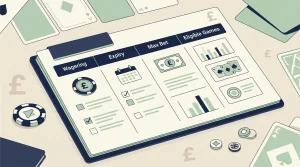
A bonus buy skips the wait for a slot feature, but the purchased round still follows the game’s rules and can lose.
What a Bonus Buy Changes in a Slot
A bonus-buy feature lets a player pay to enter a slot’s bonus round instead of waiting for it to appear during ordinary play. The reels and game remain the same; what changes is the route into a particular feature. A standard spin begins with the base game and may lead to a bonus according to its rules. A purchase skips that wait and starts the bonus directly, where the option is available.
That distinction matters because “buy” can suggest ownership, as though a player were buying the slot itself. They are not. The payment is for access to a round within the game, and the round still follows the slot’s design. It can produce a return, a loss, or an outcome between the two; paying for entry does not purchase a winning result.
Nor is this a casino welcome bonus. A welcome offer is a promotion provided by an operator, subject to its own terms. A bonus buy is an in-game feature initiated with a stake. The shared word is a small linguistic trap: one “bonus” belongs to the casino’s marketing, the other to the slot’s rules.
The appeal is plain enough. Ordinary spins can make the bonus feel distant, while a purchase removes that particular uncertainty about whether the feature will begin. But it removes only the wait, not the uncertainty inside the round. A purchased feature is still part of a gambling game, not a shortcut around its underlying odds.
That is why searches for the best slot to buy a bonus cannot be answered by treating the purchase as a value guarantee. The feature’s price and its possible outcomes are tied to the individual game, and a player has to judge the feature on those terms. A slot may make the route to its bonus visible and immediate; it cannot make the eventual result certain.
Fast Payout Online Casinos in the UK: What Can Be Verified
There is a quieter arithmetic beneath the theatrical entrance. In any game whose rules give the house an edge, the expected result for the player is negative when play is considered across enough sessions. A bonus-buy option changes when the feature is reached, not that basic relationship. Losses may arrive in a measured trickle or in a sharper interruption. The accounting does not become kinder because the doorway has been paid for.
The feature therefore changes the sequence of play, not the nature of the wager. It can suit someone who prefers to enter a slot’s bonus round directly, but the purchase remains a risk made within the game. The slot has opened a door. It has not promised what is behind it.
How the Purchase Works on the Reels
A bonus-buy option sits inside the slot’s own play interface. It is not a separate game, nor a setting that changes the reels. When the option is available, it gives the player a route into a feature round without waiting for that feature to arrive through ordinary spins. The precise layout varies by game: the control may appear beside the spin button, within a feature menu, or behind an information panel.
The practical sequence is generally straightforward, although the labels and screens are not identical from one slot to another. The player opens the game, checks its rules or feature information, and finds out whether a bonus can be purchased. If it can, the interface shows the price attached to the purchase. Selecting the control may open a confirmation screen; after confirmation, the amount is deducted from the available balance and the game moves into the bonus round.
That final pause matters. A button can be easy to mistake for an ordinary spin control, especially on a compact screen, while a paid feature is a separate transaction within the game. The displayed cost should be read before confirmation, not inferred from the current stake or from how another slot handles its feature. A purchase does not mean the round has already produced a win; it buys entry to the feature, whose result is still determined by the game.
Bonus Purchase Process
Step 1: Review Rules
Open the game and check the rules or feature information to determine if a bonus can be purchased.
Step 2: Check Cost
Locate the bonus-buy control and identify the specific price attached to the purchase.
Step 3: Confirm Transaction
Select the control and confirm the purchase on the confirmation screen to deduct the amount from the balance and enter the round.
The underlying stake and the purchase price are related to the game’s own settings, but they are not necessarily presented in the same way. A slot may show a stake selector for regular spins and a separate cost for entering the bonus. The purchase screen is therefore the place to check what will be charged. Changing the stake setting, where that setting is available, can affect the cost shown by the game; the interface should make the current amount visible before the player confirms.
Reels and paylines remain part of the game
The reels describe the slot’s visual and mechanical layout. Paylines, or other ways of recognising winning combinations, belong to that layout too. They determine how symbols are read during the game; they are not created by buying the bonus. A five-reel slot, for instance, may apply a single stake across all five reels. Purchasing its feature does not turn those reels into a different configuration or add paylines to the base game.
This distinction can be obscured by screens that place the bonus-buy control close to the stake or spin controls. The buttons may share a panel, but proximity is not the same as function. A stake sets the amount used for play under the slot’s rules. A bonus purchase pays for entry to a particular feature. Neither action, by itself, rewrites the reel arrangement.
Some games present a menu of feature choices rather than one purchase button. In that case, the rules panel can explain what each choice starts and how the game proceeds after selection. The names may sound similar while referring to different bonus rounds, so the cost alone is not enough to identify what is being purchased. The feature description is part of the decision, not decorative text.
Video slots in the UK: formats, play and costs
If the option cannot be found, that does not necessarily mean the game is malfunctioning. Bonus-buy controls are not a universal part of every slot, and their visibility can depend on the game and the version being played. A feature may be unavailable altogether, or the relevant information may sit in a rules menu rather than beside the reels. Searching the game’s own instructions is more reliable than assuming that every slot offers the same shortcut.
The purchase changes the route into the game’s feature, not the basic architecture of the slot. The reels keep their design; the feature keeps the rules assigned to it. That is the useful distinction when a screen makes every control look like another way to spin. Not the same thing.
The Bonus-Buy Feature Is Still a Slot Feature
A paid entry to a bonus round does not create a second game alongside the slot. It gives access to a feature designed as part of that game: its symbols, win conditions and internal logic remain those of the underlying title. The purchase changes when the feature is reached, not what kind of feature it is.
That distinction matters because “bonus round” covers very different designs. One slot may build a feature around free spins; another may use special symbols or a multiplier applied to wins gathered during the round. A buy option is attached to whatever structure the game already uses. It does not make the feature more generous by definition, nor does it replace the rules that determine how its outcomes are calculated.
A bonus-buy option changes when a feature is reached, but it does not change the underlying slot design, symbols, win conditions, or internal logic.
In lower-volatility games, bonus rounds are often built around multiplying accumulated wins. The design tends to sit within a broader, comparatively steady arrangement: five reels, at least twenty-five paylines, and fixed jackpot amounts rather than a progressive pool are common characteristics. These details describe the game’s architecture, not a guarantee about what any particular round will return.
The multiplier structure also explains why the bonus can feel like an extension of ordinary play rather than a separate spectacle. Wins gathered inside the feature may be increased according to its rules, so the round’s interest lies in how those wins accumulate and interact with the multiplier. Buying entry does not alter that relationship. It simply places the feature within reach without waiting for its usual trigger.
There is a small but useful distinction between access and design. A purchase can make the bonus immediate, but it cannot make a modest feature into a different kind of feature. A slot whose bonus is built around modest accumulated wins still has that structure when entered by purchase. The feature’s tone belongs to the game, not to the button that opens it.
This is why the phrase “bonus-buy slot” can mislead when treated as a separate category. The slot remains the primary object; the purchase is one route into a pre-existing part of its design. Its value, shape and possible outcomes still depend on the rules of that particular bonus. The label is simpler than the machinery.
Best casino sites in the UK
- BritsinoBonus: Welcome Package – Get your £2,200 + 2,000 FS · Payout speed: 1-3 business days
- BeOnBetBonus: 100% up to €500 + 100 FS · Payout speed: 1-3 business days
- Revery PlayBonus: 100% up to€1,000+ 100 FS · Payout speed: 1-3 business days
- EvoSpinBonus: 125% up to €2500 + 125 Free Spins · Payout speed: 1-3 business days
- WinBeastBonus: €5000 + 500 FS + €650 Freebet · Payout speed: 1-3 business days
- SpinFormulaBonus: 550% Up To £15,000 + 550 FS · Payout speed: 1-3 business days
- JetsetspinsBonus: 200% Bonus + 100 Free Spins + Free Royal Wheel · Payout speed: 1-3 business days
- NightWinBonus: £900 + 400 free spins · Payout speed: 1-3 business days
- NightLuckBonus: Welcome Pack + 805% Up To 6400€ + 280 FS · Payout speed: 1-3 business days
Volatility, Small Wins and the Shape of a Session
Volatility describes the rhythm of returns, not the quality of a slot. A low-volatility game tends to return value in smaller amounts more often; a high-volatility game tends to leave longer gaps between wins, with larger returns when they arrive. Neither pattern says what a particular session will pay. It says something about the shape of uncertainty.
High-Volatility Slots in the UK: How They Play
That distinction matters when a bonus buy is part of the experience. The feature can bring a player straight to a round whose result is still subject to the game’s underlying design. In a low-volatility slot, ordinary spins may offer a succession of modest wins, while a purchased feature may add a different kind of variation. In a high-volatility game, the quieter stretches can be longer, and a bonus round may carry a more dramatic swing. The purchase changes where play begins; it does not make the outcome predictable.
Low-volatility slots are often associated with winning combinations appearing every three to six spins on average across most titles. That is a broad pattern, not a timetable. A particular run can contain fewer hits or more, and a winning combination does not necessarily return as much as the stake. The eye notices the lights and the repeated small credits; the account balance keeps a less sentimental record.
This is one reason frequent wins can feel reassuring without establishing that a game is favourable. A slot may pay out often while returning less than it takes in over time. Each win is an event in the session, not evidence that the next one is due. A run of quiet spins does not store up a balancing payment either. Randomness has no memory, although people are very good at supplying it with one.
Do
- View volatility as a description of the rhythm of returns
- Recognise that randomness has no memory
- Treat each win as an independent event in a session
Don’t
- Assume frequent small wins mean a game is favourable
- Believe a quiet stretch of spins stores up a balancing payment
- Use volatility as a guide to whether a session is going well
The same separation applies to bonus rounds. A low-volatility game may have a steadier pattern during base play, but a feature can still produce a weak result. A high-volatility game may offer a conspicuous prize, but the possibility of a larger return is not a forecast. With a bonus buy, the contrast can become sharper because the player reaches the feature without first passing through the ordinary sequence of spins. The round remains part of the same game, with the same uncertainty.
A session is also shaped by how the player interprets its small events. Several modest wins may keep the balance moving, but they can obscure the amount staked along the way. Conversely, a quiet stretch may make a later win seem like recovery, even when the overall result remains below the starting point. Volatility is useful as a description of pace; it is a poor guide to whether a session is going well.
There is a mathematical limit beneath both styles. Where a game has a positive house edge, its expected return to the player is negative across enough play. A low-volatility design can spread that disadvantage across many small outcomes, making losses less abrupt; it cannot remove the disadvantage. A high-volatility design can concentrate outcomes into sharper rises and falls; it cannot turn uncertainty into an advantage.
The difference is therefore not between a safe game and a risky one. It is between patterns of risk: more frequent, smaller returns on one side; less frequent, potentially larger ones on the other. For bonus-buy slots in the UK, that distinction can help explain why two sessions feel unlike each other even when both end without a meaningful return. It cannot identify which feature will pay, or when.
3-Reel Slots UK: Classic Games and How They Work
A steady rhythm is still a rhythm of chance.
Casino Bonuses and Slot Bonus Buys Are Different Offers
The word bonus does two different jobs in online gambling. A casino bonus is an offer made by an operator; a slot bonus buy is a feature within a particular game. The first belongs to the relationship between a casino and its customers. The second belongs to the slot’s design. Search phrases can blur them together, but the distinction matters before money changes hands.
A casino promotion might take the form of promotional funds or free spins, subject to the operator’s stated terms. It is not automatically available on every game, and its conditions are not set by the slot itself. A bonus buy, by contrast, is an in-game option to pay for entry to a feature round. That payment is part of playing the slot, rather than a gift from the casino. The name sounds generous. The transaction is not.
This difference is easy to miss when a casino advertises bonus-buy slots alongside an offer for new or returning customers. The same page may discuss both, but they remain separate arrangements. A promotional offer may have its own qualifying rules and expiry conditions; a purchased game feature has a price and outcome determined by the slot. Accepting a casino promotion does not, by itself, mean a bonus round has been bought, and buying a slot feature does not mean the casino has granted a promotional bonus.
Regulatory Status
A site described as "not on Gamstop" is not a guarantee of a UKGC licence; gambling in the UK is only legal at licensed and regulated sites.
Promotional terms need to be read as terms, not as decoration around an attractive headline. They describe what the offer applies to and what must happen for it to be used or withdrawn. A specialist review describes casino bonuses as having a 48-hour lifespan; that is a report about the offers it reviewed, not a universal deadline for every casino promotion. The operator’s own current terms are the relevant place to establish the conditions of a particular offer. An old banner can outlive its usefulness.
The slot feature has a different source of authority: the game itself. Its rules explain whether a bonus buy is available and what the purchase does. A casino can make a game available, but it cannot turn a slot without that feature into one that has it merely by attaching a promotion. Nor does an offer called a “bonus” necessarily pay for access to a slot round. The same word, two ledgers.
The wider casino setting adds another source of possible confusion. Online casinos may offer live casino games as well as slots. In a live game, a dealer or presenter and a streamed table form part of the experience; roulette and blackjack are familiar examples. These are distinct products from slot games, even when they appear in the same casino lobby. A live casino promotion, if offered, is still an operator’s promotion, not a slot bonus buy. A slot feature cannot be inferred from the presence of live games, or vice versa.
Best RTP Slots UK: How to Read Return Figures
In Great Britain, remote gambling operators serving consumers must hold the relevant UK Gambling Commission licence, irrespective of where their key equipment is located. The commission regulates remote gambling offered to consumers in Great Britain; a casino’s own description does not replace that regulatory status. Online gambling is legal in the UK at licensed and regulated sites, and legal online casinos serving UK players must hold a current operating licence. The distinction between a licensed operator and a game feature is separate from the distinction between a promotion and a purchase, but both are useful when assessing what a casino page is actually offering.
A label such as “casino with bonus buy” can therefore mean no more than a casino that lists slots containing the feature. It does not establish that the casino is offering a bonus to cover the purchase, that every listed slot includes the option, or that the option is available in every jurisdiction or account state. The casino’s promotion page and the individual game’s rules answer different questions. One concerns the operator’s offer; the other concerns the game.
That separation is especially useful when a page uses several versions of the same phrase. “Casino bonus” ordinarily points to an operator promotion, while “buy a bonus” points to a paid game feature. Context settles the meaning: a promotion has terms issued by the casino; a slot purchase is described in the game’s own information. Neither should be treated as free money simply because the word bonus appears.
Distinction between Promotions and Features
A casino bonus is an operator offer (like promotional funds or free spins) subject to specific terms. A bonus buy is an in-game feature initiated with a stake, governed by the slot’s own rules, not the casino’s marketing.
Trying Bonus-Buy Slots in Demo Mode
A demo can make a slot’s bonus-buy feature visible without turning the session into real-money gambling. The distinction is not cosmetic. Demo credits are fictional, and any result produced with them has no cash value: no real-money payout is awarded, however persuasive the celebration on screen may be. The exercise is observation, not a way of earning or testing a route to profit.
Free play can be useful because a bonus round is often the part of a slot least likely to appear during a short run of ordinary spins. In demo mode, a game may let its bonus be started through a purchase option, though availability depends on the particular game and the version being offered. Some demos may omit the option or present a different set of controls from real-money play. The screen itself is not a promise that every feature can be practised for free.
That distinction matters when a demo is being used to understand how a feature behaves. A bought round can reveal its presentation, pace and sequence of events: whether the game moves straight into a feature, pauses to show a choice, or continues through a series of bonus actions. It can also show how the game displays results and returns to its base screen. Those are useful details about the design. They do not reveal what a real-money session will return.
Highest RTP Slots in the UK: Understanding RTP
The fake balance is part of the interface, not a small bankroll waiting to become genuine. It may be possible to spend it quickly, and a demo may make further fictional credit available, but neither circumstance changes the nature of the activity. A large-looking demo win remains a graphic accompanied by a number in a simulated account. It cannot be withdrawn, transferred or treated as evidence that the same result is likely with cash.
What a demo can and cannot show
Free demo slots with a bonus-buy option are best understood as a way to inspect a game’s workings. They can show where the purchase control appears, how the bonus begins and what the feature asks the player to do. They may also make it easier to recognise symbols or follow the game’s explanations without the pressure of a real stake. Familiarity is not foresight, however. Seeing one feature round does not predict the next, and a favourable demo result does not make a real-money outcome more likely.
The difference between practice and gambling can become blurred when the same game is available in both modes. The graphics may be identical; the emotional machinery is designed to be. Yet the consequences are not. Demo funds are fake, and the game awards no real-money payouts in that mode. A screen that resembles a casino account should not be mistaken for one.
The demo’s controls may also be configured differently from those in real-money play. A feature could be unavailable, or its presentation could differ by platform. The game’s help panel or information screen is therefore more useful than assumptions drawn from another version. It can explain what the controls mean within that particular game. It cannot certify that a demo round reproduces every condition of a real-money session.
Attention: Demo results are produced with fictional credits and have no cash value; a successful demo round does not predict a real-money outcome.
In Britain, online slot spins must take at least 2.5 seconds, and autoplay is banned. A demo presentation should not be read as permission to bypass the rules governing online slot play. Nor should a faster-looking animation be taken as proof that a real-money game cycle can proceed at a different pace. The entertainment is dressed in motion; the regulated game still has a structure.
A rehearsal with no financial consequence
There is a modest, legitimate purpose to free play: seeing whether the feature is intelligible and whether its sequence is enjoyable to follow. Some players may prefer to understand the controls before deciding whether a game suits them; others may find the demo’s lack of consequence changes the experience so much that it tells them little about their likely feelings during real-money play. Both observations can be true. The absence of financial risk makes the mode safer in one sense, while also making it a poor substitute for the stakes and emotions of gambling.
A demo cannot establish that a slot is generous, safe to play for money or likely to produce a particular return. A sequence of fictional wins is not evidence of a future pattern. The game is not negotiating with its audience, and the screen does not remember a previous demo result as a reason to produce another. Practice helps with recognition, not prediction.
There is also a difference between learning the feature and rehearsing a purchase. Repeatedly triggering a bonus with fake funds may familiarise a player with the button and animation, but it does not reproduce the cost of choosing that feature with real money. The demo’s balance removes precisely the consequence that gives a real-money purchase its weight. That is not a flaw in the demo; it is the reason the two modes should not be confused.
Online Slot Payout Percentages: Limits of Comparison
A useful demo session can therefore stay narrow. It can establish whether the rules are understandable, whether the bonus sequence is clear and whether the game’s pace feels appealing. It cannot settle the question of what a real-money session would cost or return. Those belong to a different decision, with actual financial consequences.
Free online slots with bonus-buy features may be presented as an easy way to try a game, but the phrase “free” describes the play mode, not a hidden source of winnings. The money is invented. The payout is absent. What remains is a preview of the game’s design, and that is all.
Finding Games Without Pretending There Is a Definitive List
A list of online bonus-buy slot games can look authoritative while telling very little. Catalogues change, titles appear under different labels, and a game’s presence on a casino site does not by itself establish that its bonus-buy option is available there. A list assembled once can therefore age faster than its confident heading suggests.
Golden Sevens is one named example, but a single title cannot stand in for a complete or current inventory. Nor does naming a game make it “best”: that judgement would need a stated basis, and preferences about pace, design and features are not the same as evidence of quality. The useful question is narrower: whether the game currently offers the feature being sought, and whether that feature is available in the version presented by the casino.
Labels like "New" describe timing rather than value, and the presence of a game in a casino catalogue does not guarantee the bonus-buy feature is available in that version.
New releases create a particular temptation to turn recency into a ranking. A recently added game may attract attention without being better suited to a particular player, and an older title may remain in a catalogue. “New” describes timing, not value. Casino catalogues and promotional pages may also use broad labels for collections, so the wording around a game should not be treated as proof that every title in the collection has the same option.
A careful comparison begins with the individual game’s information, not a headline promising a definitive selection. The title and its feature description should match; if the feature is not clearly identified, the label alone settles nothing. Availability can also differ between casino catalogues, which makes a static list a poor substitute for checking the current entry. This is less glamorous than a ranked chart. It is also more honest.
The same caution applies to claims about the “best bonus buy slots in the UK”. Without a clear method, such a phrase may simply dress a changing assortment as a measured verdict. A useful guide can name an example, describe what is known about it and distinguish that from claims it cannot support. It need not pretend to have surveyed every release or settled a subjective contest.
There is no virtue in padding a short catalogue into a long one. A compact set of clearly identified titles is more useful than an expansive inventory whose labels blur together. For games released later, the sensible test remains the same: confirm the title, confirm the stated feature, and treat recency as information rather than recommendation.
No definitive list required.
Bonus Buys and the Limits of ‘Not on Gamstop’ Claims
A casino described as “not on Gamstop” is being identified by its relationship to a self-exclusion scheme, not by a guarantee about its licence, standards or suitability. That distinction matters especially when the same site advertises bonus-buy slots: a feature inside a game says nothing about the legal status of the casino offering it.
In Great Britain, commercial gambling is regulated by the UK Gambling Commission. Its remit covers remote gambling offered to consumers there, wherever the operator’s key equipment is located. A business serving the British market therefore cannot make its regulatory position depend simply on having servers or offices elsewhere. The Commission issues operating licences to businesses and personal licences to individuals working in regulated roles. It is the sole regulator for commercial gambling in Great Britain.
The practical question is not whether a casino uses a particular label, but whether the operator holds the relevant UKGC licence to serve customers in Great Britain. A site outside the UKGC system does not gain that licence by appearing in a list of casinos, offering familiar games or describing itself as “not on Gamstop”. Nor does the label establish that a site is suitable for someone who has chosen self-exclusion. It may indicate precisely the sort of separation from that safeguard that calls for caution.
That is a regulatory distinction, not a recommendation of one kind of casino over another. Online gambling in the UK is legal at licensed and regulated sites; offshore casinos operate outside the UKGC system. A polished interface or a recognisable bonus-buy title cannot substitute for a current operating licence. Neither can an assurance on the casino’s own pages settle the matter by itself.
Searches for a bonus-buy casino outside Gamstop can also blur two different ideas: access to a game and the operator’s permission to offer real-money gambling to British customers. A demo version, where available, does not resolve that question. It may let someone view a game, but it is not evidence that the casino is licensed for real-money play in Great Britain.
The boundary is institutional, not decorative. A casino’s claims about its location, games or exclusion arrangements do not alter which regulator oversees commercial gambling in Great Britain. “Not on Gamstop” is a description, not a certificate.
Material created by the team Pure Casino UK Guide