

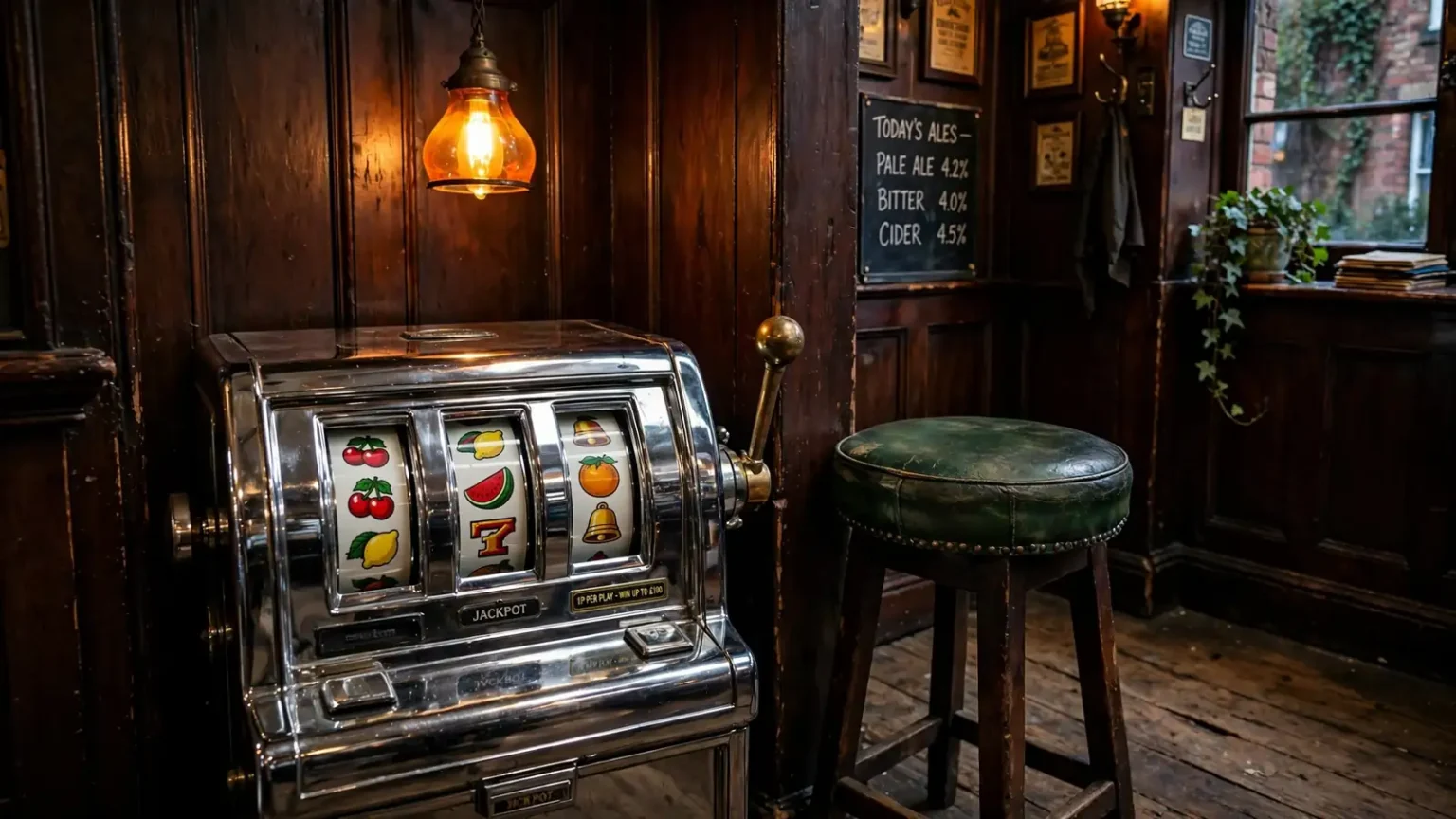
Three-reel slots use a compact symbol layout, while rules and presentation vary from game to game.
The Three-Reel Slot: A Small Grid with a Long History
A three-reel slot is defined by its compact arrangement: three vertical reels, each carrying a sequence of symbols. When the reels stop, the symbols visible across them form a result according to the game’s rules. That small grid is the format’s clearest distinction from the broader family of slots, where reels, rows and decorative layers can multiply until the original idea is almost hidden beneath them.
The three-reel design has become shorthand for the classic slot. It suggests a direct visual language: a limited cast of symbols, a compact playing area and a result that can be read without navigating a crowded screen. That simplicity is not the same as uniformity. Individual games can differ in their symbols, rules and presentation, even when they share the same number of reels. The label describes the frame, not every detail inside it.
The format belongs to a much older public imagination than the online casino. Its ancestors were mechanical machines, built for rooms where entertainment had a physical presence: a cabinet, a handle or button, the visible movement of reels. The modern screen has changed the setting, but the three-reel outline remains recognisable. A small arrangement survived the move from mechanism to software because it is easy to understand at a glance. It needs little explanation.
There is something telling in that persistence. The three-reel slot presents chance in a form that looks orderly. Symbols occupy fixed places; the eye searches for a pattern; the result appears contained within a narrow frame. It is a tidy little theatre, with no need for elaborate scenery. The appeal is partly aesthetic, though the format’s familiarity also carries the weight of repetition: a design encountered often enough begins to feel like a natural shape rather than a historical choice.
That feeling can obscure how many different games now sit under the word “slot”. A modern slot may use a broader grid, layers of animations, changing symbols or elaborate thematic scenes. Its presentation can be closer to a small digital production than to a simple machine. The classic three-reel slot makes a different promise of form, if not of outcome: less visual territory, fewer elements to interpret, and a structure that remains close to the old emblem of reels turning in sequence.
The difference is visible before any result is considered. In a compact three-reel layout, there is less space for a game to distribute its symbols across rows and columns. A larger format can use a more expansive grid, and its rules may involve patterns that cross several reels. A five-reel slot, for instance, can apply a bet across all five reels. The extra reels change the shape of the game and the ways its rules can be arranged; they do not, by themselves, explain what a particular result is worth.
That last distinction matters because a familiar frame can invite assumptions. Three reels may look simpler than five, but the reel count alone cannot tell the whole story of a game. It does not reveal every rule, determine the value of a result or establish how a game behaves. A classic design can be visually spare while still having its own particular terms. The grid is a useful first description, not a complete account.
Nor does “classic” mean that every example must look like a surviving piece of machinery. Online versions can borrow the visual vocabulary of traditional machines or reinterpret it with contemporary artwork. The underlying category remains a three-reel format, while the screen may dress it in polished graphics, nostalgic lettering or a theme far removed from the arcade-era image. Nostalgia is a costume, not a rulebook.
This distinction helps make sense of the phrase “3 reel slots online”. It refers to the format appearing in a digital setting, rather than to a separate kind of slot defined by a different number of reels. Some games preserve the spare, familiar look associated with classic three-reel slots; others use the same compact arrangement with a more contemporary presentation. The screen changes the surroundings, but the central visual idea remains legible.
A reader looking for the best three-reel slots in the UK in 2026 may therefore be looking for several things at once: the recognisable old-fashioned layout, an uncluttered design, or simply games that use three reels rather than a larger grid. Those are related preferences, not identical ones. The number of reels is one way to sort a broad catalogue, but it cannot stand in for a judgement about every title. A ranked list would imply comparisons that the label alone cannot support.
The old format also occupies an unusual place between object and image. In a physical machine, a reel was a moving part; online, it is a visual representation of movement. Yet the familiar sequence still gives the game a grammar. The reels turn, stop and leave symbols in view. The eye knows where to look because generations of machines taught it. The screen inherits that habit.
This is why the three-reel slot remains useful as a category even as the larger slot family has grown more varied. It offers a clear point of comparison: a small grid against more expansive arrangements, a recognisable visual tradition against designs built to accommodate more elements. It does not need to be treated as the sole authentic form, or as a guarantee of simplicity in every respect. It is one branch of a much larger design family, and a particularly memorable one.
Best RTP Slots UK: How to Read Return Figures
The phrase “best 3 reel slots” can sound as though the format itself supplies a verdict. It does not. It names a preference for a particular shape, one with a long cultural afterlife and a direct visual logic. Within that shape, games still make their own choices about appearance and rules. The reels may be few; the category is not one single game.
A small grid, then, is more than a reduced version of a larger one. It carries the outline of an older machine into a setting where the machine itself may no longer be present. That is the quiet achievement of the classic three-reel slot: not that it has remained unchanged, but that its basic form is still immediately understood. A compact inheritance.
Slot Games, Machines and the Shape of a Spin
A slot machine is the cabinet, screen and controls through which a game is presented; a slot game is the set of symbols, rules and responses that gives those controls meaning. In a traditional venue, the distinction can seem academic: the machine is what stands before the player, and its game is what happens when the handle or button is used. Online, the cabinet disappears, but the machine-like interface remains. Reels turn on a screen, controls invite a spin, and the game supplies the visual language.
That separation matters because the same compact arrangement can feel different in different settings. A 3 reel slot machine places the symbols in a small, legible field. Its movement is easy to follow, and the result arrives without a large cast of characters or a sequence of side screens. The format borrows from the physical machine: a simple action, a visible change, then a settled display. Its economy is part of its character.
Online presentation can preserve that restraint or surround it with more elaborate design. A three-reel game may use familiar fruit, bells or sevens, while another slot puts animated scenes, layered menus and bonus sequences around the reels. The screen can make the game feel larger than its underlying grid. It can also leave the reels as the central event, with little competing for attention. The difference is not merely old against new; it is a difference in how much ceremony is placed around a spin.
This is why the phrase “3 reel slot games” covers more than one visual experience. Some are designed to resemble a mechanical cabinet, even when the controls are digital. Others use a compact reel arrangement but dress it in contemporary graphics and sound. The number of reels alone does not tell how busy the interface will be, what features the game contains, or how those features are presented. A small grid can be surrounded by a surprisingly large amount of design.
The machine-style interface also creates a particular rhythm. A control is pressed, the reels move, and the display resolves into symbols. That sequence offers a clear beginning and end, unlike games whose action continues across multiple screens or unfolds through extended rounds. The clarity is part of the attraction: the player can see where to look. It is also a design choice, not proof that the game is simple in every respect.
Some broader slot designs make their extra layers visible through additional reels, paylines and bonus rounds. Low-volatility slots, for instance, commonly use five reels and at least twenty-five paylines, with fixed jackpot amounts rather than progressive pools. Their bonus rounds may apply multipliers to wins accumulated during play. These elements change the interface as well as the rules: more lines and features ask the screen to explain more, and the player’s attention moves between the main reels and the added components. A classic layout keeps that visual conversation narrower.
The word “machine” can therefore refer to two things at once: the physical object associated with traditional play and the familiar arrangement of controls reproduced by software. In online casinos, a 3 reel slot machine is not a metal cabinet hidden behind the screen. It is a game presented in a machine-like form. The distinction helps explain why a digital game can feel recognisably traditional without being a copy of the hardware that first carried the format.
There is a small social history in that interface. The physical machine made gambling a visible, local pastime, built around a cabinet and a repeated gesture. Online, the cabinet becomes a graphic convention, portable across screens and detached from a particular room. Yet the old visual grammar survives because it is immediately readable. Three reels, a row of symbols, a button: a compact ritual, neatly contained.
Real-Money Play and the Mathematics of Loss
A three-reel game changes character when a stake is attached to each spin. The symbols still turn and settle into combinations, but the result now affects a balance that can be lost or, on a winning spin, increased by a payout. That is the distinction between a slot as amusement and a real-money slot as gambling. The screen may look much the same; the consequence does not.
There is no special mathematics reserved for real-money three-reel slots. The format describes the arrangement of the reels, not a promise about what they return. Each game has its own rules and probabilities, while the stake makes those outcomes financially consequential. A familiar design can make the change feel modest: a lever-like control, a short row of symbols, a result delivered without ceremony. The money involved is no less real for the interface being simple.
Attention: The house edge means the expected result for the player is negative over enough sessions, regardless of the visual simplicity of the slot.
The central idea is mathematical expectation. Where a game has a positive house edge, the expected result for the player is negative over enough sessions. This does not mean that every spin loses, or that a particular session must end badly. Wins can arrive, and losses can be spread out so gradually that the pattern is difficult to feel while it is happening. The expectation describes the long-run direction, not a timetable for an individual player.
That distinction matters because human beings are attentive to episodes. A win is vivid; a slow subtraction is less so. A player may remember a run of favourable results as evidence that a machine has become generous, or interpret a quiet stretch as a prelude to compensation. Neither interpretation changes the underlying expectation. Random outcomes do not keep a ledger and do not owe a recovery. The arithmetic is less theatrical than the symbols.
A search for the best real-money three-reel slot can therefore obscure the more consequential question: what does playing for money mean in a particular game? A short format is not automatically safer, more rewarding or more predictable than an elaborate one. Nor does a run of wins establish that the game has changed its character. The reels supply outcomes; the house edge shapes the long-run expectation.
Highest RTP Slots in the UK: Understanding RTP
Regulation belongs to this picture, though it is not a feature of the spin itself. In Great Britain, the UK Gambling Commission regulates commercial gambling, including remote gambling offered to consumers. Its remit does not depend on where an operator’s key equipment is located. The Commission is the sole regulator for commercial gambling in Great Britain, issuing operating licences to businesses and personal licences to individuals working in the sector.
That division of responsibility says something about how gambling is treated: not merely as a private exchange between a player and a machine, but as a commercial activity requiring public oversight. The rules governing a game’s mathematics and the rules governing the company offering it are different matters. A licence does not alter a slot’s house edge, just as the house edge does not tell a player whether an operator is properly authorised. Both questions sit beside the reels.
Real-money play is thus not simply the classic slot with a different button. It joins uncertain outcomes to financial stakes, under a regulatory system intended to govern the businesses that provide it. The mathematical expectation remains indifferent to the drama of a win, the familiarity of a fruit symbol or the speed of a spin. It keeps its own account.
Quietly, but persistently.
Free Online Play and the Classic Slot
A free online classic slot can look much like its wagering counterpart: a compact display, three reels and symbols that settle into combinations. The important difference is not visual. The credits shown in free play are fictional, and any apparent win remains on the screen. No money is paid out.
That distinction can be easy to overlook because the familiar language of slots survives the change. A game may show a balance rising after a winning combination, or mark a result as a win, but those signals belong to the simulation. They do not represent cash held for the player or a prize waiting to be claimed. Free play is a way to encounter the format without staking money, not a route to real-money winnings.
Free-play modes use fictional credits and are intended for simulation; they are not a route to real-money winnings.
The old-fashioned three-reel slot has a particular visual economy. With fewer reels and a simpler arrangement than many elaborate games, each spin is easy to read: symbols pass, stop, and form a result. The format can feel almost modest beside games built around layered animation or extended features. Its restraint is part of the appeal. There is little theatrical machinery between the spin and its outcome.
In a free version, that compactness makes the game legible. The symbols and their arrangement can be observed without the extra pressure of a financial stake. A player can see what happens when the reels stop, notice how the game presents combinations, and get a sense of its pace. It is a small piece of interface design, and an old one: the machine’s central promise is still that a brief movement will resolve into a visible result.
But free play has limits as a test. It can show how a game looks and behaves, not what real-money play would feel like. The absence of a stake changes the experience, even if the graphics are identical. A simulated balance has no value to lose and cannot turn into a payout. The emotional weight of a result is therefore different. A screen may celebrate; the celebration is not a payment.
This is also why free classic three-reel slots should not be confused with a bonus or a free-money offer. A promotion may have conditions attached to a real gambling account, while a free-play mode uses fake money and awards nothing. The shared word “free” does not make the two arrangements equivalent. One is a non-wagering simulation; the other may be part of an offer connected to gambling.
UK First-Deposit Casino Bonuses: What the Label Means
There is a useful social history in that difference. Slot machines have long presented chance through symbols and ritual: the pull, the pause, the stopped reels. Online, the same ritual can be reproduced at no financial cost, while the interface retains the vocabulary of stakes and rewards. The design borrows the shape of a wager without making one. The distinction matters more than the animation.
People looking for high-payout three-reel slots may find the phrase attached to games or promotions, but a free-play result cannot establish that a game pays well for money. A simulated win is not evidence of a real payout, and a run of favourable-looking results in free mode does not promise the same outcome elsewhere. The screen can demonstrate the rules as presented; it cannot turn pretend credits into proof of earnings.
Likewise, asking how to win on a three-reel slot has two different meanings in this setting. In free play, “winning” means seeing a combination the game recognises as successful and perhaps watching the displayed balance change. It does not mean receiving money. That distinction is plain once stated, though the celebratory graphics are designed to make every result feel complete.
Free play can still be useful for deciding whether the classic format holds any interest. Some people prefer its directness; others may find the repeated sequence too spare. The point is not to discover a method for securing a payout, but to see how the game presents its symbols, controls and results without placing a wager. It offers familiarity, not financial evidence.
The same caution applies when comparing an online casino’s free three-reel games with one another. Their surfaces may differ in artwork, sound or presentation, but a free session cannot establish the value of real-money play. Nor does a convincing imitation change the basic terms: the credits are fictional, and no payout is awarded. A practice balance is a prop.
That is the clean boundary. Free online play lets the classic slot be encountered as a piece of entertainment and interface, detached from wagering. It can make the format easier to understand, or simply confirm that its old-fashioned rhythm is not for everyone. It cannot pay a win, test a real-money outcome, or convert a simulated result into a claim. A modest distinction. A necessary one.
Playing Online for Money: Limits and Account Controls
A real-money slot account is not simply a doorway to a game. In Great Britain, it sits inside a licensing system: operators offering remote gambling to British customers must hold the relevant licence from the UK Gambling Commission, wherever their key equipment is based. The Gambling Act 2005 governs gambling in England, Wales and Scotland; Northern Ireland has a separate legal framework. A current licence can be checked on the Commission’s public register before an account is funded.
Account creation also involves a boundary that free-play screens do not have to cross: age verification. Operators must confirm a customer’s age before allowing a deposit. Online gambling is legal in the UK for adults aged 18 and over when it takes place with a UKGC-licensed operator. That check is a condition of access, not a courtesy added after the money has arrived.
A specialist review reports that the stake limit for an online slot game cycle in Great Britain is £5 for customers aged 25 or older, and £2 for those aged 18 to 24. The limit applies to the amount staked in a cycle, rather than serving as a general ceiling on all gambling activity. It concerns online slots, including classic 3 reel slots online, not roulette or blackjack. The distinction matters: familiar casino labels do not make different games subject to the same rules.
Live Casino UK: What to Know About Table Play
Controls also begin before the first deposit. Remote operators must prompt new customers to set a financial limit at that point and make account-level limit controls accessible afterwards. These settings put a boundary around spending in the account; they do not change the odds of a game or turn a limit into a prediction of what a session will cost. A set boundary is only useful if it is treated as one.
The payment route is restricted too. UK-licensed casinos cannot accept credit cards for gambling, including credit-card funding channelled through a money service business. They also cannot accept wallet payments when the wallet permits credit-card funds to be used for gambling. These rules close off a particular route to borrowing; they do not make other forms of spending harmless.
The interface itself has limits. Online slot autoplay is banned in Britain, and a new slot game cycle cannot begin until at least two and a half seconds have passed from the start of the previous one. That interval is not a pacing suggestion for operators to waive when a game is designed to move quickly. The machine must wait.
Account Safety Check
- Verify the operator holds a UK Gambling Commission licence
- Confirm age verification is completed (18+)
- Set a financial limit for the account
- Ensure payment is not made via a credit card
Licensed casinos must also provide responsible-gambling tools, including self-exclusion. Customers must have access to an internal complaints process and an approved Alternative Dispute Resolution service if a complaint remains unresolved. These are part of the regulated account environment, not extras that depend on a game’s theme. The controls are procedural, often unglamorous. That is rather the point.
Fruit Machines, Paylines and the Meaning of Odds
“Fruit machine” belongs to a familiar British vocabulary of play: fruit symbols, bells and bars suggest a compact machine whose rules can be read at a glance. Online, the same label may describe a three-reel game, but the name alone reveals little about its paytable or the likelihood of a return. Those details sit in the game’s mechanics, not in its nostalgic packaging.
A payline is the route across the reels on which symbols must land to form a winning combination. In a simple three-reel design, that route may be a straight line across the centre. Other games can offer additional lines, including patterns that move across different rows. The more routes available, the more ways a spin may qualify as a win—but that does not, by itself, tell anyone how much a win pays or how often a particular outcome occurs.
That distinction matters when comparing three-reel fruit machines. A small grid may look simpler than a sprawling game, yet its odds depend on the symbols, their distribution, the paytable and the rules for each line. A reel count is a description of layout, not a mathematical summary. Two games with the same number of reels can behave quite differently.
Volatility describes the pattern of returns. Low-volatility slots tend to spread returns across many smaller wins. High-volatility games pay less often, with larger amounts when they do pay. Neither label means that a player will receive a particular result in a particular session; volatility is about the shape of outcomes over time, not a promise about the next spin.
High-Volatility Slots in the UK: How They Play
Across most low-volatility titles, winning combinations are typically reported every three to six spins on average. That average is a broad description, not a schedule. A sequence can run longer without a win, or produce wins closer together. The individual outcomes do not take turns to make the average come true. Averages are tidy; play is not.
Paylines and volatility answer different questions. A payline identifies which symbol patterns count as wins. Volatility describes how returns tend to be distributed. A game may have several paylines yet still produce infrequent, larger returns; another may concentrate its outcomes in smaller, more frequent wins. The visible number of lines cannot substitute for the paytable, and a busy screen is not evidence of better odds.
The word “odds” is also used loosely. It can mean the chance of a winning combination, the size of a payout relative to a stake, or the overall mathematical balance of a game. These are related but not interchangeable. A frequent small win may return less than the stake; an occasional larger payout does not erase the pattern of all the other results.
Where a game has a positive house edge, its mathematical expectation is negative over enough sessions, however gently losses arrive. That says nothing precise about the outcome of one brief run. It does describe the underlying direction of the arithmetic. Slowly, then.
What is the difference between classic and video slots?
Classic slots feature a spare layout with a small set of controls and usually fewer reels, while video slots often include animated scenes, layered features, and additional reels.
Does a browser-based slot change the game rules?
No, a no-download slot remains the same regardless of whether it is installed or delivered through a browser; only the route into play changes.
What does volatility mean for a player?
Volatility describes the pattern of returns: low-volatility slots tend to provide smaller, more frequent wins, while high-volatility games pay less often but in larger amounts.
No-Download Play and the Difference Between Classic and Video Slots
A slot that runs in a browser removes one small barrier: there is no separate game program to install before the reels appear. The game is opened through a web page, on a computer or compatible mobile device. That changes the route into play, not the game’s underlying rules. A compact three-reel game remains a compact three-reel game whether it is installed or delivered through a browser.
“No download” also says nothing by itself about the kind of play on offer. A browser game might be available in a free mode or as a real-money game, depending on the operator and the particular title. The phrase “no deposit” can be especially easy to misread: it describes a payment condition, not necessarily a game with no real-money consequences. Free play, meanwhile, means play with no cash payout. Those are separate distinctions, and the screen may look much the same in either mode.
That separation matters because access and wagering are often bundled together in casual descriptions. A game can load without an installation while still requiring an account for real-money play. In Great Britain, remote operators serving consumers must hold the relevant Gambling Commission licence; a browser window does not place a game outside that system. The route is digital. The responsibility remains real.
Classic slots and video slots
Classic slots are generally associated with a spare layout: reels, symbols and a small set of visible controls. A three-reel version makes the arrangement especially easy to read. Its appeal is partly visual economy. There is little scenery to cross before reaching the central event, which is the alignment of symbols.
Video slots tend to make more room for presentation. They may use additional reels, animated scenes, layered features and bonus sequences, so the game can feel less like a single mechanical action and more like a designed environment. “Video” describes a broad family, however, not a guarantee of complexity. Some are restrained; some place their rules and features in several layers. The number of reels alone does not explain the whole experience.
The distinction can be seen in the way a stake interacts with the grid. A five-reel game may apply a bet across every reel, rather than treating one reel as the whole field of play. That wider layout can support more combinations and a busier display, though the exact arrangement depends on the individual game. A classic slot’s smaller grid can make its structure more immediately legible; it does not, on that account, make every outcome simpler to assess.
Nor is the difference simply old against new. The classic style survives because its visual grammar is direct: reels turn, symbols settle, and the result is presented without much theatrical interruption. Video slots inherit that basic premise but often add a surrounding show. The machine becomes a little stage. Sometimes the stage is more memorable than the machinery.
What browser access does—and does not—settle
A download-free version can be useful when storage, software updates or device compatibility make installation inconvenient. It may also make it easier to move between devices, although access can depend on the operator’s site and the device being used. A browser is a doorway, not a promise that every title will work identically everywhere.
The same caution applies to searches for three-reel games that require no deposit. The wording may point to a free demonstration, an introductory offer, or simply a real-money game that can be viewed before funds are added. Those are not interchangeable. The terms attached to an offer, where one exists, determine what it means; the label alone does not establish that winnings can be withdrawn or that no payment is involved later.
For a player interested chiefly in the classic format, the useful question is therefore not only whether a game downloads. It is whether the browser version preserves the clear, compact layout that makes three-reel play recognisable, and whether the mode is genuinely free or involves wagering. The interface answers the first question. The stated play conditions answer the second.
Convenience is not a rule.
Best casino sites in the UK
- BritsinoBonus: Welcome Package – Get your £2,200 + 2,000 FS · Payout speed: 1-3 business days
- BeOnBetBonus: 100% up to €500 + 100 FS · Payout speed: 1-3 business days
- Revery PlayBonus: 100% up to€1,000+ 100 FS · Payout speed: 1-3 business days
- EvoSpinBonus: 125% up to €2500 + 125 Free Spins · Payout speed: 1-3 business days
- WinBeastBonus: €5000 + 500 FS + €650 Freebet · Payout speed: 1-3 business days
- SpinFormulaBonus: 550% Up To £15,000 + 550 FS · Payout speed: 1-3 business days
- JetsetspinsBonus: 200% Bonus + 100 Free Spins + Free Royal Wheel · Payout speed: 1-3 business days
- NightWinBonus: £900 + 400 free spins · Payout speed: 1-3 business days
- NightLuckBonus: Welcome Pack + 805% Up To 6400€ + 280 FS · Payout speed: 1-3 business days
Material created by the team Pure Casino UK Guide


