

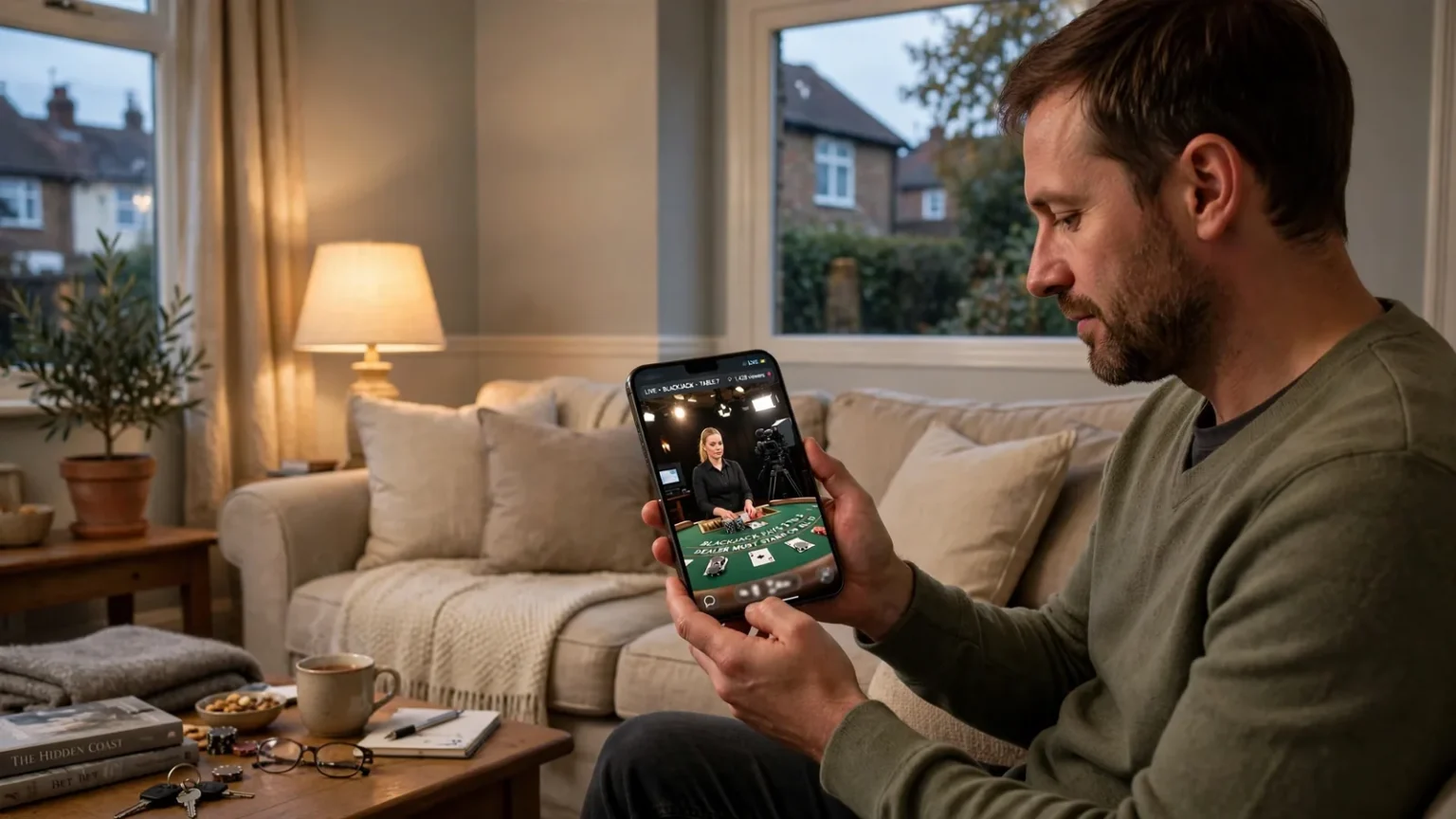
Live dealer games bring a physical table to a screen, with distinct rules, controls, pace and bonus terms.
A Casino Online, and a Room on Screen
A live casino begins with a camera. On one side of it is a dealer at a table; on the other, a player watching through a screen. The arrangement borrows the visible furniture of a casino—the felt, the cards, the wheel, the measured gestures—and sends it through a network into a private room, a kitchen or a train seat. The building has gone. The performance remains.
That distinction matters. A conventional digital game renders a table and its motion through software. A live table gives the image a human source: a dealer handles the equipment while cameras carry the action to players who are not physically present. The screen is not merely a picture placed over a game. It is the place where the game becomes available, where its pace is observed and where a player’s choices are conveyed back to the table.
The exchange is divided between two kinds of attention. The dealer attends to the physical sequence: presenting cards, moving the wheel, acknowledging the next stage. The player follows that sequence on screen and uses the controls supplied alongside it. A click or tap stands in for a gesture that, in a real room, might be made with a chip or a nod. The interface translates. It also sets the limits of what can be seen and done.
There is something old-fashioned in the appeal. Casinos have always sold more than rules and outcomes; they sell the feeling of being in a room where other people are doing the same thing. A live stream can imitate some of that public atmosphere while leaving every player alone with a device. The dealer is visible, the table is shared in appearance, and yet each participant may be separated from the rest by distance, silence and the small rectangle of a screen. Sociability, reduced to an image.
Best RTP Slots UK: How to Read Return Figures
The camera makes the dealer the centre of the scene, but not necessarily its host. The dealer’s movements are part of the game’s legibility: a card is turned where it can be seen, a result is shown to the camera, and the next round begins. Meanwhile, the software beside the stream carries the player’s decisions to the table. Video and interface are therefore not competing attractions. One shows what is happening; the other lets a remote participant take part.
That combination gives the format its particular tension. A streamed table appears immediate, but it is still mediated. The image may be clear or delayed; controls may be familiar or crowded; a player may feel present without being able to affect the room beyond the options the interface offers. The live element does not abolish software. It makes software the passage between the player and the dealer.
Nor does “live” mean that every table is available at every moment, or that every casino presents the same selection. A current lobby is the practical record of what a particular service is offering. The wider idea is simply a dealer-led game transmitted to remote players, not a promise about any individual site. Even within that idea, the atmosphere can vary: a close camera makes the dealer’s hands prominent, while a broader view gives more of the table and less of the person behind it.
The format also changes the meaning of a room. A physical casino has doors, staff, noise and the quiet choreography of people waiting for a turn. Online, the room is assembled from video, sound and interface. Its edges are wherever the device is placed. That makes the setting unusually portable, but portability is not the same as privacy. A screen shared during a live stream can expose personal information, so account details, notifications and other identifying material should remain out of view.
The boundary between public spectacle and private activity is thin. A player may be alone, but the game is not exactly solitary: a dealer is working, a stream is being produced, and other participants may be represented on screen or through a shared table format. The result is a small social fiction, carefully maintained by cameras and software. It can feel like entering a room without having to cross one.
Financial Safety
Only money that can be afforded to lose should be wagered, with a budget set in advance and losses never chased.
In Great Britain, the institutions behind gambling are less theatrical. The UK Gambling Commission oversees gambling activity, online casinos included, and its remit over remote gambling offered to consumers there does not depend on where the operator’s key equipment sits. It is the sole regulator for commercial gambling in Great Britain. The Commission grants operating licences to businesses and personal licences to individuals working in the sector. The stream may travel across borders; the regulatory responsibility does not simply travel with the server.
This is one reason a live online casino should be understood as both entertainment format and organised service. The dealer’s image supplies the human presence; the interface makes remote participation possible; the regulatory structure concerns the businesses and people who provide it. None of those layers is the same thing as the others, though the screen compresses them into one view.
The screen is a room, of sorts. Not a neutral one. It shapes what can be noticed, how quickly a choice must be made, and how close a distant table seems. Its intimacy is engineered; its distance is real. A sensible boundary remains outside the frame: only money that can be afforded to lose should be wagered, with a budget set in advance and losses never chased. A screen can bring the table nearer. It cannot make the stakes weightless.
Live Casinos in the UK: The Meaning of the Label
“Live casino” names a kind of online gambling, not a particular company or a guarantee that a particular game can be found at every site. The label generally refers to casino games presented through a live video stream, with a human dealer and a digital interface for player decisions. A site may offer that format alongside other casino games, or may use the label prominently while its actual selection varies. The category is broad; the lobby is specific.
Keno Online Casinos in the UK: Rules, Payouts and Evidence
That distinction matters in Britain, where a familiar-looking web page does not, by itself, establish who is legally entitled to offer gambling to local customers. Online casinos are part of a regulated industry, not a separate realm simply because the table appears on a screen. The regulatory question attaches to the operator and the service it provides, rather than to the visual style of a game or the location of a studio.
In England, Scotland and Wales, remote gambling operators selling to consumers must hold the relevant licence from the UK Gambling Commission. Its remit follows the provision of gambling to people in Great Britain, even when the equipment used to run a service is located elsewhere. The Commission is the sole regulator for commercial gambling in Great Britain; it issues operating licences to businesses and personal licences to relevant individuals. A live dealer working from a distant studio does not move the legal boundary with the camera.
The Gambling Act 2005 supplies the main statutory framework in England, Wales and Scotland. Northern Ireland has a different legal framework, so the phrase “UK live casino” can conceal a jurisdictional distinction that a neat marketing label does not explain. In Great Britain, the Act’s definition of a casino turns on an arrangement that gives people the opportunity to take part in one or more casino games. The screen changes the setting, not the basic character of the activity.
UK Licensing
In England, Scotland and Wales, remote gambling operators selling to consumers must hold the relevant licence from the UK Gambling Commission.
Accordingly, a site serving Great Britain customers with online gambling needs a current UK operating licence. A foreign company may have a licence issued by another jurisdiction, but that is not the same thing as permission from the UK Gambling Commission to offer remote gambling to British consumers. The difference is not a matter of prestige between badges. It is a difference in which regulator has authority over the service and its obligations to the market.
This is where the broad category and the individual site part company. “Live casino” can describe a game format across many operators; it cannot establish that any named operator is licensed, that a particular table is currently available, or that every customer can access it. The offer may depend on the operator’s current arrangements and the customer’s location or account status. A category label is a beginning, not a credential.
The word “live” can also lend a service an air of physical presence. There may be a dealer, a studio and a stream, but the player is still using an online gambling service. The same regulatory frame applies whether the table is presented as an intimate card room or as a polished studio set. Its atmosphere may suggest a room with a door; its legal status comes from the operator’s authority to provide the service.
A live-casino page therefore belongs to two descriptions at once: it is a format of casino play, and it is part of an operator’s regulated online business. The first describes what appears on screen. The second concerns whether the business may lawfully offer gambling in the relevant market. Confusing the two turns a product label into an imagined guarantee.
3-Reel Slots UK: Classic Games and How They Work
The distinction also explains why “UK” in a site’s branding is not enough to settle the question. A business can use British imagery, accept familiar payment brands or publish pages written for British readers without those details amounting to a UK operating licence. The relevant test is the operator’s regulatory position, not the nationality implied by its design. A flag is not a licence.
One practical boundary is unambiguous: UK gambling regulations prohibit the use of credit cards for gambling. That restriction belongs to the wider framework around online gambling, rather than to the live format alone. It is a reminder that the rules follow the activity even when the technology makes it look like entertainment in a private room.
The term, then, is useful but limited. It identifies dealer-led games delivered online; it does not certify the operator, promise a fixed selection, or erase differences between jurisdictions. In Great Britain, the licence is the dividing line between a live-casino service offered within the local regulatory system and one outside it. The camera is incidental. The permission is not.
Best casino sites in the UK
- BritsinoBonus: Welcome Package – Get your £2,200 + 2,000 FS · Payout speed: 1-3 business days
- BeOnBetBonus: 100% up to €500 + 100 FS · Payout speed: 1-3 business days
- Revery PlayBonus: 100% up to€1,000+ 100 FS · Payout speed: 1-3 business days
- EvoSpinBonus: 125% up to €2500 + 125 Free Spins · Payout speed: 1-3 business days
- WinBeastBonus: €5000 + 500 FS + €650 Freebet · Payout speed: 1-3 business days
- SpinFormulaBonus: 550% Up To £15,000 + 550 FS · Payout speed: 1-3 business days
- JetsetspinsBonus: 200% Bonus + 100 Free Spins + Free Royal Wheel · Payout speed: 1-3 business days
- NightWinBonus: £900 + 400 free spins · Payout speed: 1-3 business days
- NightLuckBonus: Welcome Pack + 805% Up To 6400€ + 280 FS · Payout speed: 1-3 business days
Real-Money Play and the Limits of a Welcome Offer
A live table may look sociable, but real-money play begins with an account balance. Funds have to be deposited before a cash stake can be placed; the dealer’s cards and the other players’ decisions may be on screen, while the money at risk remains the player’s own. That distinction can become blurred when a promotional balance appears beside cash in an account. The interface is tidy. The terms are less so.
Attention: A balance displayed on screen is not always money that can be taken out at once, as withdrawals may be restricted during KYC verification.
An account also has to pass the operator’s checks before deposits are allowed: a customer’s age must be verified first. Later, a withdrawal may be restricted while identity checks, commonly described as KYC verification, are underway. A balance displayed on screen is therefore not always money that can be taken out at once. Verification is part of the financial arrangement, not an interruption invented by the table.
Cash and bonus funds are not interchangeable simply because both can appear in the same account. Cash is deposited money available for eligible play under the account’s rules. Promotional funds come with conditions attached, which may govern the games they can be used on and what must happen before any resulting balance can be withdrawn. The distinction matters particularly at a live dealer table: a game can be available for cash play without qualifying in the same way for a promotion.
Welcome offers can make the first deposit look more substantial, but they are not a substitute for cash with no strings attached. A specialist review has described minimum deposits for welcome-offer stages in the £10-to-£20 range; that is an indicative account of offers reviewed, not a promise about a particular operator or a current offer. Eligibility and terms can differ between UK accounts and can change. The current promotions page and the full conditions for a specific offer need checking before sign-up or opt-in.
Wagering requirements are one reason a bonus may be less useful than its headline suggests. Live and other table games can have restricted contribution rates, so a player who prefers them may find that a promotional balance advances the conditions more slowly, or does not qualify for the expected play at all. For a welcome bonus, attention should be limited to slots with a 100% contribution rate; game eligibility still depends on the current terms. Free spins may bring their own restrictions, including a cap on winnings and further wagering conditions.
Fastest payout online casino UK: how to assess claims
That is a poor fit for a player whose interest is the live room rather than slots. A bonus can steer play towards games chosen for their contribution rate, rather than those a player intended to play. The cash balance may be simpler, though it still carries the ordinary risk of loss. Promotional value is conditional value.
Depositing should therefore be treated as a decision about exposure, not as a way to unlock an advertised figure. A budget set in advance places a boundary around the session; increasing stakes to recover losses removes it. Chasing losses is not a payment strategy. Only money that can be afforded to lose should be wagered, whether the stake comes from a deposit or from winnings already left in the account.
The live room also has its own current availability. A game shown in an old promotion or on a general site page is not proof that it is open in the lobby now. The current lobby establishes what can actually be selected, while the promotion’s terms determine whether that game counts towards its conditions. Both matter; neither turns a bonus into cash.
A live casino for real money is thus not merely a stream with a stake button. It is an account relationship involving deposits, verification, withdrawal conditions and, where promotional funds are involved, a separate set of rules. The dealer may announce the next hand. The balance has already done its paperwork.
Do
- Set a budget in advance
- Verify account details first
- Check full bonus conditions
Don’t
- Chase financial losses
- Use credit cards for gambling
- Treat bonuses as unrestricted cash
Table Games, Slots and the Rules That Separate Them
The distinction between a live table and an online slot is not simply a matter of appearance. A roulette wheel streamed from a studio may look like a machine on a screen, but the game belongs to a different regulatory category from a slot. That difference matters in Britain, where the stake rules for online slots do not apply to roulette or blackjack.
At a live table, the game follows a recognisable sequence. Roulette turns on a wheel and a ball; baccarat compares hands according to fixed rules; blackjack asks players to act on their cards while the dealer follows the table’s procedures. The dealer, cards or wheel give these games a visible centre. Their pace is shaped by rounds and decisions, not by the repeated spin of a virtual reel.
The formats vary. Roulette is built around a number and its position on the wheel. Baccarat is a comparison between two hands, with the rules governing how each is completed. Blackjack offers choices as a hand develops. Some live studios also present games with a quiz-show appearance, where a host introduces rounds and the rules are adapted for the format. Their theatrical styling can make them feel unlike a traditional table, though they remain distinct from slots.
Casino Games: Slots, Live Games and More
Online slots work differently. Reels, symbols and programmed outcomes replace the dealer-led round; the player’s choice is generally centred on the stake and whether to begin a spin. Britain also prohibits autoplay for online slots, a rule that removes one of the old machine habits: setting a sequence in motion and letting it run. There is no equivalent slot-style spin cycle at a roulette or blackjack table.
A specialist review reports that, in Great Britain, the stake on an online slot for a customer aged 25 or over is capped at £5 per game cycle. That cap is specific to slots. It does not extend to roulette or blackjack, whether those games are presented online or streamed from a live studio. The distinction is easy to miss when every game sits in the same lobby, under the same account balance. The screen groups them; the rules do not.
That is one reason a catalogue label is a poor guide to how a game works. “Live” describes a presentation and a dealer-led format, not one uniform set of mechanics. A roulette table, a baccarat table and a hosted game can each have separate rules and ways of making decisions. Nor does a label guarantee that a particular title is available at every site: the current lobby is the place to establish what is actually offered.
Free play, where a site makes it available, should not be confused with a live table’s rules or with cash play. It may allow the format to be explored without wagering real money, but the existence and terms of such a mode depend on the operator. The useful distinction remains simple: live tables organise play around rounds, while slots organise it around spins. Their shared screen conceals a difference in both custom and regulation.
Live Tables
Organise play around rounds and decisions, led by a human dealer.
Online Slots
Organise play around spins of virtual reels with programmed outcomes.
Hosted Games
Theatrical quiz-show formats with a host and adapted rules.
Reading a Casino Site Before Settling In
A live-casino lobby is a changing catalogue, not a promise that every game shown in an old review remains available. A table may disappear, a provider’s range may change, or a game may not be offered to every account. The useful check is therefore the operator’s current lobby: whether it shows live dealer games now, and whether the listed titles and providers match what the site says elsewhere. A polished page can describe a room that no longer exists.
Licensing claims need a separate examination. For customers in Great Britain, an operator offering remote gambling must hold the relevant UK Gambling Commission operating licence, wherever its equipment or company is based. The Commission regulates commercial gambling there; a licence from another jurisdiction is not a substitute. The distinction is not ceremonial. A foreign regulator’s entry may establish that a business is listed in that regulator’s system, but it does not establish permission to serve the British market.
A specialist review reports that the Curaçao Gaming Authority’s register showed Usoftgaming N.V. holding an active business-to-consumer licence, CGA/2025/1353/1345. That is a Curaçao licence, not a UK operating licence. The same review reports that a search of the Gambling Commission register on 25 September 2026 found no operating-licence entry for Usoftgaming N.V. or Hustles Casino. Register results are time-sensitive, so the relevant question is whether the operator has a current UKGC entry, not whether a different authority has issued a licence.
Five-Reel Slots in the UK: Features and Format
The name on the licence matters. A casino brand, a payment business and the company responsible for the gambling may not share one name. The terms and conditions should identify the operator, while the Gambling Commission register can be searched for that legal entity. A logo or badge on a website is a claim, not the register itself. If the legal company is unclear, the chain between the brand and its licence is unclear too.
This makes a list of live-casino websites less useful than it first appears. Rankings can change, and a familiar name does not by itself establish either current game availability or a UK operating licence. A careful assessment separates three things: the games visible in the live lobby, the company named in the site’s terms, and the licence recorded for that company. Each answers a different question.
In Britain, legal online gambling is offered through sites holding a UK Gambling Commission licence. Playing only with money that can be afforded to lose remains essential; a budget should be set in advance, and losses should not be chased. The paperwork is less theatrical than the tables. It matters more.
Blackjack at the Live Table: Busts, Ties and Insurance
Blackjack makes arithmetic feel personal. A hand is not simply a total: it is a small argument with the dealer’s cards, and the player must decide when the argument has gone far enough. The central boundary is twenty-one. Go past it and the hand busts; the bet is lost, even if the dealer later exceeds the same total. Timing, in this respect, is part of the rule.
Blackjack Key Rules
- Bust: Going over twenty-one results in a lost bet.
- Push: A tie between the player and dealer where the stake is returned.
- Insurance: A side bet costing half the original stake, available if the dealer shows an Ace.
A tie is less dramatic. When the player and dealer finish on the same total, the stake is returned rather than treated as a win or a loss. That outcome is often called a push. It leaves the money where it began, though not necessarily the player’s mood.
The dealer’s second card can introduce a separate choice. If it is an Ace, the player may buy Insurance. This is an additional bet, costing half the original stake, placed against the possibility that the dealer has blackjack. It is not another chance to improve the player’s hand. It is a wager on the dealer’s position.
The word “insurance” carries a comforting tone from ordinary life; at the table, it describes a specific side bet, not protection against every bad result. Its cost is tied to the original stake, and it should be considered separately from the decision to hit or stand. A player weighing it is dealing with two questions at once: what the hand can still become, and what the dealer may already hold.
That distinction matters in live blackjack, where the visible dealer and the unfolding cards can make a rule feel more like a conversation than a calculation. Yet the outcomes remain sharply defined. A hand above twenty-one loses its bet; matching the dealer returns the stake; Insurance is available against an Ace showing and costs half the original wager. The drama is human. The accounting is not.
Monopoly Live Casino UK: What to Check
A live blackjack casino may offer other table variations, but the precise rules can differ, so the posted rules for the particular game matter. The name alone does not settle how every situation is handled. Nor should a hand’s suspense be mistaken for evidence that a loss is due to turn around. A budget set in advance gives the session a boundary; losses should not be chased, and only money that can be afforded to lose should be wagered. That is not a strategy. It is a limit.
The same care applies when a session is streamed or shared: personal information should not appear on screen. At the table, the cards are public enough.
Deposits, Dealers and the Small Print Around Play
A live table may look like a room with a dealer at its centre, but access begins with an account. Before allowing a customer to deposit, an operator must verify their age. The cashier is therefore more than a list of payment symbols: it is part of the boundary between an unregistered visitor and someone permitted to fund an account.
Credit cards cannot be used for gambling under UK rules. Other payment methods may be displayed by an operator, but a logo alone does not establish that a method is available for every account or suitable for every transaction. The current cashier and its terms are the practical reference. A payment option appearing on a general information page is not a promise that it will be offered at the point of deposit.
That small distinction matters because dealer-led play can make the route from account to table feel almost incidental. The dealer is visible, the cards or wheel are in motion, and the interface is built to keep attention there. Funding, identity checks and account conditions sit backstage. They remain part of the experience, whether or not the camera shows them.
Privacy Risk
A shared screen during a live stream can expose personal information, account details, and notifications.
Verification can also affect withdrawals. An operator may restrict access to funds while KYC checks are under way, so the apparent ease of making a deposit says little about when a later withdrawal will be available. The terms attached to an account and the operator’s verification requests deserve attention before play, not only at the moment a payment is pending.
Some casinos present tables supplied by studios such as Evolution or Pragmatic Play. Naming a provider does not confirm that a particular live game is in a casino’s current lobby; availability can vary and needs checking there. Nor does a dealer’s presence make the financial decisions less personal. A budget set in advance, and a refusal to chase losses, matter more than the room’s polished staging. Only money that can be afforded to lose belongs in play.
Live streams add another ordinary but easily overlooked constraint: a shared screen can reveal account details or other personal information. Keeping private information out of view is part of using the interface safely. The dealer may be on camera; the account holder’s life need not be.
The table is only one part of the arrangement. Age checks, payment rules, verification and privacy shape who reaches it and on what terms. The ceremony is visible. The conditions are not.
Bonuses That Look Larger Than Their Table-Game Value
A live casino bonus can look generous on a banner and much smaller at the table. The difference often lies in wagering requirements: the amount that must be staked before bonus funds, or winnings linked to them, can be withdrawn. A specialist review gives a concrete illustration: a £100 bonus carrying a 35x wagering requirement calls for £3,500 in bets before cash-out. That is turnover, not a promise of profit.
JetX Casino Game in the UK: Demo, Risk and Play
A welcome offer may also require a qualifying deposit. One specialist review puts the minimum deposit for offer stages in the £10 to £20 range; the amount and qualifying conditions belong to the particular promotion, not to a market-wide rule. A modest entry point does not make the bonus money unrestricted.
For someone drawn to live blackjack, roulette or other table games, the contribution rate matters more than the headline. Live and other table games may count less towards wagering requirements than slots, so progress can be slow even while bets are being placed. When using a welcome bonus, focus only on slots with a 100% contribution rate. That is a practical distinction, not an endorsement of slots: bonus conditions can make a preferred game a poor fit.
Free spins have their own small print. A specialist review notes that winnings from them may be capped and may carry wagering requirements. The displayed spin value, therefore, need not equal the amount that can be withdrawn. The cap and any attached wagering condition should be read alongside the main bonus terms.
Offer codes do not settle the question either. A live casino bonus code may unlock an offer, but the code does not establish eligibility or explain which games count. Promotion structures, wagering requirements and game eligibility can change, and terms may differ between UK accounts. The current promotions page and the full terms should be checked before signing up or opting in.
Bonus Wagering
Step 1: Receive Bonus
An operator provides a £100 bonus with a 35x wagering requirement.
Step 2: Calculate Turnover
Multiply the bonus by the requirement (£100 × 35) to find the required betting volume: £3,500.
Step 3: Place Bets
Stake the required amount, noting that live table games may have lower contribution rates than slots.
Bonuses are optional, and the money used for play should be affordable to lose. A budget set in advance, with no attempt to chase losses, is more useful than a larger number on a promotional banner.
Live Dealer Software: Timers, Stakes and Table Pace
Live dealer software sets the tempo as much as the person dealing. A camera feed may make the table feel unhurried, but the controls run to a clock: wager windows close, decisions have to be recorded, and a late click may not count. A specialist review reported a live blackjack setup with 15 seconds to place wagers and 12 seconds to choose between hitting and standing. Those are reported table settings, not a promise about every operator’s software; the countdown can differ between games and tables.
That distinction matters when moving between live blackjack and other streamed games. A roulette layout asks for a different kind of interaction from a baccarat table, while a dragon tiger game may have its own betting window. The dealer’s pace, the interface and the rules of a particular table combine to make the experience. Availability is not settled by a game’s name on a general site page: the current lobby is the place to confirm whether a live dealer table is actually offered.
The stake controls also define who can comfortably sit down. One specialist review described live blackjack limits running from a £5 minimum to a £5,000 maximum. That range should be read as a reported example, not a standard across UK tables. A low minimum can make a table technically accessible without making its pace or atmosphere suitable; a high ceiling is no reason to treat it as a target. Software shows the permitted stake, but it cannot decide what is affordable.
Fast Payout Online Casinos in the UK: What Can Be Verified
A table’s small interface details therefore carry social weight. Timers favour quick decisions; bet limits divide casual participation from play at a larger scale. Neither makes the game more skilled, and neither changes the need to set a budget, avoid chasing losses and wager only money that can be afforded to lose. Before settling in, the current lobby and table controls are more useful than a broad claim about live casino software. The screen is exact. The experience is not.
Offers and the Wagering Arithmetic Behind Them
A live casino offer is best judged by the work attached to it, not the headline balance. A wagering requirement turns a promotional amount into a target for bets: a specialist review illustrates the arithmetic with a £100 bonus carrying a 35x requirement, which means £3,500 in bets must be placed before cash-out. That is turnover, not a promise of winnings, and each bet can still lose.
The calculation alone does not reveal whether live tables count towards it. A promotion may assign live blackjack, roulette or poker a restricted contribution, or exclude them altogether. The same label—live casino sign-up offer—can therefore describe very different practical value. For anyone considering live poker at a casino, the game’s presence in a current lobby does not establish that it qualifies for a promotion.
Welcome bonuses have reduced value for players who prefer table games or live casino games when their contribution rates are restricted. When using a welcome bonus, focus only on slots with a 100% contribution rate; even then, the game list and terms matter. Bonus terms, wagering requirements and game eligibility can change, while eligibility and value may differ between UK accounts.
The current promotions page should be checked before signing up. The full bonus terms and wagering conditions need reading before opting in, especially the sections explaining eligible games, contribution rates and any limits on winnings. Free spins may also carry a cap on winnings and further wagering conditions, so a large display figure can shrink under the small print.
Offers are not income. A budget set in advance, and no attempt to chase losses, matter more than the size of the advertised balance. Only money that can be afforded to lose should be wagered.
Material created by the team Pure Casino UK Guide


