

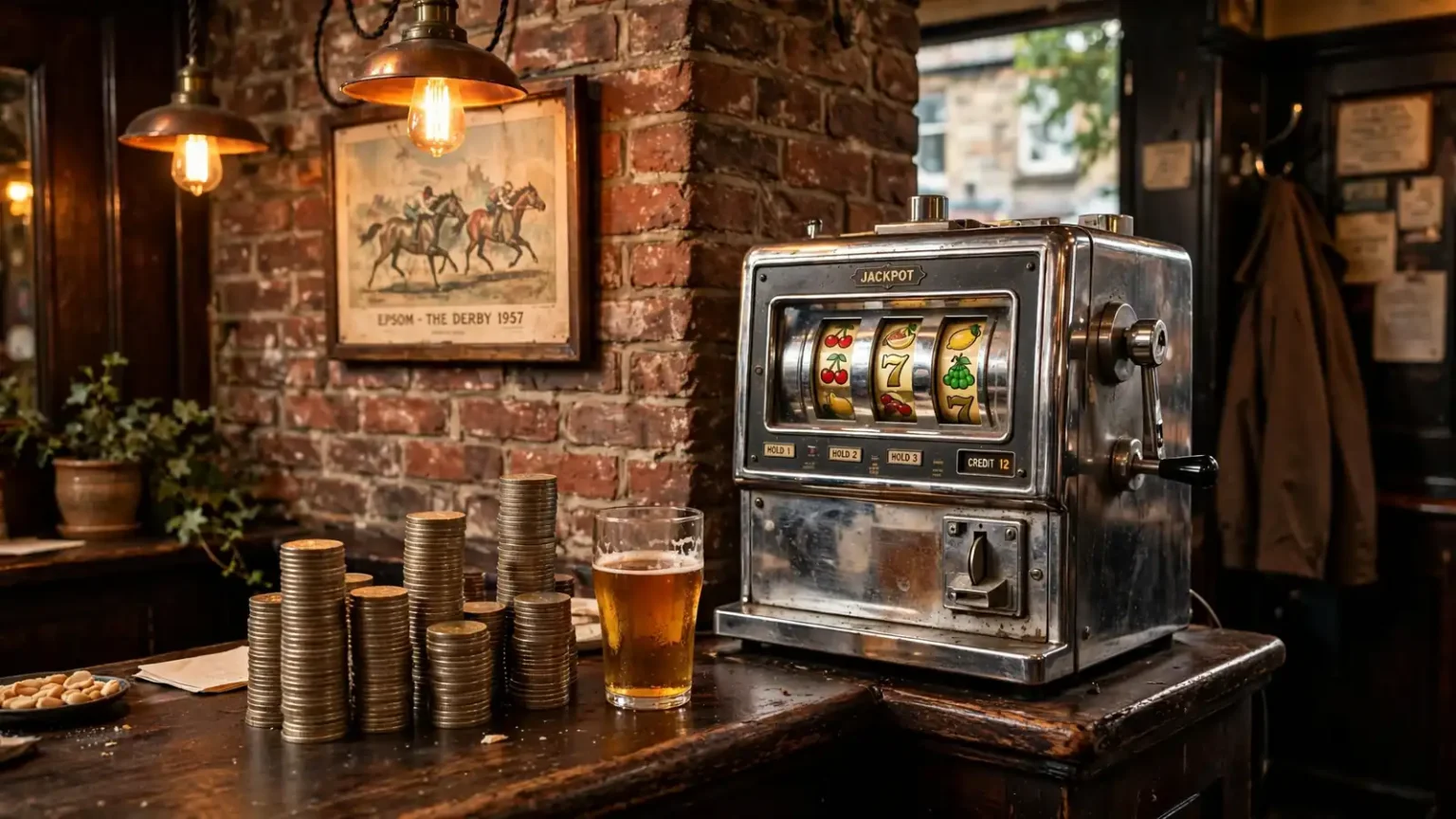
Progressive prizes grow from contributions across connected games, while trigger rules, odds and demo conditions affect what a displayed total means.
Where the Jackpot Money Comes From
A progressive jackpot is not simply a large prize attached to a slot’s ordinary paytable. Its value grows as wagers feed a separate pool. In a progressive slot, a portion of each wager is directed to that pool, while the remainder supports the game’s other payouts and operating costs. The display may make the prize look like a solitary number, but its growth depends on many plays.
The pool is built across connected slot machines. When a wager is placed on one of them, a contribution is added to the jackpot fund; contributions from other connected machines accumulate there too. The visible total is therefore not necessarily the product of one player’s activity or of one machine in isolation. It represents the combined effect of wagers made across the connected game.
That arrangement is the defining feature of progressive slots online in the UK, as elsewhere: the prize can grow beyond the scale of a single game’s routine payouts because the pool receives contributions from multiple plays. Each individual addition may be small, but the process continues as qualifying wagers are made. The jackpot is collective in its funding, even though its eventual award belongs to one winning play.
The contribution is commonly a small slice of each wager. Progressive jackpot slots typically direct between 1% and 3% of a wager to the pool. The precise rate can differ by game, but the principle is consistent: part of the money staked is reserved for the progressive prize rather than being used for the base game’s ordinary return. A wager thus has two destinations, not one.
This split helps explain why a progressive game’s base-game return can look lower than that of a comparable slot without a growing jackpot. Base-game RTP for progressive slots often falls in the 88%–92% range, with the difference in payout going towards the jackpot pool. RTP, or return to player, describes a theoretical return across a very large number of plays; it does not promise that a particular session will return a matching share. Nor does the base-game figure describe the changing jackpot total by itself.
Penny Slot Machines in the UK: Stakes and Costs
The distinction matters because a large advertised prize can dominate the eye. The base game, meanwhile, carries the more frequent rhythm of ordinary play: its symbols, smaller payouts and features. A portion of the money that might otherwise contribute to those returns has been allocated to a prize that grows separately. The visible jackpot is not free money sitting beside the game. It is funded by the structure of play.
There is a trade-off. A progressive slot offers access to a pool that can increase as connected machines are played, but that funding has to come from somewhere. In these games, some of the expected return is directed away from ordinary base-game payouts and into the jackpot fund. The appeal is plain enough: a shared pool can become substantial. So is the cost in design terms: the everyday game may return less than a non-progressive counterpart.
That comparison should not be reduced to a simple verdict that one kind of slot is better. The figures describe different parts of the same arrangement. The contribution rate tells how much of a wager is allocated to the pool; the base-game RTP indicates the theoretical return from the game outside that progressive prize. Neither figure, on its own, says what a player will receive in a short session, or whether a jackpot will be awarded during it. Those are separate questions.
Nor should a rising total be mistaken for money generated by the machine’s display. The counter shows the accumulated pool, but the mechanism behind it is the stream of contributions from connected play. Its movement is a record of pooled wagering, not a measure of an individual’s chances or a signal that a prize is due. A number that climbs can look like a promise. It is accounting, dressed for the lights.
For anyone comparing progressive slots, the useful first distinction is between the base game and the jackpot fund. A title may offer an ordinary return that is reduced because a share of wagers supports the progressive pool. Another slot may not have a progressive prize at all, and so has no such contribution to account for. Comparing headline jackpot totals without noticing this difference leaves out the central bargain.
Progressive jackpot slots typically direct between 1% and 3% of each wager to the jackpot pool, while base-game RTP often falls in the 88%–92% range.
This is why the phrase “progressive” describes more than a prize that gets bigger. It describes a funding model: wagers from connected machines feed a shared pool, and each game balances that allocation against its base-game return. The jackpot’s scale comes from accumulation. The ordinary game pays for it.
One Game, Many Operators
A progressive jackpot slot can appear on more than one casino site without becoming a separate competition at each one. When operators carry the same networked game, wagers on connected machines feed a shared jackpot pool. The casino window may look local; the prize belongs to a wider network.
That distinction matters. A game’s presence at one operator does not mean it is exclusive to that site, and a jackpot displayed there need not have been built only by its customers. The network links play across participating operators. A player moving between sites may therefore encounter the same game and the same shared pool, rather than a fresh jackpot created for each account.
The arrangement is a form of reach. Providers can make a title available across a network, while operators decide which games appear in their own catalogues. The pool may be shared; the shopfront is not. Each casino presents its own selection, and the list on one site is not a reliable map of what another carries.
This is why a search for a particular progressive slot can turn up uneven results. A specialist review reports that availability differs between operators and can shift as providers refresh their catalogues. That is a snapshot, not a permanent directory: a game listed at one point may later be added, removed or presented differently. Catalogues are living inventories, not public infrastructure.
Amatic Casino Games: How UK Casinos Offer Them
The practical consequence is that “the same game” and “the same place to play” are separate questions. A title may belong to a shared network while appearing only at selected operators. Another site may offer different progressive games from the same provider, or none from that network at all. Provider relationships and catalogue choices shape the visible range, but the shared pool applies only where the same progressive slot is actually carried.
This can make comparisons feel less tidy than the jackpot display suggests. A prominent prize figure draws the eye, while the less visible arrangement behind it involves several businesses: the provider supplies the game, participating operators make it available, and the network connects play. The logo on the casino page tells only part of the story. The jackpot’s reach is determined by the connected game, not by the number of websites that happen to advertise similar-looking slots.
Searches for a list of progressive jackpot slots can also mislead when treated as a definitive inventory. Any list can describe what its compiler saw at a particular moment; it cannot establish what every UK operator offers or what will remain available. The same applies to new releases. “New” describes a point in a catalogue’s changing life, not a guarantee of universal launch. Providers update their offerings, and operators’ selections do not necessarily move in step.
Nor does a shared network make every version interchangeable. Titles may look alike in a lobby, but the relevant question is whether they are the same progressive game connected to the same pool. Similar artwork or a familiar provider name is not enough to establish that. The pool is shared across operators carrying the same game, not across every slot with a jackpot sign.
A shared jackpot pool applies only where the same progressive slot is actually carried; similar artwork or a familiar provider name does not guarantee the games are connected to the same pool.
Bitcoin-related searches raise a different distinction. A payment method and a jackpot network are not the same thing: the former concerns how an account is funded, the latter how a game connects participating play. The presence of one does not establish the availability of the other. A casino’s payment options cannot, by themselves, identify which progressive slots it carries.
For anyone comparing progressive jackpot slots across UK casino sites, the meaningful unit is therefore the individual game and its network, not a broad label such as “jackpot slots”. Operator catalogues can overlap, diverge and change. A shared prize can travel across sites; access to the game remains selective. The network is wider than any one lobby.
How a Progressive Jackpot Is Triggered
The word “progressive” describes a prize that grows; it does not, by itself, explain what makes the prize fall. In progressive casino slots, the award can be tied to different events. Some jackpots are triggered randomly. Others depend on landing a particular combination or entering a bonus round. The distinction matters because a rising prize display says nothing about which event the game requires.
With a random trigger, the jackpot is awarded by chance rather than by a specified winning pattern on the reels. A spin may produce no obvious jackpot combination and still be the one on which the game’s random mechanism awards the prize. The symbols and the jackpot event are not necessarily the same thing. That can make the result feel unexpected: the screen’s familiar language of matching pictures is not always the whole story.
Online Craps Casinos in the UK: What Can Be Verified
The exact presentation depends on the game. A random award may arrive during ordinary play, while the reels appear to be doing nothing out of the ordinary. That does not mean the jackpot is due after a long run without a win, or that a sequence of near-misses points towards one. Random means the event is not announced by a required combination; it does not turn the history of previous spins into a clue.
Other progressive jackpots are more legible. The game may specify a combination that awards the prize, or make the jackpot available through a bonus round. In that case, the route to the award is part of the game’s rules: a qualifying pattern may appear on the reels, or a feature may need to be entered before the jackpot can be won. The bonus round is a gateway, not necessarily the prize itself. Its presence alone does not establish that the jackpot has been awarded.
That difference changes what the player sees, not the basic uncertainty of the outcome. A combination-based game gives the jackpot a visible condition, but it does not make that condition predictable. A bonus feature may create a separate stage in which the prize can be awarded, but reaching the stage is not the same as receiving the jackpot. The rules of the particular game determine which event counts.
This is why descriptions such as “random jackpot” and “bonus jackpot” should not be treated as interchangeable labels. One points to the way the award is triggered; the other may describe a route or feature through which it becomes possible. Some games make the relevant condition clear in their rules or help screen. The reels alone may not explain it, especially where a random award has no distinctive symbol pattern to announce itself.
Do
- Check the individual game rules for the trigger mechanism
- Distinguish between random and combination-based awards
Don’t
- Assume a rising prize display indicates a win is due
- Treat “random jackpot” and “bonus jackpot” as interchangeable
For anyone comparing online slots with progressive jackpots in the UK, the useful first question is not how large the displayed prize looks, but what the game says must happen for it to be awarded. That information belongs to the individual game, not to progressive slots as a single category. A jackpot shown beside one title may depend on chance; another may be attached to a combination or a bonus feature. Similar displays can conceal different rules.
There is no universal jackpot trigger. The game decides.
Best casino sites in the UK
- BritsinoBonus: Welcome Package – Get your £2,200 + 2,000 FS · Payout speed: 1-3 business days
- BeOnBetBonus: 100% up to €500 + 100 FS · Payout speed: 1-3 business days
- Revery PlayBonus: 100% up to€1,000+ 100 FS · Payout speed: 1-3 business days
- EvoSpinBonus: 125% up to €2500 + 125 Free Spins · Payout speed: 1-3 business days
- WinBeastBonus: €5000 + 500 FS + €650 Freebet · Payout speed: 1-3 business days
- SpinFormulaBonus: 550% Up To £15,000 + 550 FS · Payout speed: 1-3 business days
- JetsetspinsBonus: 200% Bonus + 100 Free Spins + Free Royal Wheel · Payout speed: 1-3 business days
- NightWinBonus: £900 + 400 free spins · Payout speed: 1-3 business days
- NightLuckBonus: Welcome Pack + 805% Up To 6400€ + 280 FS · Payout speed: 1-3 business days
Free Spins, Demos and the Fine Print
A demo is a way to explore a progressive slot without making a deposit. Where an operator offers a browser-based version, it can be opened without downloading a separate game file. The distinction is practical, not cosmetic: a demo lets the player see the game’s layout and features, while promotional spins come with terms that determine what, if anything, can be withdrawn.
The word “free” does not settle those terms. A free-spin offer may be limited to named games, and a progressive slot may not qualify at all. A specialist review reports that most free-spin promotions exclude progressive games; it also describes caps of £50–£100 on winnings from progressive-slot free spins. Those figures should be read as that review’s account, not as a standing rule across UK operators. The promotion’s own terms govern.
That is the small print doing its large work. Even when a promotion names a progressive game, the terms may define which spins count, how winnings are treated and whether any cap applies. The game’s jackpot potential and the promotion’s eligibility rules are separate matters. A free spin in a slot with a progressive feature does not, by itself, establish that the jackpot is available during promotional play.
Barcrest online casinos in the UK: what to check
No-deposit bonuses deserve the same scrutiny. A specialist review reports wagering requirements of 40x–60x and maximum withdrawal caps of £50–£100 for such winnings. These are reported promotional terms, not universal conditions; an offer can set different rules. The requirement and withdrawal cap are also distinct: completing a wagering condition does not mean that every amount shown as a win can be withdrawn. The offer’s terms say what applies.
What a demo can—and cannot—show
A demo can help distinguish games that look alike on a catalogue page. It may reveal the pace of play, the bonus interface and how clearly the game presents its features. That is useful for deciding whether the experience suits someone’s taste. It cannot establish the value of a promotional offer or promise that a jackpot will be awarded.
For players looking for progressive slots without a download, the relevant question is whether the operator provides the chosen game in a browser-play format. Availability differs between operators and can change as their catalogues are updated. A game appearing in a demo list does not necessarily mean it is eligible for free spins, and a free-spin promotion does not necessarily include progressive slots.
It is tempting to treat the demo as a preview of the real-money experience in every respect. It is better understood as a preview of the game’s presentation. Promotional conditions sit elsewhere, in the offer terms. Dry, but consequential.
Most free-spin promotions exclude progressive games, and where they are included, winnings may be subject to caps of £50–£100.
The same distinction applies when deciding whether progressive slots are worth trying. A demo can answer a question of preference: whether the game is enjoyable to watch and play. It cannot answer whether a bonus is generous, whether its winnings can be withdrawn without conditions, or whether a jackpot is likely to fall. Those are different questions, and the terms attached to each promotion are where its limits become visible.
Real-Money Play in a UK-Regulated Market
A progressive jackpot slot played for cash is still part of a wider commercial arrangement: a business offers gambling, a game is made available through that business, and the player’s stake enters a regulated setting. In Great Britain, the central public authority for commercial gambling is the UK Gambling Commission. It regulates gambling activity, including online casinos, and is the sole regulator for commercial gambling there.
The distinction between the operator and the game matters. A progressive slot does not carry its own UK operating licence in place of the casino offering it. The Commission grants operating licences to businesses and personal licences to individuals who perform specified roles in gambling operations. The licence sits within that framework of responsibility; it is not a badge attached to a jackpot or a promise about what a game will pay.
For remote gambling, the location of the key equipment does not remove the operator from the Commission’s remit when the service is offered to consumers in Great Britain. A company cannot make the regulatory question disappear by placing its servers elsewhere. The relevant issue is the market being served, not simply the address of the machinery. Geography, in this case, has a rather practical definition.
Isoftbet and Amatic in UK Casinos: Key Differences
This is the legal frame for real-money progressive slots in Great Britain. The Gambling Act 2005 governs gambling in England, Wales and Scotland, while Northern Ireland is outside that Act’s scope. “UK” is common shorthand in the industry, but the Commission’s specific remote-gambling remit is described in relation to Great Britain. The distinction is worth keeping: a familiar label can cover more territory than a particular legal rule.
The rules also apply to online casinos as businesses, not only to traditional venues or physical machines. A progressive jackpot slot offered online does not become a separate category beyond the regulator’s reach because its prize can grow across connected play. Its unusual prize structure may distinguish it from a regular slot as a product, but both are encountered through an operator’s gambling service. That difference does not alter who regulates the commercial activity.
Nor does the phrase “progressive jackpot slots strategy” change the legal character of the activity. A strategy may describe how someone chooses to play, but it does not replace the operator’s licensing obligations or create a different regulatory category. Real-money play belongs to the regulated service through which it is offered.
The Commission’s role is institutional rather than theatrical: it licenses businesses and individuals and regulates commercial gambling within its remit. The jackpot may attract the attention; the licence attaches accountability to the business behind the screen. Ordinary administration, with unusually visible stakes.
How the Jackpot Can Be Won
A jackpot can be visible on a game screen without every wager being eligible for every prize it displays. In some random-trigger progressive slots, the rules attach a qualifying condition to the highest jackpot tier: a minimum stake must be in play. A specialist review has reported this condition for certain games. It is a game-specific rule, not a universal feature of progressive slots, and it concerns access to that tier rather than a method of making the random event more likely.
Minimum Stake
Some games require a minimum stake to be eligible for the highest jackpot tier; without meeting this condition, the top prize cannot be awarded regardless of the trigger.
That distinction matters. A minimum stake may determine whether a player can receive the top prize if the game selects their play; it does not turn a random trigger into a predictable one. The condition belongs to the rules of the particular game, where it should be stated alongside the jackpot tiers and their eligibility requirements. Without checking those rules, the displayed pool can be mistaken for a prize available on any stake.
The wording of a game’s paytable or information panel can carry more weight than its promotional description. A game may show several prize levels, while the rules assign different eligibility to different levels. The relevant details are the stake required for the highest tier, whether that requirement applies to each spin, and what the game says about lower tiers. Those terms are not interchangeable: qualifying for one prize does not necessarily mean qualifying for all of them.
This is a modest but important boundary in the idea of “winning”. There is the random event itself, and there is the separate question of whether the play meets the game’s conditions when it occurs. A player can satisfy a stated stake requirement and still receive no jackpot; the requirement establishes eligibility, not an advantage over chance. Nor does increasing a stake create a reliable way to force a random trigger. The rules describe the gate, not a route through it.
Online versions do not erase that distinction. The relevant terms remain those attached to the specific slot and its jackpot structure, rather than a general assumption about how progressive games behave. Where a qualifying stake is specified, it is part of the game’s conditions; where no such condition appears, one should not be inferred from the existence of a top tier. A familiar format can conceal a different set of terms.
Greentube Casinos in the UK: What Can Be Verified
There is a dryly practical reason to read the rules before treating a large displayed figure as personally available: the amount on screen and eligibility for it are separate matters. The first catches the eye. The second is in the small print, where casinos have long placed the less theatrical part of gambling. Eligibility is not a strategy. It is a condition.
Odds, Contributions and What They Can—and Cannot—Tell Us
A progressive slot has two figures that can look like clues to its odds: the share of each wager assigned to the jackpot and the return-to-player rate, or RTP, of the base game. Neither is a forecast of when the prize will fall.
Across progressive jackpot slots, the jackpot contribution is commonly between 1% and 3% of each wager. The base game RTP often sits in the 88%–92% range, with the difference in payout directed towards the jackpot pool. These figures describe how the game allocates money over time; they do not reveal the chance that a particular spin will win the jackpot.
RTP is a theoretical measure of returns across a very large volume of play, not a schedule for an individual session. A stated rate cannot promise that a player will receive that share back, nor does a lower base-game RTP show how soon the progressive prize will be awarded. The jackpot has its own conditions and probability, which cannot be calculated from the contribution percentage alone.
RTP and Contributions
Neither the base-game RTP nor the jackpot contribution rate can be used to predict when a progressive prize will fall.
That distinction matters when considering the odds of winning progressive slots. A contribution rate says something about the pool’s funding, while RTP describes the base game’s designed return. Neither supplies the missing information needed to calculate jackpot odds or establish how often progressive slots hit. A large or steadily growing displayed prize is not, by itself, evidence that a win is due.
The useful tips for playing progressive slots are therefore less dramatic than a system: read the game’s published RTP and jackpot terms, and treat each figure as a description of the game rather than a prediction. Comparing contribution rates without the full rules can also mislead; a higher share going to the pool does not, on its own, mean better chances of winning.
Mathematics can clarify the arrangement, but it cannot turn pooled contributions into a countdown. In a random outcome, past spins do not provide a reliable timetable for the next jackpot. The figures explain allocation, not timing.
Mystery Jackpots and Must-Hit-By Games
The word mystery describes uncertainty about when a prize will be awarded, not necessarily the size of the prize or the game’s ordinary rules. A mystery progressive jackpot may be attached to a slot without requiring a particular winning combination to appear. Its award point is not something that can be read from the visible reels or inferred from a sequence of previous spins. The uncertainty is the feature.
Pragmatic Play Casinos in the UK: What to Check
A must-hit-by jackpot makes a different kind of promise. Its terms state a point by which the prize is due to be awarded. That condition gives the jackpot a defined boundary, but it does not identify the spin on which it will fall. Nor does seeing the displayed value approach that boundary turn the next spin into a likely winner. “Must hit by” is a limit on the jackpot’s life, not a countdown that reveals its final moment.
The distinction matters because the labels can sound more informative than they are. Mystery says the timing is hidden; must-hit-by says there is a stated endpoint. Neither label, on its own, tells a player how often a jackpot is awarded, what stake qualifies, or whether the prize is available at every operator carrying the game. Those details belong to the game’s own rules and presentation.
Some progressive jackpots are awarded randomly; others depend on a particular combination or entry into a bonus round. That broad distinction can overlap with jackpot labels, but it is not identical to them: “mystery” and “must-hit-by” describe how the award’s timing is framed, while a combination or bonus condition describes what the game requires for an award. The terminology is not a substitute for the rules.
A specialist review has reported that certain random-trigger games make the highest jackpot tier conditional on a minimum bet. That is a specific observation, not a general rule for mystery progressive slots in the UK. The relevant game terms matter more than the label on a tile or a promotional banner.
There is a small theatre in these formats. One conceals the moment; the other gives it a boundary while withholding the moment itself. Neither turns uncertainty into a schedule.
Mystery Jackpots
Uncertainty is the main feature; the award point is not readable from the reels or previous spins.
Must-Hit-By Jackpots
These have a defined boundary or stated endpoint by which the prize is due to be awarded.
Playing Responsibly, Without Autoplay
A progressive slot can make each spin feel like part of a larger event, but the safeguards around ordinary play are deliberately less theatrical. In Britain, online slot autoplay is banned. Each game cycle must last at least 2.5 seconds before another can begin, a small interval imposed against the old machinery of frictionless repetition. The pause is part of the design now.
Playing a progressive slot follows the same basic pattern as playing another online slot: the game is opened, a stake is set, and a spin begins. What distinguishes it is the linked jackpot feature, not a different permission to ignore the rules of play. Nor does the prospect of a larger prize make progressive slots inherently better. The attraction is a matter of preference; the costs of play remain real.
UKGC-licensed operators must provide tools intended to keep gambling within chosen boundaries. These include deposit limits and loss limits, reminders about time spent in a session, self-exclusion and access to support resources. New customers must be prompted to set a financial limit before making a first deposit, and account-level limit controls must be accessible. Such measures are not a promise that gambling will remain harmless. They put practical controls within reach, which is more useful than a solemn disclaimer after the event.
Age checks precede deposits: operators must verify a customer’s age before allowing money to be added to a gambling account. For online slots, the amount staked in an individual game cycle is capped at £2 for customers aged 18 to 24 and £5 for those aged 25 or older. Credit cards cannot be used to fund gambling, including through a money service business; wallets that allow credit-card funds to be used for gambling are also barred. The rules attend to the route money takes as well as the spin itself.
Free-play versions may let someone inspect a game’s layout without staking money, but they are not a substitute for the account controls required in real-money play. The distinction is plain. One is rehearsal; the other has consequences.
A slot’s pace is regulated, its funding routes constrained, and its account tools made visible. None of that turns a jackpot into a plan. It does, however, place a little structure around an activity built to repeat.
Finding Games Without Pretending There Is a Definitive Best
A “best” progressive slot is difficult to name without first deciding what best means. One player may value a familiar theme; another may prefer a particular style of play. A ranking can make these preferences look like objective differences, but a list of titles cannot settle them.
The catalogue itself is not fixed. A specialist review reports that availability varies between operators and can change as providers update their games. A title found at one casino may not appear at another, and a list assembled at one point can become dated. The practical starting point is therefore the current game library, not an assumed universal shortlist.
Free play can make that library easier to explore. A demo, where offered, lets someone see a game’s presentation and controls without treating it as a recommendation to deposit. It cannot establish how the game will feel over time, or make a jackpot more likely. A little browsing, rather than a league table, is often the more useful exercise.
Promotional free spins are a different matter from a demo. A specialist review reports that free-spin winnings from progressive slots may be subject to caps of £50–£100, and that most free-spin offers exclude progressive games. The terms attached to a specific offer decide what applies; the word “free” does not mean every game or prize is included. A small distinction, with consequences.
This leaves room for preference without pretending that preference is a measurement. A game catalogue can be filtered by provider or theme where an operator makes those options available, then explored in free play if the title permits it. None of that produces a definitive winner. It produces a better-informed choice among the games actually on offer.
What should I look for in a progressive jackpot slot?
Check the base-game RTP, how much of each wager goes to the jackpot, and how the jackpot is triggered. Some games also require a minimum bet to qualify for the highest jackpot tier.
Do all UK casinos offer the same progressive jackpot games?
No. Game selections vary between operators and can change as providers update their catalogues, although the same networked game can share its jackpot pool across operators that offer it.
Can you win a progressive jackpot on a minimum bet?
Sometimes, but certain games require a minimum bet to qualify for the highest jackpot tier. Check the game’s rules to see which bet levels qualify.
How fast are progressive jackpot withdrawals paid out?
Debit card withdrawals typically take 1–3 working days, e-wallets can take hours, and bank transfers often take 3–5 working days or longer. Large jackpots may require extra verification and can be paid in structured instalments over several years.
What are the differences between UK licensed and non-UK regulated online casinos?
UK-licensed operators are regulated by the UK Gambling Commission and must offer responsible gambling tools such as deposit and loss limits, session reminders and self-exclusion. The Commission regulates remote gambling offered to consumers in Great Britain regardless of where the key equipment is located.
Material created by the team Pure Casino UK Guide


