

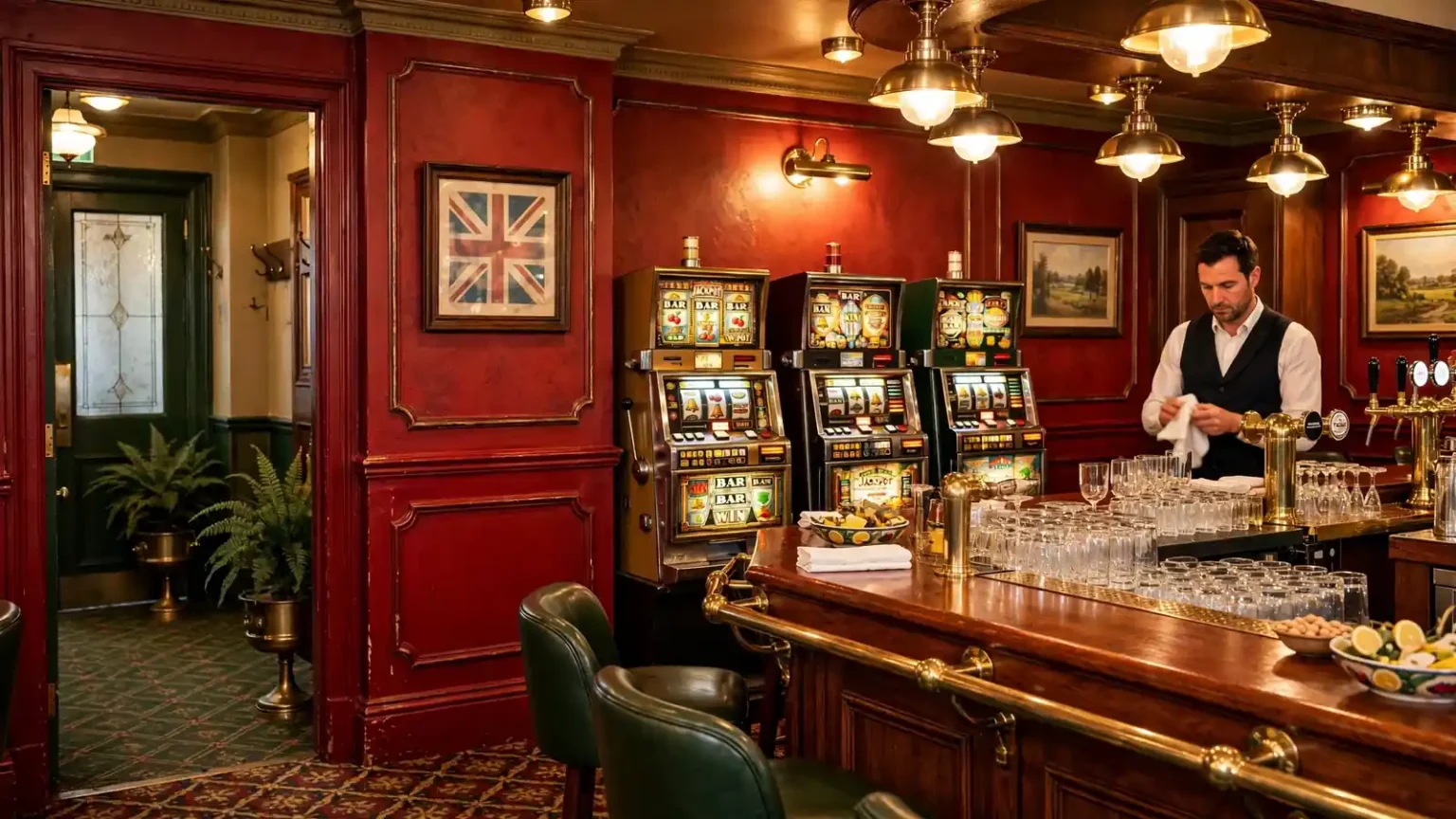
Barcrest branding does not identify the business taking deposits or paying winnings; UK licensing and game availability need separate checks.
Barcrest in the UK Casino Landscape
A name on a slot screen and the name of the business running a casino belong to different parts of the arrangement. For anyone looking for Barcrest slots online, that distinction matters before any question of style or preference arises: a provider name does not, by itself, identify the operator taking deposits, paying winnings or holding the licence for a casino.
In Great Britain, commercial gambling is regulated by the UK Gambling Commission. Its remit includes remote gambling offered to people in Great Britain, even when the equipment used to run a service is located elsewhere. A casino’s physical distance from its customers therefore does not remove the activity from the British regulatory framework. The important question is whether the business offering the gambling holds the relevant UKGC licence.
The Commission issues operating licences to businesses and personal licences to individuals working in roles that require them. These licences serve different purposes. The operating licence attaches to the business authorised to provide gambling; a personal licence concerns an individual’s role in the industry. Neither should be confused with a game title, a software label or a search result presenting a casino as a place to play.
That distinction is easy to miss in a market where games, brands and operators appear together in the same lobby. A player may encounter a slot carrying a provider’s name inside a casino run by a separate company. The visual arrangement can make the relationship look seamless, but the regulatory responsibility for the gambling service rests with the licensed operator. The UKGC regulates the activity, not the impression created by a logo.
This is why claims about the best Barcrest online casinos require more than recognition of the name. A list would need to establish which businesses actually offer the relevant games and whether those businesses hold the appropriate UKGC licence. Without that groundwork, a ranking risks turning a familiar label into an unsupported assurance about a casino. A polished lobby is not a licence.
Betsoft Casinos in the UK: What Can Be Verified
The same principle applies to phrases such as “Barcrest casino” or “Barcrest online slots”. They can describe what someone hopes to find, but they do not establish who supplies a game, who operates a gambling account or whether a particular title is available at a particular site. Those are separate questions. Treating them as one can blur the line between a product name and the regulated service through which real-money play takes place.
The Commission’s authority also gives the British market a particular shape. Regulation follows the offer made to consumers in Great Britain, not merely the address of a company or the location of its servers. This matters in remote gambling because technology can cross borders with little ceremony. The law’s answer is less romantic: where the service is directed at the British market, a relevant UKGC licence is required.
That framework is not a recommendation of any specific casino. A provider’s name cannot stand in for checking the operator behind a site, and a claim that a casino carries a particular catalogue cannot establish its regulatory status. The two checks answer different questions: one concerns what may be available to play; the other concerns who is legally authorised to offer remote gambling.
Amatic Games at UK Online Casinos: What to Know
The UKGC is the sole regulator for commercial gambling in Great Britain. That central role means there is a clear regulatory authority for the market, rather than a collection of competing bodies whose responsibilities depend on a casino’s branding. For consumers, it also means that a casino’s own presentation is not the final word on its status. The licence belongs to the business, and the regulator is the body responsible for overseeing the market.
A search for the best Barcrest casinos may begin with a provider name, but that name is only a starting point. The legal landscape is organised around licensed businesses and the gambling they offer, not around a presumed connection between a provider and every casino that mentions it. Until both sides of that relationship are established, a recommendation would be premature.
There is a quiet social history in this arrangement. Remote gambling makes a service feel borderless, while regulation insists that commercial responsibility remains legible: a business must be identifiable, a licence must attach to it, and the regulator must have jurisdiction over the offer. The screen may conceal the machinery. The licence is meant to name who runs it.
Regulatory Responsibility
The regulatory responsibility for a gambling service rests with the licensed operator, not the software provider or the impression created by a logo.
Best casino sites in the UK
- BritsinoBonus: Welcome Package – Get your £2,200 + 2,000 FS · Payout speed: 1-3 business days
- BeOnBetBonus: 100% up to €500 + 100 FS · Payout speed: 1-3 business days
- Revery PlayBonus: 100% up to€1,000+ 100 FS · Payout speed: 1-3 business days
- EvoSpinBonus: 125% up to €2500 + 125 Free Spins · Payout speed: 1-3 business days
- WinBeastBonus: €5000 + 500 FS + €650 Freebet · Payout speed: 1-3 business days
- SpinFormulaBonus: 550% Up To £15,000 + 550 FS · Payout speed: 1-3 business days
- JetsetspinsBonus: 200% Bonus + 100 Free Spins + Free Royal Wheel · Payout speed: 1-3 business days
- NightWinBonus: £900 + 400 free spins · Payout speed: 1-3 business days
- NightLuckBonus: Welcome Pack + 805% Up To 6400€ + 280 FS · Payout speed: 1-3 business days
Classic, Fruit-Machine and Big-Bet Styles: What Can Be Verified
“Classic” and “fruit-machine” describe a mood as much as a format. They evoke the compact cabinet, bright symbols and familiar rhythms of the British amusement arcade: a small theatre of chance whose design made the game legible at a glance. “Big bet”, by contrast, points towards the scale of a stake, not necessarily a distinct visual style. These labels can help describe what a slot appears to offer, but they do not establish who made it.
That distinction matters when a game is described as a Barcrest classic or a fruit-machine slot. A familiar look, a British theme or an arcade-like presentation is not proof of Barcrest authorship. The game’s own information and the operator’s listing are the relevant places to establish its provider. Nor does the phrase “big bet” override the rules governing online slots in Britain. A promotional label is not a licence to stake without limit.
The rules are set at market level, not by a provider’s branding. For online slots, the maximum stake per game cycle is £5 for players aged 25 and over, a cap that took effect on 9 April 2025. For players aged 18 to 24, it is £2 per game cycle, effective from 21 May 2025. The difference makes age relevant to the permitted stake, even when the game and its presentation are otherwise the same. “Big bet” is therefore a relative description, bounded by regulation.
Amatic Online Casinos in the UK: Supplier or Operator?
There are also rules about pace. Online slot autoplay is prohibited in Britain, and a minimum interval of 2.5 seconds must separate spins. Those requirements shape the experience regardless of whether the screen imitates an old fruit machine or presents itself as a modern video slot. The familiar symbols may be borrowed from arcade culture; the rhythm is governed by contemporary rules. Nostalgia, with safeguards.
The distinction between theme and mechanics is easily blurred in casual descriptions. Fruit imagery, traditional-looking reels or a bold prize display might suggest a particular family of games, but appearance alone cannot confirm a feature, a payout structure or a provider. A name associated with a British slot style is not enough to establish that the title belongs to Barcrest. The same caution applies to “classic”: it may mean an older design, a simpler-looking screen or merely a marketing description. Without a specific game and its provider attribution, the word does little technical work.
Rainbow Riches is sometimes folded into broad descriptions of British fruit-machine slots. That association should not be treated as proof of Barcrest authorship. A game’s popularity, cultural familiarity or resemblance to an arcade tradition does not settle its corporate provenance. The distinction may seem narrow, but provider names matter: they identify who made the software, while the operator presents and supplies the game to its customers.
Likewise, a “big bet” label should not be mistaken for an assurance about how a particular title behaves. It does not, by itself, confirm a game’s maximum stake, volatility or prize potential. The applicable British stake cap is the firm boundary; the label is only descriptive unless the game and its terms supply something more definite. It is a small example of the way casino language can make a product sound more precise than it is.
Do
- Verify the game provider via the operator’s listing
- Check the current British stake caps based on age
- Observe the mandatory 2.5-second interval between spins
Don’t
- Assume authorship based on a “classic” or “fruit-machine” look
- Use “big bet” labels as a licence to stake without limit
- Use autoplay, which is prohibited in Britain
The old fruit-machine vocabulary persists because it carries a social history. These machines belonged to pubs, arcades and seaside amusements, places where play was visible and local. Online, that history is translated into screens and symbols, but a visual resemblance cannot establish a direct lineage between an individual title and a particular manufacturer. A British setting is not a provider credit.
For anyone comparing descriptions, the useful separation is simple: style says how a game is presented; provider attribution says who produced it; regulation sets the conditions under which online slots may be played in Britain. Those are different questions, and one cannot answer the others. A title may look classic without being verified as a Barcrest game, while the stake and spin rules apply independently of its appearance.
That leaves the labels in their proper place. Classic, fruit-machine and big-bet language can sketch a desired atmosphere, but it cannot certify a game’s identity or mechanics. The British rules are clearer than the branding: no autoplay, a minimum pause between spins, and age-based limits on stakes. The rest depends on the individual title’s reliable identification—not on how convincingly it recalls an arcade.
Free Play and Demo Access: The Evidence Gap
A request to try a Barcrest slot without depositing sounds straightforward, but “free play” can describe different things. It may mean a practice version with simulated credits, a free-to-play game outside a casino, or a promotional offer attached to real-money play. Those are not interchangeable. A free-play label alone does not show which format is involved, whether winnings can be withdrawn, or whether the game is actually a Barcrest title.
Amatic Online Casinos in the UK: What to Check
A demo, in the narrow sense, lets someone experience a game without staking cash. Its purpose is familiar from other forms of entertainment: a sample offers a feel for the product before a purchase. In a casino, however, a demo’s presence and terms are choices made by the operator and depend on what the operator makes available. A provider name in a description cannot establish that a playable demo exists, and a title mentioned elsewhere does not prove that its practice version is accessible in a British casino.
That distinction matters because a real-money casino is not simply a shop window for software. In Great Britain, remote gambling operators serving consumers must hold a UKGC licence, even when their key equipment is located elsewhere. The Gambling Commission regulates commercial gambling; a software supplier’s role is different from the operator’s. A demonstration with no wager is not the same thing as a real-money session, and the word “demo” should not be treated as a shortcut for knowing who operates a site or what protections apply.
Nor does a free version necessarily reproduce every detail of paid play. A practice mode can be configured separately, may use simulated balances, and may not offer cash prizes. Without clear information from the operator, there is no sound basis for assuming that its rules, presentation or availability match a real-money game. The reverse assumption is just as shaky: seeing a title in a casino does not establish that it can be launched for free.
This is why searches for Barcrest slots to play for fun can lead to a frustratingly blurred boundary. The phrase can point to an authentic operator-hosted demo, an unrelated game using similar imagery, or a page that merely describes a game without letting anyone play it. Search results and promotional wording are not substitutes for a playable game screen and clear terms. A name is not a demo.
Difference between demos and free spins
A demo is a practice version used to experience a game without staking cash, whereas free spins are promotional rewards provided by an operator that may carry specific terms and wagering conditions.
There is also a difference between free practice and free spins. A demo is generally about trying a game without risking a deposit; free spins are a promotional form of play whose eligibility and conditions come from an operator. The two can be placed side by side in advertising, but that does not make them equivalent. Promotional rewards may carry terms, while a demo may have no cash value at all. Treating both as “free” can conceal the most important distinction: whether any money is being wagered and whether a resulting balance can be withdrawn.
On a licensed casino site, the operator—not the game supplier—handles deposits, payouts, bonus terms and customer support. That division is less visible in a demo than in a paid session, because no deposit or withdrawal may be involved. It remains useful context nonetheless. A practice screen can introduce a title, but it cannot by itself confirm the operator’s standing, the terms of a later promotion, or the availability of the same game for real-money play.
The sensible standard is modest: a demo claim should be supported by an actual, clearly labelled practice option on an identifiable casino platform, with any restrictions explained before play. If the page offers only a title, a picture or a promise of free access, it has not shown a demo. And if the game does open, its free mode should not be mistaken for proof that every Barcrest title has one, or that the experience is identical across casinos.
That is the distinction worth keeping. A no-cost trial, where one exists, is a way to inspect a game; it is not evidence of a wider catalogue or a guarantee of access elsewhere. The label may be inviting. The terms do the explaining.
Amatic Games at UK Casinos: Licensing and Bonuses
Barcrest Game Range: What Is—and Is Not—Confirmed
A name associated with casino games can suggest a settled catalogue: a family of titles, recognisable formats and a clear distinction between one release and another. But a name on its own establishes little. It does not show which games belong to a range, whether a title is currently offered, or whether two similarly named entries are the same product.
That distinction matters when considering Barcrest casino games. A dependable account of the range would need to identify individual titles and show how each is attributed. Without that foundation, naming supposed Barcrest slot games or describing their features would turn an uncertain association into a statement of fact. There is no useful precision in a list that cannot be substantiated.
A casino’s games lobby is not, by itself, a catalogue. It is a changing display shaped by the operator’s selection, agreements and interface. A title’s presence there may indicate that it is available through that operator; it does not automatically establish the full extent of a developer’s output. Nor does a familiar visual style prove who made a game. Names and artwork can travel farther than reliable attribution.
The same caution applies to broad labels such as “slot machine games” or “online slot games”. They describe a format, not a verified collection. They cannot establish how many titles exist, what features they contain, or whether a game appearing under a particular label is part of an official Barcrest range. Those details belong to the individual product, not to the impression created by a brand name.
Attention A software provider’s name is not an operator licence, and the presence of a name in a casino setting does not establish the site’s regulatory status.
This is not merely a matter of tidy terminology. Game attribution affects what a player thinks they are choosing. A title may be described by a casino, a software company or an independent listing, and those descriptions need not serve the same purpose. An operator’s lobby helps organise what it offers. A provider’s own catalogue, where available, is a different kind of record. Editorial material can help interpret both, but should not be mistaken for either.
The UK market adds a practical reason to keep those categories separate. Remote gambling offered to consumers in Great Britain must be provided by businesses holding the relevant UKGC licence. A software name is not an operator, and the appearance of a name in a casino setting does not make it a licence entry. The institutions are different; so are their responsibilities.
Accordingly, Barcrest slot machine games should be treated as a claim about identifiable products, not as a category that can be filled by assumption. A responsible description would need a title, a clear attribution and current evidence that the game is offered where claimed. Until those elements are established, the sound account is a narrow one: the name alone does not define a verifiable game range. No catalogue by inference.
Casino Listings Require More Than a Provider Search
A casino’s name in a list of Barcrest venues can look like a settled recommendation. In reality, a provider search and a reliable operator listing are different things: one concerns a software company, the other concerns the games available at a particular casino. The distinction matters because a provider does not run the gambling account or decide which titles appear in an operator’s lobby.
Isoftbet and Amatic in UK Casinos: Key Differences
Barcrest availability cannot be inferred from a casino’s general profile, its size or the prominence of its brand. A listing that calls a site one of the leading Barcrest casinos would need to establish that the operator currently offers Barcrest titles to UK players. Without that link, a ranking is decoration rather than evidence.
There is a further question behind the word “casino”. In Great Britain, a business offering remote gambling to local customers must hold a UKGC licence. The licence belongs to the operator responsible for the gambling service; it is not proof that a particular software provider’s games are present. Conversely, a provider’s relationship with the regulated market would not, by itself, establish that any named casino carries its catalogue.
This is why provider names are a poor shortcut to a shortlist. Casino lobbies change, and game availability can depend on the operator’s arrangements. A title may be absent even where a site offers many other providers’ games. The evidence that would make a listing useful is specific: a current operator catalogue identifying Barcrest, alongside confirmation that the casino is licensed to serve the British market.
The word “top” adds another difficulty. It implies a comparison, but comparison needs a defined basis: confirmed Barcrest availability, licensing status, or some other disclosed measure. Without verified operator entries, ranking sites would give an impression of scrutiny without showing what was scrutinised. Neat rows, uncertain foundations.
Verifying a Casino
- Identify the provider in the operator’s current game catalogue
- Verify the operator’s UKGC licence on the Gambling Commission’s public register
- Confirm the casino is currently offering Barcrest titles to UK players
For anyone compiling a shortlist of UK casino sites associated with Barcrest, the sensible standard is therefore narrow. The operator’s own current game catalogue should identify the provider, and its UKGC licence should be checked on the Gambling Commission’s public register. A general casino review or an old provider list cannot substitute for those checks. Nor should a site be presented as a Barcrest destination merely because another brand in the same corporate group has been associated with the provider.
That is a less satisfying answer than a ready-made league table. It is also a more honest account of what a casino listing needs to prove.
Free Spins and Promotional Play
A free spin is an operator’s promotion, not evidence that a game provider is offering a reward of its own. That distinction matters for searches for Barcrest free spins: without a confirmed Barcrest-specific offer, there is no sound basis for naming a casino, setting out a spin allocation or describing a qualifying deposit. Such details belong to the operator’s current terms, not to a provider label.
Promotions can make an ordinary slot appear to have acquired a special relationship with the casino. In practice, the offer is attached to the operator’s account rules; the game named in its terms is only one part of the arrangement. A title may be excluded, a reward may expire, or winnings may be subject to conditions. Those are possibilities to check in an actual promotion, not conditions that can be attributed to Barcrest without evidence. The small print is the product.
Amatic Games at UK Online Casinos: How They Work
For British customers, the UK Gambling Commission’s bonus-wagering limit is a concrete part of that picture. Since 19 December 2025, wagering requirements on bonus funds have been capped at ten times the bonus amount. This is a market-wide rule, not a Barcrest promotion and not a promise that a particular free-spin reward has no other conditions. The cap limits one kind of requirement; it does not turn an unconfirmed offer into a confirmed one.
“Free play” can also mean different things in promotional language. It may refer to spins provided under an operator’s offer, while a demonstration version of a game is a separate question of access and availability. Neither should be inferred from the other. A casino’s general promotion page cannot, by itself, establish that Barcrest titles are included.
The useful evidence is therefore specific and current: an operator’s own terms identifying the eligible game, the reward, any deposit condition, the expiry and the treatment of winnings. A third-party list can be a starting point, but promotions change and a provider name in a headline is not confirmation of eligibility. Any relevant operator serving Great Britain must hold a UKGC licence; the licence belongs to the operator responsible for the account and its bonus terms.
Until an offer explicitly names an eligible Barcrest title, claims of Barcrest casino free spins remain unsubstantiated. That is less exciting than a banner promising a windfall. It is also more precise.
Mobile Access Cannot Be Assumed
A casino’s presence on a phone does not establish that every game in its catalogue will run there. A mobile site or app is the doorway; each title still has to be supplied and made available through that operator’s system. The distinction is easy to miss when a provider’s name is treated as though it were a badge covering every device and every casino.
Mobile Availability
A mobile-friendly casino interface does not guarantee that every title in its catalogue is available on mobile devices; availability must be checked via the live listing.
For Barcrest-branded games, mobile availability should therefore be treated as an operator-and-title question, not inferred from the existence of a casino app. A game appearing on a desktop lobby does not, by itself, establish that it will appear on a phone. Nor does a mobile-friendly casino establish that a particular Barcrest title is included. Catalogues can be presented differently across an operator’s services, and the relevant check is the live game listing on the licensed casino’s own platform.
The regulatory boundary does not move with the screen. Remote gambling offered to consumers in Great Britain falls under UK Gambling Commission rules, regardless of where the operator’s key equipment is located. A business serving the British market must hold the relevant UKGC licence; a mobile interface is not a separate route around that requirement. In Britain, online slot autoplay is prohibited, and spins must be separated by at least two and a half seconds. The rules travel with the product, not the handset.
This is one of the quiet features of regulated gambling: the law follows the arrangement being offered, while the technology changes its costume. A casino may be encountered in a browser or through an app, but neither format settles whether a particular provider’s game is available or how it behaves on that device. The operator remains responsible for the gambling service it offers.
Claims about the best mobile casino for Barcrest play consequently need more than a polished phone interface. They require a current, title-level listing and a valid UKGC licence for the operator. Without both, “mobile casino” describes the screen, not the game. A small distinction, with practical weight.
Greentube Casinos in the UK: What Can Be Verified
GamStop and the UK-Licensed Casino Boundary
GamStop is part of the boundary around remote gambling licensed in Great Britain, not a label attached to a particular game. Since 31 March 2020, every online operator licensed in Great Britain has been required to participate in the scheme. The date matters: this is not a voluntary feature that a licensed casino can quietly remove from its offer.
That distinction can become blurred when a casino is described as carrying Barcrest games and, elsewhere, as operating outside GamStop. A game’s name says nothing by itself about the operator’s licensing status. Nor does a provider relationship establish that a casino is outside the scheme. The relevant question is whether the business offering remote gambling to customers in Great Britain holds the appropriate UKGC licence. Licensed operators must be in GamStop.
A site’s own description is not a substitute for that distinction. “Not on GamStop” may describe an operator outside the Great Britain licensing system; it does not mean that the site is an exception within it. Offshore casinos operate outside UKGC regulation, so they do not offer the same UK consumer protections or routes for regulatory redress. Their accessibility does not turn them into UK-licensed casinos.
This is a boundary with consequences beyond a game lobby. A UKGC licence places the operator inside a system of obligations, including participation in GamStop. A claim about Barcrest availability cannot establish that those obligations apply, and a claim of non-participation cannot establish that a casino is a licensed alternative. Those are separate matters.
The language of “outside the scheme” can sound like a minor account preference, as though a casino were simply choosing a different setting. In Britain, it points instead to a different regulatory position. GamStop’s mandatory status for licensed operators leaves no licensed middle ground in which a casino can offer remote gambling to Great Britain customers while opting out.
Non-GamStop Sites
Casinos operating outside GamStop are typically offshore operators that sit outside UKGC oversight and do not provide the same UK consumer protections.
So a Barcrest casino described as not participating in GamStop should not be treated as a UK-licensed operator on that description alone. The game association and the regulatory status are not interchangeable. A neat phrase; a less neat boundary.
Barcrest Slots, Mobile Play and GamStop Claims
A Barcrest game advertised as playable on a phone still sits within two separate questions: whether the operator is licensed for the British market, and whether that particular title is available on its service. A provider name in a casino’s promotional language answers neither question by itself. Nor does a mobile-friendly site turn an offshore operator into a UK-regulated one.
For remote gambling offered to people in Great Britain, the operator needs a UKGC licence regardless of where its equipment is located. The licence belongs to the business taking deposits and paying winnings, not to a game label. That distinction matters when a site claims to offer Barcrest slots outside GamStop: the claim concerns a casino’s relationship with the scheme, not a special category of Barcrest game.
GamStop has been mandatory for all Great Britain-licensed online operators since 31 March 2020. A casino that is not part of GamStop is therefore not operating within that licensed framework. Offshore sites may be accessible, but they sit outside UKGC oversight and do not carry the same UK consumer protections. A mobile interface does not soften that boundary.
The UK’s rules also shape play at licensed online slots: autoplay is prohibited, and spins must be separated by at least two and a half seconds. Stake caps apply per game cycle, with the lower cap for younger adults. These are market-wide safeguards, not features attached to Barcrest as a provider.
“Outside GamStop” can sound like a technical setting, as if exclusion were a switch that a casino had simply chosen not to install. In Britain, it is a signal about regulatory status. Small wording, large consequence.
BGaming Casinos in the UK: What the Listings Show
Claims about a particular Barcrest title working on a phone, or appearing at a named casino, need checking against that operator’s current offering. The relevant distinction remains plain: mobile access describes the device; GamStop participation belongs to the licensed operator. Neither should be inferred from the other.
Bonus Terms and the UK Wagering Cap
A casino bonus is an offer made by an operator, not a feature of a game provider. The Barcrest name, where it appears in a casino’s promotions, does not by itself determine who qualifies, how an offer is credited or what conditions apply. Those details belong to the operator’s terms.
For remote gambling offered to customers in Great Britain, the UKGC sets a limit on wagering requirements attached to bonus funds. Its cap of 10× took effect on 19 December 2025. In practical terms, a UKGC-licensed operator cannot require bonus funds to be wagered beyond that multiple before the relevant bonus conditions are met. The rule applies to bonus funds; it does not turn every promotion into the same offer.
Amatic Games at UK Online Casinos: Operator Roles
That distinction matters when an offer is described as a no-deposit bonus. The label concerns whether a deposit is required to receive it. It does not, on its own, explain eligibility, expiry, eligible games or how winnings are handled. Those conditions still need to be read in the operator’s terms, within the UK wagering cap. A headline can be generous in tone and narrow in its small print.
Nor does a bonus become Barcrest-specific merely because a casino also offers Barcrest games. The provider’s titles and the casino’s promotional terms are separate matters. A promotion may be available across an operator’s service, or may carry restrictions set by that operator; the game name alone cannot settle the point.
The cap is a consumer rule, not a promise that a particular bonus exists or that every player can claim it. Offers change, while the legal ceiling governs the conditions an operator may impose on bonus funds. In a market fond of attaching a bright label to a complicated arrangement, the limit is less theatrical than the advertisement. More useful, too.
Are Amatic slots covered by GamStop self-exclusion?
Yes. GamStop self-exclusion applies to gambling accounts with participating Great Britain-licensed operators, so you cannot use those accounts to play Amatic slots.
Do Amatic casinos work on mobile phones and tablets?
Yes. Amatic games are generally played in a mobile browser as HTML5 games, without a download.
Do Amatic casinos on GamStop have self-exclusion options?
Yes. GamStop has been mandatory for all Great Britain-licensed online operators since 31 March 2020.
What is Amatic Industries and when was it founded?
Amatic Industries GmbH is an Austrian business-to-business gaming software supplier, founded in 1993. It supplies games to casino operators rather than running consumer-facing casinos.
Material created by the team Pure Casino UK Guide


