

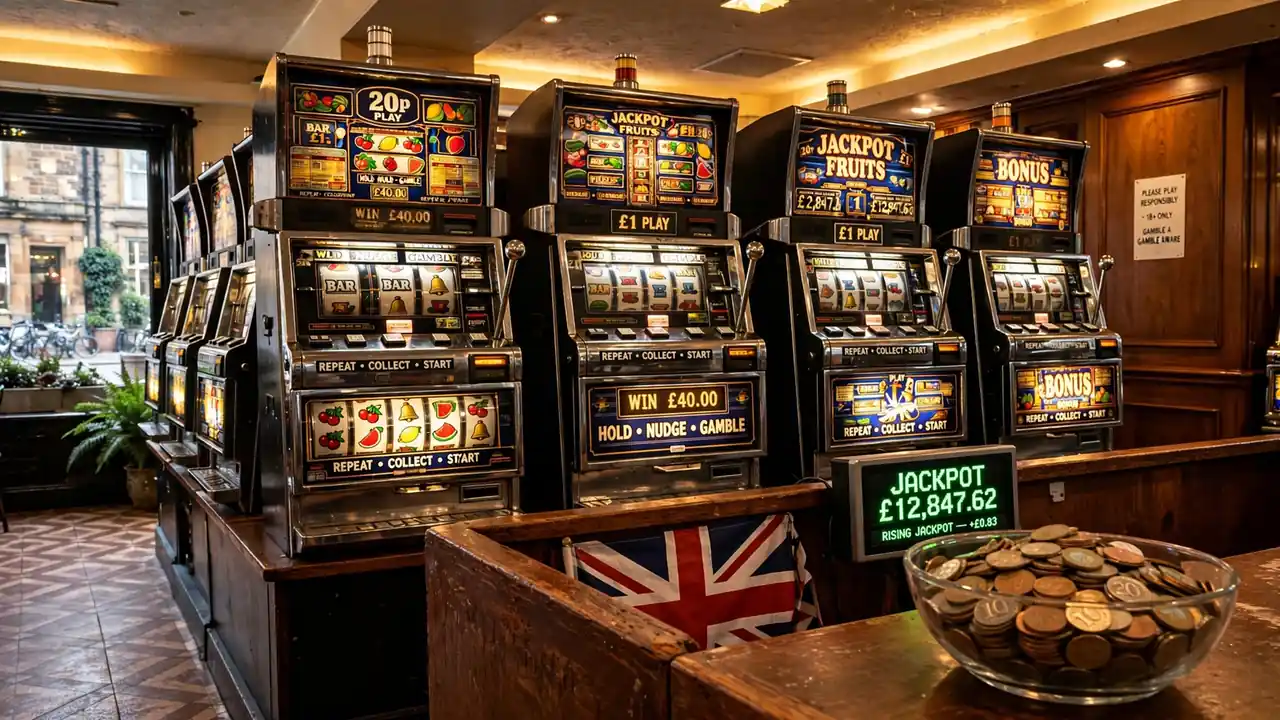
See how contributions build shared prizes, what bonus play means for eligibility, and why a jackpot figure alone cannot show a game’s value.
Where the Jackpot Money Comes From
A progressive jackpot is funded by play, rather than being a fixed prize that remains unchanged from one spin to the next. A portion of wagers is directed into a pool, and the displayed jackpot grows as contributions accumulate. The arrangement gives the prize its defining quality: it can rise while the game is being played, before a qualifying win resets or otherwise changes it.
The contribution is small beside the full stake, but repeated across many plays it becomes the visible figure that attracts attention. Progressive jackpot slots typically allocate between 1% and 3% of each wager to the jackpot pool. The rest of the wager supports the ordinary game, including its symbols, features and other payouts. The exact structure belongs to the individual game, so the percentage should not be treated as a universal setting shared by every progressive title.
That distinction matters because the jackpot is not an extra pot appearing from nowhere. It is part of the game’s payout design. When a stake is divided between the main game and a progressive pool, the two parts serve different purposes: one supports prizes paid through ordinary play, while the other helps build a larger prize that may be won less often. The player sees a single wager; the game’s accounting separates its possible destinations.
The base game has its own return
Return to player, or RTP, describes the proportion of stakes a game is designed to return over a very large number of plays. It is a statistical measure of long-run performance, not a promise about what an individual session will return. A short run can depart sharply from the theoretical figure. The jackpot display does not remove that uncertainty.
NetEnt Slots at UK Online Casinos: Rules and Checks
Progressive games often have a base-game RTP in the 88%–92% range, with the difference in payout directed towards the jackpot pool. In practical terms, this means the ordinary game may return less through its regular prizes than a comparable design without a progressive feature. Some of the value that might otherwise sit within routine payouts is assigned to the accumulating prize instead.
It is tempting to read that as a simple exchange: less back in everyday wins, more chance at a striking prize. The accounting does point in that direction, but it does not tell any one player what will happen. The pool contribution is not a personal saving account, and a stake does not become a claim on a matching share of the jackpot. It joins the game’s wider calculation, while the chance of receiving the prize depends on the game’s rules and outcomes.
The difference between the base game and the progressive pool also explains why a large displayed amount cannot be read as the whole value of a slot. It shows the size of the accumulating prize, not the full distribution of returns across ordinary wins and the jackpot. Those are separate parts of the design. The headline figure is vivid; the accounting beneath it is less so.
A shared contribution, not an individual deposit
Where a progressive feature draws on connected play, contributions build through wagers placed on the linked machines. Each qualifying stake feeds the pool according to the game’s structure. The resulting prize can therefore reflect activity beyond a single screen or a single player’s session. That pooled funding is the mechanism behind a jackpot that keeps growing as play continues.
Quickspin online casinos in the UK: what listings prove
This is different from a fixed top prize, where the amount is set in advance and does not rise with ongoing wagers. A progressive amount changes because new contributions enter the pool. Its movement is part of the game’s design, not evidence that the odds of a win have changed in step with the number on the display. The prize and the probability of triggering it are distinct elements.
For online progressive jackpot slots, the same broad idea applies: wagers provide the stream of contributions, while the game’s rules determine how that stream is divided and what event awards the pool. A bright counter makes accumulation easy to see. It does not reveal every detail of the payout model, nor does it make the jackpot more attainable simply because it has grown.
The economics are deliberately split between the frequent, smaller rhythm of the base game and the much more conspicuous possibility of a pooled prize. That split can make progressive jackpot casino slots feel different from games whose entire return is contained in their ordinary features. Yet the underlying wager still funds a designed payout structure; the jackpot is one component of it, not a separate promise layered on top.
The arithmetic is quieter than the display. A small share, repeated across play, can become a large pool, while the base game carries its own return profile. Understanding those two streams gives a clearer account of where the money goes—and a firmer footing than the jackpot counter alone.
Free Play, Bonus Spins and the Progressive Catch
Free spins make a slot look briefly detached from money. The player presses a button, the reels turn, and any winnings appear to arrive without a stake. Progressive jackpot slots complicate that impression: a prize may be connected to the game’s ordinary rules, while the promotion that supplied the spins adds a separate set of conditions. The game and the offer are not the same thing.
Online Casino Game Shows in the UK: How They Appeal
Most free spins are restricted to non-progressive games, according to specialist reviews of casino promotions. That distinction matters because a spin on a progressive jackpot slot may not qualify for the jackpot at all, even if the game is visible in the casino catalogue. If progressive titles are excluded, a bonus can still be useful for exploring other games, but it is not a route to the shared prize pool.
Promotional terms decide what happens. They may specify eligible games, the value of each spin, how winnings are treated and whether a withdrawal cap applies. Specialist reviews report caps of £50–£100 on winnings from free spins on progressive slots. That is a reported range, not a standard condition across UK casinos: the offer itself is decisive, and terms can change. A headline about free play says little about whether a progressive jackpot online casino promotion actually permits jackpot play.
What free spins can—and cannot—do
A free spin is not necessarily a free-standing cash balance. Its value may be credited as winnings only after the spin, and those winnings may remain subject to the offer’s conditions. Where a progressive game is excluded, no amount of winning on an eligible non-progressive slot changes that exclusion. The promotion sets the boundaries.
This is why the phrase “free online progressive jackpot slots” can carry more promise than a particular offer supports. A casino may provide free spins, while its terms confine them to selected games that do not contribute to a progressive prize. Another offer may allow a progressive title but still impose a cap or other conditions on what can be withdrawn. The offer must be read as a contract for that promotion, not as a general description of every game at the casino.
Attention: Free spins may be restricted to non-progressive games, meaning a bonus may not provide a route to the shared jackpot pool.
A no-deposit bonus is a different promotional form: it gives a player bonus funds without first requiring a deposit. It does not make those funds equivalent to cash already deposited. Specialist reviews describe wagering requirements of 40x–60x for no-deposit offers, alongside maximum withdrawal caps of £50–£100 on resulting winnings. These figures describe reported promotional terms, not a market-wide promise. An individual offer may set different conditions or may not offer a no-deposit bonus at all.
The multiplication matters because the bonus can have to be wagered repeatedly before the winnings become withdrawable. A withdrawal cap, meanwhile, can limit the amount payable even if the balance is higher. Those conditions are separate: completing wagering does not, by itself, remove a stated cap. In a progressive game, the offer also needs to explain whether the game is eligible and how a jackpot win would be handled. Without that clarity, “bonus available” is not enough to establish that the bonus applies to the jackpot feature.
Promotional play beside deposited play
With deposited funds, the player is staking their own balance under the game’s ordinary rules. A progressive jackpot slot online may then operate according to its usual eligibility requirements, subject to the game and the operator’s terms. With free spins or bonus funds, the promotional terms sit on top of those rules. Eligibility can therefore differ even when the same title is involved.
That difference is easily blurred by the familiar language of casino advertising. “Play for free” describes the source of the spin or balance, not necessarily the conditions attached to a resulting win. Nor does it establish that every part of the game is available. A progressive jackpot may be excluded, or its winnings may fall under a promotion-specific cap. The wording of the offer, rather than the label on the bonus, settles the matter.
Thunderkick Slots at UK Online Casinos: What to Check
The distinction also changes what “real money progressive jackpot slots UK” means in practice. A game played with deposited money and a game reached through promotional play may look identical, but they need not create the same rights to winnings. Deposited play does not turn a promotional balance into cash; promotional play does not automatically inherit the rules of ordinary cash play. The terms define the boundary.
For anyone comparing an online progressive jackpot slot with a bonus attached, the useful question is not simply whether the casino offers free spins. It is whether that particular game is eligible, whether the progressive feature is included, and what limits apply to winnings. These details belong to the offer, not to the general idea of a progressive jackpot online casino.
The promotional lure is familiar; the fine print does the accounting. A bonus can open the door to a game while leaving the prize outside it.
Casino Bonuses Meet the Rules of the Market
A casino bonus can look like a private bargain between a business and a customer: an offer appears, its conditions are attached, and play begins. But in Great Britain, the bargain sits inside a public system of oversight. The UK Gambling Commission regulates commercial gambling, including online casinos, and is the sole regulator for commercial gambling in Great Britain. A progressive jackpot casino bonus is therefore not outside the rules merely because it is promotional, nor does the word “bonus” make the operator’s wider obligations disappear.
The UK Gambling Commission is the sole regulator for commercial gambling in Great Britain, overseeing both businesses and individuals through operating and personal licences.
That distinction matters because promotions are presented as individual offers, while regulation concerns the business making them and the gambling activity it provides. The Commission issues operating licences to businesses and personal licences to individuals working in regulated roles. These are different forms of permission: one concerns the company’s authority to operate, the other the people who carry out specified functions. A progressive jackpot casino site is not made legitimate by a prominent prize or an attractive welcome offer. Its place in the market depends on the relevant regulatory framework.
The Commission’s reach is not determined by where a company keeps its equipment. Remote gambling provided to consumers in Great Britain falls within its regulatory remit even when the key equipment is located elsewhere. That principle is particularly important for online services, which can separate the customer-facing website from the infrastructure supporting it. A business cannot turn a British-facing casino into a different kind of transaction simply by locating its machinery abroad.
The rule concerns the service offered, not the vocabulary used to sell it. Whether an online casino describes itself as a jackpot destination, advertises a progressive jackpot casino bonus UK, or promotes a particular kind of slot, those labels do not replace the question of who operates the service and under what authority. Nor does a payment method, by itself, answer that question. References to a bitcoin progressive jackpot casino or a crypto-focused casino describe a method or marketing angle, not a separate regulatory category established by the Commission’s remit.
The word “best” can make a comparison sound like a matter of prize size or promotional generosity. In practice, those qualities do not settle the more basic issue of whether a business is operating within the regulated market. A list of the best progressive jackpot casino sites UK would be an unstable measure if it treated bonuses as the main evidence of standing. An offer says something about how a company chooses to attract custom; it does not, on its own, establish the company’s regulatory status.
There is a social history in this arrangement. Gambling once depended heavily on visible premises and local oversight; remote services loosened the connection between place and operation. The regulatory answer was not to treat distance as a loophole. The Commission’s authority over remote gambling directed at Great Britain follows the customer-facing activity even when the equipment sits elsewhere. The internet may have made the counter invisible. It did not make responsibility vanish.
That does not mean every promotional term is set out by the regulator in the same way as a licence. A bonus remains an offer with its own conditions, and those conditions need to be read as such. The regulatory frame answers a different question: which authority oversees commercial gambling in Great Britain, and which businesses and individuals require licences to operate within it. Confusing those layers can make a promotion seem like proof of something it is not.
Regulatory Risk A business cannot bypass the UK Gambling Commission’s remit by locating its equipment abroad if it provides remote gambling services to consumers in Great Britain.
A search for progressive jackpot casino sites UK can therefore produce a jumble of bonus language, prize imagery and claims of distinction. These are commercial signals, not substitutes for the licensing framework. A progressive jackpot casino may emphasise its games; another may put a bonus first. Neither presentation changes the Commission’s role in regulating gambling activity or its reach over remote gambling offered to people in Great Britain.
The institutional division is plain, even if the advertising is not. Businesses receive operating licences; individuals in relevant functions receive personal licences. The Commission oversees commercial gambling in Great Britain, including online casino activity, and location of essential equipment does not remove remote services from its reach. A bonus may be the doorway. It is not the regulator.
From Connected Machines to Shared Pools
A progressive jackpot can look local while its funding is not. A player may open a slot at one casino, but when that game is linked to a network, the jackpot pool can be shared with other operators carrying the same progressive slot. The screen is in one place; the pool reaches further.
Jackpot King Slots at UK Casinos: What’s Verified
The network works by connecting machines running the same progressive game to a common jackpot structure. Wagers made on those connected machines contribute to the pool. The contributions do not have to come from people playing at one casino, or even from machines gathered in one room. A game offered by several operators can draw on activity across those separate venues.
That changes the meaning of a progressive jackpot slot machine. It is not simply a cabinet, or an online game window, with a prize that grows in isolation. It is one point of access to a wider arrangement. The machine presents the game to an individual player; the network links that play to a pool fed elsewhere as well.
For players, the distinction can be easy to miss. The casino account, game lobby and slot itself all appear under one operator’s name, giving the impression that the jackpot belongs to that venue. In a networked progressive, however, the operator carrying the game is not necessarily the boundary of the prize pool. Other operators carrying the same game may be part of it too.
This is why “connected” matters more than the physical form of the machine. A land-based cabinet and an online slot may both offer progressive play, but the relevant question is whether the game is linked to a shared network. The pool depends on that connection, not on whether the player is sitting at a machine or using a screen at home.
The arrangement also separates the place where a wager is made from the scale at which the jackpot accumulates. Each connected machine contributes through play, while the shared pool gathers those contributions across participating operators. It is a small piece of infrastructure with a large effect on the story the game tells: a solitary spin can belong to a much broader stream of activity.
There is no reason to assume that every slot labelled progressive is part of the same network, or that all progressive slot machines across UK casinos feed one common fund. The shared arrangement applies across operators that carry the same progressive game. A different title, or a game not connected to that pool, is not part of it merely because it also displays a growing jackpot.
The network is therefore less a decorative feature than the structure behind the prize. It joins separate operators without making their casinos one business, and lets wagers made in different places contribute to the same pool. The interface remains personal. The funding is collective. That is the quiet machinery behind a shared jackpot.
How Progressive Games Release Their Jackpots
A progressive jackpot can be attached to a game without being released in the same way as every other progressive prize. The decisive detail is the trigger written into that game’s rules. Some jackpots are awarded through a random trigger; others depend on landing a particular combination or entering a bonus round. The shared label describes a prize that can grow, not a universal route to winning it.
Slots & Providers: UK Casino Game Guides
With a random-trigger design, the jackpot may be awarded independently of a particular winning symbol pattern. That does not mean every spin is a winner, or that the result follows a visible sequence. The trigger is part of the game’s mechanics, and a player cannot infer from a run of ordinary outcomes that a jackpot is due. Random does not mean predictable by watching.
A combination-based jackpot is more visibly tied to the reels: a specified arrangement has to appear for the prize to be awarded. In another design, the jackpot becomes available through a bonus round, where entry is itself a condition in the game’s rules. These distinctions matter because two progressive jackpot slot games can present similar growing prizes while asking for different events before payment. The title alone is not a guide to the trigger.
The rules also shape how a progressive jackpot casino game feels to play. A random award may arrive without the familiar visual pattern of a jackpot combination; a combination or bonus-round trigger makes the qualifying event more explicit. Neither format, by itself, establishes how likely a win is. That information cannot be read from the size displayed on screen, and a large figure is not evidence that a particular trigger is near.
Even the same game may not appear in every UK casino. A specialist review notes that availability can differ between operators and shift when providers update their catalogues. That makes lists of popular progressive jackpot casino games a temporary snapshot, not a dependable map of what every operator carries. A game’s reputation may travel further than its current availability.
For the same reason, claims about the biggest or largest progressive slot jackpot do not settle which game suits a particular player. A headline prize says nothing on its own about the route to qualification, and catalogue presence says nothing about how the jackpot is released. The useful comparison is in the game rules: whether the award is random, attached to a combination, or reached through a bonus round. Small print, not spectacle.
Random Trigger
The jackpot may be awarded independently of a particular winning symbol pattern.
Combination-Based
A specified arrangement of symbols must appear on the reels for the prize to be awarded.
Bonus Round
Entry into a specific bonus round serves as the condition for the jackpot to become available.
Best casino sites in the UK
- BritsinoBonus: Welcome Package – Get your £2,200 + 2,000 FS · Payout speed: 1-3 business days
- BeOnBetBonus: 100% up to €500 + 100 FS · Payout speed: 1-3 business days
- Revery PlayBonus: 100% up to€1,000+ 100 FS · Payout speed: 1-3 business days
- EvoSpinBonus: 125% up to €2500 + 125 Free Spins · Payout speed: 1-3 business days
- WinBeastBonus: €5000 + 500 FS + €650 Freebet · Payout speed: 1-3 business days
- SpinFormulaBonus: 550% Up To £15,000 + 550 FS · Payout speed: 1-3 business days
- JetsetspinsBonus: 200% Bonus + 100 Free Spins + Free Royal Wheel · Payout speed: 1-3 business days
- NightWinBonus: £900 + 400 free spins · Payout speed: 1-3 business days
- NightLuckBonus: Welcome Pack + 805% Up To 6400€ + 280 FS · Payout speed: 1-3 business days
UK Casinos: Licensing and Player Protections
A progressive jackpot slot in Britain sits inside a system of operator oversight, not outside it. Commercial gambling in Great Britain has one regulator: the UK Gambling Commission. Its remit includes remote gambling offered to people in Great Britain, even when the operator’s key equipment is located elsewhere. Businesses need the relevant operating licence to serve this market; the Commission also issues personal licences to individuals whose roles require one.
The legal framework is not identical across the whole United Kingdom. The Gambling Act 2005 sets the rules for gambling in England, Wales and Scotland, while Northern Ireland is outside that Act’s scope. For online casino play in Great Britain, the practical distinction is clear: a site offering real-money gambling to local customers must hold a current UK Gambling Commission operating licence. Online gambling is legal for adults aged 18 and over when it takes place through an appropriately licensed operator.
A licence is more than permission to display casino games. UKGC-licensed operators must provide tools that let customers set deposit and loss limits, receive session reminders, and exclude themselves from gambling. They must also make support resources accessible. These measures do not make gambling harmless; they give people ways to put boundaries into the account before play becomes difficult to manage. A small piece of infrastructure, with human consequences.
There are further requirements at the point of account use. Operators must verify a customer’s age before allowing a deposit, and new customers must be prompted to set a financial limit before their first deposit. Account-level limit controls must remain accessible. Credit cards cannot be used to fund gambling, including through a money service business, and operators cannot accept wallet payments where credit-card funds can be used for gambling. Online slots also cannot offer autoplay in Britain, and a game cycle must last at least 2.5 seconds before another can begin.
These obligations matter when comparing progressive jackpot casinos in the UK. A familiar game title or a polished lobby does not establish that the operator is authorised. The UK Gambling Commission’s public register is the place to confirm a licence before depositing. Licensed casinos must also provide an internal complaints route and access to an approved Alternative Dispute Resolution service if a dispute remains unresolved.
The structure is deliberately institutional: permission, controls, and routes for complaint. It cannot decide whether a progressive jackpot slot suits someone’s circumstances. It does establish who is answerable when a British-facing casino accepts real-money play. That distinction matters.
Why the Biggest Jackpot Is Not the Whole Calculation
A progressive jackpot can dominate a slot’s advertising because its displayed prize is easy to understand: it is large, visible and still growing. The base game’s return is less dramatic, but it matters to the calculation. A headline figure describes a possible prize, not the overall rate at which a game returns stakes through ordinary wins and its jackpot.
Progressive jackpot slots commonly direct between 1% and 3% of each wager into the pool. That contribution is part of the game’s design, not an extra payment that sits outside its economics. The base game RTP—the theoretical share of stakes returned through play—often falls within the 88%–92% range, with the difference in payout directed towards the jackpot pool.
Do
- Consider the base-game RTP (typically 88%–92%)
- Note the pool contribution rate (typically 1%–3%)
Don’t
- Rely solely on the size of the displayed jackpot
- Treat the jackpot figure as the full value of the slot
Those figures describe a trade-off, not a forecast for an individual session. RTP is calculated over extended play; it does not promise that a particular player will receive a particular share back. Nor does a growing pool make the ordinary rounds more generous. The jackpot may be the most conspicuous element, but the base game is where the ongoing return is measured.
This is why the biggest progressive slot jackpots cannot, by themselves, identify the best progressive jackpot slot. A larger advertised prize says something about the possible jackpot, but not enough about the game’s overall return. Comparing the jackpot alone leaves out the portion of each wager allocated to the pool and the RTP of the base game. A striking ceiling, viewed without those terms, is only half a calculation.
There is no simple equation in which the largest prize automatically means the best value. Pool contributions and base-game RTP need to be read together, while keeping their different meanings clear: one concerns the jackpot’s funding; the other describes the theoretical return across play. The appeal of a progressive slot machine jackpot is understandable. A number that keeps climbing makes chance look almost tangible. But the ordinary game remains part of the bargain, whether or not the display attracts attention.
The less visible figure matters. And it is not a promise.
Availability Changes Faster Than Reputation
A progressive jackpot slot can acquire a familiar name long before it becomes a dependable fixture in any particular casino’s catalogue. A specialist review notes that availability differs between operators and can change when providers update their games. A title appearing on one site, then, is not evidence that every UK casino offers it—or that it will remain there.
That distinction matters when popularity is treated as a guide to access. Players may discuss a well-known game, and review pages may give it prominent placement, while an operator’s current selection tells a different story. Catalogues are commercial arrangements, not public inventories shared by every casino. Providers revise their offerings; operators decide which titles to carry. Reputation travels more freely than availability.
The same caution applies to lists labelled “top-rated” or “popular”. Without a clear basis for the ranking, those labels describe an editorial choice rather than a settled measure of quality or access. A slot’s visibility in reviews cannot establish that it is currently playable at a particular UKGC-licensed operator. Nor does a search result confirm that a title remains in the catalogue when a player reaches the site.
Eyecon Slots at UK Casinos: Checking Provider Listings
A progressive jackpot slot is a slot in which a prize can grow as play contributes to a jackpot pool. That identifies a feature of the game, not a promise about where it can be found. The practical check is the operator’s own current game catalogue: a remembered title, an old review or a passing mention elsewhere may not match what is available now.
This makes claims about the biggest or most popular progressive jackpot slots especially slippery. A large-sounding reputation can persist after catalogue changes, while a currently offered game may attract less attention. Neither prominence nor familiarity settles the question of access. Availability is local to the operator and time-sensitive; reputation is not. A modest distinction, with real consequences.
Mega Moolah and the Shared-Jackpot Idea
Mega Moolah is a useful name through which to consider what “progressive” means beyond a prize that grows. The defining idea is a pool connected to play across operators: when several operators carry the same progressive slot, contributions from wagers on that game feed a shared jackpot pool. The pool is not simply a separate prize attached to each casino’s copy.
That distinction can be easy to miss when a game appears inside an individual casino’s catalogue. The screen belongs to one operator’s site, but a networked jackpot can extend beyond that site. In this model, the operator is a point of access to the game, not the sole boundary of its prize pool. The shared element is the pool linking play on the same game across participating operators.
For a Mega Moolah progressive jackpot slot, the broader point is the network principle: a progressive jackpot can connect players using the same game through different operators. The casino interface may make the experience look local; the pool itself need not be. A familiar title, then, can stand for a larger arrangement in which separate venues feed into one connected prize.
This does not mean every progressive slot shares a pool across every casino, or that a title’s presence at one operator establishes its presence elsewhere. The connection depends on operators carrying the same progressive game. Nor does the shared-pool idea establish what the jackpot is at a particular moment. The model explains how a pool can be shared, not what its current balance is.
Play’n GO Slots at UK Online Casinos: What to Verify
There is a small reversal here. The slot looks like a solitary machine, presented on a single screen, while its defining prize may belong to a network. The interface is intimate; the pool is collective. That is the progressive arrangement in miniature: separate acts of play joined by a common jackpot.
When a Progressive Win Becomes a Withdrawal
A progressive jackpot win and money arriving in an account are separate events. The first settles the game result; the second depends on the operator’s payment process, the chosen method and any checks attached to the prize. For someone playing progressive jackpot slots for real money, the balance displayed after a win is not necessarily a promise of immediate access to the full sum.
A specialist review describes debit-card withdrawals as taking 1–3 working days, e-wallet payments as sometimes arriving within hours, and bank transfers as taking 3–5 working days or longer. These are reported timeframes, not a universal schedule: an operator’s own terms and the circumstances of a transaction determine what happens in a particular case. A pending withdrawal can therefore reflect processing rather than a change to the result of the game.
The scale of a progressive prize may bring another step. A specialist review notes that large jackpot withdrawals can involve additional verification and, in some cases, structured instalments spread over several years. That possibility makes the prize’s payment conditions worth distinguishing from the game’s rules. A jackpot can be won in one moment while its settlement follows a longer administrative timetable.
The distinction is especially relevant when comparing ways to play progressive jackpot slots online in the UK. Deposited real-money play does not, by itself, establish how quickly a particular operator will release a large win. Payment method, verification and any instalment arrangement all matter; the precise terms belong to the operator’s withdrawal policy, not to the slot’s headline jackpot display.
For a substantial win, the practical question is not only whether the game has awarded it, but what process governs its transfer. The answer may be less dramatic than the spin. It is paperwork.
Do all UK casinos offer the same progressive jackpot games?
No. Availability varies between operators and changes as their game catalogues are updated, although network jackpots are shared by operators carrying the same game.
Are progressive jackpot slots worth playing?
They may appeal if you value the chance of a large pooled prize, but the base game often has a lower RTP of 88%–92%. The jackpot display does not mean the prize is more likely to be won.
How fast are progressive jackpot withdrawals paid out?
Debit card withdrawals typically take 1–3 working days, e-wallet withdrawals can take hours, and bank transfers often take 3–5 working days or longer. Large jackpot payouts may require extra verification and can be paid in instalments over several years.
What should I look for in a progressive jackpot slot?
Check the game’s RTP, how the jackpot is triggered, and whether a minimum bet is needed to qualify for the highest tier. Contributions to the pool are typically 1%–3% of each wager.
Can you win a progressive jackpot on a minimum bet?
Some games require a minimum bet to qualify for the highest jackpot tier. Check the game’s rules to see whether a minimum stake is required for the jackpot you want to enter.
Material created by the team Pure Casino UK Guide


