

A guide to the mechanics and changing context of UK fruit-machine-style games, from familiar reels to online play.
From Pub Fruit Machines to Online Reels
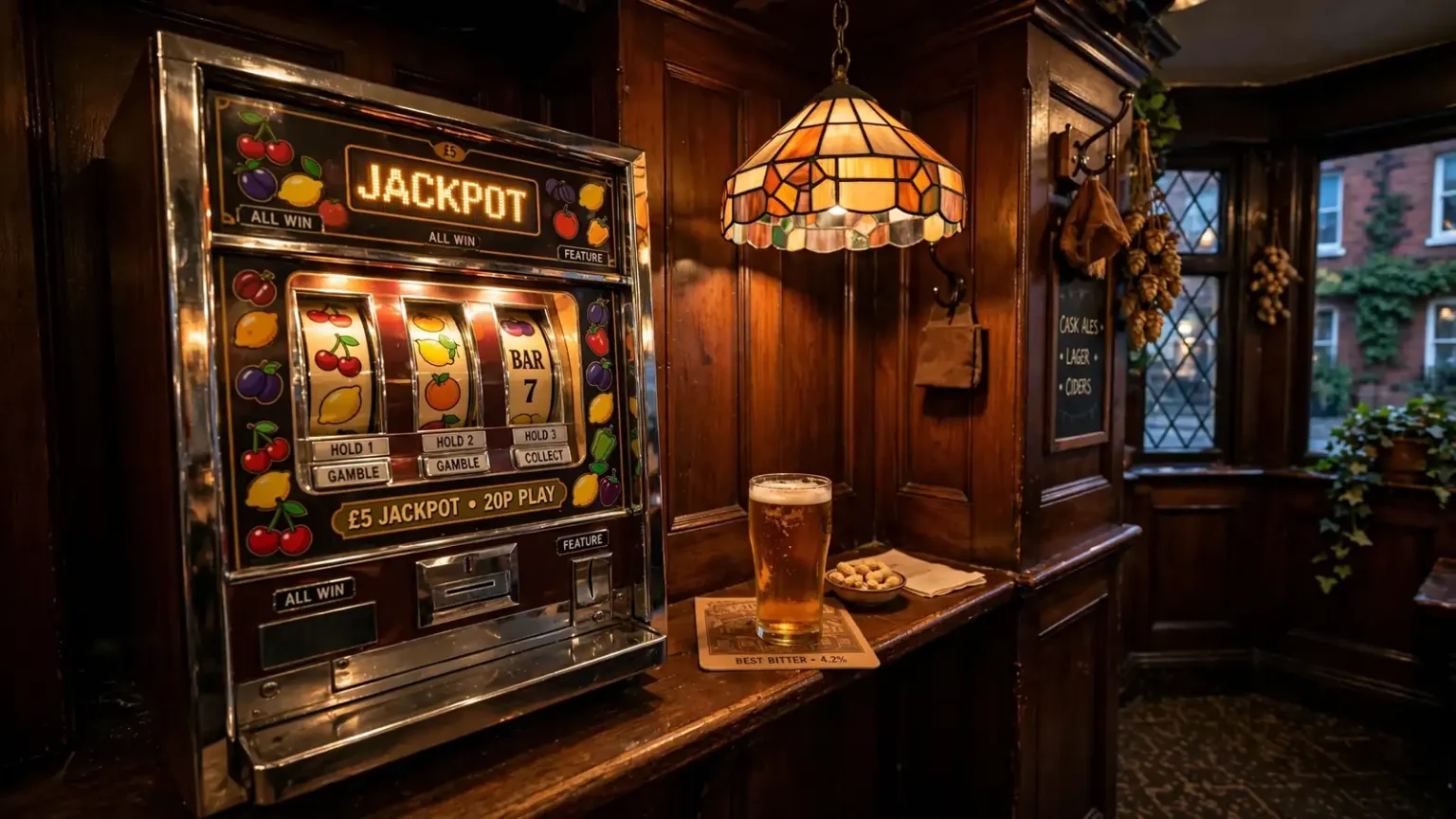
Before fruit machines became a feature of a screen, they belonged to particular rooms. A pub, an arcade or a betting shop offered more than a place to play: it supplied the noise, the pause in conversation, the small ritual of standing at a cabinet and watching its reels settle. The machines were objects in shared spaces, encountered alongside other people and the ordinary business of a night out. Their bright symbols made the game legible at a glance. Fruit, bells and familiar lucky signs needed little translation.
That physical setting helped give the genre its character. The machine was compact and self-contained, with a visible action and an immediate result. A player put money in, set the reels moving and waited for the symbols to stop. The appeal was not only the chance of a win, but the satisfying sequence of sounds and movement between stake and outcome. Fruit machines made gambling into a small public performance, even when the person playing was alone.
Online fruit-machine-style games inherit that visual language, but not the machinery or the social setting. Their digital reels are images generated by software; beneath them, a random number generator determines each result. Its outcomes are independent: one spin does not remember the previous one or become due to produce a particular symbol because of what has happened before. The familiar display is therefore a kind of theatre. It preserves the old vocabulary while the process behind it has changed.
The change is easy to underestimate because the screen looks so recognisable. A digital game can reproduce fruit symbols, reel sounds and the rhythms of an old cabinet without being a physical machine in miniature. The cabinet once contained the mechanism and presented its result in the same place. Online, the screen presents a designed sequence while the outcome is produced through digital systems. What survives is the grammar of the game; what disappears is the cabinet as an object in a room.
Slots & Providers: UK Casino Game Guides
Rainbow Riches offers a useful example of that journey. Barcrest first placed it on cabinets in UK pubs, arcades and betting shops in 2006. Around 2009, it moved online. The shift was not simply a matter of putting the same machine on a website. It carried a recognisable pub-game identity into a setting where the cabinet, its surroundings and the people gathered around it were no longer part of the experience.
That identity mattered. A named machine could become familiar through repetition: the same visual world encountered in different venues, then later on a screen. In that sense, the move online did not erase the old culture so much as detach one of its emblems from the places that had made it ordinary. The fruit machine became portable, though portability is not the same as companionship.
The change can also be seen in the published return figures for Rainbow Riches. The online version has an RTP of 95%, while physical machines are generally set to return less than that. RTP describes a theoretical return across play over time, not a forecast for an individual session. The comparison is a reminder that a shared title does not guarantee identical terms across formats. Familiarity of name and image can conceal a difference in how a game is configured.
This is part of the broader story of fruit machine slots in the UK: an inherited look, adapted to a medium with different possibilities and a different relationship to its audience. In a pub, a cabinet occupied space and announced itself. Online, the game sits among other digital choices and can be opened wherever a compatible screen is available. Its old symbols now travel without the room that once gave them context.
Penny Slot Machines in the UK: Stakes and Costs
That continuity is real, but it is selective. The screen can preserve the fruit, the reels and the anticipation of a result. It cannot reproduce the pub’s background murmur or the small social negotiations around a machine. Nor does a digital image mean the underlying process works like a mechanical cabinet. The modern game borrows an old surface and gives it a new engine.
The history is less a straight line from cabinet to screen than a change in what the machine means. Once, it was a piece of furniture in a public venue, tied to the habits of a place. Now, online fruit slots can carry that visual memory into private digital spaces. The symbols still turn. The room has changed.
Best casino sites in the UK
- BritsinoBonus: Welcome Package – Get your £2,200 + 2,000 FS · Payout speed: 1-3 business days
- BeOnBetBonus: 100% up to €500 + 100 FS · Payout speed: 1-3 business days
- Revery PlayBonus: 100% up to€1,000+ 100 FS · Payout speed: 1-3 business days
- EvoSpinBonus: 125% up to €2500 + 125 Free Spins · Payout speed: 1-3 business days
- WinBeastBonus: €5000 + 500 FS + €650 Freebet · Payout speed: 1-3 business days
- SpinFormulaBonus: 550% Up To £15,000 + 550 FS · Payout speed: 1-3 business days
- JetsetspinsBonus: 200% Bonus + 100 Free Spins + Free Royal Wheel · Payout speed: 1-3 business days
- NightWinBonus: £900 + 400 free spins · Payout speed: 1-3 business days
- NightLuckBonus: Welcome Pack + 805% Up To 6400€ + 280 FS · Payout speed: 1-3 business days
The UK Casinos Behind the Games
A fruit machine can look much the same on a screen wherever it is hosted. The setting behind it is less interchangeable. In the UK, an online casino serving local players must hold a valid licence from the UK Gambling Commission. The licence is not a decorative mark beside a game: it places the operator within the country’s regulatory system, with responsibilities attached to the business offering the gambling.
That distinction matters because an online casino is not simply a shelf of games. It is also the account through which deposits, play and withdrawals take place, and the organisation responsible for the terms and safeguards around them. A casino with fruit slots therefore sits within a wider arrangement of oversight. The regulator’s concern is not whether a particular reel looks like the familiar pub fruity, but whether the operator serving the market is licensed to do so.
Playtech Online Casinos UK: Supplier and Operator
The legal framework has boundaries. Remote gambling operators selling into the British market need the relevant Gambling Commission licence regardless of where the business is based. A foreign address does not remove that requirement. Operators outside the UK system do not acquire a UK licence merely by making a site available to British customers. They are outside the protections and regulatory routes that come with a UKGC-licensed casino.
This can be easy to miss when a site presents itself in polished English and offers the same broad category of games. The screen may be international; the licence is not. An unlicensed offshore casino operates outside the UK Gambling Commission’s system, and a player there loses access to UKGC protections, GAMSTOP and IBAS dispute resolution. If a payout is withheld or a dispute arises, the player may have no comparable route for recourse. The difference is not cosmetic. It is the difference between a business answerable to the local regulator and one that is not.
The licence also gives context to the ordinary account controls that may appear around play. Many UK-licensed operators offer deposit limits, reminders about session time and reality checks. These tools do not change a game’s result. They make time and spending more visible within an account, which is a quieter kind of intervention than a warning on a screen after the fact. A reminder arriving during a session is not a command to stop, but it interrupts the smoothness with which one spin can lead to another.
The details vary by operator. Some offer controls for deposits; some display prompts about time spent; reality checks may appear at intervals such as every hour or every thirty minutes. Their presence is part of the regulated setting, but the tools are not a substitute for personal limits or for taking a break. Nor does a licence mean that every safeguard will look identical across every site. The common point is that licensed operators operate within a system where safer-gambling responsibilities are part of the business, rather than an optional flourish.
Unlicensed Casinos
Playing at an unlicensed offshore casino removes access to UKGC protections, GAMSTOP, and IBAS dispute resolution, leaving players with no comparable route for recourse if a dispute arises.
GAMSTOP occupies a more decisive place in that landscape. It is a self-exclusion service: registration blocks a person from gambling with every operator on the scheme for the period selected. A specialist review describes the available choices as six months, one year or five years. This is different in character from a deposit limit or a time reminder. Those controls shape activity within an account; self-exclusion is intended to prevent access across participating operators for the chosen period.
Such a boundary has social meaning beyond the mechanics of a website. Gambling has long been organised around places, from pubs and arcades to betting shops and casinos. Online, the place has become a set of accounts, and a person can move between operators without crossing a street. A scheme that applies across participating businesses recognises that the risk does not necessarily remain inside one company’s walls. The border has to follow the activity.
That does not make every online fruit slots casino UK search result equivalent, nor does the appearance of familiar games establish that the operator is licensed. The relevant question is whether the business itself holds the required UK Gambling Commission licence. A game’s supplier or branding cannot stand in for the operator’s licence; the casino offering access is the party whose regulatory status matters.
Novomatic and Amatic Casinos in the UK: What to Know
The phrase “best” is often attached to lists of casinos, but the more important distinction is less glamorous: whether a site belongs to the UK-licensed market and what account protections it makes available. A large game library, an attractive page or a familiar fruit-machine title cannot answer that. Regulation is a threshold, not a prize for presentation.
In that sense, the licensed casino is not merely a digital venue for old-fashioned fruit machines. It is a regulated business with duties to the people using its accounts, and with limits on what protection can follow them elsewhere. The interface may be bright. The framework underneath should be legible.
Real-Money Play Under UK Rules
Real-money fruit slots in the UK begin with an account, not a coin dropped into a cabinet. Anyone wishing to play for money must be at least eighteen and register with an identity that has been verified. The requirement makes age and identity part of access to the game: an account is not simply a name attached to a balance, but a record linked to a person whose eligibility has been checked.
That distinction matters because online play can make the act of staking feel almost weightless. A tap replaces the old movement of feeding a machine; the screen gives little sense of the cash changing hands. Verification puts a formal boundary around that ease. It establishes who is playing before real-money fruit slots become available, rather than treating the account as an anonymous doorway.
Identity Verification
Real-money play requires players to be at least eighteen and register with a verified identity to ensure eligibility before access is granted.
The age threshold is not the only rule that changes the shape of a session. In Great Britain, the permitted stake for an online slot depends on the player’s age: those aged eighteen to twenty-four may stake no more than £2 on a spin, while the maximum for players aged twenty-five or over is £5. These limits apply to online slots, including fruit-machine-style games. They are ceilings, not suggested amounts or targets.
The difference between the two age groups is deliberate in effect, whatever a player’s personal view of it. The rules recognise that a single stake does not have the same significance for everyone, and set a tighter boundary for younger adults. A fruit slot may borrow the cheerful imagery of a pub fruity, but its online form is still real-money gambling. Bright symbols do not alter the value of a stake.
Nor is the cap left to a player’s arithmetic at the point of each spin. Operators must apply the limits at account level and cannot permit a stake above the relevant maximum. That places responsibility on the system as well as the person using it. A player should not be able to bypass the boundary by changing the amount manually, moving between games within the account, or treating a larger stake as a harmless exception. The cap is a rule the operator has to enforce.
Pragmatic Play Casinos in the UK: What to Check
This account-level approach has a practical consequence: the permitted stake follows the player’s age category, rather than being a feature that a particular fruit slot can set for itself. Game menus may present different stake choices, but the legal maximum remains the boundary. A button on screen is not permission to exceed it.
The distinction between a per-spin limit and a wider spending plan is also important. The cap restricts the stake on an individual spin; it does not describe how much a person might spend across a session. Staying within the maximum does not make every session affordable, and the presence of a legal ceiling is not a recommendation to stake at that level. A small number on a button can still become a substantial outlay through repetition. The limit is narrow by design.
For anyone considering fruit slots for real money, the relevant sequence is therefore straightforward: meet the age requirement, register with verified identity, and play within the stake ceiling attached to the applicable age group. The operator must keep the account within that ceiling. These are conditions of real-money access, not optional settings buried among a game’s features.
There is a social history in the contrast. A physical fruit machine made the stake visible in the hand and the result visible on the cabinet. Online, the same exchange is mediated by an account, verification checks and software limits. The rules do not restore the old physical pause, but they do make eligibility and maximum stakes explicit. Administration takes the place of the coin slot. A quieter kind of boundary.
Do
- Verify your identity before playing
- Adhere to the age-based stake ceilings
- Use account-level controls
Don’t
- Attempt to bypass stake limits manually
- Play without a verified account
- Ignore the legal maximum per spin
The word “real money” can suggest that the important difference is merely whether winnings can be withdrawn. In practice, it also marks a different set of obligations from playing without a stake. Real-money play requires verified registration and is constrained by age-based limits that the operator must enforce. The game may look familiar; the route into it is not the same as approaching a cabinet in a pub or arcade.
Those rules do not turn a stake into a safe amount, or promise that a session will end with a return. They define who may play and the largest permitted stake for each spin. That is a limited but essential distinction: access is conditional, and the maximum is not negotiable.
From Three Reels to Changing Ways to Win
The shape of a fruit machine is part of its grammar. A compact row of symbols asks for one kind of attention; a broad grid, with several routes to a prize, asks for another. Online fruit machine games retain the old vocabulary of cherries, bells and bars, but their layouts can be considerably less old-fashioned.
The traditional arrangement is spare: three reels and a single payline, with few features around it. That narrow route gives each symbol a clear place in the result. A line is either made or it is not. This format still matters because it preserves the directness associated with a pub fruity, even when the cabinet has disappeared and the game sits on a screen.
New Online Casino Sites UK: Amatic Games and Licensing
Many modern fruit machines instead use a grid of five reels and three rows. Across that wider field, fixed paylines mark the routes that count. A game may have between ten and fifty of them, and the lines remain set from spin to spin. Symbols can therefore land across several parts of the grid, but only combinations following a recognised route qualify. The display looks busier; the rules still draw boundaries through it.
Those boundaries are easy to overlook. A winning-looking cluster is not necessarily a winning combination if it does not follow a payline. The paytable or game information explains which paths are active and what symbols count along them. In this respect, a larger grid does not simply mean more freedom. It means a different map, whose routes have to be read before the result can be understood.
A “243 ways to win” format removes the fixed line pattern. With three symbol positions on each of five reels, the possible combinations across the reels produce 243 ways for matching symbols to connect. The important distinction is not that every arrangement wins, but that a combination can form across adjacent reels without following one drawn line. This changes how the screen is read: attention shifts from tracing a route to seeing whether matching symbols align across the reels.
It is a small design choice with a cultural echo. The old machine made the line visible; the newer layout can make the winning path less obvious at a glance. More possibilities do not make a game more generous in themselves. They describe how a result can be formed, not how often a prize appears or how large it will be.
Three Reels
A spare, traditional arrangement with a single payline and a direct result.
Five Reels
A wider grid with ten to fifty fixed paylines that mark the winning routes.
243 Ways
A format where matching symbols connect across adjacent reels without fixed lines.
Megaways
A dynamic system where reel symbol counts vary, creating up to 117,649 ways to win.
Megaways takes the changing grid further. Rather than keeping the same number of symbols in each reel position, its reel system varies the symbol count from spin to spin. That moving structure can produce as many as 117,649 ways to win. The figure describes the maximum number of possible ways under the system, not a promised number of active routes on every spin. A screen can seem to redraw its own architecture each time it turns.
These formats are not simply steps on a ladder from plain to sophisticated. A fixed-payline grid makes its routes explicit; 243 ways removes the need to follow those fixed paths; Megaways makes the number of available combinations move with the reel structure. Each design places a different demand on the eye, and none can be judged by the size of its grid alone.
That distinction matters when browsing fruit-themed games online. Familiar symbols may suggest a traditional machine, while the layout underneath may use modern ways-to-win mechanics. The name and artwork tell only part of the story. The game rules reveal whether symbols must follow a set line, connect across reels in multiple combinations, or work within a changing reel structure.
The visual language has travelled further than the machine itself. Cherries remain recognisable; the routes beneath them have multiplied. Classic, fixed-line and changing-reel formats now sit beside one another, each making a different promise about how a result is counted—though none, by layout alone, promises a win.
Holds, Nudges and the Old Fruit-Machine Logic
Holds and nudges belong to the vocabulary of the pub fruity: small interventions that make a spin feel less like a single event and more like a sequence of choices. Their appeal is easy to understand. A row of symbols appears, and the machine seems to leave a little room for judgement.
A hold keeps selected reels still while the others spin again. On the following round, those held reels remain in place rather than turning with the rest. A nudge works after a spin: a reel shifts down by one position, bringing another symbol into the payline. The movement is modest; its promise, in the player’s imagination, can be considerably larger.
Stakelogic Slots in UK Casinos: Provider Explained
That is the old logic of the fruit machine casino game: a pause, a shift, then a fresh reading of the line. The player is offered a decision point, but not control over the random process that determines the outcome. Holding a reel or nudging a symbol changes what is displayed and how the next moment feels. It does not make the result less random or turn a near miss into a dependable route to a win.
The details are not uniform across titles. A specialist review may describe a particular game’s feature, but that should not be mistaken for a rule applying to every fruit machine. One title may offer more than one hold or nudge; another may make the feature available only under particular conditions. The game’s own instructions explain what is possible in that version.
This distinction matters because the language of choice can suggest influence where there is only an extra step. A hold may feel like preserving promise; a nudge may look like correcting fate. Neither changes the underlying odds by itself. The feature adds texture to play, not a means of steering the random outcome.
In UK fruit machine games, these mechanics survive because they make the familiar cabinet logic legible on screen. The reels still invite inspection; the player still weighs whether to leave a symbol where it is or move on. A little theatre.
What Changes When Fruit Slots Go Online
A specialist review describes online fruit-machine titles with features such as free spins, pick-style mini-games, autoplay, quick spin and mobile compatibility. That is a catalogue of possibilities, not a checklist every game carries. The digital version can keep the familiar fruit symbols while changing how a session is presented: a bonus round may interrupt the reels, or a set of choices may appear on screen. The old cabinet had buttons and a physical frame; the online game has room for layers of prompts and animation.
Wazdan Online Casinos UK: Amatic’s Role Explained
Free spins are a distinct feature from ordinary play: the game grants a run of spins without requiring a fresh stake for each one. A pick-style mini-game offers another kind of pause, asking for a selection from displayed options before revealing what it contains. Neither feature makes a title more predictable. They change the sequence and presentation of play, not the principle that a spin’s result is generated independently.
Autoplay removes the need to start each spin manually, while quick spin shortens the visual interval between one result and the next. These settings alter pace, not the underlying odds. Their neatness is also their risk: a session can become less noticeable when the hand is no longer returning to the button. The interface can make repetition feel almost administrative.
Mobile compatibility changes the setting more than the game. A fruit machine that once occupied a corner of a pub or arcade can now be viewed on a phone, with controls adapted to a smaller screen. That convenience is a matter of access, not evidence that the experience has become lighter or less consequential. The same symbols travel; the surroundings do not.
These features are not universal, and their exact form depends on the title. Some games keep the screen spare; others use a sequence of bonuses and prompts to keep attention moving. The digital cabinet is less a single machine than a choice of interfaces. More options, more motion.
The Classic Machine, Kept in Three Reels
The classic fruit machine is deliberately spare: three reels, a single payline and few features. Its appeal lies partly in what it leaves out. There is no shifting grid to interpret and no elaborate sequence of bonus stages to follow. The eye settles on one line, and the result is legible at a glance.
That simplicity carries the memory of the pub fruity into online play. The screen may now sit in a browser or on a phone, but the basic picture remains familiar: symbols travel past, stop, and are read across the line. For anyone looking up classic fruit slot machines in the UK, this is the defining distinction—not simply an older theme, but a compact structure with little between the spin and its visible outcome.
Classic Fruit Slots
The appeal of the classic three-reel format lies in its simplicity and legibility, focusing on the symbols rather than complex features.
A small format can feel more involving than its feature count suggests. Each symbol has a clear place; the payline gives the screen a centre. There is less to scan, and fewer interruptions between one spin and the next. The machine does not need to announce itself with a parade of side games. It makes its case quietly.
“Classic” does not mean that every game bearing a fruit-machine theme follows this layout. Online fruit machines span many designs, and the label alone cannot settle how a particular title plays. The game’s own information is what distinguishes a pared-back three-reel version from a more elaborate interpretation.
Nor does a simpler screen make outcomes more predictable. A familiar arrangement may look close to the physical machines that shaped the genre, but appearance is not a forecast. The restrained design changes the experience of reading the game, not the uncertainty of a spin.
There is a social history in that restraint. The old machine had to make sense amid conversation, movement and the ordinary noise of a pub; its central line was easy to recognise without ceremony. Online, the same economy becomes a design choice. Less machinery on screen, more attention on the symbols.
For some players, that is the point: a fruit machine reduced to its clearest form, with the theme and the line doing nearly all the work. No spectacle required.
A Demo Is a Chance to Read the Paytable
A demo version can turn a fruit machine from a moving picture into a set of rules that can be inspected. Where a casino makes one available, spins can be tried without staking money, giving the paytable time to explain what the symbols do, which combinations pay and how the game’s features are triggered. The point is not to predict what a later spin will do. It is to understand what the screen is asking the player to watch.
That distinction matters in games whose familiar fruit symbols sit beside less familiar features. A few trial spins may show how a bonus round appears, but they cannot establish how often it will arrive or what a future session will return. Random outcomes remain random in demo mode as in paid play. Practice is useful for reading, not for discovering a pattern.
The paytable is also where a published RTP should be checked. RTP describes a theoretical return across a large volume of play; it does not forecast the result of a short run. A specialist review has noted that the published RTP can differ between versions of the same game. That makes the game information at the specific casino more useful than a figure copied from a general description elsewhere. The build matters.
Using Demos
Use demo versions to inspect the paytable and understand how features are triggered without staking real money.
Not every title or casino offers a demo, and the absence of one does not make a game’s rules unknowable: its information screen may still explain the symbols, features and payout conditions. But when a trial version is available, it gives those details a quieter setting than the paid game. No balance is moving; the small print has a chance to be noticed.
This is a modest use of a demo, and a better one than treating it as rehearsal for a win. It can clarify what a fruit machine does, not what it will do next.
Bonus Spins and the Terms Behind Them
A fruit slot bonus can look generous while carrying a substantial condition: bonus-derived funds may have to be wagered before they can be withdrawn. The wagering requirement is a multiplier applied to the bonus, not a promise that the required bets will produce enough winnings to cash out. A regulatory summary of the UK Gambling Commission’s Social Responsibility Code 5.1.1 sets the ceiling at ten times the bonus amount.
The arithmetic is plain; the outcome is not. A £50 bonus with a 30-times requirement calls for £1,500 in bets before withdrawal is permitted. At 40 times, a £100 bonus means £4,000 in total bets. Neither figure describes a likely loss or a route to profit. It describes the volume of wagering attached to the offer.
The terms also determine which games count, and how much each qualifying game contributes. A fruit machine may contribute at a different rate from another casino game, or may not qualify at all. A large game library says nothing about eligibility. The live promotion terms are the controlling document, including any restrictions on the bonus, the qualifying games and the time allowed for use.
There is a further boundary: Great Britain-facing incentives cannot combine more than one gambling product type. The wagering and mixed-product rules began applying on 19 January 2026, with the product categories covering betting, casino, bingo and lottery. The terms of a particular offer still need to be read as written; a headline alone cannot establish how its wagering works.
Bonus spins sit inside this same arrangement. Their value depends on the conditions attached to resulting funds, not simply on the number of spins advertised. Fine print does the arithmetic.
What a High RTP Can—and Cannot—Tell You
Return to player, or RTP, is a long-run theoretical measure: the share of wagered money a game is designed to return across a very large number of spins. For UK fruit-machine-style games, published figures commonly sit between 94% and 97%, although some titles fall outside that band. The percentage describes the game’s model, not the result of an individual session.
That distinction is easy to lose in the phrase “high payout”. A figure nearer the top of the range does not mean a player is likely to receive that share back during an evening’s play, or that one spin is more promising than the next. Outcomes remain random; a high RTP is no forecast for the next reel.
There is another complication. A game may exist in versions with different published RTPs. A specialist review can describe one version, while the casino’s edition may be configured differently. The relevant figure is the one shown in that game’s own paytable or help information at the specific casino, rather than a number attached to the title elsewhere.
RTP can help describe a game, but it cannot settle whether it suits a particular budget or make play a dependable way to earn money. It is a long view, and a rather impersonal one. The machine does not keep a player’s accounts.
A sensible reading treats the percentage as one piece of information alongside the game’s rules, not as a promise hidden in decimals. Even a published figure is about theoretical return across extensive play, not a personal return on a chosen stake. A larger number may look decisive; its limits matter just as much.
Can I play fruit slots for real money in the UK?
Yes, if you are 18 or over, register with verified identity and play with an online casino holding a valid UK Gambling Commission licence.
What is the RTP of Rainbow Riches?
The online version has a published RTP of 95%; physical machines are generally configured to return less. RTP is a theoretical figure over time, not a prediction for an individual session.
What controls help manage my play?
UK-licensed operators commonly offer deposit limits, session reminders and reality checks, which may appear every 30 minutes or hourly. GAMSTOP can block you from gambling with participating operators for six months, one year or five years.
What is the maximum wagering requirement in Great Britain?
Wagering requirements on bonus funds are capped at 10 times the bonus amount under rules that took effect on 19 January 2026.
Material created by the team Pure Casino UK Guide


