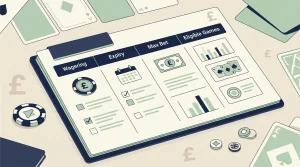
Boku acceptance is not evidence of WebMoney support; payment routes, cash-out limits and terms need checking separately.
What the UK Casino Evidence Actually Says About WebMoney
A casino’s payment options are not interchangeable labels. Boku and WebMoney are different payment services, so a casino described as accepting Boku cannot be counted as a WebMoney casino on that basis. The distinction matters when looking for casinos that accept WebMoney in the UK in 2026: a list of operators associated with another payment method does not answer the WebMoney question.
That may sound like a narrow point, but payment names often become blurred in online casino descriptions. A site can offer several ways to fund an account, and a mention of one service says nothing by itself about another. Nor does a casino’s general availability in Britain establish which methods appear in its cashier. Treating those details as equivalent turns a payment search into guesswork.
For the same reason, names attached to Boku cannot responsibly be repackaged as WebMoney options. That remains true whether the list is labelled “best”, “new”, or simply “all”. A ranking cannot repair a mismatch between the payment method being discussed and the one the reader needs. The relevant distinction is not which casino has the most familiar name, but whether WebMoney itself is offered by that operator.
The UK’s licensing framework provides a separate, firmer point of reference. The UK Gambling Commission regulates gambling activity in the country, including online casinos. For remote gambling offered to consumers in Great Britain, the operator’s location or the location of its key equipment does not remove the licensing requirement. The Commission is the sole regulator for commercial gambling in Great Britain, issuing operating licences to businesses and personal licences to individuals who operate there.
This makes licensing and payment acceptance two different checks. A UK Gambling Commission licence concerns the operator’s authority to offer gambling to the relevant market; it does not certify that the operator accepts WebMoney. Conversely, seeing a payment logo or method named somewhere does not establish that a casino is licensed to serve British customers. Neither detail substitutes for the other.
Casinos That Accept Wire Transfers in the UK
The distinction is especially important because a search for a WebMoney casino can sound like a single question while containing several. There is the question of whether an operator serves customers in Great Britain under the appropriate licence. There is the separate question of whether WebMoney is available as a deposit option. A further question might concern withdrawals or a particular offer. An answer to one does not automatically answer the rest.
A casino may be discussed as an online, mobile, or Android option, but the device does not identify its payment methods. The same is true of games: the presence of casino games tells nothing, by itself, about whether an account can be funded with WebMoney. Payment compatibility belongs to the operator’s own available methods, not to a game category or a label such as “mobile casino”.
The phrase “best WebMoney casinos” also carries a promise that a ranking has been built from comparable, current information. Without confirmed WebMoney acceptance, that promise would be empty. Adding bonus language does not make it more precise: a casino’s general welcome offer, where one exists, cannot establish that WebMoney deposits qualify for it. The payment method and the terms attached to an offer are distinct details.
Casinos That Accept Solana in the UK: Evidence
This is not a technical quibble. People choose payment routes for practical reasons, and a mistaken label can send them towards an operator that does not provide the method they wanted. It can also obscure the more consequential question of whether the casino is entitled to serve the market. A responsible description keeps those claims apart rather than allowing one to lend false weight to the other.
In Great Britain, real-money online gambling is legal through operators holding the relevant UK Gambling Commission licence. That regulatory boundary applies to remote operators serving consumers there, even when the business or its equipment is elsewhere. The Commission’s role is not to turn every payment service into an approved casino list; licensing concerns the gambling business and its operation.
So the careful answer to whether WebMoney casinos are still available in the UK is not a borrowed list of Boku operators. Boku acceptance establishes only a claim about Boku. It does not establish WebMoney acceptance, a WebMoney bonus, or a WebMoney withdrawal route. Those are operator-specific matters, and each needs to be stated on its own terms.
Do
- Check for a valid UK Gambling Commission licence
- Verify WebMoney acceptance in the casino’s current cashier
Don’t
- Assume Boku acceptance implies WebMoney support
- Use a general list of operators as proof of payment availability
A sound comparison therefore begins with two separate questions: whether the casino holds the required licence for the British market, and whether WebMoney is actually among its payment options. The first belongs to the regulator’s licensing framework. The second belongs to the operator’s current payment information. Confusing them produces a confident answer with the wrong subject. Dry distinction; useful one.
Best casino sites in the UK
- BritsinoBonus: Welcome Package – Get your £2,200 + 2,000 FS · Payout speed: 1-3 business days
- BeOnBetBonus: 100% up to €500 + 100 FS · Payout speed: 1-3 business days
- Revery PlayBonus: 100% up to€1,000+ 100 FS · Payout speed: 1-3 business days
- EvoSpinBonus: 125% up to €2500 + 125 Free Spins · Payout speed: 1-3 business days
- WinBeastBonus: €5000 + 500 FS + €650 Freebet · Payout speed: 1-3 business days
- SpinFormulaBonus: 550% Up To £15,000 + 550 FS · Payout speed: 1-3 business days
- JetsetspinsBonus: 200% Bonus + 100 Free Spins + Free Royal Wheel · Payout speed: 1-3 business days
- NightWinBonus: £900 + 400 free spins · Payout speed: 1-3 business days
- NightLuckBonus: Welcome Pack + 805% Up To 6400€ + 280 FS · Payout speed: 1-3 business days
When Boku Gives Way to Other Payment Routes
When a cashier no longer offers Boku, the replacement is not necessarily another version of WebMoney. Boku, Fonix and Siru Mobile belong to the Pay by Phone category: the payment is tied to a mobile service. WebMoney is a separate payment name, and a casino offering one of these phone-based routes is not thereby shown to accept it. The distinction is practical, not cosmetic. Similar places in a cashier do not make different systems interchangeable.
A specialist review describing the UK market reported that operators had been moving away from Boku since 2023. Some replaced it with Fonix or Siru Mobile; others removed Pay by Phone altogether. That account describes a change in payment menus, not a general migration to WebMoney. A familiar label disappearing can leave a player looking for an equivalent, but the replacement may serve only the same broad purpose of funding an account by phone. It does not establish that a WebMoney deposit is available.
The operator examples in that review illustrate the narrower point. MrQ and Duelz were associated with Fonix, while Mr Vegas and Videoslots were associated with Siru Mobile. Those names identify reported Pay by Phone options, not WebMoney casinos. Payment arrangements can change, so the cashier remains the relevant place to establish what an operator currently supports. The wider principle is steady: an alternative to Boku is not automatically an alternative to WebMoney, even when both are being considered as ways to put money into an online account.
Casinos that accept Monzo in the UK: what to check
The UK’s licensing structure gives that distinction a public consequence. Remote gambling operators serving consumers in Great Britain must hold the relevant UK Gambling Commission licence, wherever their key equipment is located. The Commission licenses businesses offering gambling and regulates the activity; it does not turn one payment label into another. A licensed operator may provide particular methods through its cashier, but the licence itself says nothing about whether WebMoney is among them. Payment compatibility is an operator-level fact.
There is another route sometimes discussed alongside Boku: using it to fund Neteller, then using Neteller at a casino that accepts that e-wallet. A specialist review has described this as a possible two-stage path. It is not direct WebMoney acceptance, and it should not be confused with a casino supporting Boku and Neteller as one combined service. The route depends on each link being available: Boku must be usable for funding Neteller, and the casino must accept Neteller. One does not prove the other.
That arrangement also changes the character of the payment. Instead of selecting a single method at a casino cashier, the funds pass through an intermediate account before reaching the gambling account. It may be relevant to someone comparing ways to move money, but it does not answer whether a casino accepts WebMoney. Nor does the appearance of Neteller in a payment discussion provide evidence about WebMoney; the names refer to distinct services, each requiring its own confirmation.
Payment menus are small bureaucracies. They sort transactions into systems with different operators and rules, while a player sees only the choice presented on screen. When a method is withdrawn, the menu may offer a neighbour in the same broad category, or no phone-based option at all. That shift can be mistaken for continuity because the purpose looks similar. The underlying route has changed.
Fonix & Siru Mobile
Pay by Phone services that have been reported as replacements for Boku at some operators.
Neteller
An e-wallet route that can be funded via Boku as a two-stage path to reach a casino.
WebMoney
A separate payment service that requires its own specific confirmation of acceptance.
So the search for alternatives to WebMoney needs to keep two questions apart: which other payment methods are reported at UK casinos, and whether any particular casino accepts WebMoney. The Boku-related examples answer only the former in limited ways. Fonix and Siru Mobile are Pay by Phone services; Neteller is an e-wallet route that has been described as fundable through Boku. None of those details establishes WebMoney availability at an operator.
For British customers, the distinction sits within a regulated market. Online gambling is legal at sites holding a current UK Gambling Commission operating licence, and operators must verify age before allowing deposits. But regulatory status and payment support are separate checks. A licence establishes that the operator is authorised to serve the market; the cashier establishes which payment routes it offers. One cannot be used as a substitute for the other.
A payment method is not a family resemblance. Boku’s reported replacements may be useful alternatives for someone seeking Pay by Phone, and Neteller may offer a separate route where both stages are supported. Neither amounts to proof of WebMoney acceptance. The labels matter.
How a Boku Deposit Works—and Why It Cannot Pay Out
Boku is a Pay by Phone method: the deposit is charged to the player’s mobile phone bill rather than sent from a WebMoney wallet or debit card. The distinction matters. A casino cashier showing Boku describes a phone-billing route, not acceptance of WebMoney. The two names refer to different payment methods, and the steps for one cannot be treated as instructions for the other.
Bitcoin Casinos in the UK: What Payment Pages Show
The Boku process begins in the casino cashier. The player selects Boku, enters the amount to deposit and supplies a mobile number. Boku then sends an SMS verification code; entering that code confirms the transaction. The phone number is part of the payment itself, because the charge is routed through the mobile account. It is not simply a message used to approve a bank or card payment.
Once confirmed, the deposit is charged to the mobile bill. That can make the transaction feel less like moving money between financial accounts and more like adding a purchase to an existing household bill. The convenience has a boundary: the money is still being used to fund gambling, even if no card details are entered at the casino. In Britain, remote operators must hold a UK Gambling Commission licence to offer gambling to customers in Great Britain. The Commission’s public register is the place to check an operator’s licence before depositing.
The cashier flow is straightforward, but the route ends at the deposit. Boku is deposit-only: winnings cannot be sent back to it. A player using Boku therefore needs another withdrawal method registered with the casino, such as a debit card, an e-wallet or a bank transfer. The payment method that brought money into an account does not necessarily provide a way to take money out. Here, it does not.
That difference is easy to miss when payment names are gathered under a broad label such as “online casino deposit”. A phone-bill payment, a wallet balance and a debit card may all appear in a cashier, but they are not interchangeable. WebMoney acceptance has to be established as WebMoney acceptance; a Boku option cannot stand in for it. Nor does a casino’s use of Boku establish anything about whether WebMoney deposits can be made there.
Boku Deposit Process
Step 1: Selection
Select Boku in the casino cashier and enter the deposit amount and mobile number.
Step 2: Verification
Receive and enter the SMS verification code sent to the mobile device.
Step 3: Billing
Confirm the transaction to have the deposit charged directly to the mobile phone bill.
The same distinction applies to bonus offers. A deposit method and a promotion are separate parts of a casino’s terms. A Boku confirmation does not itself promise free spins, a welcome offer or any other bonus, and it says nothing about the conditions attached to WebMoney. Promotion eligibility depends on the operator’s terms; the payment route alone is not a reliable guide.
The transaction’s SMS step also gives the process a particular texture: the mobile network is not merely carrying an alert but is tied to the charge. The payment appears on the phone account, while the casino account records the deposit. That is the practical meaning of Pay by Phone. It is not a withdrawal channel, and it is not another name for WebMoney.
For anyone comparing casino payment options, the useful distinction is therefore mechanical, not cosmetic. Boku uses a mobile number and SMS confirmation, then bills the phone account. WebMoney should be assessed under its own name and terms. A familiar-looking cashier, or the presence of one phone-based option, cannot answer that separate question. The route matters. The label matters.
Mobile Slots Do Not Verify a Payment Method
A slot that opens on a phone answers one question: whether the game is available in that format. It does not answer how the casino accepts deposits. The same distinction applies to online slots viewed on a computer. A game’s presence in a mobile lobby cannot establish that WebMoney is available at the cashier, just as a payment option in a cashier cannot identify which games can be played on a phone.
Casinos That Accept Dogecoin in the UK: What to Check
That separation matters because the terms often sit side by side. “Mobile slots” describes the playing experience; WebMoney describes a payment method. One concerns the game interface, the other the movement of money into an account. A casino may present its games consistently across devices while offering payment routes that depend on the operator and the customer’s account. The screen alone does not settle the matter.
The UK’s licensing system provides a more useful boundary than a game catalogue. Remote gambling operators serving consumers in Great Britain must hold the relevant Gambling Commission licence, wherever their equipment is located. The Commission regulates commercial gambling there and issues operating licences to businesses. That status concerns the operator’s authority to provide gambling services; it does not certify that every named payment method is accepted, or that a particular slot is tied to WebMoney.
A careful check therefore has two separate parts. The casino’s current cashier is where payment availability must be established; the game lobby is where mobile or online slot availability is shown. A WebMoney logo in promotional material, if encountered, would still need to be read in context rather than treated as proof that the method can fund every account. Payment options can be operator-specific, and what appears in a general description may not match the options presented at account level.
“Free WebMoney slots” can also blur those categories. A free-play mode describes play without a real-money stake; the payment label does not turn that mode into evidence of a deposit route. Conversely, a slot being playable on a mobile device does not confirm WebMoney support. The words may share a page, but they describe different functions.
A casino’s game catalogue and its payment options are separate systems; the availability of a mobile slot does not certify that WebMoney is an accepted deposit method.
This is not a technical quibble. People tend to read a polished game catalogue as a promise about the whole service. Yet a slot’s availability and a cashier’s payment list are separate pieces of information, maintained for different purposes. A UK-facing casino should be assessed as an operator, and its licence checked on the Gambling Commission’s public register before any deposit. The payment method itself still needs confirmation in the casino’s own cashier.
Games show what can be played. They do not show how it can be paid for.
Real-Money Slot Searches Need a Separate Payment Check
A slot game and the way an account is funded belong to different parts of the transaction. The game determines what a player can play; the casino’s cashier determines which payment methods it accepts. A slot described as available for real money therefore says nothing, by itself, about whether WebMoney can be used to fund the account.
That distinction matters when a search for WebMoney slots turns into a search for a particular game. A title might be offered by several casinos, while their cashiers differ. Even the same casino can present a wide game catalogue without every payment method being available to every customer or in every circumstance. The game page is not the payment desk.
“Real money” also describes the nature of play, not a route for putting money into an account. A free-play mode, where offered, is not evidence that WebMoney can be used for wagering. Nor does a game being available at a casino establish that a deposit made through WebMoney is possible. Those are separate questions, and collapsing them makes the label do more work than it can bear.
Entropay at UK Casinos: How to Check Availability
In Britain, online gambling is legal at sites holding the appropriate UK Gambling Commission licence. The Commission regulates remote gambling offered to people in Great Britain, and operators selling into that market need the relevant licence regardless of where their equipment is located. Licensing describes the operator’s regulatory status. It does not certify a particular cashier method, and it does not turn a game listing into proof of WebMoney acceptance.
A sound check therefore has two parts: whether the casino is licensed for the British market, and whether its own payment information currently lists WebMoney for the account in question. The first concerns who may offer the gambling service; the second concerns how that operator allows the account to be funded. Neither can substitute for the other. The licence should be checked on the Gambling Commission’s public register before money is deposited.
The same separation applies to claims about “no deposit” play. That phrase concerns whether a player must make a deposit to access an offer or play under its terms; it does not establish that a casino accepts WebMoney. Any offer still depends on the operator’s conditions, and a payment method cannot be inferred from the wording of a promotion.
The British rules also place a boundary around who may gamble: operators must verify a customer’s age before allowing a deposit, and legal online play is for adults using a UKGC-licensed operator. Those safeguards govern access to gambling, not the compatibility of a payment service with a slot.
A game can be real-money entertainment without being a WebMoney game. A payment method can be supported without identifying which slots are available. The two descriptions meet only at the casino account, where the operator’s current terms and cashier must establish the connection. Nothing more elegant than a separate check.
Licensing Risk
Always verify an operator’s licence on the UK Gambling Commission’s public register before depositing money to ensure the site is authorised to serve the British market.
Boku Limits Are Set in More Than One Place
A payment limit can belong to the casino, the payment service or the mobile network. Boku deposits sit across those layers, so a figure attached to one does not necessarily describe the whole arrangement. None of these Boku limits establishes what a UK casino permits for WebMoney.
The published accounts do not give one consistent transaction limit. A specialist review describes £30 as the standard Boku ceiling for a single deposit, while noting that some casinos or network operators may permit £40 or £50. Another specialist account puts the transaction figure at about £10 and the network’s daily allowance at £30. A separate account gives a £30 daily limit but specifies no per-transaction cap. Those are competing descriptions, not a single schedule.
The distinction matters. A casino cashier may set a maximum for one payment, while the mobile operator controls how much can be charged through the phone over a day. A deposit within the casino’s stated transaction ceiling may still be refused if the network’s daily allowance has been reached. Conversely, a network allowance does not mean that a casino accepts a deposit of that size.
Responsibility for daily limits is attributed to the mobile operator rather than the casino in a specialist review. That account describes a limit shaped by the phone account and network, not simply by the casino’s cashier. The operator’s own payment conditions remain relevant too: the displayed amount is not necessarily the amount available through every Boku route.
This is why a single number can mislead. The £30 transaction figure and the £30 daily network figure refer to different boundaries, while the alternative account with an approximately £10 transaction amount does not settle the disagreement. The limit visible during a deposit attempt may reflect the casino’s settings, the mobile network’s rules, or both.
Casinos That Accept Litecoin in the UK: What to Check
WebMoney is a separate payment method. Boku’s transaction and network figures cannot be carried across to it, and they say nothing about WebMoney deposits, card funding, withdrawals or instant banking at UK casinos. Payment limits belong to the method and route actually offered—not to a broad label such as “online casino payment”.
The practical picture is less tidy than a cashier’s number suggests. One ceiling may stop a single deposit; another may block further phone-billed payments for the day. The mobile operator has the final say over its daily allowance. A limit, in other words, has more than one address.
Pay-by-Phone Bonuses Depend on the Operator’s Terms
A welcome offer is not automatically available simply because a casino accepts a particular way to deposit. Pay by Phone eligibility is decided by the operator’s bonus rules, and those rules can distinguish between payment methods even when they all fund the same account.
A specialist review identifies MrQ, Duelz, Mr Vegas and Videoslots as casinos where Pay by Phone deposits count towards bonus eligibility. That is a specific finding about those operators and that payment route, not a general promise that phone-bill payments qualify everywhere. Bonus terms can change, so the offer conditions in force at the casino matter more than a broad description of its cashier.
The same distinction applies to WebMoney. A bonus attached to a Pay by Phone deposit does not establish that WebMoney deposits qualify, and the named operators should not be treated as confirmed WebMoney casinos on that basis. Payment acceptance and bonus eligibility are separate decisions.
Bonus Eligibility
Payment acceptance does not guarantee bonus eligibility; always check the operator’s specific terms to see if WebMoney or Pay by Phone deposits qualify for offers.
A specialist review describes a common UK welcome-offer structure as a 100% deposit match up to £100, subject to a 35x wagering requirement. Those figures are a snapshot of a typical format, not a promise that every casino offers it or that every payment method is eligible. The wagering condition also means the headline match is not the same thing as withdrawable cash.
Time limits can make an offer less generous in practice. The same type of review gives 30 days for bonus funds to expire and 72 hours for bonus spins. These are reported terms, not universal deadlines; each promotion may set its own conditions. The small print is where the offer becomes an actual arrangement.
That matters particularly for no-deposit offers and bonus codes. A promotion may be restricted to selected customers, require a qualifying deposit, or exclude certain payment routes. A code alone cannot establish that a WebMoney deposit will qualify, nor does the presence of a slots promotion prove that WebMoney can be used at the casino.
The prudent distinction is plain: check the bonus conditions for the payment method and the offer itself, rather than inferring one from the other. Pay by Phone eligibility varies by operator. WebMoney bonus eligibility remains a separate question.
Small Deposits: What the Boku Figures Do—and Do Not—Show
Small-deposit figures attached to Boku do not settle the question of whether a UK casino accepts WebMoney, or what minimum it might set for that payment method. They describe different arrangements and cannot be transferred from one cashier option to another.
Casinos That Accept MiFinity in the UK: What to Check
A specialist casino review gives Boku figures of a €10 minimum, a €30 maximum and a €240 monthly limit. A separate UK account instead puts the standard transaction limit at £30, with some operators allowing £40 or £50. Those figures conflict: they use different currencies, and one describes a monthly ceiling while the other describes a per-transaction limit. They should not be combined into a single, dependable schedule. Payment terms can also change, so a figure from a review is not a promise about a casino’s current cashier.
The same specialist review says Boku deposits must be in amounts divisible by ten, naming £10, £20 and £30. That is a narrow claim about Boku, not a general rule for phone payments, and certainly not a rule for WebMoney. A £5 deposit cannot be inferred from those Boku increments; nor do they establish that a £5 WebMoney deposit is available.
The distinction matters because a payment method’s minimum is set within its own terms and the operator’s cashier. A Boku limit tells nothing, by itself, about another service’s minimum, maximum or monthly allowance. “Instant deposit” describes speed, not the size of an eligible payment; it cannot fill in a missing minimum.
For UK gambling, payment convenience does not replace licensing. Remote operators serving consumers in Great Britain must hold a UK Gambling Commission licence, and a valid licence should be checked on the Commission’s public register before money is deposited. That is a separate question from whether the cashier offers WebMoney, or permits a particular deposit amount.
The safe reading is modest: the published Boku figures disagree, and the amount increments belong to Boku alone. They provide no confirmed WebMoney minimum, including no evidence for a £5 WebMoney deposit at a UK casino.
Boku Transaction Limits
Reported limits vary: some sources cite a £30 standard ceiling (with some allowing £40 or £50), while others suggest a £10 transaction limit with a £30 daily network allowance. Some accounts specify that deposits must be in increments divisible by ten (e.g., £10, £20, £30).
A Shrinking Boku Option Is Not a WebMoney Alternative List
The retreat of Boku from British casino cashiers is a story about one payment method, not a map of where WebMoney can be used. A small number of UK Gambling Commission-licensed casinos still take Boku deposits, and that group has narrowed since 2023. The change may make payment choices feel less settled, but it does not identify WebMoney-accepting casinos or establish that WebMoney remains available at any particular site.
There is a useful distinction in the reason for Boku’s decline. The Commission did not introduce a rule banning Boku by name. Individual operators stopped offering it because they judged the compliance risks too great. That is an operator decision, not a regulator’s general prohibition. It also says nothing about the status of a separate service: each payment method has to be assessed on its own terms.
This matters when considering alternatives to WebMoney, or a casino where WebMoney-funded play might be possible. A list of casinos that once accepted Boku cannot be repurposed as a list of WebMoney sites. Nor does a casino’s UK licence establish which payment options appear in its cashier. Licensing governs the operator’s permission to serve the market; payment availability is a separate, operator-level detail.
The same caution applies to slot sites. A casino offering slots and accepting Boku would not, on that evidence alone, accept WebMoney. The game catalogue and the cashier answer different questions. A payment method’s name in an old review is not a current confirmation either, particularly when the documented Boku list has been contracting.
British regulation gives the distinction weight. Remote gambling operators serving Great Britain must hold the relevant Commission licence, while payment choices remain subject to the operator’s decisions and compliance assessment. A current licence can be checked on the Commission’s public register before a deposit. It cannot serve as a payment-method directory.
So Boku’s dwindling presence offers context for the changing shape of casino payments, but no shortcut to a WebMoney alternative list. Each claim of acceptance needs to be checked against the casino’s current cashier and the relevant terms. Otherwise, one shrinking option is being mistaken for another. A neat mistake.
Casinos That Accept eCheck in the UK
WebMoney and Gamstop: No Verified Connection Established
A casino described as “not on Gamstop” and a casino that accepts WebMoney are being defined by two different things. The first phrase concerns a claimed relationship with Gamstop; the second concerns a payment method. Neither label proves the other. A site’s use of WebMoney would not, by itself, establish its Gamstop status, and a claim about Gamstop would not establish that WebMoney appears in its cashier.
That distinction matters because search results can make adjacent terms look like a verified combination. A page may use “WebMoney” and “not on Gamstop” together without demonstrating either claim for a particular operator. The wording is not a licence, a cashier listing or an assurance about how an account is treated.
In Great Britain, the regulatory question stands apart from both. Remote gambling operators serving consumers there must hold the relevant UK Gambling Commission licence, wherever their key equipment is located. Online gambling is legal for adults at sites operating under that licence. An operator outside the UKGC system does not become a licensed British casino because it accepts a familiar payment method or describes itself as outside Gamstop.
The Gambling Commission issues operating licences to businesses and personal licences to people working in the regulated system. Its public register is the place to check an operator’s licence status before depositing. That check answers a different question from whether a payment option is available, and neither answer should be inferred from promotional wording.
The phrase “WebMoney slots” also folds together two separate matters: games and the way an account is funded. A slot’s presence does not establish that WebMoney can be used to deposit, just as a payment logo does not establish a site’s regulatory position. Each claim needs its own confirmation.
This is not a technicality. Payment brands travel easily across borders; regulatory responsibility does not. A name in a cashier can say something about the route money might take, but it cannot substitute for the UK licence that governs a casino serving Great Britain. Two labels, two checks.
What are the deposit limits at pay-by-mobile casinos?
Boku deposits are generally limited to about £10 per transaction and £30 per day at network level. The usual UK casino limit is £30 per transaction, though some casinos or networks may allow £40 or £50; PAYG deposits are also capped by your remaining phone balance.
What is the standard Boku deposit limit in the UK?
The standard limit is £30 per transaction, with deposits typically made in amounts divisible by ten. Some casinos or mobile networks may allow up to £40 or £50.
Can a casino deny issuing a promotion if I deposit with Boku?
Yes. Bonus eligibility varies by operator, and Boku deposits generally do not come with specific bonuses, so check the casino’s promotion terms before depositing.
How does Boku work?
Choose Boku in the casino cashier, enter the deposit amount and your phone number, then confirm using the SMS verification code. The deposit is charged to your monthly phone bill or deducted from your PAYG credit; Boku cannot be used for withdrawals.
Material created by the team Pure Casino UK Guide