

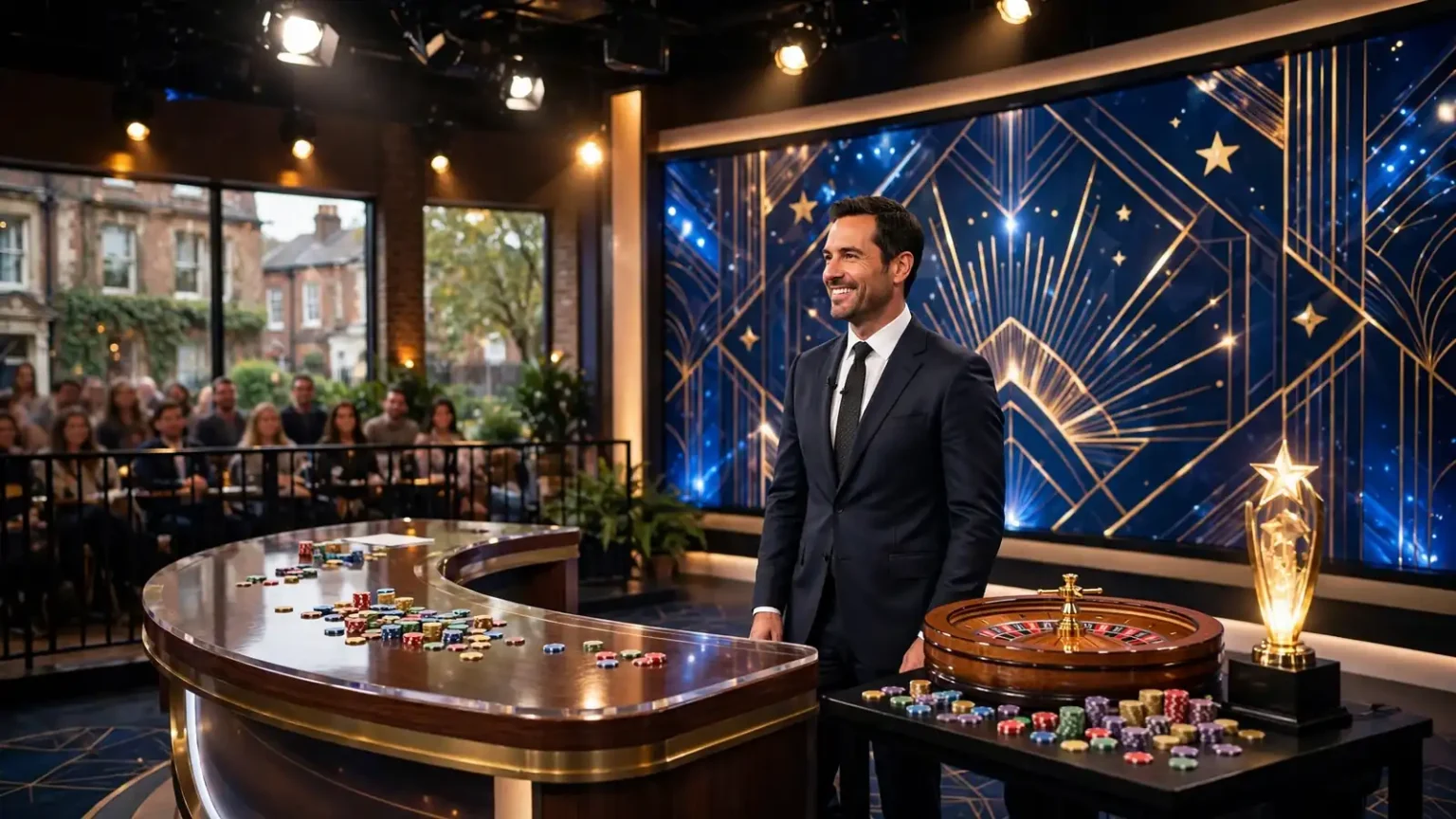
These formats combine gambling with television-style presentation, making chance feel like an event unfolding in real time.
The Appeal of Casino Game Shows on Screen
A casino game show sits at an appealing crossroads: part wager, part performance, part familiar television grammar. Its attraction is not simply the possibility of a result. It is the sense that a result is being made into an event, with suspense given a face and chance placed in a frame. The screen turns an abstract outcome into something that can be watched unfold.
That distinction matters. A game played alone may be absorbing, but it belongs chiefly to the private rhythm of play: a choice, an interval, an outcome. A show adds the suggestion of an audience, even when the person watching is by themselves. Its language belongs to entertainment as much as to gambling. There may be anticipation, reveal, reaction and the old television promise that something is happening now. The appeal lies partly in that promise.
The phrase “live” carries unusual weight in screen entertainment. It suggests immediacy, or at least the sensation of it: a moment not yet settled into the safe distance of replay. The viewer is invited to feel that the outcome is arriving in the present rather than being recalled from the past. That feeling can be compelling even when the central activity remains a game of chance. Liveness does not abolish uncertainty; it gives uncertainty a stage.
This is a durable trick of performance. A musician on screen, a sporting contest, a televised quiz: each can make time itself part of the spectacle. Something is pending, and the viewer waits alongside it. Casino entertainment borrows from that cultural vocabulary. The interval before an outcome becomes more than dead space. It can be held open, dressed with tone and image, and made to feel like suspense.
Online Casinos With No Limits: What the Claim Means
Chance, with an audience
Chance is often imagined as impersonal. It has no motive, no sense of timing, no appreciation of a dramatic pause. Yet people naturally tell stories about uncertain outcomes. They speak of luck as if it had a temperament; they remember near misses and unlikely turns; they give a sequence of events the shape of a plot. A show can lean into that instinct. It makes randomness watchable by arranging the experience around it.
The result is not necessarily a story in the conventional sense. There need be no character development or moral lesson. Instead, there is a compact arc: expectation, delay, resolution. The mind is good at supplying meaning to such a structure. A moment that might otherwise pass as a bare result can feel charged because it has been anticipated in company, framed by sound or image, and allowed to arrive with ceremony.
This helps explain why game shows have long had a place in popular entertainment. Their pleasures are legible. A contest has stakes; a question has an answer; a turn has a consequence. The audience does not have to enter a complicated fictional world before it can feel involved. Casino game shows draw on a related simplicity, while adding the particular tension of wagering. Entertainment and money occupy the same frame, though they are not the same thing.
That combination is also the source of a certain unease. Television generally offers a safe distance from the events it depicts. A viewer can watch a contest without being one of its contestants. Gambling, by contrast, can involve personal financial risk. When the two are brought together, spectacle can soften the boundary between watching and participating. The screen may make the experience feel sociable or theatrical; it does not change the underlying significance of a wager.
A clear-eyed account of the appeal has to hold both ideas at once. The show can be entertaining as a piece of presentation, and gambling can still carry consequences beyond the presentation. Neither point cancels the other. Glamour is not a safeguard. Suspense is not a measure of value.
Amatic Online Casinos in the UK: Supplier or Operator?
The comfort of familiar television
Part of the draw may be the familiarity of the form. Television has taught its audiences how to watch a game show: attend to the presenter, notice the cue, wait for the reveal, read a reaction. Even without knowing the details of a particular production, people recognise the broad arrangement of performance and outcome. It is a grammar learned across decades of entertainment, not a rulebook that needs explaining.
That grammar can make an unfamiliar kind of gambling appear approachable. A show format offers a social surface: faces, voices, gestures, a sense of occasion. It gives the mind more to follow than a solitary interface might. For some, this can be the difference between an experience that feels mechanical and one that feels staged. The attraction is not necessarily that the game has become more understandable; rather, it has become more watchable.
There is a small cultural reversal here. The casino has often been imagined as a place apart, associated with velvet rooms, private tables and a particular mythology of risk. A screen can loosen that image. It brings a performance into an ordinary setting and makes the casino’s theatre available as a form of home entertainment. The old glamour is miniaturised, translated into light, sound and the careful management of attention.
The translation is not neutral. A screen is designed to hold the eye. A well-shaped entertainment experience can make a pause feel meaningful and a result feel momentous. Those are ordinary tools of television, used across genres; in gambling, they sit beside the prospect of financial loss. The polished surface can invite attention without offering any reason to assume that the activity beneath it is harmless.
Amatic Online Casinos in the UK: What to Check
The appeal, then, is partly aesthetic. People are drawn to performance that gives uncertainty a visible shape. It is also partly social, because the language of a show evokes a shared audience, whether or not anyone else is present. And it is partly psychological: suspense has a pull of its own, especially when the mind is waiting for a definite outcome. None of these qualities belongs exclusively to casino entertainment. Their combination is what gives the format its particular character.
A spectacle that narrows attention
A show concentrates attention. It directs the viewer towards what matters at each moment and discourages the mind from wandering. This is one of entertainment’s oldest services: the shaping of attention into a short passage of expectation and release. In a game-show setting, attention is not merely directed towards a performance. It may also be attached to the result of a wager.
That attachment can make a brief event feel larger than it is. A momentary outcome may acquire the emotional weight of the build-up around it. The surrounding presentation can create an impression of momentum, although each new outcome does not owe anything to the previous one. The mind tends to make connections, especially when events are arranged in a sequence. Narrative is a human reflex. Probability is less sentimental.
This is why words such as “excitement” and “fun” deserve care when applied to gambling. They describe an emotional experience, not a guarantee about its consequences. The entertainment may feel lively; the financial result may still be unwelcome. A sense of occasion does not make the underlying risk disappear. The show’s most effective qualities may be precisely those that make it absorbing.
There is no contradiction in finding the presentation compelling while keeping a distance from its claims on attention. The screen can be appreciated as performance: the pacing, the atmosphere, the use of suspense. At the same time, the wager remains a wager, not a ticket into a story whose ending can be earned by watching closely. The drama may be carefully presented. The outcome is not a character that can be persuaded.
Financial Risk
While the presentation of a game show may be entertaining, it does not change the underlying significance of a wager or the risk of financial loss.
That tension is more interesting than a simple verdict that these experiences are either exciting or dangerous. They can be both entertaining and risky, and the balance will not be the same for every person. The language of television tends to make participation feel natural. The language of money asks a less romantic question: what is being put at stake, and what happens if it is lost? Both questions belong in the same room.
What the screen changes — and what it does not
A screen changes the setting in which gambling is encountered. It can make the experience feel more like a programme and less like a traditional casino visit. It places presentation in the foreground and offers the viewer a composed scene rather than an imagined room of tables and crowds. This shift in atmosphere is part of the attraction. So is the sense that entertainment has travelled into ordinary life.
But a change of setting is not a change in the nature of risk. The screen may supply an audience-shaped feeling without a physical audience; it may create a theatrical mood without turning a wager into fiction. The familiar conventions of television can make the event easier to watch, but they cannot make a financial decision consequence-free. Presentation frames an activity. It does not rewrite it.
This distinction also helps place the phrase “best online casino game shows” in perspective. “Best” can mean different things: most engaging as entertainment, clearest in its presentation, or most suited to someone’s preferences. Those are not interchangeable standards, and excitement alone cannot settle them. A format that feels vivid may not be the right fit for someone seeking a quieter form of play; a polished performance may still leave the central questions about money untouched.
Amatic Games at UK Online Casinos: How They Work
The broad subject is therefore not only a catalogue of attractions. It is a meeting between two familiar impulses: the wish to watch something unfold and the wish to take part in an uncertain outcome. Television gives the first impulse a structure. Gambling gives the second a cost. The blend can be captivating, but the two strands should not be confused.
Casino game shows on screen belong to a wider history of turning contests into entertainment and entertainment into something participatory. Their appeal comes from that overlap: the sense of occasion, the readable shape of suspense, the intimacy of watching from a screen, and the possibility that the viewer’s own stake is involved. It is a neat arrangement. Perhaps too neat.
Best casino sites in the UK
- BritsinoBonus: Welcome Package – Get your £2,200 + 2,000 FS · Payout speed: 1-3 business days
- BeOnBetBonus: 100% up to €500 + 100 FS · Payout speed: 1-3 business days
- Revery PlayBonus: 100% up to€1,000+ 100 FS · Payout speed: 1-3 business days
- EvoSpinBonus: 125% up to €2500 + 125 Free Spins · Payout speed: 1-3 business days
- WinBeastBonus: €5000 + 500 FS + €650 Freebet · Payout speed: 1-3 business days
- SpinFormulaBonus: 550% Up To £15,000 + 550 FS · Payout speed: 1-3 business days
- JetsetspinsBonus: 200% Bonus + 100 Free Spins + Free Royal Wheel · Payout speed: 1-3 business days
- NightWinBonus: £900 + 400 free spins · Payout speed: 1-3 business days
- NightLuckBonus: Welcome Pack + 805% Up To 6400€ + 280 FS · Payout speed: 1-3 business days
UK Casinos, Licensing and Live Shows
A casino screen can make distance feel irrelevant. A presenter, a studio set and a stream of activity appear in the same small rectangle as a slot or table game. Yet the screen does not determine who is responsible for the gambling service behind it. In Britain, that distinction begins with the UK Gambling Commission, the regulator for commercial gambling, and the businesses that hold permission to offer gambling to customers.
The Commission oversees gambling activity in the UK, including online casinos. For remote gambling offered to consumers in Great Britain, its reach does not depend on where the operator keeps the equipment that powers the service. A server somewhere else does not, by itself, move a British-facing gambling business outside the regulator’s remit. The jurisdiction follows the service being offered, not simply the physical address of its machinery.
Regulatory Reach
For remote gambling offered to consumers in Great Britain, the UK Gambling Commission’s jurisdiction follows the service being offered, regardless of where the operator’s equipment is physically located.
That principle matters in a market where digital products cross borders more easily than laws do. A game may be streamed or delivered through systems located far from the customer, while the commercial relationship is still with a business offering gambling in Great Britain. Regulation is not a matter of locating a particular studio or machine on a map. It concerns the activity and the business conducting it.
The regulator and the casino are not the same thing
The UK Gambling Commission sets the licensing framework and oversees commercial gambling in Great Britain. It is not itself an online casino, a game-show producer or a supplier of entertainment. The businesses that offer casino products to customers are operators; the Commission is the regulator that issues operating licences to businesses and personal licences to individuals working in regulated roles.
The distinction can disappear in the interface. A customer sees a lobby, a game tile or a live stream, rather than the separate organisations that may sit behind the service. But the visual unity of a website does not make its responsibilities interchangeable. A regulator authorises and supervises. An operator makes the gambling product available to customers. Individuals in relevant roles may hold personal licences. These are different positions in the same regulatory arrangement.
That division is especially useful when considering casinos that feature live game shows. The presence of a show on a platform would not make the show itself the regulator, nor would a studio presentation replace the operator’s role. A show is part of the customer-facing product; the operator is the business offering gambling. The Commission’s remit concerns the regulated activity and the businesses conducting it, rather than the theatrical appearance of a particular game.
This is a modest distinction, but a consequential one. Entertainment can borrow the language and staging of television: a host, a set, a camera and a sense of shared occasion. The licence question is less theatrical. It attaches to businesses and regulated individuals, not to the mood created by lighting or the presence of a presenter.
Wazdan Online Casinos UK: Amatic’s Role Explained
Why the equipment’s address is not decisive
Remote gambling can be technically dispersed. The customer may be in Great Britain, the operator may be based elsewhere, and key equipment may be located in another place again. The Commission’s authority over remote gambling offered to Great Britain consumers is not erased by that geography. The location of the key equipment does not, on its own, settle whether a business must be licensed for the service it offers to those consumers.
This approach reflects a practical problem built into digital commerce. If regulation depended only on the address of the machinery, a business could make the location of its technical infrastructure more important than the market it serves. The British framework instead treats the offering of remote gambling to consumers in Great Britain as the relevant connection. A stream may travel; responsibility does not simply evaporate along the route.
The point is not that every element of a remote gambling service must sit in Great Britain. It is that the Commission’s remit is concerned with gambling offered to consumers there, regardless of where the essential equipment is housed. This makes the operator’s regulatory status more informative than the geography of a studio or server when assessing a casino service aimed at the British market.
A live show may make the arrangement feel more like a broadcast than a conventional game interface. The technology can suggest a distant production, while the customer experiences the product through a domestic screen. Neither impression answers the licensing question. The relevant distinction remains between a business offering gambling to consumers and the regulator responsible for licensing commercial gambling.
What a licence says—and what it does not
An operating licence is issued to a business. A personal licence is issued to an individual operating in Great Britain in a role for which that authorisation is required. The two forms of permission address different subjects: one concerns an organisation’s ability to conduct gambling activity; the other concerns an individual’s role within that activity.
Betsoft Casinos in the UK: What Can Be Verified
This is why the word “licensed” should not be treated as a decoration attached loosely to a website, a game or a studio. A licence relates to its holder. The operator’s status is not transferred to every supplier, performer or technical system associated with a product. Nor does the existence of a regulator mean that the regulator has become a participant in the games it oversees.
The separation also guards against a familiar confusion in digital entertainment: the tendency to treat whatever appears together on a screen as a single entity. A branded game, a presenter and the casino interface can look like one production. Behind that surface, the question of who offers the gambling remains a question about the operator. Licensing concerns the businesses and individuals within the regulated system, not the visual coherence of the experience.
For live-show products, this matters because presentation can make a casino product seem unusually self-contained. The camera provides a focal point; the host gives the activity a human face; the interface supplies the means to participate. Yet a well-presented format does not alter the legal identity of the business making the gambling available. The screen may compress several functions into one scene. The regulatory framework keeps them distinct.
Barcrest online casinos in the UK: what to check
Great Britain, the UK and the language of regulation
Those terms should not be casually treated as interchangeable in every legal context. The important point for remote casino services is that the Commission regulates gambling offered to consumers in Great Britain regardless of where the key equipment is located; it is also the regulator for commercial gambling in Great Britain.
That geographical precision is not a fussy technicality. Regulation is made through defined jurisdictions, while websites are designed to feel borderless. A casino page does not announce the legal boundaries of the market in the same way that it announces a game or promotion. Clear language has to do that work instead.
The Commission issues business operating licences and personal licences to individuals. It is the sole regulator for commercial gambling in Great Britain. Those roles provide the institutional frame for any discussion of remote casinos in the market, including services whose presentation resembles a live television show. They do not, by themselves, identify which casinos include such shows, or establish that a particular product is available at a particular operator.
Do
- Distinguish between the regulator and the operator
- Verify the licensing status of the business
- Treat the regulatory framework as an institutional guide
Don’t
- Assume a license is a decoration for a game
- Confuse a show’s presentation with its regulation
- Infer product availability from the existence of a regulator
That last distinction is worth preserving. A regulatory framework explains who supervises gambling and how licensing is divided. It does not serve as a directory of entertainment formats. The existence of a UK regulator cannot be used to infer that every licensed casino carries live shows, that a particular show is present, or that two platforms offer the same experience. Licensing and product availability answer different questions.
Reading a live casino through its institutional setting
The appeal of a live presentation may rest on its apparent immediacy: a person speaking to a camera, an unfolding sequence and a sense that the screen is showing an event rather than simply rendering a game. But immediacy is a design quality, not a regulatory category. The product still sits within the wider business of remote gambling when an operator offers it to consumers in Great Britain.
This is where the Commission’s role provides context without becoming part of the entertainment. It regulates commercial gambling and issues licences to businesses and relevant individuals. The operator supplies the customer-facing casino service. A studio or screen format may shape how that service is presented, but it does not displace the distinction between oversight and operation.
The framework is deliberately less vivid than the product. It contains no host, dramatic pause or camera angle. It draws lines around responsibility. In a digital market, that quiet work matters: without it, a customer-facing brand, a software component and a remote production could be mistaken for a single accountable organisation.
Nor does the location of technical equipment offer a shortcut around those lines. Where remote gambling is offered to consumers in Great Britain, the Commission’s regulatory reach is not decided by the equipment’s address. The commercial activity and the licensed business remain central. A faraway server is infrastructure, not an alternative regulator.
This does not turn licensing into a guarantee about the character of a show or the quality of its presentation. It identifies the institutional setting in which commercial gambling is offered. That is a narrower claim, and a more useful one. It keeps the attention on who is authorised to conduct the business rather than allowing the production style to stand in for accountability.
BGaming Casinos in the UK: What the Listings Show
For casinos with live shows, then, the relevant background is not that regulation makes every platform alike. It does not. The point is that the same basic distinction applies whether a casino page is quiet and conventional or arranged like a broadcast: the Commission regulates, operators offer gambling, and licensed individuals occupy their own defined roles. The surface changes. The structure beneath it remains recognisable.
The framework is not a show.
Named Show Formats and the Limits of the Evidence
Names such as Crazy Time and Funky Time can look like useful shortcuts. They suggest that a particular kind of casino entertainment is being sought, rather than a slot or a conventional table game. But a name, by itself, establishes very little. It does not confirm the rules, the way a programme is presented, whether it is currently offered in the United Kingdom, or which operator makes it available.
That distinction matters because titles carry a peculiar authority. A familiar-sounding label can seem to describe a stable product, even when the practical details that matter to a player sit elsewhere: in the operator’s catalogue, the game’s own information panel and the terms attached to participation. Without those details, a comparison would be a performance of certainty rather than an account of what is known.
The word “live” can add to the impression. It evokes a broadcast, a presenter and an event unfolding in real time. Yet the presence of that word in a product name or description cannot, on its own, settle what the format contains. Nor can it establish whether a particular version is available through a British casino. Those are separate questions, and a title is not an answer to them.
This is why a search for a Crazy Time casino game show or a Funky Time live casino show should not be turned into a confident guide to their mechanics. The names identify the subject of interest; they do not verify features. Claims about rounds, prizes, odds, presenters, interaction or mobile performance would need to be checked against reliable, current product information. Repeating such claims because they sound plausible would make the page more vivid and less useful.
Amatic Games at UK Online Casinos: What to Know
The same caution applies to rankings. “Best” invites a neat order, preferably with a winner at the top. But a ranking requires grounds for comparison: consistent information about what is offered, how it works and what distinguishes one option from another. Where those grounds are absent, placing one named format above another would imply a test that has not taken place. The neatness would be cosmetic.
There is a broader reason to be careful with this kind of entertainment. Casino products are sold through both names and presentation. A title can be memorable; a show-like frame can make a game feel closer to television than to a menu of gambling products. That framing may shape expectations, but it does not replace the information needed to understand a real-money activity. The distinction between spectacle and terms is not glamorous. It is important.
Availability is also not a permanent property of a name. A format might be listed by one operator and absent from another, or its listing could change. A general label cannot establish that it is present in any particular casino at the time of publication. Nor does a mention in a catalogue, review or discussion prove that the same offer is accessible to every British player. Product access belongs to the operator’s current offering, not to the title’s reputation.
A useful account can therefore be modest without being evasive. The names indicate which show-style formats people may have in mind, but they do not justify claims about their detailed rules or current UK availability. That boundary is not a technicality. It separates description from guesswork, especially in a market where an entertaining name sits beside a financial decision.
The temptation is to fill the gap with familiar language: “wheel”, “bonus round”, “host”, “big win”. Those words might fit some show-style games, but without confirmation they remain assumptions. They can also blur differences between products, making two titles appear interchangeable simply because both sound theatrical. A comparison built that way would answer nothing beyond the names themselves.
For the named formats, then, the responsible distinction is between recognition and knowledge. Recognition says which products are being discussed. Knowledge requires dependable particulars about what each one offers and where it can be played. A title can open the door to that investigation. It cannot do the investigating.
Main Conclusions
- Game show formats use the grammar of television to make randomness watchable.
- The UK Gambling Commission regulates the business activity, not the theatrical presentation of the game.
- Terms like “live” and “game show” are broad labels and not substitutes for specific game rules.
- A polished production does not alter the legal identity or regulatory requirements of the operator.
What “Live Casino Game Show” Means in Practice
The phrase live casino game show joins three ideas that are easy to mistake for a single promise. “Casino” places the subject in gambling; “game show” suggests entertainment shaped around a visible event; “live” hints at immediacy. Together, they describe a kind of presentation, but they do not, on their own, explain what happens on screen or how a particular game works.
That distinction matters because a label can feel more informative than it is. It may signal that a casino product is presented with the look or tone of a show, but it cannot establish whether there is a host, what participants do, whether decisions affect the outcome, or how the underlying game is structured. Those details belong to the rules and description of the specific product. The category name is not a substitute for them.
“Live” is especially suggestive. In ordinary conversation it can mean happening as events unfold, rather than recorded or staged in advance. In a product title or promotional description, however, the word needs context. It does not independently prove that a human presenter is involved, that every part of the experience happens in real time, or that players interact with one another. A live-looking presentation and a particular technical arrangement are not the same claim.
Nor does “game show” settle the question of participation. The phrase evokes contests, suspense and a presenter guiding events, but an evocative comparison is not a rulebook. It does not say whether the player makes choices, watches a sequence unfold, or takes part in some other way. The actual relationship between entertainment and gambling must be described by the product itself, not inferred from familiar television language.
This is where the category becomes useful, even with its limits. It helps distinguish show-styled casino entertainment from a plain label such as “table game” or “slot”, while leaving open the details that need to be established separately. It is a signpost, not a specification. A clear description should make the game’s object, rules and role of chance intelligible without asking a grand name to do all the work.
New Online Casino Sites UK: Amatic Games and Licensing
The same caution applies to the word “show”. A show can be a visual frame, a theme or a style of presentation; the word does not certify the presence of a conventional television programme. It also does not mean the experience is primarily passive. Those assumptions may come naturally from the phrase, but the language alone cannot distinguish among them. Product descriptions need to do that.
For a casino to call something a live game-show experience is therefore to make a broad promise about its character, not to provide a complete account of its operation. The useful questions are more modest: what is being played, what determines an outcome, and what does the player actually do? If a description answers those points plainly, the label can help place the product. If it does not, the label leaves the important work undone.
There is a small cultural sleight of hand in the combination. A show brings the familiar grammar of entertainment—presentation, anticipation, spectacle—into a setting where outcomes also have monetary significance. The two registers can sit side by side, but they should not be confused. The language of entertainment cannot tell anyone whether the game is simple or complex, nor whether a dramatic presentation changes its underlying rules. It only frames the experience.
That framing may be exactly what makes the category appealing to some people: it sounds less like a solitary game and more like an event. But appearance is not evidence of social participation, and atmosphere is not a description of odds or rules. Those are separate matters. A polished title cannot answer them by implication.
In practical terms, then, “live casino game show” is best read as a broad label for casino entertainment presented in a show-like register. It can identify the kind of experience being advertised, while leaving its mechanics, degree of interaction and production details to be explained elsewhere. The name opens a door. It does not show what is behind it.
What is the new UK slots stake limit, and how does it affect Amatic games?
The limit is £5 per game cycle for players aged 25 and over, and £2 for those aged 18 to 24. It applies to online slots, including Amatic games.
Must a casino be Gambling Commission-licensed to offer Amatic slots to UK players?
Yes. The casino must hold the appropriate UK Gambling Commission operating licence; Amatic’s software licence does not license a casino to serve players.
How do Amatic slots perform on a mobile browser?
Amatic games generally run in mobile browsers as HTML5 games, without a download.
Are Amatic casinos on GamStop?
Amatic does not operate consumer-facing casinos. UK-licensed online casinos offering Amatic games must participate in GamStop.
Do Amatic casinos on GamStop have self-exclusion options?
Amatic does not operate consumer-facing casinos, but UK-licensed online casinos offering its games must participate in GamStop, which lets customers self-exclude.
Material created by the team Pure Casino UK Guide


