

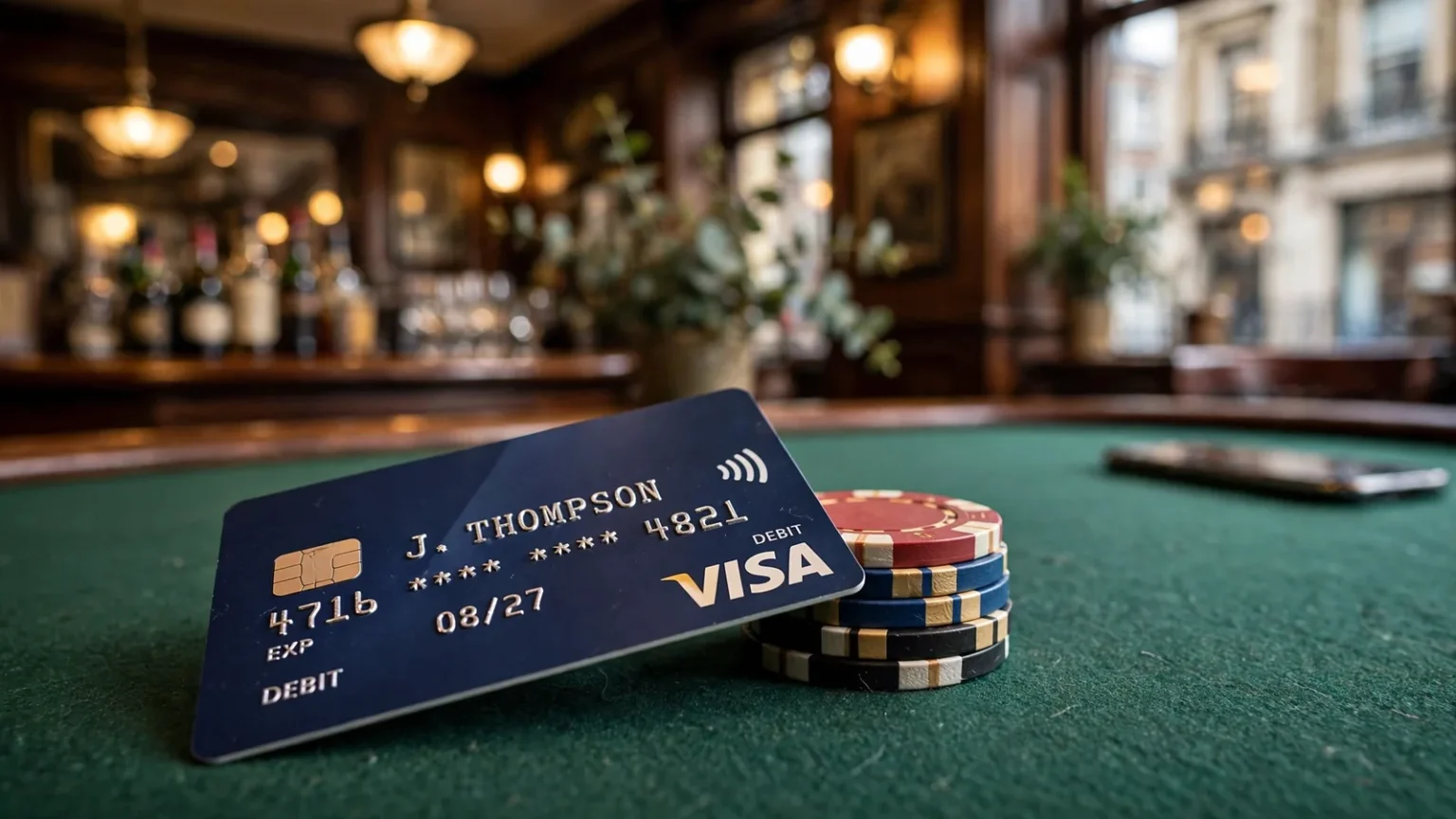
UK casino Visa listings apply to eligible debit cards; the cashier’s current options and card conditions determine whether a deposit can proceed.
Visa at UK Casinos: Debit Cards, Not Credit
The phrase “casinos that accept Visa in the UK” sounds like a simple category. In practice, it joins two separate questions: whether a casino’s cashier offers Visa, and whether the particular Visa card is eligible for gambling payments. For customers of UK-licensed casinos, the relevant card use is debit, not credit.
UK casinos commonly accept debit cards, including Visa and Mastercard. That does not make every card bearing the Visa mark usable for a deposit. A payment network can be widely listed while a particular card product remains ineligible. The cashier is where the distinction becomes practical: its current payment options and any stated card conditions are more useful than a general list of methods elsewhere on a site.
This is why a page describing Visa as accepted should not be read as confirmation that every Visa card will work. Specialist casino reviews may list Visa and Mastercard, but availability can change, and eligibility depends on the card product. The operator’s own cashier is the place to check the current position for a UK account. A logo is an invitation to inspect the details, not a promise of acceptance.
The UK’s credit-card rule is not a small print qualification. On 14 April 2020, the regulator banned credit-card payments for gambling, and that rule has not been relaxed. Remote gambling licensees cannot accept credit-card payments for gambling. The restriction also covers credit-card funds routed through a money service business, so changing the route does not turn credit into an eligible gambling payment.
The point of the distinction is consumer protection, not card branding. Visa can sit on different kinds of card product; the logo alone does not tell the cashier whether the underlying funds are debit or credit. A casino can therefore accept Visa debit while rejecting a Visa credit card. The two statements are compatible. Treating “Visa accepted” as shorthand for “any Visa card accepted” collapses the exact distinction the UK rule requires.
Casinos That Accept WebMoney in the UK: Payment Facts
A cardholder may also encounter a payment attempt that does not proceed even when Visa appears among the available methods. A listed method is not a guarantee that a transaction will be authorised. The card product must be eligible, the casino must currently offer it in its cashier, and the payment must pass the relevant checks. Those are separate stages, rather than competing descriptions of the same thing.
For that reason, “Visa casinos” is an imprecise label. It may describe a casino that supports Visa debit, not one that accepts every card issued on the Visa network. The same caution applies to lists of casinos said to take Visa: a list can help identify possible options, but it cannot settle a particular card’s eligibility. Cashier details matter more than the broad label.
There is a larger regulatory idea behind this ordinary payment screen. In Britain, gambling has been brought within a system in which remote gambling licensees must hold a UK Gambling Commission licence to serve customers. Payment rules are part of that system’s attempt to draw boundaries around how gambling is funded. The distinction between debit and credit is one of those boundaries, made visible in a small menu beside a deposit button.
Casinos That Accept AstroPay in the UK
That menu is less glamorous than the casino’s games or welcome banners. It is also more exact. A Visa mark indicates a payment network; it does not erase the difference between borrowing and spending funds held in a debit account. In a regulated cashier, the useful question is therefore not simply whether Visa appears, but whether the debit card in question is accepted for the account and transaction.
A UK-licensed casino may accept Visa debit without accepting Visa credit. A general payment-method list may name Visa without confirming current availability for every UK customer or every card product. The cashier provides the immediate answer, while the credit-card ban sets the firm limit around it. The logo is not the rule.
Best casino sites in the UK
- BritsinoBonus: Welcome Package – Get your £2,200 + 2,000 FS · Payout speed: 1-3 business days
- BeOnBetBonus: 100% up to €500 + 100 FS · Payout speed: 1-3 business days
- Revery PlayBonus: 100% up to€1,000+ 100 FS · Payout speed: 1-3 business days
- EvoSpinBonus: 125% up to €2500 + 125 Free Spins · Payout speed: 1-3 business days
- WinBeastBonus: €5000 + 500 FS + €650 Freebet · Payout speed: 1-3 business days
- SpinFormulaBonus: 550% Up To £15,000 + 550 FS · Payout speed: 1-3 business days
- JetsetspinsBonus: 200% Bonus + 100 Free Spins + Free Royal Wheel · Payout speed: 1-3 business days
- NightWinBonus: £900 + 400 free spins · Payout speed: 1-3 business days
- NightLuckBonus: Welcome Pack + 805% Up To 6400€ + 280 FS · Payout speed: 1-3 business days
When Visa Is Not the Only Route
Visa is one way to move money into a casino account, but it is not the only route shown in UK-facing cashiers. The alternatives are not interchangeable: some connect a payment to a bank account, some use a separate wallet, and one is a prepaid voucher intended for deposits. Their differences matter before a payment is made, not merely when a preferred option is missing.
Bank-Based
Open banking and bank transfers connect payments directly to a bank account, potentially providing instant deposits and fast withdrawals.
Prepaid Vouchers
Paysafecard allows deposits from a prepaid value, though it is a deposit-only route and cannot be used for withdrawals.
E-Wallets
Services like PayPal, Skrill, and Neteller provide separate payment accounts, though they may be excluded from certain bonus promotions.
Open banking and bank transfers belong to the bank-based group. Open banking services connect a payment to a bank account, while a bank transfer moves funds through the banking system. A specialist review reports that these routes can provide instant deposits and fast withdrawals at many sites. That is a description of availability, not a promise about every operator or transaction: the cashier determines which route is offered, and the bank’s own processing can affect what happens. A method’s presence on a general information page is not a substitute for seeing it available in the account.
The bank connection may appeal to people who prefer not to enter card details or maintain a separate payment wallet. It also leaves the transaction attached to an existing account, rather than creating a balance with another provider. Yet “bank-based” does not mean identical. Open banking and a conventional transfer have different steps, and a casino may offer one without the other. The label is only the beginning of the comparison.
A different arrangement is a prepaid voucher. Paysafecard is used for deposits only, so it should not be treated as a route for moving money both into and out of an account. It functions as a way to pay from a prepaid value rather than by initiating a bank transfer or using a card at the cashier. That distinction is decisive: a deposit method is not automatically a complete payment route. The voucher may suit a person who wants to separate a deposit from a bank-card transaction, but its deposit-only role limits what it can do within the account.
Casinos That Accept Solana in the UK: Evidence
E-wallets sit between those models. Skrill and Neteller are available at some sites, according to a specialist review, but that review also notes that they are often excluded from promotions. This is not a universal rule for every casino or offer; the terms attached to a particular promotion and the cashier’s current options have to be read together. The important point is structural: a wallet can be accepted for payment while still being treated differently under an offer’s conditions. Acceptance and eligibility are separate questions.
PayPal is another wallet-based option. A specialist review describes it as popular for speed and convenience, while also noting that it may be excluded from bonus eligibility. That observation should not be turned into a fixed rule for the entire market. Operators set their own payment and promotion terms, and those terms can change. A familiar brand name at the cashier settles only whether a route is offered there; it does not settle what conditions apply after selection.
Jeton has a more limited footprint. A specialist review reports that it remains available at a handful of UK online casinos in 2026. That makes it an option to check for, rather than a method to assume will appear across casino sites. Availability can be specific to an operator, and a payment list copied from elsewhere may not reflect the live cashier.
These categories answer different needs. Bank-based options work through a customer’s bank; a prepaid voucher is deposit-only; wallets provide a separate payment account and may carry offer conditions. None is simply “Visa by another name”. Even where a casino lists several brands, the useful question is whether the chosen route is available for the intended transaction and whether its conditions fit the account.
Remote gambling licensees serving the British market must hold a UK Gambling Commission licence; a payment logo alone does not confirm this regulatory status.
The word “casino” can make payment choice sound like a matter of taste, as if every route led to the same place. In practice, the cashier is a small map of the operator’s arrangements with banks and payment providers. A route shown in a review may not appear in a particular account, while a route visible at deposit may have a different role elsewhere. Only the live payment screen confirms what that casino currently accepts.
There is also a regulatory boundary behind the apparent variety. Remote gambling licensees serving the British market must hold the relevant Gambling Commission licence; a payment logo alone says nothing about that status. Within a licensed casino, the choice is between payment routes with distinct functions, not a guarantee that every method behaves alike. A bank transfer, a wallet and a prepaid voucher each carry their own limits of use.
So Visa is not the only route, but alternatives should be compared by what they actually do. The next sensible distinction is not between familiar and unfamiliar names; it is between depositing, withdrawing and satisfying the conditions attached to an account or offer. Same cashier. Different rules.
Deposits, Minimums and the Credit-Card Line
A Visa logo does not, by itself, settle whether a card can fund a casino account. The relevant distinction is the card product: Visa debit can be eligible for gambling deposits, while credit-card payments for gambling are prohibited at UK-licensed casinos. A card that draws on borrowed credit does not become acceptable because it carries the same familiar network mark.
Casinos That Accept USDC in the UK: Payment Guide
The rule dates to 14 April 2020, when the regulator banned credit-card gambling. It has not been relaxed. That line applies to remote gambling as well as other forms of gambling covered by the restriction; routing a credit-card payment through a money service business does not turn it into an eligible deposit. The point is not a preference in a cashier menu. It is a regulatory boundary.
For a Visa debit deposit, the amount accepted at the first step is shaped by the casino’s payment settings. A specialist casino review puts the starting minimum within a £10–£20 range, varying with the chosen method. That is a guide to the sort of threshold a player may encounter, not a fixed price of admission across UK casinos. The cashier is where the specific figure becomes meaningful: its stated minimum applies to that operator and that payment route.
This distinction matters for people searching for a casino with no minimum deposit. A phrase like that can suggest that any small sum will pass, or that a Visa debit card has a universal threshold. Neither follows. The minimum is set in the payment flow, and a casino may apply different entry amounts to different methods. A low minimum advertised in general terms is not enough to establish the amount permitted for a particular Visa transaction.
The deposit screen also cannot make an ineligible card eligible. If the card is a credit product, selecting Visa or entering its details does not override the UK ban. Where a card’s status is unclear, the relevant question is whether the funds come from a debit account or a credit facility—not simply whether the card bears Visa branding. This is a practical distinction, not a technicality.
Credit-Card Ban
Since 14 April 2020, the regulator has banned credit-card payments for gambling, including funds routed through money service businesses.
That separation reflects a wider regulatory choice. Gambling payments are not treated as ordinary retail spending when borrowed funds are involved. The rule draws a firm line around credit, even as debit cards remain part of the payment landscape. Familiarity is not permission.
Minimums, meanwhile, are operational rather than universal. A figure shown beside one payment option should not be carried over to another, and a deposit amount accepted by the cashier is not a statement about what a different casino will accept. The selected method matters. So does the operator’s own configuration.
There is therefore no single answer to whether Visa is accepted for a deposit or what the smallest permitted amount will be. Visa debit may be available, but the cashier confirms the usable card route and its minimum for that account. The credit-card rule is clearer: it remains in force, regardless of how convenient a card payment might appear. A logo is not a loophole.
Mobile Slots and the Payment Screen
On a phone, the practical question is not whether a casino has mobile slots, but whether its payment screen offers a usable route to fund the account. A site may display Visa among its payment methods in general information, yet that alone does not establish that the option is currently available to a UK customer or eligible for a particular card product. A specialist payment-method review may list Visa and Mastercard, but the cashier is where current availability needs to be confirmed.
Casinos that accept Citadel UK: availability checks
That small distinction matters more on a compact screen. Payment options may be presented in a menu or grouped behind a deposit button; the names shown there, rather than a general logo elsewhere on the site, indicate what the account can select at that point. If Visa appears, the displayed instructions and any eligibility message still matter. A familiar symbol is not a promise that every card with that mark will work.
Some UK Gambling Commission-licensed casinos also accept Apple Pay for deposits. It can offer a mobile route without requiring card details to be entered into the casino’s payment form, but its presence is not universal. The option may be available at one casino and absent at another, so a phone’s wallet does not by itself determine what the cashier supports.
The payment screen is also a useful boundary between browsing and action. A slot may load neatly on a phone while the available deposit methods remain a separate matter. Mobile access to games does not mean every payment choice is mobile-compatible, and a payment method visible on a desktop site may not appear in the same way on a smaller display. The cashier provides the concrete answer; promotional banners and payment logos are only signposts.
For real-money slots, the distinction between a payment option and a completed deposit is important. Selecting Visa or Apple Pay begins a transaction, but the casino and payment provider still have to process it. A payment screen can therefore clarify availability without guaranteeing acceptance. That is not a flaw in mobile play so much as the ordinary friction of moving money through systems built by different institutions.
There is a cultural oddity in the arrangement: games have travelled easily to the pocket, while payment access remains conditional on the operator, the cashier and the card product. The screen looks singular; the underlying arrangements are not.
Do
- Verify the casino is UK-licensed
- Check the live cashier on your device
- Confirm specific card eligibility
Don’t
- Assume a general logo guarantees access
- Rely on desktop lists for mobile availability
- Use a phone wallet to determine cashier support
A careful check is unglamorous. Confirm that the casino is UK-licensed, open its cashier on the device being used, and see whether the intended method is offered before proceeding. For Visa, that means checking current UK availability and card eligibility there; for Apple Pay, it means confirming that the casino accepts it for deposits. The game can wait. The payment screen decides.
Real-Money Play and the Longer Journey Back
A Visa deposit can put funds into a casino balance almost at once. That speed belongs to the payment into the account, not to the later movement of winnings out of it. A specialist review describes card deposits as potentially instant while noting that payouts can take several business days. The two transactions may use the same card, but they are not one process running in reverse.
The balance first has to become a withdrawal request. The casino reviews it internally, and the account may need to be fully verified before payment is approved. KYC is part of that passage from play to payout: checks can take longer on a first withdrawal, when the operator is still establishing who holds the account and whether its details are in order. A fast deposit does not settle those questions. It merely starts the account’s money moving in one direction.
There is a quiet institutional logic to this. Gambling payments are not treated as anonymous sums that enter and leave by whichever route happens to be quickest. UK anti-money laundering rules generally require payouts to return to the original payment source. That closed-loop principle ties the outgoing funds to the route used to put money in, making a withdrawal less like collecting a parcel and more like completing a recorded transaction.
Casinos that accept Giropay in the UK: cashier checks
The casino’s approval stage also sits between the request and the payment provider’s work. After approval, the provider and banking system still have to process the transfer. A delay can therefore arise before the payout is released, or after it has left the casino. The word “withdrawal” compresses both stages into one neat label. The money is less obliging.
For someone playing slots for real money with Visa, the important distinction is between a playable balance and money actually returned to a bank account. Seeing funds credited to a casino account says nothing by itself about how quickly a later request will be approved. Nor does an instant deposit promise an instant cash-out. The operator’s processing arrangements and the account’s verification status shape the interval.
A first request may be the point at which identity checks become more visible, particularly if verification has not already been completed. Once the account is verified, that particular hurdle may be reduced, but approval remains part of the withdrawal journey. A casino can still have its own review process before funds are sent onward.
This is why real-money play involves more than choosing a game and pressing a button. The payment path has an entrance, an account review and an exit, each with its own handling. Visa may make the entrance feel immediate; the return journey has more gates. The distinction is ordinary, not dramatic. But it matters whenever a balance is mistaken for money already back in the player’s hands.
Withdrawal Process
- Deposits can be instant, but payouts often take several business days.
- KYC and identity verification are required before payments are approved.
- Anti-money laundering rules generally require payouts to return to the original payment source.
- A playable balance is not the same as money returned to a bank account.
Visa Deposits, Fast Payouts and the Original Source
A Visa deposit can reach a casino balance quickly without making the route back equally direct. Depositing and withdrawing are separate transactions, handled under different checks; the cashier’s support for a card deposit does not, by itself, promise that winnings will be sent straight back to that card.
The constraint is partly about tracing money. Returning funds to the original payment source is a common anti-fraud and anti-money-laundering control. If a Visa debit card was used to fund an account, the casino may therefore direct a withdrawal towards that source, subject to its payment arrangements and the account checks it must complete. Closed-loop rules are not a decorative feature of the cashier. They help show where funds came from and where they are going.
That can make the phrase “Visa direct withdrawal” less simple than it sounds. A card may be listed for deposits while the available payout route depends on the operator’s process, the card and the payment system involved. If the original route cannot receive a particular withdrawal, another method may be offered. That switch can bring additional verification rather than an instant change of direction.
Speed claims also need careful reading. A specialist payment-method review identifies PayPal, open banking and debit cards connected to fast payout systems as options associated with quicker withdrawals. That is a description of payment routes, not a guarantee that every casino, card or customer will see the same result. Casino approval and account status still matter; the word “fast” does not erase the queue of checks.
Casinos That Accept Interac in the UK: Payment Guide
This is why a quick Visa deposit and a quick payout should not be treated as one promise. The first confirms that money has entered the gambling account. The second depends on the casino’s withdrawal process and whether the original source can receive the funds. Where a different route is needed, verification may be required before it can be used.
For a player using Visa debit, the useful distinction is therefore between card acceptance and a stated withdrawal route. The cashier and withdrawal terms should make clear whether the card is eligible for payouts, whether another method may be used, and what checks apply. A Visa logo beside the deposit button answers only the first question.
There is a quiet administrative logic here. Gambling payments are expected to be traceable, while payment systems do not all behave alike when money moves out. The smoothest-looking entrance may not be the exit. Check the route, not just the logo.
Bonuses and the Payment Methods That May Miss Out
A casino can accept a payment method without treating it as eligible for every promotion. The cashier answers whether a deposit can be made; the offer terms answer whether that deposit counts towards a bonus. Those are separate permissions, and a Visa logo beside the payment options does not settle the second question.
Specialist casino reviews report that PayPal may be excluded from bonus eligibility. The same kind of review reports that Skrill and Neteller are often left out of promotions at sites that offer them. These are not fixed rules across the market: an operator can set different conditions for different offers, and terms can change. The practical distinction is between a payment route being available and its use qualifying for a particular promotion.
Attention: A payment method may be accepted for deposits while remaining excluded from bonus eligibility according to the promotion’s terms.
That matters when comparing a Visa casino welcome bonus with a slot promotion tied to a code. The words “welcome bonus” or “bonus code” do not, by themselves, say which deposit methods qualify. A payment could be accepted while the bonus is withheld because the chosen route is excluded. The promotion’s terms are the relevant place to establish whether Visa is eligible, whether a code must be entered, and whether the offer applies to the games being played.
“No-deposit” is another label that should be read literally, not treated as a promise that every account or payment choice qualifies. The offer terms still define who can claim it and what conditions apply. A casino’s general payment page and its promotional rules serve different purposes.
There is a small but telling distinction here: payment systems are built to move money, while bonuses are instruments of marketing, each with their own conditions. The cashier may be broad; the promotion may be narrow. Rather less glamorous.
For real-money slots play, the same check applies whether the intended deposit is made by Visa or another method. Before claiming an offer, the relevant terms should be checked for payment exclusions and any code or eligibility requirements. A bonus headline cannot substitute for that detail, and payment acceptance alone cannot establish that a deposit will qualify.
Small Deposits, Account Limits and Payment Ownership
A low figure on a payment screen can look like a simple invitation. In practice, the amount a casino will accept is only one part of the account’s financial controls. A Visa deposit may be affected by the casino’s permitted transaction range, the payment route and the status of the account. Those conditions can differ between accounts and methods; a small amount displayed in a promotion or elsewhere should not be mistaken for a guaranteed Visa minimum.
Casinos That Accept UKash in the UK: How to Check
The distinction matters when looking for a five-pound deposit. That figure cannot be assumed to apply across UK casinos, or even across every payment option at one casino. The cashier is the point at which the currently available method and its stated limits become concrete. A Visa symbol on a general payments page does not, by itself, settle the minimum or maximum for a particular transaction.
The upper boundary can be just as account-specific. A specialist casino review notes that maximum deposits may be set per transaction, per day or per month, with the applicable amount varying by payment method and account status. A newly opened account may therefore encounter different controls from one with an established payment history. The useful detail is not a headline limit detached from context, but the limit shown for the selected method and account.
There is also a separate control before money enters the account. UK Gambling Commission rules require remote gambling licensees to prompt new customers to set a financial limit before their first deposit, and to make account-level limit controls accessible. These are not merely cashier settings: they allow a customer to set boundaries on gambling expenditure at account level. The prompt belongs before the first payment, not after a deposit has already been made.
Ownership details can affect how smoothly a transaction proceeds. When the casino account information and the Visa payment route belong to the same customer, basic checks are less likely to be complicated by a mismatch. A card in another person’s name, or account details that do not correspond, can create avoidable questions even where the payment method appears in the cashier.
To avoid transaction complications, the name on the casino account must match the name on the Visa payment route.
This is an administrative safeguard as much as a payment detail. The name must match.
Comparing Visa Alternatives by Their Actual Cost
A payment route can look free at the cashier and still cost money elsewhere. A specialist payment-method review identifies several possible charges: fees from the casino or payment provider, charges from a bank or card issuer, currency-conversion spreads and network costs. The useful comparison is therefore not a method’s headline label, but the amount that would actually leave an account and the amount credited to the casino balance.
Currency is where a small-looking difference can become harder to see. If the casino account and the payment account use different currencies, conversion may be involved; the rate applied can include a spread rather than appearing as a separate fee. A specialist payment-cost review notes that this spread can exceed a visible flat charge. The fee printed in plain sight is not always the largest one.
Casinos That Accept Wirecard in the UK: What to Check
A fair comparison uses the same intended deposit amount and checks each part of the route: whether the casino charges for the transaction, whether the provider or bank adds a fee, what exchange rate is applied, and whether network costs are passed on. A route with no stated casino fee may still be more expensive after conversion. Conversely, a visible charge does not by itself make another route worse. The arithmetic belongs to the whole journey, not one line of the cashier screen.
There is no universal lowest-fee alternative to Visa. The result depends on the specific payment route, the account currency and the transaction being compared. Specialist payment-method guidance makes the same practical point: compare casino charges, provider fees, currency spread and network cost against the actual amount, rather than treating one method as cheapest by reputation.
This is less glamorous than a badge promising a smooth payment. It is also more useful. A casino’s payment page may name several routes, but the cost comparison is meaningful only when the displayed terms and the currency conversion are considered together. A fee-free label is a beginning, not a verdict.
Casinos That Accept Instadebit in the UK
Visa Payments and GamStop: What Availability Alone Cannot Show
A Visa logo in a casino cashier answers a narrow question: whether that payment route is offered there. It does not establish the casino’s relationship with GamStop, the UK self-exclusion scheme, or tell anything by itself about the operator’s regulatory status. Payment access and self-exclusion are separate matters.
In Great Britain, a remote gambling licensee serving local customers must hold the relevant UK Gambling Commission licence. That requirement applies whether the business is based in Britain or elsewhere. A casino describing itself as “not on GamStop” should therefore not be treated as though Visa acceptance makes it an approved alternative. Offshore casinos operate outside the UKGC system; a familiar card method does not change that position.
The wording around GamStop can also obscure what matters. A casino may accept Visa and still be outside the UK self-exclusion scheme; the card network is not a test of participation. Nor does a payment option establish that a site is suitable for someone who has chosen to self-exclude. Self-exclusion is a protective boundary, not a payment preference.
Dry distinction.
For British players, the legal framework is not inferred from a cashier page or a list of deposit methods. Real-money online gambling is permitted through sites holding a current UKGC operating licence, and licensed casinos must provide self-exclusion tools. The Gambling Act 2005 governs gambling in England, Wales and Scotland, while Northern Ireland has a separate legal position. Those details are more meaningful than whether Visa appears among the logos.
Before depositing, the operator’s licence can be checked against the UK Gambling Commission’s public register. That check concerns regulatory standing; it does not turn Visa availability into evidence about GamStop, or make a non-participating site a safe substitute for self-exclusion. Casinos outside GamStop that accept Visa may be discoverable, but card acceptance alone says little about the protections, oversight or consequences attached to playing there.
Are Visa and Mastercard deposits definitely debit cards?
No. UK casinos commonly accept Visa and Mastercard debit cards, but credit-card gambling payments are banned; check the cashier and card eligibility before depositing.
Why can a fast payout casino still delay my withdrawal?
A casino must approve the withdrawal internally, and processing can take longer if your account is not fully verified. First withdrawals may take longer while verification is completed.
What is the current minimum deposit?
The minimum deposit usually starts at £10–£20, depending on the payment method.
Are fast casino withdrawals guaranteed?
No. Withdrawal speed depends on the casino’s approval process, whether your account is verified, and the payment method’s processing time.
Why must withdrawals return to the deposit method?
Returning funds to the original payment source is a common anti-fraud and anti-money-laundering control. Using another route may require additional verification.
Do UK casino withdrawals require verification?
Verification may be required, and first withdrawals can take longer while it is completed. A fully verified account can help avoid delays.
Which payment methods are accepted in Great Britain?
UK-facing casino cashiers may offer Visa and Mastercard debit cards, bank transfers or open banking, PayPal, Skrill, Neteller and Paysafecard; some also accept Apple Pay or Jeton. Options vary by casino, so check its cashier.
Material created by the team Pure Casino UK Guide


