

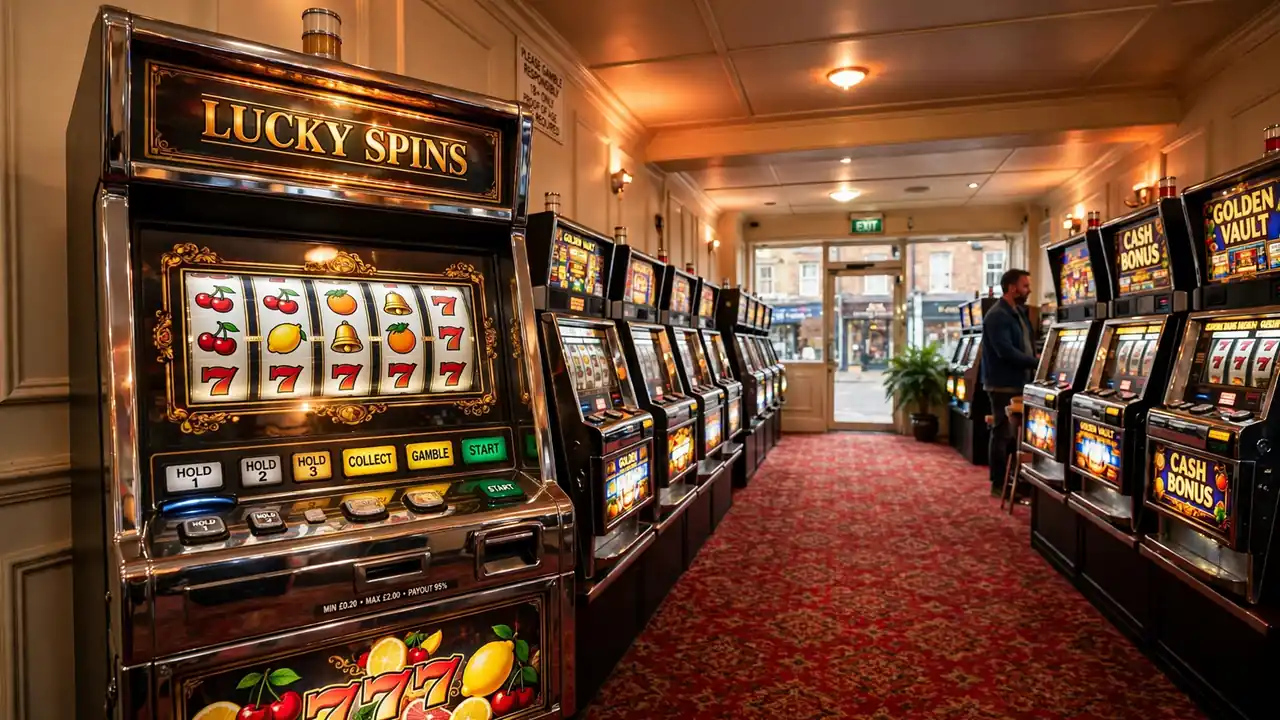
The guide distinguishes Merkur-associated games from casino branding and examines how online slot rules, offers and site claims should be read.
Merkur Slots and the Rules That Shape a Spin
“Merkur slots” can mean a particular style of machine, games associated with the Merkur name, or simply slot games someone hopes to find at a casino carrying that name. Those are not quite the same thing. A familiar label does not, by itself, establish which games a particular website offers. The useful question here is narrower: what shapes an online slot round in Great Britain, from the stake placed to the pause before the next spin?
Book of Dead is one recognisable example of a slot title in the wider market. Its name evokes the old theatrical promise of the machine: a small stake, a bright screen, the possibility that the next turn will change the story. But online play in Britain is not governed by the old physical rhythm of a handle and a spinning reel. Rules now intervene in the timing and pace of the game. Quietly, but decisively.
A specialist review gives a general casino stake range beginning at £0.10 and extending to £100 per round at many sites. That is a description of reported casino betting ranges, not a universal rule for slot games and not a promise about any Merkur-branded site. Online slots have their own statutory stake ceilings, which take precedence over broad claims about casino rounds.
For slot games, the maximum stake per game cycle is £5 for customers aged 25 and over. For those aged 18 to 24, it is £2. The £5 ceiling for all adults took effect on 9 April 2025. These limits concern the stake in a single game cycle, rather than a player’s total spending across a session. That distinction matters: a capped spin is still a spin, and a succession of permitted stakes can still add up. The rule limits the size of each turn, not the persistence with which turns may be taken.
Safe Online Casinos in the UK: What to Check
The rules also change the tempo. Autoplay was removed from UKGC-licensed slot games in 2021, so a player cannot set a machine to keep spinning without making each further choice. A separate requirement means there must be at least 2.5 seconds between spins. The pause was introduced to slow play and reduce the intensity of a session. In a game built around repetition, a little time between rounds is a form of friction—deliberate, not decorative.
That friction alters the experience more than a screen full of responsible-play language might. Autoplay once made it possible to leave the machine running while attention wandered elsewhere; the pause makes the next spin a fresh action. It does not remove chance or make losses impossible. It does, however, interrupt the smooth mechanical flow that can make one round blur into another. A small interval. A real one.
These are rules for UKGC-licensed slots, not characteristics of the Merkur name itself. A game title and a casino brand do not determine whether a site falls within the British regulatory system. Nor does a familiar visual style tell anyone what stake settings a particular game offers. The legal limits apply to licensed operators serving Great Britain, and the relevant limit depends on the player’s age. A website’s branding cannot turn a higher stake into a lawful one.
The practical result is that “Merkur slot” is not a reliable description of a single set of mechanics. It may point towards an intended game or a brand association, but the rules governing a spin come from the game’s actual setting and the regulatory status of the operator. The same named title can be encountered in different contexts; the British limits remain the relevant boundary where the operator is licensed here.
There is also a social idea tucked inside these technical rules. A slot is designed to repeat, and repetition can make time feel thinner than it is. Britain’s intervention does not abolish the machine’s appeal; it places a minimum pause in its rhythm, removes unattended spinning and caps the stake by age. The state has chosen to regulate the shape of the moment, not merely the sign at the entrance.
Slot Stake Limits
For customers aged 25 and over, the maximum stake per game cycle is £5. For those aged 18 to 24, the limit is £2.
For anyone comparing online slot play, the useful details are therefore concrete: the stake per game cycle, whether the operator is within the UKGC system, and whether the game follows the required pace. General casino figures may describe other games or broad betting ranges, but they cannot override the slot limits. A brand name can draw the eye. The rules still govern the spin.
Best casino sites in the UK
- BritsinoBonus: Welcome Package – Get your £2,200 + 2,000 FS · Payout speed: 1-3 business days
- BeOnBetBonus: 100% up to €500 + 100 FS · Payout speed: 1-3 business days
- Revery PlayBonus: 100% up to€1,000+ 100 FS · Payout speed: 1-3 business days
- EvoSpinBonus: 125% up to €2500 + 125 Free Spins · Payout speed: 1-3 business days
- WinBeastBonus: €5000 + 500 FS + €650 Freebet · Payout speed: 1-3 business days
- SpinFormulaBonus: 550% Up To £15,000 + 550 FS · Payout speed: 1-3 business days
- JetsetspinsBonus: 200% Bonus + 100 Free Spins + Free Royal Wheel · Payout speed: 1-3 business days
- NightWinBonus: £900 + 400 free spins · Payout speed: 1-3 business days
- NightLuckBonus: Welcome Pack + 805% Up To 6400€ + 280 FS · Payout speed: 1-3 business days
Merkur Gaming, Games and the Login Question
“Merkur Gaming” can point to a gaming business, a collection of games, or a casino site using a familiar name. Those are related ideas, but they are not interchangeable. A game’s branding does not identify the company that operates the website on which it appears, and a casino’s login page belongs to that site’s operator, not automatically to the maker or distributor of a game.
That distinction matters because gambling searches often compress several questions into one phrase. Someone looking for Merkur casino games may mean titles associated with the name. Someone seeking an online casino may instead be trying to find a place to play. A login request is narrower still: it concerns access to a specific account on a particular website. A shared wordmark cannot answer all three.
Casino Types & Safety: UK Casino Options
The British system gives the distinction legal weight. The UK Gambling Commission regulates operators serving players in Great Britain, and an online casino must hold a UKGC licence to operate legally for those players. The licence belongs to the operator and covers its regulated activity; it is not a general endorsement of every game, brand or web address carrying a related name. The commercial identity on a game and the legal identity behind an account may differ.
A familiar name can travel further than its paperwork. It may appear in a game catalogue, an advertisement, a comparison page or a login prompt. None of those appearances, by itself, establishes who takes deposits, holds an account or owes a player an explanation when access fails. In online gambling, the quiet legal details sit behind the bright front door.
A game is not an account
Game titles and casino accounts serve different purposes. A title can be listed or discussed without establishing that a particular UK casino offers it. A casino account, by contrast, is created and controlled by the operator of the relevant site. Its login credentials are for that account alone; they should not be presumed to work across sites simply because those sites use similar branding.
This is also why a mobile casino page and a mobile game are not the same thing. One describes a route to an operator’s service; the other describes a product within a catalogue. The name Merkur may help identify what a page claims to concern, but it does not settle who is responsible for the service or whether that service is authorised for the British market.
Do
- Check the operator’s current UKGC licence
- Verify the domain against the public register
- Confirm the legal business identity
Don’t
- Trust a brand name as a contract
- Use login credentials across different sites
- Rely on a licence badge alone
The sensible question around a login is therefore not merely whether a page looks familiar. It is whether the account belongs to the exact site intended, and whether the company operating that site is the one recorded by the regulator. Before depositing, the operator’s current UKGC licence should be checked against the Commission’s public register. The website domain, trading name and legal business need to match the register entry; a badge or broad statement about licensing is not a substitute.
There is an old habit in commerce of letting a brand do the work of a contract. In gambling, that habit is especially poor protection. Names are visible; accountability is found in the operator’s identity.
The age boundary comes first
Access to gambling-related material on licensed platforms is subject to age verification, including material connected with free demonstrations. Operators must also establish a customer’s age before allowing money to be deposited into a gambling account. These are separate safeguards: seeing gambling-related content is not the same as being cleared to fund play.
A login form can look like a simple technical gate, but an account is part of a regulated relationship. Age checks sit alongside it because online access can otherwise make a casino appear no more consequential than an ordinary entertainment service. The rules insist otherwise. A game may be presented as software; when it is offered as gambling, the operator’s obligations follow.
For anyone encountering a Merkur-branded casino page, the practical sequence is to identify the operator first, then confirm its UKGC licence and the exact domain in the register before depositing. If the site is only a games catalogue or a general brand page, it is not an account portal. If it is a casino, its login belongs to the named operator, not to a brand in the abstract.
Curacao Casino Licence in the UK: What It Means
Pure Casino UK Guide may receive a commission if a reader registers with a partner casino. That commercial relationship does not change the need to establish which business runs the account. A login button is a small piece of interface; the identity behind it is the substance.
What “Best Merkur Casino” Can—and Cannot—Mean
A “best” label sounds like a verdict on games, service and value. For a casino carrying the Merkur name, the more basic question comes first: which legal business operates the site, and is that business authorised to serve players in Great Britain? A familiar brand is not, by itself, an answer. Nor is a polished page, a list of games or a confident claim about bonuses.
The distinction matters because remote gambling operators serving the British market must hold a UKGC licence. A licence belongs to an operator, not to a mood of reassurance created by a logo. The name on a website may be a trading name; the company behind it may be different again. Until those identities match the public record, comparisons between supposed Merkur casino sites risk comparing labels rather than accountable businesses.
A badge is only a starting point. It can be copied, displayed without enough detail to identify its holder, or left on a site after circumstances change. The useful check is the UK Gambling Commission’s public register, reached through a working link placed alongside the licence information. The licence number should be cross-referenced there before any deposit. The precise website domain, trading name and legal business should all correspond to the register entry; a generic statement that a site is “licensed” does not establish that correspondence.
Attention: A licence badge can be copied or outdated; the only reliable verification is a cross-reference of the domain and legal business in the UK Gambling Commission’s public register.
That small piece of administrative work carries a larger idea. Regulation is attached to a legal entity and a defined market, not to a theme or a family resemblance between websites. A casino that invokes Merkur may have no legal connection to the company whose name it borrows. Conversely, a legitimate operator’s identity cannot be inferred merely from the games or graphics it presents. Brand familiarity is not a substitute for responsibility.
The same caution applies to rankings. “Best Merkur casinos” can suggest that several verified sites have been assessed on consistent grounds. Without clear operator identities, a ranking would give a veneer of comparison to uncertain objects. It would be more honest to treat “best” as a standard to test: a traceable licence, an exact domain that appears in the register, and an identifiable business answerable to the regulator. These are threshold checks, not decorative extras.
Bonuses may make one site appear more attractive than another, but they cannot repair a failure of identity. An offer belongs to the operator that sets its terms; its headline value says nothing about whether that operator is authorised for Great Britain. Any discussion of casino offers should therefore follow, not replace, the licence check. Order matters.
Editorial independence matters too. If this site receives a commission when a reader registers with a partner casino, that commercial relationship should be disclosed plainly. A commission does not prove that an operator is unsuitable, any more than a ranking proves that it is suitable. It does mean that recommendations deserve scrutiny alongside the licence details.
Gibraltar Casino Licence UK: What the Label Means
The dependable answer to a “best” question is not a badge or a superlative. It is an identifiable operator, matched to its domain in the regulator’s own record. Everything else is decoration.
Bonus Codes, Deposits and the Arithmetic Behind an Offer
A code can look valuable before its conditions are read. Searches for a Merkur casino bonus or a promotional code often lead to the same practical question: what must happen to the deposit and bonus before any winnings can be withdrawn? The code itself is only a key to an offer; its value depends on the terms attached to it. A code’s appearance on a page does not establish that it is current, valid for a particular account, or connected to a UK-licensed operator.
The first distinction is the wagering requirement’s base. It may be calculated against the bonus alone, or against the deposit and bonus together. A specialist review illustrates the difference with a £100 deposit matched by a £100 bonus: at 35x on the bonus, the stated turnover is £3,500; at 35x on the combined £200, it is £7,000. That is arithmetic, not permission. For a UKGC-licensed offer, the wagering requirement must not exceed 10x. A 35x example therefore cannot describe an allowable incentive at such an operator.
Wagering Calculation Example
A £100 deposit matched by a £100 bonus with a 35x requirement results in a turnover of £3,500 if calculated on the bonus alone, or £7,000 if calculated on the combined £200.
The multiplication can conceal the more important question: which activity counts towards it? Slots contribute the full value of each pound staked in the calculation described by a specialist review, while table games contribute only a fraction. The review puts that table-game contribution at 5% to 10%. The offer’s own rules determine eligible games and their contribution; a large turnover figure may take longer to meet when the chosen game counts only partially.
Eligible-bet limits matter too. A specialist review reports that many operators restrict a spin to £5 while bonus credit is active. That is not a universal term, so the written conditions for the particular promotion take precedence. A stake above an offer’s ceiling may fail to count, or may breach its rules. Either way, a player can spend money without making the expected progress.
The promotion must also stay within product boundaries: one incentive cannot combine more than one type of gambling, such as betting, casino, bingo or lottery. That restriction makes a seemingly broad package less flexible than its headline may suggest. “No deposit” does not remove the need to inspect the conditions; it describes the funding arrangement, not the absence of rules.
For British customers, deposits sit within a wider set of safeguards. A UKGC-licensed operator must prompt a new customer to set a financial limit before the first deposit and provide account-level controls. Credit cards cannot be used for gambling deposits, including through a money service business, and wallets cannot be used if they allow credit-card funds to reach gambling. Age verification is required before accessing gambling-related content on licensed platforms, and operators must verify age before allowing a deposit.
Anjouan casino licence in the UK: legal position
Before acting on any code, the operator’s UKGC licence should be checked against the Commission’s public register. The licence number, trading name, legal business and exact website domain should match; a badge alone proves little. The site may receive a commission if a reader registers at a partner casino. That interest does not change the arithmetic. It makes the terms worth reading twice.
When a “Top Merkur Casino” Claim Meets the Licence Register
A “top” label can make a casino look as though it has passed a public test. Often it is only a ranking on a commercial page: the order may reflect advertising arrangements, editorial choices or a mixture of both. That is not proof that a site is authorised to serve people in Great Britain, nor that its players have access to the protections attached to a UKGC licence.
The distinction matters because an overseas licence describes the operator’s relationship with another regulator; it does not bring the operator inside Britain’s system. A foreign permit, including one from Malta, is not a substitute for the UKGC licence required of an online casino serving British customers. Offshore sites may still be accessible, but accessibility is not regulatory approval.
The practical difference is clearest when something goes wrong. Operators outside the UKGC framework are not required to connect to GamStop. A person who has self-excluded through that scheme should not assume the exclusion will apply at a site without an identifiable UKGC licence entry. The same caution applies to complaints: non-GamStop casinos sit outside UK dispute-resolution channels, so the familiar route through UK-regulated arrangements may not be available.
Regulatory Risk
Offshore sites without a UKGC licence do not connect to GamStop and sit outside UK dispute-resolution channels.
There is also no basis for assuming that safeguards around customer funds match those required of UKGC-licensed operators. A site may display a licence badge or describe itself as regulated, but a graphic is not a regulator and a broad claim does not establish which legal business stands behind the domain. The Commission’s public register is the place to check the current entry; the trading name, legal business and exact website address need to match, not merely resemble the wording on a promotional page.
That is a less glamorous test than a “top Merkur casino sites” list. It is also the test that separates a recommendation from an advertisement. A page may receive commission if a reader registers through a partner casino, so any ranking should be read with that commercial interest in view. A coupon or app mentioned beside a high placement does not change the operator’s regulatory status.
The UK rules are not an abstract preference for paperwork. They define the conditions under which a casino may legally offer online gambling to people in Great Britain. An offshore operator serving that market without the required UKGC licence operates outside those conditions. The player is not thereby subject to a fine or criminal prosecution, but the protections available through Britain’s regulated system should not be presumed.
Online Casino No Registration UK: What It Means
No defensible “top” list follows simply from a familiar brand name, an overseas licence or a confident badge. The useful distinction is not between first place and second place; it is between a claim made by a ranking page and an entry that can be checked with the regulator. If the UKGC connection cannot be established, the protection gap is the point. That is the ranking that matters.
Merkur Casino in the UK: Brand, Operator and Domain
“Merkur” can identify a familiar name, but a name on a page is not the same thing as the legal business accepting a deposit. A Merkur casino presented to British players would need to be assessed by the operator behind it and the precise website address used to provide the service. Branding alone establishes neither.
That distinction is central to the phrase “Merkur casino online UK 2026”. A logo, a page title or a general statement that a site is licensed cannot show which company holds the relevant permission. In Great Britain, a casino must hold a current UK Gambling Commission licence to operate legally for players. The licence belongs to an operator, not to a name floating free of its company and domain.
The useful check is therefore exact rather than impressionistic. Any licence number displayed by a casino should be cross-referenced against the UK Gambling Commission’s public register before money is deposited. The register entry should match the website domain, the trading name used on the site and the legal business named as operator. A working link to the Commission’s register should sit beside the licence information, making the claim traceable rather than decorative.
Licence Verification
- Locate the licence number on the site
- Cross-reference the number in the UKGC public register
- Match the website domain to the register entry
- Confirm the trading name and legal business match
These details matter because online casino names can travel more easily than legal responsibility. A brand may appear in a domain, a banner or an affiliate description; only the operator’s regulatory entry connects that presentation to an accountable business. A badge without a matching record is not a substitute for that connection. Nor is a licence belonging to a differently named company enough unless the register establishes the relevant relationship.
The domain deserves the same attention as the company name. Similar-looking addresses can lead to distinct businesses, and a page using Merkur branding does not by itself establish that it is the official site of a particular operator. The address in the browser and the domain recorded by the regulator need to correspond. It is a small clerical act with unusually practical consequences.
If no identifiable UK Gambling Commission licence entry matches the operator and domain, a player should not assume that GamStop self-exclusion applies. Nor should they assume access to UKGC-regulated alternative dispute resolution or UK-specific consumer-funds protections. Those protections are tied to regulation, not to the reassuring familiarity of a brand.
The name catches the eye. The register carries the weight. Where this site links to a partner casino, it may receive a commission if a reader registers; that commercial relationship does not replace the independent licence check.
Casino Without a UK Licence: Rules and Protections
Reviews and Free Spins: Read the Terms, Not the Promise
A review can describe a promotion; it cannot make its terms generous by repetition. That matters when a page discusses free spins associated with Merkur slots: the presence of a headline offer does not establish that a particular Merkur-branded casino provides it, or that the terms are suitable for every player. The useful question is what the offer requires before any resulting balance can be withdrawn.
The wagering requirement is one place where the small print changes the apparent value. It may be calculated on the bonus alone or on the deposit and bonus together. Those bases produce different amounts of qualifying play, even when the headline bonus is identical. A specialist review also reports different contribution rates across games: slots count each pound staked in full, while table games may count only a fraction, stated there as 5% to 10%. Such rates belong to the particular offer’s terms, not to a universal promise about every promotion.
For incentives offered by UKGC-licensed operators, the wagering requirement must not exceed 10 times the relevant bonus amount. A single incentive must not bundle different kinds of gambling product, such as casino play with betting, bingo or lottery activity. The distinction matters: a tidy-looking offer can still be restrictive if eligible games contribute differently or if the terms narrow which spins count.
Age is another boundary, not a footnote. Licensed platforms must verify age before allowing access to gambling-related content, including free-spin material, and before accepting a deposit into a gambling account. A promotional page is not outside that rule merely because the spins are described as free.
Bonus Limits
For UKGC-licensed operators, the wagering requirement for a single incentive must not exceed 10 times the bonus amount.
Reviews are most useful when they separate a stated offer from an operator’s identity and current terms. A licence badge, a promotional banner or a familiar brand name cannot substitute for checking the actual operator and the conditions attached to its offer. If a site recommends a partner casino, it may receive a commission when a reader registers. That commercial relationship should be visible, since enthusiasm and independence are not the same thing.
The promise is the easy part. The conditions do the work.
Withdrawals, Verification and the Unanswered Sister-Site Question
A withdrawal is not simply the reverse of a deposit. For a licensed operator, identity checks must be completed before money can be released, so verification is part of the process rather than an unexpected obstacle at the end. The practical sequence is to provide a government-issued photo ID, such as a passport or driving licence, and proof of address dated within the previous three months, such as a utility bill or bank statement. Some operators also ask for evidence that the payment method belongs to the account holder.
Submitting these documents after registration, before depositing, can reduce the chance of a withdrawal being held up while checks are still outstanding. It does not remove the operator’s need to verify them. A welcome offer does not change that order of business.
Processing time depends on the payment route and on the operator’s own checks. A specialist review of casino payment methods reported bank-transfer withdrawals taking three to five banking days across the brands it examined. That is a reported comparison, not a promise about a Merkur-branded site. A specialist review also reported that crypto withdrawals settled on-chain within 10–30 minutes after operator processing. The clock described there begins after the operator has processed the payment; it does not include any wait for identity checks or approval.
Those distinctions matter when judging a claimed withdrawal time. A headline can describe the payment network’s part of the journey while leaving the operator’s processing stage unstated. The terms for the exact site and payment method are more useful than a general brand claim.
The same care applies to searches for Merkur sister sites. A shared name, visual style or collection of games does not establish that two casinos have the same legal owner. The relevant comparison is between each site’s domain, trading name and legal business, checked against the UK Gambling Commission’s public register. The licence number should match the register entry before any deposit is made; a badge alone is not confirmation.
Without an identifiable UKGC licence entry, GAMSTOP protection, UK-regulated alternative dispute resolution and UK-specific consumer-funds protections should not be assumed. A site may receive a commission if a reader registers at a partner casino. That commercial relationship does not establish common ownership between casino brands, or settle whether a withdrawal claim is reliable.
Mobile Play and the Slot Machine on a Smaller Screen
A slot machine once announced itself with a cabinet, a chair and the small public theatre of someone waiting for the reels to stop. On a phone, that machinery becomes a rectangle held in one hand. The image may be compact; the rules governing the spin are not.
Mobile Slot Rules
- Autoplay is prohibited for UKGC-licensed slots
- A minimum interval of 2.5 seconds must exist between spins
- Regulatory rules apply regardless of the device size or screen
For online slots offered by UKGC-licensed operators in Great Britain, autoplay is prohibited. The player must initiate each spin rather than setting a run of them in motion and letting the game continue unattended. That distinction is more than a button design. It keeps the repeated decision visible, even when the physical surroundings have shrunk to a screen on a train or beside a bed.
There is also a minimum interval between spins: each must last at least 2.5 seconds. The measure was introduced to slow play and reduce the intensity of a session. It applies to the slot game, not to the size of the device. A machine displayed on a mobile screen is still an online slot; moving it from desktop to handset does not make the play faster by right.
The practical result is a different sort of mobile experience from the one implied by older ideas of a slot machine. There is no compliant autoplay function quietly running through a sequence, and no lawful UKGC-regulated slot spin can be shortened below that minimum. The interface may rearrange buttons for a smaller display, but the pace remains bounded.
A search for Merkur slots on mobile can describe an interest in playing familiar games away from a computer. It does not, by itself, establish that a particular Merkur app exists, that a site carrying the name is authorised for Great Britain, or that its games follow British rules. The relevant distinction is between a phone as a screen and the operator providing the gambling service. The latter determines which regulatory framework applies.
Where an operator is UKGC-licensed, the slot rules travel with the game. A handset is not a loophole. The small screen, however persuasive its resemblance to a pocket-sized machine, changes the setting rather than the terms of play.
Demo Play Is Still Gambling-Related Content
A slot demo can look like a harmless rehearsal: no deposit, no cash stake, just the familiar symbols moving across a screen. But the absence of money from a spin does not remove the content from gambling’s regulated world. On licensed platforms, age verification is required before access to gambling-related material, including free demos. The boundary is drawn at access, not merely at the moment a player risks a stake.
That reflects a broader British rule: operators must check a customer’s age before allowing a deposit into a gambling account, and online gambling is legal only for people aged eighteen or over using a site with a UK Gambling Commission licence. The rules treat a demo as part of the gambling environment rather than as an exception to it. Practice mode is still behind the age gate.
The distinction matters because “free” describes the price of a spin, not the nature of the product around it. A demo may reproduce a game’s rhythms and presentation while removing the real-money outcome; it does not turn a casino service into ordinary entertainment. The law is less interested in whether a particular spin costs anything than in whether the material belongs to gambling.
A Merkur-branded demo should not be presumed to exist simply because the brand is familiar or a demo is technically possible. The name alone cannot establish that a particular game or casino service is offered, still less that its operator is authorised to serve Great Britain. Brand recognition is not a licence.
For a licensed site, the age check comes before access to a demo, not after a player decides to deposit. That is a small but revealing choice in the design of regulation: the state places the threshold at exposure to gambling-related content, rather than waiting for money to change hands. Even pretend play has a gate.
Is it safe to play at online casinos in the UK?
UKGC-licensed casinos must provide deposit limits, time-outs and GamStop self-exclusion, and keep player funds separate from operating capital. Check that the operator holds a UKGC licence; a familiar brand name alone is not proof.
What does a dependable online UK casino combine?
A dependable casino combines a UKGC licence with player protections such as deposit limits, time-outs, GamStop self-exclusion and segregated player funds. Its licence information should link to the regulator’s official register.
What determines how an online casino bonus works in practice?
The wagering requirement determines how much you must stake before withdrawing: it may apply to the bonus alone or to the deposit and bonus together. Slots usually count fully towards wagering, while table games typically count for 5% to 10%, and eligible bonus bets are often capped at £5 per spin.
What are the differences between UK-licensed and non-UK-regulated online casinos?
UKGC-licensed casinos must provide GamStop and other player protections, segregate player funds and follow UK slot rules, including the 2.5-second minimum between spins. Offshore casinos are not required to connect to GamStop, may allow autoplay and faster spins, and do not offer the same UK dispute-resolution channels.
How do I verify whether a UK online casino is safe before depositing?
Check that the operator holds a UKGC licence by following the working link beside its licence information to the regulator’s official register. Confirm the licence belongs to the operator behind the site, rather than relying on a game or casino brand name.
Material created by the team Pure Casino UK Guide


