

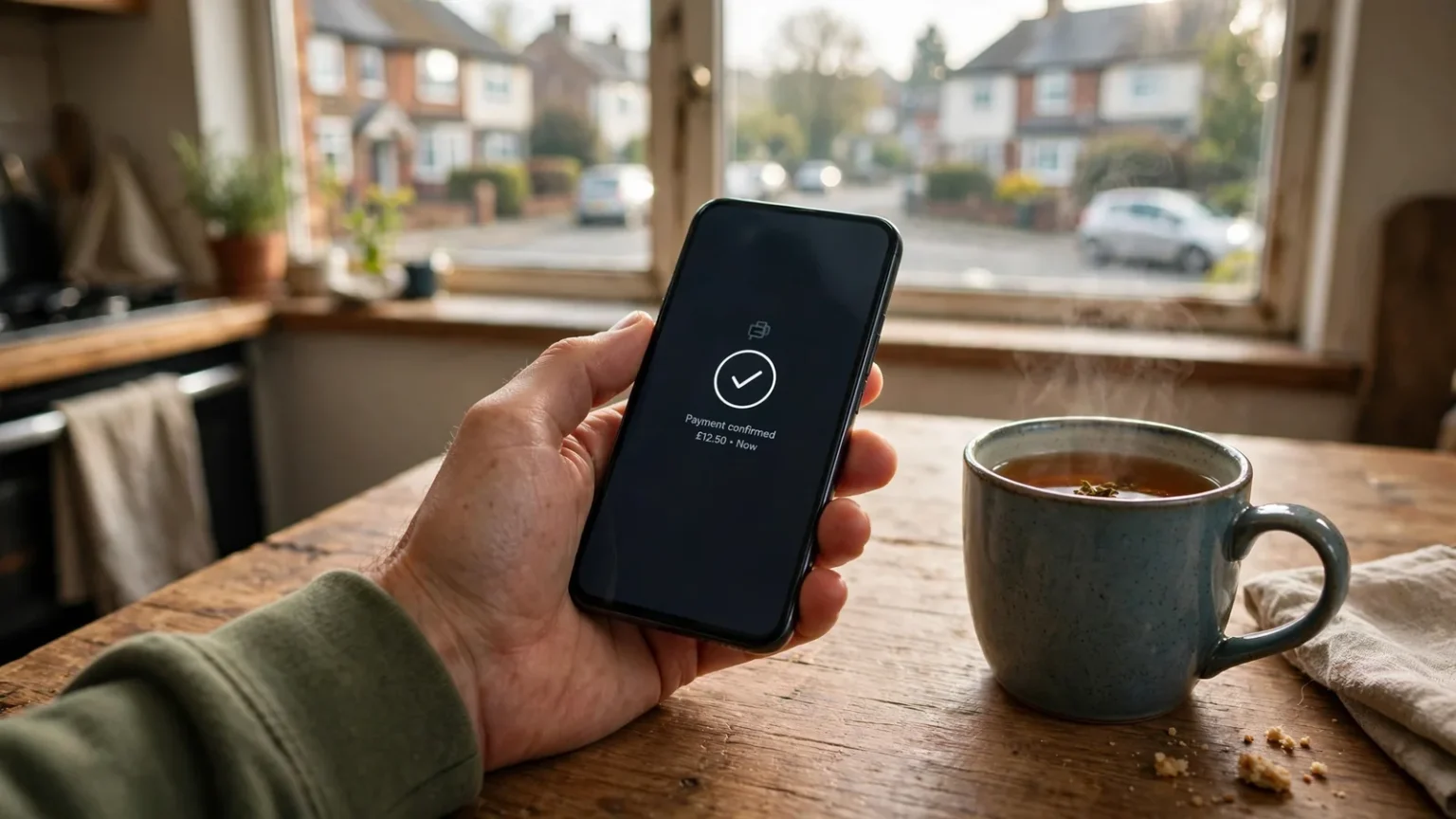
Mobile billing can fund eligible casino deposits, but network availability, deposit caps and separate withdrawal rules shape how it works.
Mobile Payments in the Casino Cashier
A casino cashier is less a single payment system than a set of routes into the same account. Pay by mobile sits among card payments, e-wallets and prepaid options, with each route shaped by different rules and practical conditions. Its appeal is plain: the payment is connected to a mobile account rather than entered as a conventional card transaction. But that convenience does not make it the default choice, or a shortcut around the safeguards attached to gambling.
In Great Britain, the first distinction is between debit and credit. UK Gambling Commission rules prevent remote gambling operators from accepting credit-card payments for gambling. The restriction also covers payments routed through a money service business, so a detour through an intermediary does not make credit-card gambling acceptable. It is a boundary around the source of the money, not merely the button displayed in the cashier.
That matters because a card logo alone does not tell the whole story. Debit cards remain an important route, while credit cards cannot be used to fund online gambling with a UK-licensed operator. A specialist review describes debit card deposits at UK casinos as free and more widely accepted than Payforit, but the live cashier is still the practical authority for a particular account. Payment arrangements can differ from one operator to another; a general description is not a promise that every method will appear at every cashier.
Independent specialist reviews also identify Visa and Mastercard alongside Skrill, Neteller and PaysafeCard, as well as several major cryptocurrencies, among payment methods accepted by casinos. That is a picture of the wider landscape, not a universal menu. Some listed methods may be absent from a particular operator’s cashier, and the existence of a payment brand elsewhere does not establish its availability at a chosen site. The cashier is where the broad market meets the individual account.
Mobile top-up casino UK: phone-bill deposits
Pay by mobile occupies a narrower place in that landscape. It can suit someone who wants a deposit associated with mobile service rather than a card or separate e-wallet. That distinction is useful, but it also means the method should not be mistaken for a card substitute with identical reach. Payforit is generally intended for mobile players, and mobile payment options depend on both the operator and the arrangements available to the account. The broad appeal of using a phone does not remove those limits.
There is also a social history in the cashier’s mixture of options. Cards belong to the everyday infrastructure of banking; e-wallets separate a transaction from the main card interface; prepaid products let spending begin with funds already set aside. Pay by mobile draws on a different familiar system: the mobile connection, already used for communication and services, becomes part of the payment route. These methods do not simply compete on speed or convenience. They reflect different habits around money, privacy and the boundary between household spending and leisure.
For UK players, regulation sets the frame. A remote casino serving customers in Great Britain must hold the relevant UK Gambling Commission licence, wherever the operator is based. Online gambling is legal for adults at sites with that licence. A polished cashier or a familiar payment logo does not establish that an operator is licensed; the payment method and the operator’s legal status are separate matters. Regulation is not decorative text beneath a logo.
Nor does a mobile payment label settle every question a new customer may have. It does not establish that a casino will offer a deposit without checks, that a payment will create an entitlement to a promotion, or that the method will suit every account. The cashier’s displayed terms and the operator’s account process matter. New customers must be prompted to consider a financial limit before making a first deposit, and financial-limit controls must remain available within the account afterwards. That is part of the payment environment too: the point at which money enters play is also a point at which spending boundaries should be visible.
Attention: A payment logo or a familiar mobile label does not establish that an operator is licensed by the UK Gambling Commission; the operator’s legal status is a separate matter.
The phrase “instant” can blur several different events into one. A payment route may be presented as a way to make a deposit, but that says nothing by itself about every later transaction or account condition. Likewise, a mobile option does not mean that a casino has no minimum deposit, no identity checks, or a special range of games. Those are separate questions, governed by the operator’s current terms and the account’s circumstances.
The useful comparison, then, is not a contest in which one method wins for everyone. Debit cards have wider reported acceptance than Payforit, according to specialist review material, while mobile payment offers a distinct route for those whose cashier provides it. E-wallets and prepaid options form further alternatives, though their availability should not be assumed. A current cashier check is unglamorous, but it is more reliable than a broad promise attached to a payment label.
The cashier is where convenience meets regulation, and where the general idea of paying by mobile becomes a specific choice. No logo can do that checking on its own.
Payforit: From SMS Confirmation to Casino Deposit
Payforit turns a casino deposit into a short exchange between the cashier and a mobile phone. It is generally intended for people using a mobile device, rather than those completing a payment from a desktop computer. That makes the method feel less like entering card details and more like confirming a request through the handset already in use.
iPad Casinos UK: Browser Play and Payments
The sequence begins in the casino account’s cashier. After choosing Payforit as the deposit method, the player enters a mobile number. The service then sends an SMS containing a confirmation code. That code must be submitted to complete the request; selecting Payforit alone does not authorise the deposit. Once confirmed, the funds are transferred to the casino account, and Payforit deposits are described as instant.
The steps are simple, but each one matters. The number must be entered accurately, the message must arrive, and the code must be submitted in the cashier as instructed. The SMS is the point at which a proposed payment becomes an authorised one. In practical terms, the process asks the person holding the phone to confirm the transaction, rather than relying on card details typed into a form.
That distinction shapes the experience of a pay-by-mobile casino. Payforit is generally reserved for mobile players, so its presence in a cashier does not make it a universal option across every device or account. A casino may offer several ways to deposit, but Payforit belongs to the narrower category that depends on a mobile number and SMS confirmation. It is therefore worth separating “the casino accepts Payforit” from “Payforit is available for every visit, device or customer.” The cashier is where the actual route appears.
Before any deposit, a new remote customer must be prompted to consider a financial limit. Account-level limit facilities must remain accessible after that first decision, too. The prompt is part of the regulated setting in which the payment takes place, not an optional flourish added by a cashier designer. Operators must also verify a customer’s age before allowing a deposit. A phone-based confirmation does not replace those responsibilities; it confirms the payment request, not a person’s eligibility to gamble.
Payforit Deposit Process
Step 1: Selection
Log into the account, reach the cashier, and select Payforit as the deposit method.
Step 2: Mobile Entry
Enter the mobile phone number in the cashier.
Step 3: SMS Confirmation
Receive the SMS confirmation code on the handset and submit it in the cashier to authorise the deposit.
The order of events is consequently important. The customer logs into an account, reaches the cashier, selects Payforit, enters the number and responds to the SMS. The casino’s own account checks sit alongside that sequence. If a deposit option is shown, that does not mean every other requirement has vanished. A payment method is one part of the transaction; the account remains subject to the operator’s identity and age controls.
There is also a difference between being able to deposit and being able to claim a promotion. Specialist casino reviews report that most UK casinos exclude Payforit deposits from welcome bonuses and other promotional offers. The detail can change between operators and over time, so a promotion’s own terms remain decisive. A payment screen showing Payforit is not evidence that a bonus will attach to a deposit made with it.
This separation is easy to miss because the cashier and the promotions page often sit close together on a casino site. Yet they answer different questions. The cashier identifies the methods available for putting money into an account; the promotion terms determine which deposits qualify for an offer. A deposit can complete successfully while remaining ineligible for a welcome incentive. No contradiction there.
For someone comparing an online casino with Payforit against one using another payment route, the practical test is not whether the method sounds convenient in the abstract. It is whether the current cashier offers it for that account and whether the applicable promotion terms allow the intended use. Payforit’s mobile-only character and SMS step are fixed features of its basic process; the surrounding conditions belong to the operator.
Casinos That Accept Apple Pay in the UK
The appeal is plain: the deposit is confirmed on the phone, without entering card details into the casino cashier. The limitation is equally plain: the method is tied to mobile use and to the operator’s own payment and promotion rules. A neat little transaction. Not a promise of a bonus.
Checking Whether a Casino Accepts Pay by Mobile
A casino’s general description can lag behind its cashier. Payment options change, and a page that mentions Payforit does not necessarily establish that it is available to every account, on every device, or at the time a deposit is being considered. The current cashier is the practical record: it shows which methods the operator is offering in that moment.
That distinction matters with pay by mobile. A casino may describe itself as accepting mobile payments while the cashier lists another method, or may discuss Payforit in older promotional material after its availability has changed. A current cashier page is stronger evidence than a broad claim on a landing page, a comparison table, or a search result. Payment arrangements are not permanent features of a brand.
Specialist payment reviews identify Kwiff, NetBet, JackpotJoy and Virgin Games among UKGC-licensed operators where Payforit remains available through the cashier. That is a useful place to begin, not a substitute for checking the operator’s own current payment screen. The word “available” has to mean available to the account in question, rather than mentioned somewhere on the site.
Kwiff
UKGC-licensed operator where Payforit is reported as available through the cashier.
NetBet
UKGC-licensed operator where Payforit is reported as available through the cashier.
JackpotJoy
UKGC-licensed operator where Payforit is reported as available through the cashier.
Virgin Games
UKGC-licensed operator where Payforit is reported as available through the cashier.
What the cashier can confirm
The cashier gives a direct answer to the narrow question: is Payforit currently offered as a deposit method? If it appears among the listed options, that is more persuasive than a general statement that a casino accepts pay by mobile. If it does not appear, an old review or an article naming the brand cannot make it available.
The check should take place within the casino account, before a deposit is made. Payment options can be presented differently across operators, and the cashier is where account-specific conditions and controls are displayed. A method named on an information page may not be enabled for a particular account. A cashier that lists Payforit provides a more concrete indication; it still does not settle every question about the payment’s terms.
This is not an argument for treating a cashier as a promise that nothing can change. It is a snapshot of the operator’s present offer. If the option is absent, the absence is meaningful for that account at that time; if it is present, the operator’s displayed conditions still govern. Promotional copy has a longer shelf life than payment menus. Sometimes too long.
The licence is part of the check
For UK players, payment availability is only one part of whether a casino belongs in the relevant market. Remote gambling operators selling into Great Britain must hold the appropriate UK Gambling Commission licence, regardless of where the company is based. The legal status of a casino therefore cannot be inferred from the fact that it accepts Payforit, nor from a familiar brand name.
Casinos That Accept Google Pay in the UK
The operator’s licensing information should be checked alongside its cashier. A payment method does not certify the site, and a list of casinos accepting Payforit is not, by itself, a list of lawful choices for UK customers. The names above are identified as UKGC-licensed operators in specialist payment reviews; the live cashier confirms the payment option, while the current licence status remains a separate condition to verify.
The distinction is useful because payment pages and regulatory details answer different questions. One establishes whether a deposit route is offered. The other establishes whether the operator is authorised to serve the market. Neither should be used as a proxy for the other.
Treat lists as leads, not guarantees
A list of online casinos that accept pay by mobile deposits can make comparison easier, but it cannot replace the final check. The point is especially clear with Payforit: availability can change, and a review that once recorded the method may no longer describe the cashier now in front of a player. Even a recently updated overview cannot show account-specific availability as reliably as the operator’s own payment page.
For Kwiff, NetBet, JackpotJoy and Virgin Games, specialist payment reviews report Payforit at the cashier. That gives the names a concrete basis, without turning them into a permanent directory. The cashier remains the deciding evidence before depositing. The licence check remains necessary too.
A careful check is deliberately unglamorous: confirm the method in the live cashier, read the operator’s displayed terms, and establish that the site holds a current UKGC licence. That is more dependable than treating a brand’s general payment claims as a standing guarantee.
Do
- Confirm the method in the live cashier
- Read the operator’s displayed terms
- Verify the current UKGC licence status
Don’t
- Rely on general payment claims
- Trust outdated review lists
- Use a payment logo as a proxy for licensing
Best casino sites in the UK
- BritsinoBonus: Welcome Package – Get your £2,200 + 2,000 FS · Payout speed: 1-3 business days
- BeOnBetBonus: 100% up to €500 + 100 FS · Payout speed: 1-3 business days
- Revery PlayBonus: 100% up to€1,000+ 100 FS · Payout speed: 1-3 business days
- EvoSpinBonus: 125% up to €2500 + 125 Free Spins · Payout speed: 1-3 business days
- WinBeastBonus: €5000 + 500 FS + €650 Freebet · Payout speed: 1-3 business days
- SpinFormulaBonus: 550% Up To £15,000 + 550 FS · Payout speed: 1-3 business days
- JetsetspinsBonus: 200% Bonus + 100 Free Spins + Free Royal Wheel · Payout speed: 1-3 business days
- NightWinBonus: £900 + 400 free spins · Payout speed: 1-3 business days
- NightLuckBonus: Welcome Pack + 805% Up To 6400€ + 280 FS · Payout speed: 1-3 business days
Pay by Mobile for Slots: What the Payment Facts Actually Show
The phrase “slots payable by mobile” can make two separate things sound like one: a way to fund a casino account and a catalogue of games. They are not the same question. Pay by mobile describes a payment route; it does not, by itself, identify which slot games an account can open or play. A casino’s cashier and its game lobby answer different questions.
That distinction matters because a payment option is not a promise about a particular title. Seeing Payforit, or another mobile-payment method, in a cashier does not establish that a named slot is available, compatible or accessible under every account condition. Nor does a game appearing in a casino’s lobby confirm that its deposit methods include pay by mobile. The two checks should not be collapsed into one.
Independent specialist reviews identify Boku, e-wallets and Paysafecard as alternatives to Payforit. That is useful as a map of possible payment categories, not as a guarantee that every casino accepts each one. Availability depends on the operator and the current cashier; a method described in a general review may not appear for a particular account. Payment names alone cannot settle what a specific casino currently offers.
The word “mobile” can also refer simply to the device used to visit a casino. Someone playing slots on a phone may fund the account by another route, while someone using Payforit is not thereby assured access to a particular game. A phone screen says where the session takes place, not which payment method funded it. Small distinctions, large consequences.
UK Casinos That Accept Boku Pay by Phone
For a British player looking for online slots that can be funded by mobile, the practical check is therefore two-part. The current cashier shows whether Payforit or another relevant method is offered to that account. The casino’s game lobby shows which games are available there. Neither screen should be treated as a substitute for the other, and a general claim about “mobile slots” cannot establish a specific pairing.
There is a further reason to keep the categories apart. Payment labels describe how money may enter an account; game labels describe the entertainment available once an account is funded. Treating the first as evidence of the second turns a broad category into a claim it cannot support. A search for a slot site accepting mobile payment may help locate operators to investigate, but it cannot verify the live cashier or confirm a particular title.
Boku, e-wallets and Paysafecard belong in the conversation as alternatives to Payforit, not as evidence that a particular slot can be bought, unlocked or played through any one method. The cashier is the place to confirm the payment option; the game lobby is the place to confirm the available catalogue. For real-money play in Britain, the operator must also hold a UKGC licence. That is a separate check, not a feature of the payment method.
Payment labels describe how money enters an account, whereas game labels describe the entertainment available; one is not evidence of the other.
“Pay by mobile slots” is best understood as a request about funding a casino account while playing on a phone, rather than a special class of games. The payment route may shape how an account is funded, but it does not name the reels. A catalogue and a cashier remain two different ledgers.
Pay by Mobile and GamStop: A Necessary Distinction
A casino’s payment menu and its relationship with GamStop are separate matters. Pay by mobile describes how a deposit is funded; it does not, by itself, establish whether an operator participates in the self-exclusion scheme. The presence of Payforit or another phone-payment option is not evidence that a casino is outside GamStop, any more than the absence of that option proves the reverse.
That distinction matters because searches for a pay-by-mobile casino not on GamStop can make two different questions sound like one. One concerns the cashier: which payment methods are available to an account? The other concerns the operator’s position in relation to GamStop. A payment method cannot answer the second question. Treating it as a shortcut would turn a detail of the transaction into a claim about the operator that it cannot support.
The same applies to searches for pay-by-mobile slots without GamStop. A slot is a game, not a statement about the casino’s scheme status, and a phone-funded deposit does not change that. There is no reliable inference from “pay by mobile” to “not on GamStop”. The wording may join them; the underlying facts do not.
Casinos that accept Siru Mobile in the UK
There is a further distinction between a scheme’s status and the controls built into an individual gambling account. UK rules require remote operators to invite new customers to consider setting a financial limit before the first deposit. Limit controls must also remain available through the account afterwards. These are account-level safeguards: they concern how much a person chooses to make available for gambling, rather than which payment route is used or whether an operator participates in GamStop.
The sequence is telling. A limit is considered before money enters the account, and the facility remains accessible once the account is active. That places a measure of control at the point where a balance is created and keeps it within reach later. It does not make Payforit a GamStop indicator, nor does it settle the operator’s status.
The phrase “pay by mobile casino not on GamStop” therefore needs careful reading. It combines a method of payment with a separate question about the operator. The cashier can show which payment choices are offered; that information should not be stretched into an answer about GamStop. Equally, a casino’s statement about the scheme would not establish which deposit methods are available to a particular account.
A cautious account of pay by mobile and GamStop keeps those categories apart. Payment tells how a deposit is made. GamStop status is a different matter. Financial limits belong to the account’s controls, and their availability does not convert one question into another. No inference should be drawn from the phone.
Why Pay by Mobile Deposits Do Not Withdraw the Winnings
Paying by phone and receiving a withdrawal are separate parts of a casino account. Payforit can put a deposit through the phone account or prepaid balance, but it cannot carry casino funds back out. A successful deposit, therefore, says nothing about which payout routes the operator makes available.
Withdrawal Limit
Payforit is a deposit-only method and cannot be used to withdraw casino winnings back to a phone bill or prepaid balance.
A specialist payment review may describe possible UK-licensed casino withdrawal methods such as a debit card, bank transfer, PayPal, Skrill or Neteller. That is a description of options found across the market, not a promise that every method will appear at every casino. The account’s cashier and the operator’s current terms are the practical reference: available routes can depend on the operator and the account.
Before making a deposit, the payout route should be checked alongside any outstanding identity requirements. Verification can involve requests for information or documents, and an unresolved check may affect the progress of a withdrawal. The payment details must also match the account holder’s information; a route that cannot be verified is of little use, however familiar its name may be.
The same-method rule should not be assumed either way. Some non-UK casinos require a withdrawal through the deposit method, but that does not establish that a UK-licensed casino will return a Payforit deposit by phone. Payforit is not a withdrawal route. A bank account, e-wallet or another verified payment source may be needed instead, subject to the account’s available options and current terms.
A “fast withdrawal” label is not a substitute for checking the route, verification status and processing information shown in the cashier. Withdrawal methods, limits, fees and processing statements can change; public banking information does not settle the terms for a particular account. The cashier does.
Before the first deposit, new customers must be prompted to consider a financial limit, and account-level limits must remain accessible afterwards. That is a separate safeguard from withdrawal planning, but both belong to the same unglamorous arithmetic: money entering an account is not automatically money that can leave by the same door.
Deposit Minimums, Maximums and the £30 Ceiling
Payforit deposits sit within a narrow band compared with many other ways of funding a casino account. A specialist payment review gives a typical minimum of £3 to £5, while the Phone-paid Services Authority caps each transaction at £30. The lower figure is not a universal tariff: the amount accepted depends on the operator’s cashier and the limits applied to the account.
That distinction matters when a cashier advertises a £3 minimum. It describes the smallest deposit the operator will accept through that route, not a promise that every Payforit transaction starts at that amount. A different casino may set a higher minimum, or the account may have financial controls that prevent a deposit even when it falls within the operator’s stated range.
The £30 ceiling is the firmer boundary. It applies to each Payforit transaction, rather than setting a target or a recommended spend. It is not a figure to work around by dividing a larger intended deposit into multiple payments. A small cap is still a cap.
Before depositing, the current cashier is the practical record of the operator’s minimum, maximum transaction value and any fee. It should also be checked for account-level financial limits. UK remote operators must prompt new customers to consider setting a financial limit before their first deposit, and those controls must remain accessible afterwards. A payment route’s stated ceiling does not override a limit already set on the account.
Typical Minimum Deposit £3 to £5
Transaction Ceiling £30
Regulated Limit Financial limit prompt required before first deposit
Searches for a £3 or £5 mobile deposit often reflect the lower end of the advertised range, but neither amount defines Payforit across every casino. Nor does the absence of a deposit requirement establish anything about the terms of a no-deposit offer; those are separate conditions. The cashier determines whether a particular amount can be submitted, while the account’s controls determine whether it can proceed.
The amounts are modest by design. For a player comparing payment routes, the useful figures are the ones displayed for that account at the time of deposit—not a remembered minimum from another operator, and not an assumption that the full transaction cap will be available.
Comparing Mobile Casino Payment Conditions
A comparison of casino payment conditions is less like choosing a winner than reading the small print on several moving targets. A payment option can look attractive in a general description, yet the terms attached to it depend on the operator and the method selected. A specialist review can offer a snapshot, but it cannot replace the cashier currently attached to an account.
The useful comparison is practical: check the minimum deposit, maximum transaction value, any fee, and the stated processing time. Those details may differ between methods at the same casino, as well as between casinos offering the same method. A low minimum does not establish that a payment will be inexpensive; a stated processing time is not a permanent promise. Conditions can change.
The same care applies to withdrawals. Deposit and payout arrangements are not interchangeable by assumption, and withdrawal methods, limits, charges and processing statements may be revised. The live cashier and the operator’s current terms are the relevant record, not a page saved from an earlier visit. Any comparison that omits the date or the payment method risks comparing unlike things.
For someone considering pay by mobile, the cashier should be checked for the option itself and for its transaction conditions. The comparison with cards or other listed methods should use the same questions: what is the minimum, what is the maximum, whether a fee applies, and how the operator describes processing. No method is best in the abstract. Its terms must fit the particular account and the intended transaction.
Before a first deposit, new remote customers must be prompted to consider a financial limit; account-level limit facilities must remain available afterwards. That belongs beside payment conditions, not beneath them as decorative fine print. A payment comparison concerns more than the route by which money enters an account. It also concerns the controls around that decision.
Static promises age. Cashiers change.
When a Casino Deposit Lands on the Phone Bill
A pay-by-mobile casino deposit does not come from a bank card or arrive as a separate cash payment. With Payforit, the charge is attached to the mobile account: the route it takes depends on whether the phone is on a monthly contract or uses Pay as You Go.
How charges appear on phone accounts
On a monthly contract, the deposit is added to a future phone bill as part of the network charges. On Pay as You Go, the deposit is deducted from the prepaid credit already held on the phone.
On a monthly contract, the deposit is added to a future phone bill. It becomes part of the amount due to the network, alongside the account’s other charges. The casino deposit may therefore be visible through the phone account rather than as a card transaction on a bank statement. On Pay as You Go, the same kind of deposit is taken from prepaid credit already held on the phone. There is no later monthly invoice for that amount; the available balance is reduced.
That difference matters when considering a mobile casino pay-by-mobile bill option. A contract customer is putting a charge onto a bill to be settled later, while a Pay as You Go customer spends existing credit. Neither route turns the phone account into a casino wallet. The network is the channel through which the deposit is charged, not a place where casino winnings are stored.
Payforit is a deposit method, not a withdrawal route. Funds cannot be sent back to a phone bill or restored to Pay as You Go credit as a casino withdrawal. A player who deposited this way therefore needs to consider the casino’s separate payout options; the phone account does not complete the other half of the transaction.
There is a small but important distinction between “paid by phone” and “paid from a phone bill”. The first describes the payment channel; the second describes where the charge lands. For a contract account, it is a future bill. For prepaid service, it is existing credit. In both cases, Payforit moves money into the casino account only. It does not provide a route for money to travel back.
The arrangement makes a casino deposit feel close to an ordinary phone purchase, but the destination is different. The charge may sit with network costs; the gambling balance remains with the casino. Two accounts, two purposes.
Boku by SMS: Confirmation, Credit and Network Fees
Boku is a pay-by-mobile option, but its presence should not be inferred from a casino’s general payment information. The current cashier is the practical record: it shows whether Boku is offered for that account and what terms apply at the point of deposit. A site described elsewhere as a pay-by-mobile casino may support another method, or no phone payment at all.
Where Boku is available, the deposit depends on a text-message confirmation. The customer selects Boku in the cashier and follows the prompt to confirm the transaction by SMS. The money does not move merely because a mobile number has been entered; the confirmation is the step that authorises the payment. A missed or uncompleted message can therefore leave the deposit unfinished.
A specialist review gives Boku a standard ceiling of £30 for each transaction. That figure is a limit, not a suggested spend, and it does not establish what a particular casino will accept below the cap. The operator’s cashier remains decisive for the amount permitted on that account.
The phone balance also has to stretch beyond the deposit itself. A specialist review notes that available credit must cover both the chosen amount and any network processing fee. Such a fee can vary with the mobile network and tariff, so a balance equal only to the deposit may not be enough. The charge is not a casino bonus or an extra gambling balance; it is part of the cost of using the payment route.
This matters when a Boku option appears alongside promotions. The cashier and the offer’s terms determine whether a deposit method qualifies; the presence of a promo code does not establish eligibility. The same check applies to any purported pay-by-mobile slot site: the payment method does not guarantee access to particular games, and Boku support should be confirmed before a deposit is attempted.
The distinction is plain, if unglamorous: SMS confirmation authorises the payment, while sufficient phone credit makes it possible. The cashier supplies the particulars.
Can I withdraw casino winnings to my phone bill with Payforit?
No. Payforit can be used for deposits, but not for withdrawing casino funds.
What is the maximum I can deposit with Boku at a UK casino?
Boku deposits are capped at £30 per transaction.
Is Boku gambling legal in the UK?
Yes, adults can gamble at UK Gambling Commission-licensed sites. Check that the casino is licensed and that Boku is available in its cashier.
What are the withdrawal limits when using a Payforit casino?
Payforit cannot be used to withdraw casino funds, so there are no Payforit withdrawal limits.
Can I claim casino bonuses using Payforit?
Usually not: most UK casinos exclude Payforit deposits from welcome bonuses and other promotions. Check the casino’s current promotion terms.
Material created by the team Pure Casino UK Guide


