

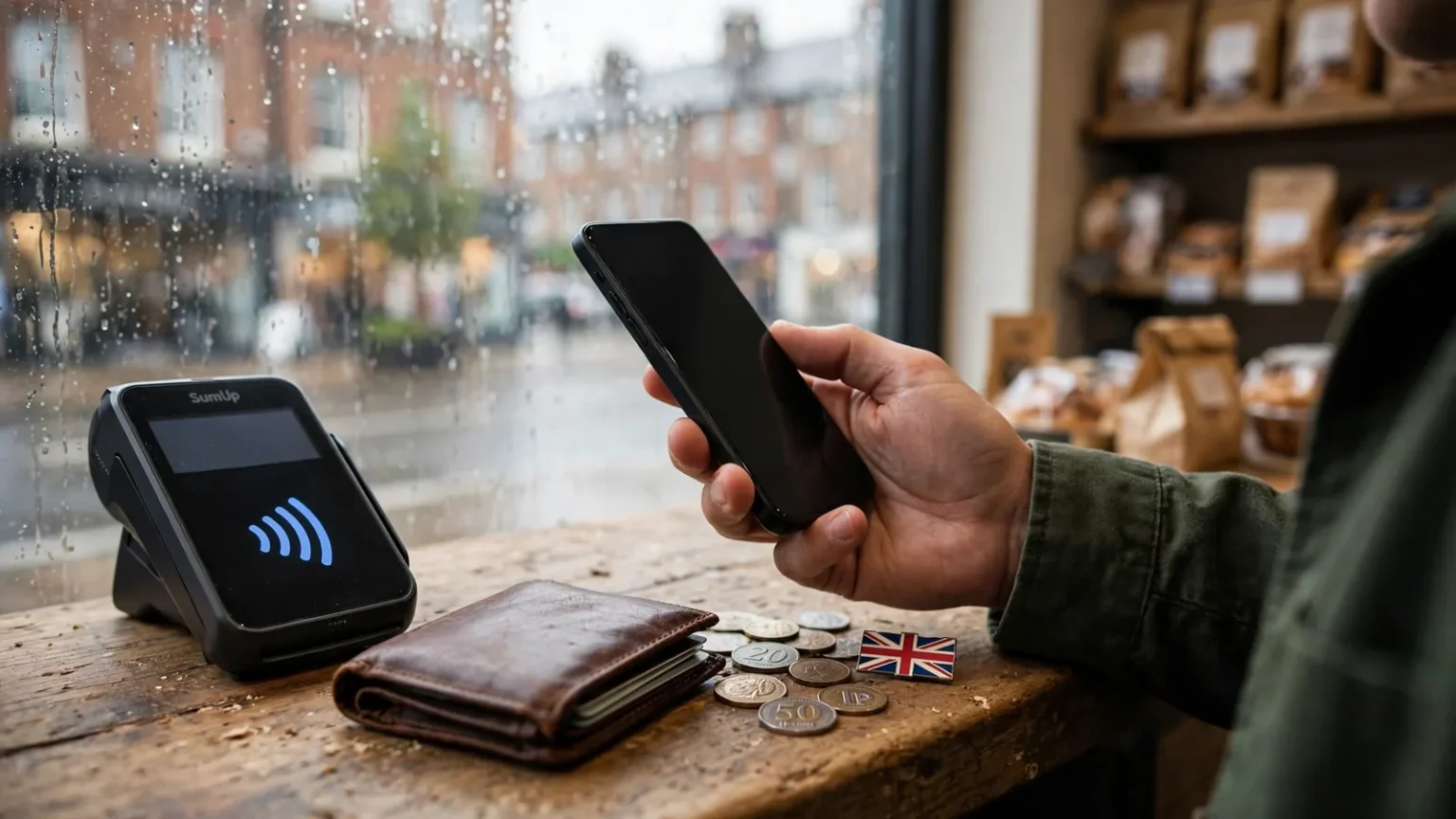
Acceptance can vary by cashier, while withdrawal timing, account limits and currency conversion affect how an e-wallet works.
Which e-wallets appear at UK casino cashiers
An e-wallet is a payment account that sits between a bank or card and a merchant. At a casino cashier, that distinction matters: a familiar logo can represent a different kind of route from a debit card or bank transfer, and the word “wallet” does not describe one uniform service. UK casinos commonly accept Visa and Mastercard debit cards, but those are card payments, not e-wallets.
PayPal is one of the recognisable names in this category. A specialist review describes it as popular for speed and convenience, while also noting that a casino may exclude PayPal deposits from bonus eligibility. That is a reported qualification, not a rule that applies everywhere. The distinction is worth keeping in view: a payment method can be accepted for ordinary account funding while being treated differently under a promotion’s terms.
Skrill and Neteller belong to the same familiar family of digital payment accounts. A specialist review reports that some casino sites offer them and that they are often excluded from promotions. Neither point makes acceptance universal, nor does it mean that every promotion treats the two wallets alike. The cashier and the promotion’s own conditions describe separate parts of the arrangement.
These names can make an e-wallet casino sound like a single, stable category. In practice, the label covers a mixture of services and payment functions. Some options are electronic accounts; others may be a mobile payment interface, a prepaid voucher or a service that connects a bank account to a merchant. The cashier’s menu is therefore less a neat taxonomy than a set of routes, each with its own terms.
Apple Pay is a mobile wallet, and some UK Gambling Commission-licensed casinos accept it for deposits. Its presence is a concrete example of how the category extends beyond the traditional wallet accounts that have long appeared in online payment menus. It should not, on that basis alone, be assumed to have identical functions to PayPal, Skrill or Neteller.
Paysafecard is different again. It is a prepaid voucher and is deposit-only. That makes it an e-wallet-adjacent option in the broad language of casino payment pages, but not an all-purpose account for moving money in both directions. Treating every cashier option as interchangeable obscures this basic difference.
Casinos that accept Giropay in the UK: cashier checks
Bank transfer and open banking may appear beside wallets, but they are not e-wallets simply because a digital interface handles the payment. Trustly is a payment method associated with that bank-connected route. The distinction is useful when a site groups several electronic methods under a broad “payments” heading: the label on the menu may be less precise than the path the money actually takes.
The same caution applies to the phrase “online casinos with e-wallets”. It can mean a site accepts one wallet, several wallets, or a wider mixture of electronic payment services. It does not establish that the same options are available to every account, or that each named method serves the same purpose. A casino cashier is a menu of particular routes, not a promise that every wallet in circulation will work there.
That is why searches for UK casinos accepting e-wallets tend to produce a broader idea than the payment category itself. A reader may be looking for a recognisable digital account, a mobile wallet, or simply a way to avoid entering card details at the cashier. Those are related preferences, but they are not identical payment methods. The word “wallet” does a lot of work.
There is also a social history tucked into the menu. Traditional banking systems made payments legible through cards and accounts; digital wallets added another layer between a customer and a merchant. Casinos adopted these routes as part of a wider shift towards online commerce, where the interface often appears simpler than the institutions behind it. Convenience is the visible part. The names in the cashier reveal the more complicated structure.
For a reader comparing casino sites that accept e-wallets, the most useful first distinction is therefore not a ranking. It is the type of route: a wallet account such as PayPal, Skrill or Neteller; a mobile wallet such as Apple Pay; or a prepaid voucher such as Paysafecard. Some names are widely recognisable, while others appear only at particular sites. The category is broad; acceptance is specific.
Wallet Accounts
Digital accounts such as PayPal, Skrill, or Neteller used for funding and payouts.
Mobile Wallets
Interfaces like Apple Pay that extend the category beyond traditional wallet accounts.
Prepaid Vouchers
Deposit-only options such as Paysafecard that do not allow money to move in both directions.
Best casino sites in the UK
- BritsinoBonus: Welcome Package – Get your £2,200 + 2,000 FS · Payout speed: 1-3 business days
- BeOnBetBonus: 100% up to €500 + 100 FS · Payout speed: 1-3 business days
- Revery PlayBonus: 100% up to€1,000+ 100 FS · Payout speed: 1-3 business days
- EvoSpinBonus: 125% up to €2500 + 125 Free Spins · Payout speed: 1-3 business days
- WinBeastBonus: €5000 + 500 FS + €650 Freebet · Payout speed: 1-3 business days
- SpinFormulaBonus: 550% Up To £15,000 + 550 FS · Payout speed: 1-3 business days
- JetsetspinsBonus: 200% Bonus + 100 Free Spins + Free Royal Wheel · Payout speed: 1-3 business days
- NightWinBonus: £900 + 400 free spins · Payout speed: 1-3 business days
- NightLuckBonus: Welcome Pack + 805% Up To 6400€ + 280 FS · Payout speed: 1-3 business days
Availability depends on the cashier, not the label
“E-wallet casino” describes a category, not a promise that every wallet will work at every site. One casino may show PayPal at its cashier, another may offer Skrill, and a third may display a narrower set of options. Even where a payment brand is familiar, its presence in a general description does not establish that it is available for a particular account or transaction. The cashier is the practical record of what the operator currently offers.
That distinction matters because payment pages often compress complicated arrangements into a row of logos. A logo can signal that a method is supported in some circumstances; it does not explain every condition attached to it. Availability may differ between depositing and withdrawing, and a method may not appear for every customer. A label on a review page is therefore a starting point, not a receipt for compatibility.
Skrill illustrates the difference between broad visibility and site-level certainty. A specialist review describes it as one of the more common deposit methods at UK-friendly casino sites in 2026. That is a useful indication of its prominence, but it cannot establish that a particular cashier offers it today, or that it is available to a particular account. The distinction is less dramatic than a new payment technology, but more useful: popularity is not access.
Cards can be presented just as broadly. A specialist review of the supplied sites lists Visa and Mastercard, while also noting that current UK availability and eligibility for a particular card product need to be checked in the cashier. The brand name alone does not settle the question. A card may be absent from the options shown, or a particular product may not qualify. The cashier’s displayed choices are more precise than a general list.
Casinos That Accept iDEAL in the UK: How to Check
For an e-wallet online casino in the UK, the useful check is not whether the site calls itself wallet-friendly, but whether the desired method appears in the account’s own payment area. That page connects the operator’s general offering to the customer’s actual account. It is also where the difference between a marketing description and a usable option becomes visible.
A careful check separates several questions that are often blurred together. Is the wallet named at all? Is it available for the action being considered? Does the cashier show it for this account, rather than merely in a general payment-information page? Are there conditions attached to its use? The point is not to turn a routine payment into an investigation. It is to avoid treating a broad label as a complete answer.
The same logic applies to lists of e-wallet online casinos in the UK. A list can help identify sites worth examining, but it cannot replace the cashier check. Payment menus change, and descriptions may lag behind them. A page that once named a wallet may remain visible after the operator has changed its options; another site may add a method without changing every promotional page. No list can make those site-level details permanent.
There is also a difference between a method being mentioned and being selectable. A payment page may name a service as part of a general catalogue, while the cashier presents only the options currently enabled. Conversely, the cashier may make an option available without the site’s headline description giving it much attention. The account-level view is the one that answers the immediate question.
Do
- Check the account’s own payment area for available methods.
- Verify if a method is available for both depositing and withdrawing.
- Consult the live cashier for the most current options.
Don’t
- Assume a general “e-wallet casino” label guarantees a specific wallet.
- Treat a logo on a review page as a receipt for compatibility.
- Rely on headline descriptions instead of the account-level view.
This is why a “best” e-wallet casino cannot be chosen on the wallet label alone. The label says little about whether the preferred method is present, whether it serves the intended transaction, or whether the account can use it. A comparison becomes meaningful only when its claims are checked against the live cashier. Otherwise, the ranking risks measuring the quality of the description rather than the payment experience.
The same caution applies when a site advertises several payment routes. A menu with many names is not automatically more useful than one with fewer: the relevant detail is whether the needed method is actually offered. Nor does a familiar brand settle every question about a card product or account. The cashier narrows the broad claim to a specific choice.
Payment interfaces are administrative things, but they reveal how much a casino’s public identity can outrun its practical arrangements. “E-wallet casino” sounds like a settled classification. In reality, it is a loose description attached to options that remain specific to each site and account. The cashier is where that description either becomes concrete or stays decorative. A small distinction. A consequential one.
Deposits and withdrawals follow different clocks
A deposit and a payout are not simply the same transaction running in reverse. Money sent from an e-wallet first has to reach the casino’s payment system and be credited to the gambling account. A withdrawal begins elsewhere: the casino must approve it before funds can be sent out. The two entries may appear beside each other in the account history, but they pass through different stages.
That distinction matters when comparing online casinos that accept e-wallet deposits in the UK. A wallet displayed at the cashier tells only part of the story. The route back may be governed by the casino’s withdrawal rules and by anti-money laundering controls, not just by the wallet’s ability to receive funds.
Casinos That Accept Revolut in the UK: What to Check
UK anti-money laundering rules generally mean that a payout should go back to the original payment source. If an e-wallet funded the account, the casino may therefore direct the withdrawal to that wallet rather than allow a different destination to be chosen freely. This is often called a closed-loop approach: the funds follow the route by which they entered.
It is not a decorative rule. A payment route can help establish where the money came from and where it is going, which is why changing destinations may interrupt an otherwise ordinary payout. The casino’s cashier terms explain how it applies the rule, including what happens if the original method cannot receive the funds. The route matters.
The casino’s own approval stage also sits between a withdrawal request and the payment being sent. A balance shown as available for withdrawal is not necessarily money already on its way to the wallet. The operator may still need to review the request and confirm that the account is ready for payment.
Specialist reviews of casino withdrawals report that this internal processing can take longer for a first payout, while verification is completed. That is a report about how the process may work, not a fixed timetable for every casino. Later withdrawals can still depend on the operator’s checks and the account’s status.
KYC is part of this distinction between requesting a payout and receiving one. If verification is outstanding, the casino may need to complete it before approving the transaction. The first withdrawal can bring the account’s payment details and identity checks into sharper focus; a deposit having gone through does not, by itself, mean that every payout check has been completed.
UK anti-money laundering rules generally require a closed-loop approach, meaning payouts should go back to the original payment source.
For someone assessing casino sites that accept e-wallet deposits, the useful question is therefore not merely whether the wallet appears among deposit options. The withdrawal terms should explain whether the same wallet can receive payouts, how the casino handles a source that cannot accept a return payment, and what checks may delay approval. A deposit route and a payout route are connected, but not interchangeable.
This is also why a payout status needs to be read carefully. “Requested” or “pending” can describe a transaction still with the casino, before it has been released to the payment provider. Once the operator has approved it, the remaining movement is outside that internal queue. Those are separate parts of the journey, even when an account page compresses them into a single line.
The phrase best online casinos that accept e-wallet deposits can suggest that a wallet’s presence settles the question. It does not. For the full route, the cashier and withdrawal terms have to agree: the wallet must be accepted for the relevant transaction, and the casino’s rules must allow it to serve as the return destination. Otherwise, the deposit may be straightforward while the later request needs further handling.
A payout is a chain of permissions and transfers, not a mirror image of a deposit. The casino’s approval comes first; the original source remains central to where the money can go. Distinct clocks.
Casinos That Accept UKash in the UK: How to Check
Payment speed is not the same in both directions
A deposit and a withdrawal may use the same payment method yet move at very different speeds. Money going in can be authorised almost at once; money coming back has another stage to pass through, and the clock at the casino is not necessarily the clock at the bank. The cashier’s label alone tells little about when funds will be usable.
A specialist payment review places PayPal, open-banking services and debit cards connected to fast-payout systems among the quicker withdrawal routes. That is a comparison, not a promise attached to every casino or account. A payment still depends on the operator’s handling of the transaction and on the particular service in use. “Fast” describes a possible route, not a fixed arrival time.
The contrast is clearest with cards. A card deposit may appear immediately, while a payout sent back through a card route can take several business days, according to a specialist review. The first movement is an authorisation to fund play; the second is a transfer that must be processed and delivered. They share a familiar piece of plastic, not a shared timetable.
Bank transfers make timing more visible because the calendar and the bank’s working day enter the calculation. A specialist payment guide notes that delivery can be affected by the bank’s cut-off time, weekends and currency conversion. A request made after a cut-off may wait for processing to resume; a weekend can leave a transfer in the queue until the next working period. Conversion can add another step where the account and payment are not in the same currency.
Attention A deposit that arrives instantly does not establish that a withdrawal will do so too, as the two directions follow different clocks.
Open banking and bank transfers can support instant deposits and fast withdrawals at many sites, as one specialist review reports. “Can” matters. The cashier, the chosen bank and the timing of the request all shape what happens in practice. A deposit that arrives instantly does not establish that a withdrawal will do so too, and a fast route at one operator cannot be assumed to behave identically at another.
This distinction also changes what a published speed estimate means. A deposit estimate generally concerns the point at which money reaches the gambling balance. A withdrawal estimate may describe the casino’s handling, the payment provider’s transfer, or both. Without separating those stages, a single label can sound more definite than the process behind it. The figures are not necessarily contradictory; they may be measuring different journeys.
For anyone comparing e-wallet payment casinos in the UK, the useful detail is therefore not simply whether a method is described as quick. It is whether the stated timing applies to deposits, withdrawals, or both, and whether it is a processing estimate or an arrival estimate. If those distinctions are absent, the cashier’s own payment information is the more relevant guide than a broad description of the method.
Bank transfers are especially sensitive to timing around non-working days. An electronic request does not make every institution’s schedule continuous. Currency conversion can also sit between the casino’s release of funds and their appearance in an account, so a transfer crossing currencies may not follow the simplest route.
Speed is directional. A payment method can be brisk on the way in and patient on the way out; the calendar may then have its say. The cashier is not a stopwatch.
Casinos That Accept eCheck in the UK
The real cost can hide in the exchange rate
A payment can look free at the point of entry and still cost money along the way. A specialist payment review identifies several possible layers: a charge from the casino, a fee from the payment provider, an issuer or bank charge, currency conversion, and, where relevant, a network fee. None has to appear in the same place. The visible line in a cashier is only part of the account.
The first distinction is between a stated fee and a price built into the exchange rate. If a balance is held in a currency different from the one used for the payment, conversion may take place somewhere in the chain: at the casino, the wallet, the card issuer or the bank. The rate applied can matter more than a flat charge. A specialist payment review cautions that the conversion spread can exceed a visible fee. That is less dramatic than a deduction labelled “charge”, but the arithmetic does not care how politely a cost is named.
Currency choice therefore belongs in the comparison, not in the small print after it. A casino account set to one currency and a wallet balance held in another can create a conversion point. The same issue may arise between a casino balance and a bank account. Where a cashier or provider shows the currency and rate before confirmation, those details help make the total clearer; where it does not, the relevant terms become part of the calculation.
There may also be separate charges at different stages. The casino could apply its own fee; the payment service could have a separate schedule; a bank or card issuer may treat the transaction under its own rules. A network charge may be relevant to some payment routes. These are possibilities, not a universal tariff. A payment method with no casino fee is not necessarily free overall, just as a displayed provider fee does not describe every cost attached to the transaction.
Potential cost layers
Costs may arise from the casino, the payment provider, the issuer or bank, currency conversion spreads, or network fees.
The useful comparison is therefore not a generic ranking of wallets, cards and transfers. It is the cost of the actual amount through the actual route, with the currencies taken into account. A specialist payment review makes the same practical point: there is no single method that is automatically the cheapest. The result can change with the casino’s charges, the provider’s terms, the exchange-rate spread and any network cost.
A clean comparison records what leaves the original account and what reaches the casino balance, then checks the applicable terms for each intermediary. If a conversion is involved, the rate matters alongside any stated fee. Looking only for a “free deposit” label can miss costs that sit outside the casino cashier.
Payment language favours the simple version: one button, one amount, one confirmation. The underlying route may be less tidy. Fees have a habit of travelling separately.
One account, one consistent payment route
An e-wallet is more than a logo in a casino cashier. It is an account held by a person, with its own registered details and payment history. When those details correspond to the gambling account, routine checks have less room to snag on a simple mismatch. The point is not ceremonial neatness. Money moving between accounts needs a credible connection to the customer who owns them.
A difference in names, addresses or account details can prompt questions that have little to do with the transaction itself. A payment route registered to someone else may be difficult to reconcile with a casino account in a different name. Even where the explanation is ordinary, the operator has to establish whose funds are involved and whether the route is properly connected to that customer. Consistency removes one avoidable uncertainty; it does not replace the operator’s checks.
Casinos That Accept Tether in the UK: What’s Verified
For e-wallet casinos serving people in the UK, the practical distinction is between using a wallet as a personal account and treating it as a convenient channel detached from its owner. The account holder’s name should match the details supplied to the casino, and the wallet should belong to that same person. A payment method that looks interchangeable from the outside is not necessarily interchangeable in an account review.
The cleanest arrangement is often one named wallet used for both a deposit and a withdrawal. It gives the transaction a continuous identity: the same customer, the same account, the same route. Switching between several wallets or bringing another person’s payment account into the chain can create extra work, even when there is no intention to obscure anything. Money is not improved by having a cast of characters.
This is a matter of reducing friction, not guaranteeing a particular outcome. A casino may still need to confirm account information or request documents, and matching names alone cannot settle every question. But a consistent route makes the basic ownership picture easier to understand. It also leaves fewer loose ends for a payment review to chase.
The same principle applies beyond e-wallets. A card or bank account belonging to the customer presents a clearer link than a route registered to another person. For anyone comparing e-wallet casinos for UK players, the payment account’s ownership is therefore part of the method itself, not a minor detail to discover after a transaction has been started.
Using a single named wallet for both deposits and withdrawals creates a continuous identity and reduces friction during account reviews.
Consistency is quiet housekeeping. It rarely attracts attention when everything matches; it becomes conspicuous when it does not.
Deposit minimums, caps and account limits
A minimum deposit is a threshold set around a payment method, not a reliable measure of what a casino considers an ordinary stake. A specialist review puts common starting deposits in the £10–£20 range, while noting that the figure depends on the method selected. That should be read as a reported snapshot, not a standing market tariff: operators can change cashier conditions, and a wallet’s minimum need not match the one shown for a debit card or bank transfer.
The amount shown at the cashier is the useful one for a particular account. A deposit can be rejected if it falls below the method’s floor, even when the casino’s general description suggests a lower entry point. Conversely, a low minimum says nothing about how much may be deposited in a single transaction or across a longer period. These are separate settings, with different purposes.
Maximum deposits can be set per transaction, per day or per month. Their levels may differ by payment method and account status, so one figure cannot stand in for every route into the same casino. A payment provider may impose its own ceiling as well. The practical result is a set of overlapping boundaries rather than one simple maximum. Exact figures belong in the account cashier and payment terms, where the method and the customer’s status are visible.
Casinos That Accept POLi in the UK: What to Check
There is another limit, less like a cashier boundary and more like a rule about how gambling accounts are managed. UKGC rules require remote gambling licensees to prompt new customers to set a financial limit before their first deposit. Account-level limit controls must also be accessible. These controls let a customer set a ceiling on spending; they are not the same thing as the casino’s minimum deposit or a payment provider’s transaction cap.
That distinction matters in a market where payment interfaces can make money look like a sequence of convenient buttons. The regulatory limit is meant to put a decision about spending alongside the ability to fund an account, rather than leaving control entirely to the cashier. It does not make every deposit sensible, or transform a low minimum into a recommendation. The button is only the beginning.
Wallet names change; acceptance remains specific
EcoPayz is now Payz: the company rebranded in 2022. The older name has not vanished from the language of casino payments, though. It may still appear in older reviews, saved notes or conversations about a wallet that has since taken a different name. Treating EcoPayz and Payz as two separate current services can therefore create a false distinction.
That history matters when comparing references to a three-e-wallet casino or trying to identify a method by name. A familiar label may point to the same service under its newer branding; it does not establish that a particular casino accepts it. Payment names travel more slowly than company decisions, and a page that preserves an old label can outlast the cashier information it once described.
EcoPayz rebranded to Payz in 2022; while the name has changed, it remains the same service.
Jeton has a different sort of visibility. A specialist review reports that it remains available at a handful of UK online casinos in 2026. That is a limited, time-sensitive observation, not evidence of broad acceptance across the market. Its presence in a list or an older article is not enough to establish that it is currently offered by a particular operator.
The distinction is useful: Payz is a renamed service, while Jeton is a wallet whose reported availability is narrow. Neither name, on its own, tells the whole story of what a casino accepts. A payment label can be accurate as history and still be inadequate as a present-tense promise. Names endure. Cashiers decide.
Wallet deposits sit inside UK gambling rules
E-wallets can be used for online casino payments in the UK, but the wallet’s name is not the deciding factor. The relevant question is whether its funding arrangements comply with the rules that apply to gambling payments. Remote gambling licensees must not accept credit-card payments for gambling, including credit-card funds routed through a money service business.
The prohibition took effect on 14 April 2020 and remains in force. It reaches beyond a card entered directly at a casino: a digital wallet cannot be used to move credit-card money into gambling where that wallet permits such funds to be used for gambling. The boundary is about the source and permitted use of the money, not whether the payment screen looks like a card checkout or a wallet balance.
That does not make e-wallets unlawful as a category. A wallet funded in a way that does not breach the restriction may be eligible, subject to the operator’s own payment arrangements. But a familiar brand is no guarantee that every account or funding route is acceptable. Payment services can differ in what they allow, and the regulatory test is not satisfied merely because a transaction appears inside a wallet.
The wider setting matters too. Real-money casinos serving the British market must hold a Gambling Commission licence; the licence brings payment rules with it. A casino cannot treat a wallet as a loophole around the credit-card ban, even if the card issuer, wallet provider and casino each handle only one part of the transaction. The chain still leads to gambling.
Casinos That Accept USDC in the UK: Payment Guide
This is a deliberate distinction: electronic payment is not itself the problem; credit-card funding for gambling is. The rule follows the money. Dry, but consequential.
Payment security starts with the return route
A casino payment is not simply money arriving and later leaving by whichever route is most convenient. Returning funds to the original payment source is a common anti-fraud and anti-money-laundering control: it helps connect a withdrawal to the person and account that funded the play. For online casino e-wallets in the UK, that can mean a payout is directed back to the same wallet used for the deposit, where the operator’s rules and the payment method allow it.
This closed-loop approach also makes it harder to use a gambling account to move money between unrelated people or accounts. The restriction is not a judgement about a particular wallet. It is part of a wider effort to establish where funds came from and where they are going.
An alternative payout route may be possible, but it can bring additional checks. The casino may need to confirm ownership of the proposed account or clarify why the original source cannot be used. That can mean providing further information before the transaction is released. A changed bank account, an inaccessible wallet or a mismatch in account details can therefore become a security question, not merely a payment preference.
KYC matters here because verification links the casino account to its holder and supports checks on the payment route. A specialist review notes that withdrawal timing can depend on the operator’s approval process and whether the account is fully verified; security checks are one reason those stages cannot be treated as automatic.
The practical distinction is simple: a familiar payment brand does not guarantee that every onward route will be accepted. A wallet may be suitable for a deposit while the return route remains subject to the casino’s closed-loop rules and ownership checks. The money has a paper trail. That is the point.
Why must withdrawals return to the deposit method?
UK anti-money laundering rules usually require winnings to be sent back to the original payment source. Using another route may mean extra verification.
Are fast casino withdrawals guaranteed?
No. The casino’s approval process and your account’s verification status affect how quickly a withdrawal arrives.
Why can a fast payout casino still delay my withdrawal?
The casino must approve the withdrawal, and a first payout may take longer while verification is completed.
Material created by the team Pure Casino UK Guide


