

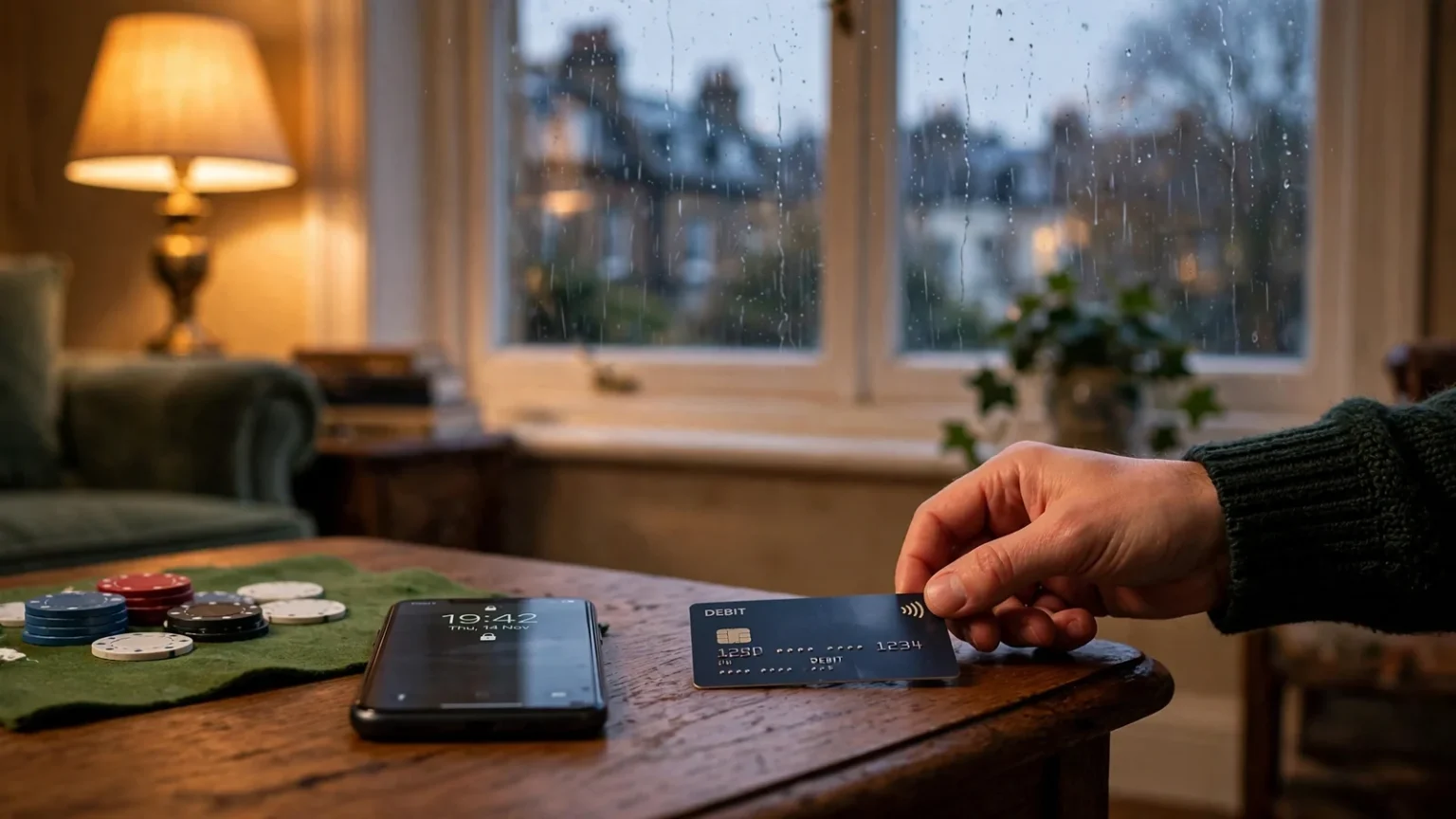
Visa and Mastercard listings do not guarantee every card will work, and deposit and withdrawal rules can differ.
Debit Cards in the UK Casino Cashier
Debit cards occupy a familiar place in the UK online casino cashier. Visa and Mastercard are commonly accepted, which makes card payment a recognisable option rather than an obscure feature of a particular site. That familiarity can make the method look more uniform than it is. A logo on a payment page is a starting point, not a promise that every card carrying that logo will work.
For anyone comparing debit card casinos in the UK, the useful distinction is between a network being listed and a particular card being eligible. Specialist casino reviews may list Visa and Mastercard among a site’s payment methods, but those summaries cannot establish what the cashier will accept for every customer at a given moment. Availability can change, and eligibility can depend on the card product and the operator’s payment arrangements. The cashier is the place where the current position becomes concrete.
This is a small but revealing feature of digital commerce: a payment network supplies broad reach, while the actual transaction passes through a chain of institutions and rules. The cardholder sees a familiar name; the casino sees a payment method whose acceptance must fit its own systems. The apparent simplicity belongs to the front of the card. Behind it, access is conditional.
Casinos That Accept USDC in the UK: Payment Guide
The phrase “casinos that accept debit card” therefore needs a practical reading. It means that the operator offers a card route in its cashier, not that every debit card issued under a supported network is guaranteed to be accepted. A card may be eligible at one casino and unavailable at another. Even where a cashier displays Visa or Mastercard, the payment screen should be checked before relying on that route. A general payment list can become stale; a live cashier is more relevant.
Debit cards also need to be kept distinct from credit cards. The UK Gambling Commission’s restriction on credit-card payments for gambling took effect on 14 April 2020 and remains in place. That does not make the two products interchangeable simply because both may carry Visa or Mastercard branding. The product type matters. A debit card draws on funds held in a bank account, while a credit card provides borrowing; the shared network name does not erase that difference. UK-licensed casinos cannot accept credit-card payments for gambling.
Casino Payments & Withdrawals in the UK
This distinction is part of the country’s attempt to shape the boundary between ordinary spending and gambling with borrowed money. Payment design is not neutral: the rule draws a line around which financial instruments remote gambling licensees may accept. The cashier is where that policy appears in everyday form, among the payment icons and fields.
A search for online casinos that accept debit card deposits may produce confident lists, but the practical question is narrower: does the chosen casino currently show the relevant card network, and is the specific debit product eligible? The answer should be checked in the operator’s cashier rather than inferred from a brand name or an old comparison page. This is not a claim that a payment method is unreliable; it is a reminder that acceptance is an operational detail, not a permanent property of a logo.
The same care applies to labels such as “top” or “best” debit card casinos. A ranking cannot make a card work where the cashier does not support it. Nor does a broad claim about card acceptance settle whether the individual card is recognised. For a useful comparison, the card route should first be confirmed at the site itself. Other considerations may matter later, but they do not change this basic test.
In practice, the cashier provides a more precise picture than a static list of payment methods. It can show which card routes are currently presented and whether the selected product can proceed. If the option is absent or the card is declined, the presence of a network logo elsewhere is not enough to establish that the route is available. That distinction keeps a search for UK debit card casinos grounded in what the operator is actually offering, rather than what a generic payment label seems to imply.
Debit cards are therefore a common, but not universal, part of the UK casino payment landscape. Visa and Mastercard are familiar names; acceptance still has to be confirmed at the point of use, and debit eligibility should not be confused with credit-card access. The cashier is less a decorative menu than a live statement of what the operator can process. No logo can do that job on its own.
Credit Card Ban
UK-licensed casinos are prohibited from accepting credit-card payments for gambling, a restriction in place since 14 April 2020.
Best casino sites in the UK
- BritsinoBonus: Welcome Package – Get your £2,200 + 2,000 FS · Payout speed: 1-3 business days
- BeOnBetBonus: 100% up to €500 + 100 FS · Payout speed: 1-3 business days
- Revery PlayBonus: 100% up to€1,000+ 100 FS · Payout speed: 1-3 business days
- EvoSpinBonus: 125% up to €2500 + 125 Free Spins · Payout speed: 1-3 business days
- WinBeastBonus: €5000 + 500 FS + €650 Freebet · Payout speed: 1-3 business days
- SpinFormulaBonus: 550% Up To £15,000 + 550 FS · Payout speed: 1-3 business days
- JetsetspinsBonus: 200% Bonus + 100 Free Spins + Free Royal Wheel · Payout speed: 1-3 business days
- NightWinBonus: £900 + 400 free spins · Payout speed: 1-3 business days
- NightLuckBonus: Welcome Pack + 805% Up To 6400€ + 280 FS · Payout speed: 1-3 business days
What Happens When a Debit Card Funds a Deposit
A debit-card deposit begins in the casino cashier, where the card option is selected and the amount is entered. The payment page then asks for the details needed to identify the card and route the request for authorisation. If the payment is approved, the casino credits the account balance. The steps are familiar from other online purchases; the difference is that the balance is intended for gambling, so the payment must pass through the operator’s own controls as well as the card system.
Visa and Mastercard are commonly used for this purpose at UK casinos, but their presence on a general payments page is not enough to establish that a particular card will work. The cashier is the practical test: it shows which methods are currently available to that account and may impose product-specific conditions. A debit card linked to a bank account is not the same product as a credit card, even when both carry a familiar card-network logo. The distinction matters in Britain, where credit-card payments for gambling are prohibited.
Once card details have been submitted, the bank or card issuer assesses the request. An authorisation can be declined, or the cashier may not offer the card route at all. That does not necessarily mean the casino has rejected the customer; the restriction may arise from the issuer, the card product, or the payment route available at that site. If the transaction is not approved, the casino balance is not funded through that attempt. A different method may be available, but its suitability depends on what the cashier supports and on the customer’s own banking arrangements.
Diners Club at UK Casinos: What Is Confirmed
There is a quiet social history in this small act of payment. A plastic card turns access to a gambling account into a familiar retail gesture: enter details, wait for approval, see a balance change. The convenience can make the transfer feel less consequential than the activity it enables. Yet the cashier is not merely a doorway. It is where the operator’s payment choices, a bank’s controls and the customer’s account meet.
Bank transfers and open-banking services offer a different route into the balance. A specialist casino-payment review describes these methods as capable of providing instant deposits at many sites. That is a description of possible service performance, not a promise that every transfer will be immediate. The payment may depend on the service offered by the casino, the bank’s response and the details entered during the transfer. A bank-transfer payment can also be affected by the bank’s cut-off times, weekends and currency conversion, as noted in specialist payment coverage. The route is therefore not simply a card payment with different branding: it involves a bank account transfer and its own timing conditions.
The choice between card and bank transfer often reflects how a person wants to move money, rather than a universal ranking of methods. A card is familiar and can be entered directly in the cashier. A bank-based service may connect the casino payment to an account without entering card details. Neither description settles which is more suitable in a particular case. Availability, the account used and the cashier’s instructions shape the actual experience.
Debit Deposit Process
Step 1: Method Selection
Select the debit card option in the casino cashier and enter the deposit amount.
Step 2: Detail Entry
Provide the required card details to identify the card and route the authorisation request.
Step 3: Approval and Credit
Wait for the bank or issuer to approve the transaction, after which the casino credits the account balance.
A prepaid voucher creates another kind of deposit. Paysafecard is a prepaid code used to add funds, rather than a direct debit from a bank account. That distinction can be useful for someone who wants to spend a balance already purchased for that purpose, but it also narrows what the method does: Paysafecard is deposit-only. It should not be mistaken for a general account that can be used for every stage of a casino transaction.
The cashier is where these differences become concrete. One option draws on a card account; another initiates a bank payment; a prepaid voucher applies a purchased value. The buttons may sit together on one screen, but they do not represent interchangeable paths. Even when the intention is simply to fund an account, each route has its own provider, approval process and conditions. The interface makes payment look uniform. It is not.
A successful deposit is also distinct from merely choosing a method. The payment must be accepted and the casino must reflect the funds in the account before they can be used for games. If the cashier displays an error or the balance does not update, repeating the payment without checking its status could create confusion. The sensible sequence is to read the on-screen response and confirm whether the first request went through before trying another route.
That is the deposit journey in miniature: select an available method, submit the payment, wait for approval and check that the balance has been credited. The route may be short. Its conditions are not.
Casinos That Accept Wirecard in the UK: What to Check
Comparing Card Payments Without a Universal Winner
Choosing a debit-card casino is not simply a matter of finding Visa or Mastercard in the cashier. The same payment can have a different practical cost depending on the currency of the gambling account and the route by which a transaction is converted. A UK debit card casino may display familiar payment logos while still requiring attention to the account’s currency before money moves.
A specialist review of casino payment pages reports GBP as a supported account currency. That does not make it safe to assume that every account is set up in pounds, or that the currency shown in a payment screen tells the whole story. The relevant detail is the account currency attached to the casino balance. If that differs from the currency of the card account, conversion may enter the transaction; the displayed deposit amount and the amount ultimately reflected by the bank can then be different in value.
This is why currency deserves attention before comparing payment methods. A card payment in pounds to a pound-denominated casino account avoids one potential conversion stage. Where the account uses another currency, the card issuer or another part of the payment route may apply its own exchange rate. The exchange rate itself can carry a spread, so the cost is not always visible as a separately labelled fee.
A comparison based only on a stated casino charge can therefore be misleading. A payment-method comparison in a specialist review notes that no route can be named as the lowest-cost option for every transaction. The relevant comparison includes the casino’s charges, the provider’s terms, currency conversion and network costs, assessed against the amount actually being moved. Those elements do not necessarily fall on the same party, and a visible charge is only one part of the calculation.
Currency Conversion
If the casino account currency differs from the card account currency, exchange rates and spreads may apply, affecting the final cost of the transaction.
The point is not that every card deposit carries all these costs, or that one particular party always charges them. It is that the total depends on the combination of account currency, payment route and the terms applying to that transaction. A debit card that appears inexpensive at one casino may not remain so when an account is denominated differently or conversion is involved. Comparisons need the same currency and the same transaction amount to mean anything.
The word “best” can conceal this distinction. A best online casino that accepts debit cards for one account may not be the best fit for another if the currency settings differ. Nor does the existence of card acceptance alone establish the final cost. The cashier can show which methods are currently offered, while the account details and payment terms determine what the transaction involves.
There is also a difference between the currency in which a casino advertises its games and the currency in which the balance is held. The latter is the one that matters for a deposit comparison. Checking it before the first transaction can prevent an avoidable conversion and make the payment amount easier to reconcile with the card statement.
For a fair comparison, the same questions apply to each candidate: is the account denominated in GBP, does the proposed payment cross currencies, and what costs apply to the actual amount? A site’s headline claim of card support answers only whether a route may be available; it does not settle these questions. The useful comparison is therefore not a league table of card casinos but a calculation tied to the account and payment being considered.
No universal winner.
Bitcoin Casinos in the UK: What Payment Pages Show
Deposit Limits and the Controls Around Them
A minimum deposit is a small figure with an outsized practical effect: it decides whether a payment route suits a modest top-up or requires a larger commitment. A specialist casino review reports that minimums begin in the £10–£20 range, with the amount depending on the payment method. That range is a reported snapshot, not a fixed rule for every UK casino or every debit-card deposit. The cashier’s stated minimum is the figure that applies to the transaction being made.
Maximums are less tidy. A specialist review reports that deposit ceilings can differ by payment method and account status, and may be set per transaction, per day or per month. A card may therefore have one cap for a single payment and another when deposits are considered across a longer period. Account-level checks can also affect what an operator permits. There is no single ceiling that can be carried from one casino to another.
These distinctions matter when a deposit is being planned around a personal budget. The minimum answers how little a payment can be; the maximum answers how much the cashier will accept under its current rules. Neither figure says what is affordable. A payment that passes the cashier’s test can still be out of step with the household budget. The software is not a financial adviser.
There is also a regulatory step before money enters a new remote gambling account. UK Gambling Commission rules require operators to prompt new customers to set a financial limit before their first deposit. They must also make account-level limit controls accessible, so limits can be reviewed and managed after registration rather than disappearing into a page of small print.
Do
- Use the cashier to check current minimum and maximum deposit limits.
- Set a personal financial limit before making the first deposit.
Don’t
- Assume a casino’s maximum deposit ceiling is a safe personal budget limit.
- Treat the first-deposit limit prompt as an optional decoration.
The distinction between a deposit ceiling and a personal financial limit is important. The casino’s maximum is a transaction rule: it restricts how much the payment system or account will accept. A customer-set limit is a safeguard intended to put a boundary around gambling spend. The two may operate at the same time, but they answer different questions. One concerns what the cashier allows; the other concerns what a person has chosen to keep within bounds.
The prompt is part of the account-opening process, not an optional decoration beside the deposit button. Setting a limit before the first payment makes the boundary visible at the moment funds are about to be committed. Accessible controls matter for the same reason: a safeguard that cannot readily be found is mostly ceremonial.
For debit-card deposits, the practical check is therefore broader than the amount entered into the payment box. The selected method may carry its own minimum or maximum, while the account can have separate financial controls. A rejected amount does not necessarily mean the card itself is unavailable; it may sit outside a payment cap or an account limit. The cashier’s wording should clarify which restriction applies.
These controls do not remove the need for personal judgement, but they make limits part of the transaction rather than an afterthought. Deposit thresholds belong to the machinery of the cashier; financial limits belong to the terms on which a person chooses to gamble. Both shape how much can go in. Only one is designed around the player’s own boundary.
Why a Card Deposit Can Be Instant but a Withdrawal Is Not
A debit-card deposit and a casino withdrawal travel through different parts of the payment system. The deposit can be authorised and credited quickly; money leaving the casino must first pass through the operator’s own approval process, then be sent through a payout route. A quick debit-card payment therefore says little about when a withdrawal will reach a bank account. Different journey.
Casinos That Accept iDEAL in the UK: How to Check
Specialist casino reviews describe card deposits as potentially instant while a payout may take several business days. That difference is not necessarily a sign that the card has stopped working. The casino may still be reviewing the withdrawal when the deposit was already accepted, and the bank or card provider has its own role after the casino releases the money. “Fast” can refer to only one leg of the journey.
There is also a rule about where the funds go. UK anti-money laundering requirements generally call for payouts to be returned to the original payment source. When a debit card funded the account, that can mean the casino withdrawal is directed back to that card rather than sent through an unrelated route. The purpose is to preserve a traceable path for funds, not to make a card behave like an instant cash transfer in both directions.
Before any payment is released, the operator may need to approve the withdrawal and complete checks on the account. This can include confirming identity and reviewing information relevant to the transaction. First withdrawals may take longer while verification is completed, as specialist casino reviews note. Once a payment is approved, processing by the payment provider and the bank still affects the arrival time. There is no single clock.
This explains why the phrase “online casino debit card fast withdrawal” needs qualification. Some specialist reviews place debit cards connected to fast payout systems among the quicker withdrawal routes, alongside PayPal and open banking services. That is a description of possible relative speed, not a promise that every card withdrawal will be fast. The particular casino’s process, the account’s verification status and the payment arrangement all matter.
Attention: A fast deposit does not guarantee a fast withdrawal, as payouts involve separate operator approvals and bank processing times.
A pending withdrawal can therefore reflect several distinct stages: the casino’s review, any outstanding verification, release of the payment, and the onward handling of the funds. A deposit confirmation covers none of those stages. Nor does a fast deposit establish that a payout has been approved; the two transactions are related by the account, but they are not mirror images.
The distinction is easy to miss because the cashier presents both actions as simple buttons. Behind them sit different checks and institutions, and a withdrawal has a longer chain of responsibility. A casino withdrawal to a debit card can be straightforward without being immediate. The button is the short part.
Keeping the Deposit and Payout Route Consistent
A debit card casino account is easier to reconcile when the casino account and the payment method point to the same person. The registered name, account details and cardholder information should agree. When they do, basic ownership checks are less likely to interrupt the transaction with questions that have little to do with the payment itself.
This is not a promise that a matching card will make every payout straightforward. It simply removes one avoidable source of uncertainty. A deposit made from an account in someone else’s name can leave the casino unable to establish that the funds belong to the customer who holds the gambling account. Even where there is an innocent explanation, the mismatch may need clarification before the transaction can proceed.
The cleanest route is often one named account used consistently for both deposit and withdrawal. That continuity makes the path of the funds easier to follow: the payment begins with an account tied to the customer and, where the operator’s process allows it, returns through the same route. A debit card casino site may offer several ways to pay, but more options do not necessarily make the account details behind them interchangeable.
Casinos That Accept Instadebit in the UK
Consistency matters beyond the card itself. If the casino account uses one person’s details and a payment account belongs to another, the route becomes harder to interpret. A bank account, e-wallet or card should not be treated as a convenient substitute for an account that does not match the registered customer. The issue is not merely neat paperwork; payment records help establish who supplied the funds and who is entitled to receive them.
Verification is a separate part of the picture. A specialist review notes that withdrawal speed can depend on the casino’s internal approval and whether the account has been fully verified. Matching ownership details may reduce one kind of friction, but it cannot replace the casino’s checks or determine how quickly it completes them. A first withdrawal may therefore involve attention to both identity and payment information, rather than a simple replay of the deposit.
For a casino with a debit card in the UK, the practical test is coherence: the gambling account belongs to the customer, and the payment route does too. A consistent route does not guarantee a particular outcome or timetable. It does make the basic story of the transaction easier to verify.
Less ambiguity.
Payment Methods Are Not Interchangeable
A casino that accepts debit cards may still offer a different set of other payment options from a competing site. The cashier is not a standard menu shared across the industry: a method’s presence depends on the individual operator, and its availability can change. For someone comparing an online casino that accepts debit card deposits in the UK, the card option therefore does not tell the whole story.
Apple Pay
Accepted for deposits at some UKGC-licensed casinos, but not a universal feature.
Skrill
One of the more common deposit methods across many UK-facing casino sites.
Jeton
Available at only a handful of sites in 2026; availability must be confirmed per operator.
Apple Pay illustrates the distinction. Some UKGC-licensed casinos accept it for deposits, but that does not make it a universal feature of licensed sites. Its appearance in one cashier is not evidence that it will appear in another. Nor should a deposit listing be read as confirmation that the same method is available for withdrawals; those functions need to be checked separately.
Skrill has a broader profile in a specialist review of UK-facing casino sites, which describes it as one of the more common deposit methods. That is a description of the sites considered in that review, not a promise that every casino will accept it. A cashier may include Skrill, omit it, or present a different mix of alternatives.
Jeton is more limited. A specialist review of UK online casinos reports that it remains available at a handful of sites in 2026. That makes it a method to look for where it is relevant, rather than a dependable feature of every casino that accepts debit card payments. Availability should be confirmed at the specific operator, not inferred from the name’s presence elsewhere.
These differences matter because payment names can create a false impression of interchangeability. Two casinos may both accept Visa and Mastercard yet diverge on Apple Pay, Skrill or Jeton. Even where a method is listed, the cashier’s stated use—deposit, withdrawal, or both—is what defines its role. A familiar logo is not a complete payment policy.
There is no meaningful universal ranking in which one casino becomes the best simply by displaying the longest row of payment logos. A top casino that accepts debit card deposits for one person may not offer the additional method another person expects. The useful comparison is narrower: which options the particular site currently supports, and for which transaction direction. The cashier, rather than a general list, settles that question.
Casinos That Accept Upaycard in the UK
When a Payment Method Affects Bonus Eligibility
A debit card can be accepted for deposits without making every promotion available. A casino welcome bonus has its own conditions, and the payment method can be one of them. The distinction is easy to miss: the cashier may approve a card transaction while the promotion’s rules exclude the method selected.
PayPal illustrates the gap between payment convenience and bonus access. A specialist casino review describes it as popular for speed and convenience, while noting that some promotions may not accept deposits made through it. That is a report about promotion terms, not a rule applying to every casino or offer. The terms attached to the specific bonus remain decisive.
The same caution applies to e-wallets. A specialist review reports that Skrill and Neteller are offered at some sites, but are often excluded from promotions. Availability in a cashier therefore says little, by itself, about whether a deposit qualifies for a welcome offer. A debit-card deposit may be eligible where an e-wallet deposit is not—or the terms may set different conditions.
The small print matters. Promotion pages may define which payment routes count, whether a qualifying deposit must be made in a particular way, and what happens if an excluded method is used. Those details belong to the individual offer; they cannot safely be inferred from a casino’s general payment list. A bonus labelled for debit-card use is not a universal category with standard rules.
Bonus Eligibility and Payment Methods
Certain payment methods, such as PayPal, Skrill, and Neteller, may be excluded from specific casino promotions or welcome bonuses. Always check the promotion’s small print to see which payment routes qualify for the offer.
This is why a “best” debit-card casino bonus cannot be judged by the headline alone. The useful comparison is between the offer’s eligibility terms and the method actually used. If an offer excludes a chosen wallet, switching to a card should not be assumed to solve every other condition; the full promotion rules still apply.
Promotions are not payments. They are contracts in miniature, and the payment route can decide whether one begins at all.
The Costs Hidden Beyond a Deposit Amount
The figure entered for a debit-card deposit is not necessarily the amount ultimately charged to the account. A specialist payment review identifies several possible layers: a casino charge, a payment-provider fee, a fee from the card issuer or bank, a card-network cost, and the effect of currency conversion. Which ones apply depends on the transaction; a list of possibilities is not a bill.
Currency deserves particular attention. If the casino account and the card are not operating in the same currency, the transaction may be converted along the way. The exchange rate can include a spread: the difference between the rate used for the payment and a reference market rate. A specialist review notes that this spread can cost more than a visible flat fee. The small, clearly labelled charge is not always the largest part of the arithmetic.
There may also be more than one conversion point. A casino could present a charge in one currency while the card issuer settles it in another, leaving the final amount shaped by the exchange rates and fees applied at each stage. The payment screen and the card statement can therefore tell different parts of the story: one records what the casino requested, the other what the account was debited.
For casino deposits with a debit card, the useful comparison is the total cost of the specific transaction, not the presence or absence of a single fee. The cashier may disclose its own charge, while the card provider’s terms explain issuer fees and conversion treatment. If the amount shown at confirmation differs from the expected debit, the statement can help identify where the difference arose.
Casinos That Accept Tether in the UK: What’s Verified
A deposit amount is only the starting point. The rate does the rest.
Card Restrictions, Fraud Checks and the Return of Funds
A Visa debit card and a credit card may look similar in a wallet, but UK gambling rules treat them differently. Credit-card payments for gambling were banned on 14 April 2020, and the restriction remains in force. UK-licensed casinos cannot accept a credit card for a gambling deposit, including when credit is routed through a money service business or a wallet that permits credit-card funds to be used for gambling. A debit card is not a workaround for that rule: the payment must genuinely come from an eligible debit-card product.
That distinction is part of what makes a safe debit card casino more than a cashier displaying the Visa name. The payment route must comply with the restrictions, and the operator must have controls to identify where money came from and where it can be returned. In the UK, anti-money-laundering and anti-fraud checks commonly require funds to go back to the original payment source. A different payout route is not automatically available simply because it appears easier.
When an alternative route is proposed, further checks may be needed to establish ownership and satisfy the operator’s procedures. That can mean providing additional information before the payment is approved. The point is not that every change signals a problem; it is that casinos cannot treat a deposit and a payout as unrelated transfers. Closed-loop rules make the trail legible.
For a Visa debit card casino in the UK, the practical safeguard is therefore a combination of eligible card use, source-of-funds controls and a return route that matches the original transaction. These measures can add friction, but they also make it harder for somebody else’s card or account to become part of a gambling payment. Security is rarely seamless. It is meant to be noticed.
Why must withdrawals return to the deposit method?
Returning funds to the original payment source is a common anti-fraud and anti-money-laundering control. Using the same customer-owned account for deposits and withdrawals can also reduce avoidable transaction checks.
What is the fastest withdrawal method for UK casinos?
PayPal, open banking services and debit cards linked to fast payout systems are generally among the quickest options. The casino’s approval process and whether your account is fully verified also affect how quickly you receive a withdrawal.
Can I deposit in GBP?
Yes, GBP is supported. Check your account currency before your first transaction to avoid conversion costs.
What is the current minimum deposit?
The minimum deposit usually starts at £10–£20, depending on the payment method.
Which method has the lowest fees?
There is no universally cheapest method: compare casino and provider charges, bank or issuer fees, currency conversion spreads and any network costs for your transaction. A conversion spread can cost more than a visible flat fee.
Is Skrill available?
Yes, Skrill is available at some UK-friendly casino sites and remains a common deposit option. It may be excluded from promotions.
Material created by the team Pure Casino UK Guide


