

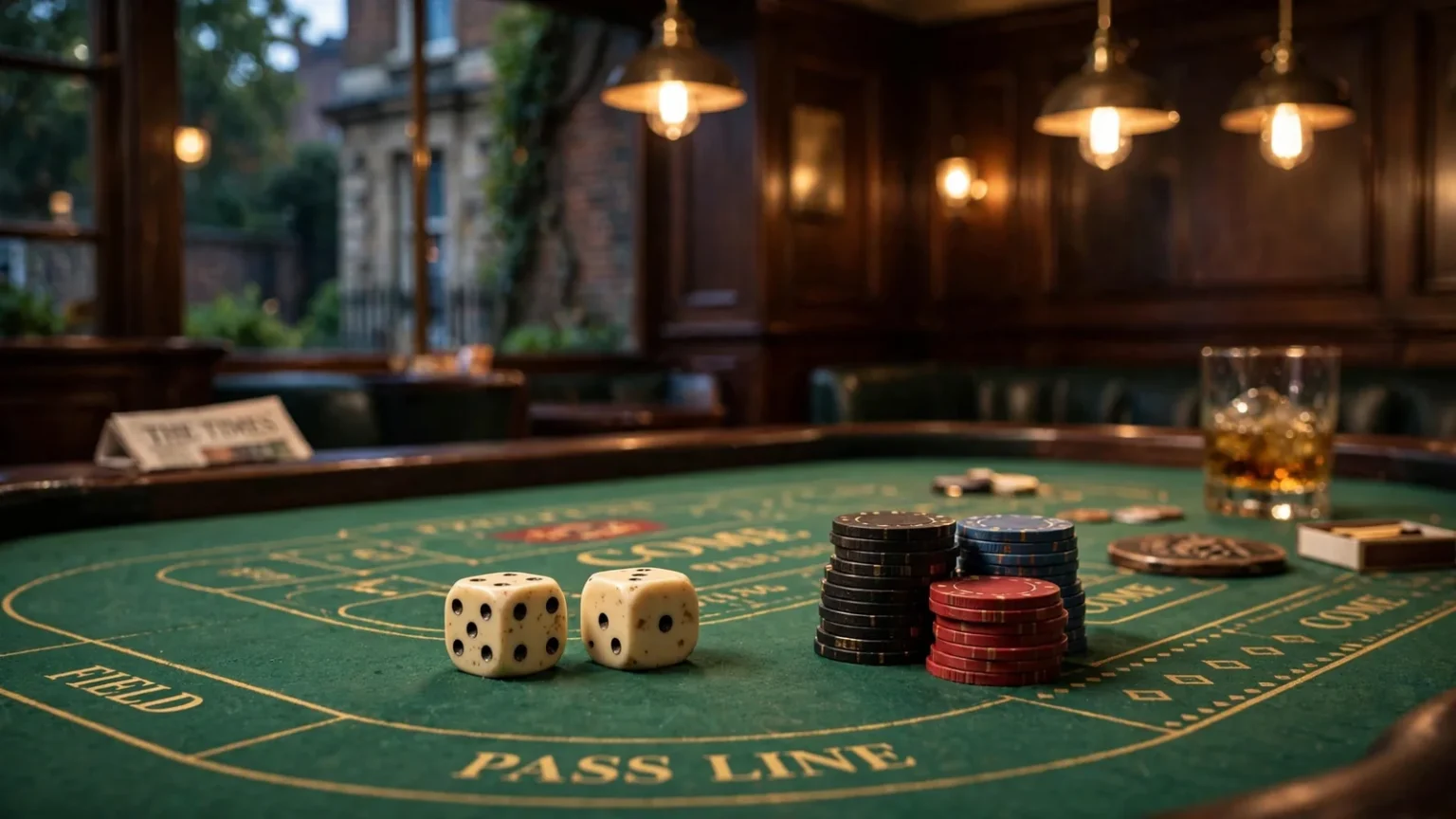
A look at how casino dice games work online, how their risks differ from dice-themed slots, and what shapes the terms of play.
The House, the Chance and the Cash
A casino wager turns money into a claim on an uncertain outcome. The stake may be cash or chips; what matters is that something of value is placed against a possibility. The player hopes for a result that pays, while the casino offers the terms on which that hope can be tested. Even a simple search for a dice casino leads back to this older bargain: chance is made public, given rules and attached to a price.
Dice have an ancient presence in gambling because their fall seems to leave little room for human influence. They are held, thrown and read; the instant of uncertainty is easy to see. Yet the important question is not whether a particular roll feels unpredictable. It is how the terms of play treat possible outcomes over time. A casino game may turn on a single event or a combination of outcomes, but the stake always enters a structure larger than that moment.
That structure is the house advantage. Casino games typically give the casino a predictable long-term edge, while leaving players the possibility of short-term gains. Those statements belong together. A player can win, perhaps decisively in a brief spell; the casino’s advantage does not mean every individual bet ends in its favour. It describes the direction in which repeated play is organised, not a script for what must happen next.
The distinction is easy to blur. A win feels like evidence that the game has changed character; a loss can feel like a temporary injustice waiting to be corrected. Neither feeling alters the terms. Random outcomes do not remember what has just happened, and a previous result does not, by itself, create a debt that the next one must repay. The house edge is not a prediction about a particular player’s evening. It is a feature of the game’s economics across time.
That is why the casino’s advantage can be both hard to notice and central to the arrangement. In a short stretch of play, luck may dominate what anyone sees. A player may leave with more than was brought in; another may not. The longer view is different. The games are arranged so that the casino can expect an advantage across the activity as a whole, while each participant faces uncertain outcomes. Chance is vivid at the table. The underlying balance is quieter.
Crash Casino Games in the UK: Rules and Risks
Cash and chips help make that balance feel immediate. A stake is visible, countable and committed to a possible result. Chips can soften the feeling of money changing hands, but they do not change what the wager means: value has been put at risk. The casino’s setting turns that act into a repeated sequence, with each decision apparently self-contained. Economically, however, the sequence connects individual hopes to the longer pattern that favours the house.
This is not the same as saying that every casino game earns money in precisely the same way. Where players are not competing against the house, as in poker, casinos generally take a commission known as a rake. The distinction matters: the casino need not always win directly against a player for gambling to produce income for the business. But the broad contrast remains. In games structured around the house, the casino’s long-term advantage is built into the terms; in other formats, revenue can come from the service of running play.
Online Bingo in the UK: Games, Rules and Stakes
The language of “best” can obscure this arithmetic. A casino may be described as generous, exciting or favourable, but those impressions do not erase the basic exchange: a possible gain is offered within a system that gives the house a long-run advantage. Nor does a dice theme change the nature of the wager. Dice may supply the image, but the economic question lies in the conditions attached to outcomes and stakes.
There is a social history in that arrangement. Gambling gives uncertainty a formal place: rules decide what counts as a result, and money gives that result consequence. The casino’s authority comes partly from making the process legible. Everyone can see that a bet has been made; the possibility of losing is not hidden. Yet visibility is not equality. The player confronts an uncertain event, while the house relies on an advantage that becomes meaningful through repetition.
That asymmetry explains why a short-term win can be real without overturning the long-term pattern. The player’s fortune concerns a particular run of outcomes. The casino’s expectation concerns the design of play across many wagers. One is immediate and personal; the other is structural. Confusing them turns luck into a theory of the system.
House Advantage
- Casino games are designed with a predictable long-term edge for the house.
- Short-term wins do not alter the structural economics of the game.
- Random outcomes are independent and do not create debts for future rolls.
- The house edge is a feature of the game’s economics across time.
A dice game can therefore promise suspense without promising balance. The throw may be uncertain, the result may favour the player, and the evening may end in profit. None of those possibilities contradicts the casino’s predictable advantage over time. The cash changes hands one wager at a time. The house edge waits.
When the Casino Moves Online
A casino no longer needs a room full of tables, lights and felt to offer its games. Where the law permits, casino games can be delivered through an online service, with the screen becoming the point of contact between the player and the game. The setting changes; the essential proposition does not. A digital version is still gambling when money is put at risk.
That distinction matters in the United Kingdom. Online gambling is lawful here only through operators holding the appropriate UK licence. The UKGC’s role is not a decorative seal attached to a website: it marks the boundary between the regulated market and activity that does not meet the conditions for serving British players legally. A phrase such as “online dice casino UK” therefore describes more than a game format. It sits inside a legal framework.
The screen can make a casino feel less like a place and more like a service available on demand. There is no visible doorway, no journey across a gaming floor, and often no human host in the immediate scene. Instead, menus and software present the available games in a format designed for a device. The room has become an interface.
Online Casino Games for Real Cash: UK Guide
This shift alters how casino play is encountered. A physical setting has its own social cues: the presence of other people, the pace set by a dealer, the sound of a table. Online, those surroundings may be absent or replaced by visual and audio elements on the screen. The game arrives as a designed digital experience, but its presentation should not be mistaken for the source of its result. Animation can make an outcome feel theatrical; it does not, by itself, explain how that outcome was produced.
For random-number games, the underlying process involves selected numbers generated by a computer or other gaming equipment. The software presents an outcome to the player, while the generation of the numbers takes place within the digital system. That is the basic connection between online casino dice and the wider family of random-number games: the screen displays the play, while equipment produces the selected numbers.
The distinction is useful because a convincing display can invite a misleading impression. A tumbling die on a screen resembles a physical object, but the image is not necessarily a miniature record of a die rolling across a table. In a random-number game, the selected numbers come from the computer or other gaming equipment. The visual treatment is the language through which the outcome is shown.
Nor does the word “online” guarantee that every game works in the same way. It names the channel of delivery, not a single mechanism shared by all casino games. A dice game presented on a website belongs to the digital environment, but the broad label alone cannot establish its rules, its design or the equipment behind it. Those details depend on the particular game and its presentation.
Random-Number Games
In online random-number games, the outcome is produced by a computer or other gaming equipment, and the visual animation is simply the language used to display that result.
This is also why the word “free” needs care when attached to online casino dice games. A screen may show a game without that alone establishing whether real money is involved, or what conditions apply to a particular mode of play. The appearance of a game and the terms under which it is offered are separate matters. A digital format is not a promise about cost.
The same caution applies to the apparent immediacy of online play. A game may be presented through a few taps or clicks, but access to a site does not erase the legal conditions governing it. In Britain, the regulated online casino market is not simply any website that accepts a visitor from the country. The operator must be entitled to serve the market. Convenience is not jurisdiction.
There is a larger social change in this migration. The casino once depended on architecture: entrances, rooms, tables and the choreography of staff and guests. Online, that architecture is compressed into a device and a sequence of screens. The form is less monumental, but the institution has not vanished. It has moved behind the interface.
The screen makes distance feel small. The rules still matter.
Best casino sites in the UK
- BritsinoBonus: Welcome Package – Get your £2,200 + 2,000 FS · Payout speed: 1-3 business days
- BeOnBetBonus: 100% up to €500 + 100 FS · Payout speed: 1-3 business days
- Revery PlayBonus: 100% up to€1,000+ 100 FS · Payout speed: 1-3 business days
- EvoSpinBonus: 125% up to €2500 + 125 Free Spins · Payout speed: 1-3 business days
- WinBeastBonus: €5000 + 500 FS + €650 Freebet · Payout speed: 1-3 business days
- SpinFormulaBonus: 550% Up To £15,000 + 550 FS · Payout speed: 1-3 business days
- JetsetspinsBonus: 200% Bonus + 100 Free Spins + Free Royal Wheel · Payout speed: 1-3 business days
- NightWinBonus: £900 + 400 free spins · Payout speed: 1-3 business days
- NightLuckBonus: Welcome Pack + 805% Up To 6400€ + 280 FS · Payout speed: 1-3 business days
Tables, Machines and the Shape of Casino Play
A casino is not one uniform kind of room. Its games arrange people differently: some place a player alone before a machine, while others gather players around a table overseen by a dealer. That distinction matters as much as the objects involved. A screen, a set of dice and a felt-covered table may all belong to casino play, but each creates a different relationship between the person gambling, the house and everyone else nearby.
Machines are generally solitary affairs. One person plays at a time, and no casino employee is needed to conduct the game. The machine supplies the setting and the interface; the player’s attention remains largely between the two. This is not necessarily a matter of isolation in the literal sense. A machine may stand among many others, in a busy room, with people passing close by. Yet the play itself is organised as an individual exchange rather than a shared event.
Table games have a more visible human centre. They are usually conducted by croupiers or dealers, and players compete against the casino rather than against one another. The dealer is not simply part of the decoration. Their presence gives the proceedings a public shape: actions take place in view of the table, and the rules are enacted through an employee’s handling of the game. The casino’s role is therefore not hidden behind a machine. It is represented by a person working on its behalf.
Dice make that contrast especially easy to imagine. In a casino game involving dice, the objects are small, but their movement can hold a whole table’s attention. They make an outcome visible as it happens, rather than presenting play solely through a private screen. That visibility gives dice table games a particular kind of theatre: several people may be watching the same moment, even though each remains an individual player facing the casino. The group shares the scene, not necessarily a wager or a contest with one another.
Machine Play
Solitary encounters where the player engages alone with an interface and no casino employee is needed.
Table Play
Socially centered games conducted by dealers, where the casino’s role is represented by a person.
That is the useful distinction between dice games at a casino and games played on machines. The presence of dice does not, by itself, tell whether a game belongs to a table or a machine. The category depends on how the game is organised. A machine is ordinarily played by one person without an employee conducting it; a table game is generally run by a dealer, with players set against the house. A familiar object can appear in different arrangements. The format does the sorting.
There is also a difference in how attention is distributed. At a machine, the encounter is direct and comparatively self-contained. At a table, the dealer’s actions and the conduct of the game become part of what players observe. The table makes the process public, even when the stakes and decisions belong to separate individuals. Casino play has always had room for both modes: the private concentration of one person and the small social ceremony of a group gathered around a working surface.
That ceremony should not be mistaken for a contest among the people at the table. In the usual structure of casino table games, the players are not opponents trying to defeat one another; the casino is the opposing side. The dealer conducts the game, but the presence of other players does not change that underlying arrangement. A crowded table can look like a collective undertaking. It is not quite one.
The same distinction keeps the broad category of casino games with dice from becoming a list of titles. A description of dice alone cannot establish the rules, format or conduct of a particular game. What can be said at this level is simpler: dice may belong to a table setting, where a dealer runs the play, or to a machine-based format, where the player engages alone and no casino employee is required. The setting tells more than the prop.
Crazy Time Live Casino Game Show in the UK
One format stages the house in a person; the other places it in a machine. Different kinds of company.
UK-Licensed and Offshore Sites: Two Different Worlds
A specialist review describes the UK online casino market in 2026 as divided between the UKGC-regulated space and offshore platforms outside it. The distinction is more than a difference in presentation. A site can accept players from Britain without belonging to the regulatory system that governs legal gambling here.
The legal line is clear: since the Gambling (Licensing and Advertising) Act 2014, operators taking bets from British residents must hold the relevant licence. In Great Britain, a casino offering real-money play therefore needs a current UKGC operating licence. Offshore casinos may still accept UK players, but that does not make them UK-licensed or bring them under UKGC oversight. Accessibility and authorisation are not the same thing.
That matters when the promise is a trusted casino with dice games or slots. A polished site, a selection of games, or a welcome offer cannot establish that an operator is licensed. Nor does the word “offshore” describe a single regulatory arrangement: it means the platform sits outside the UKGC system. The distinction is institutional, not decorative.
The UKGC space is built around an obligation imposed on operators serving the British market. Its counterpart is not a second form of UK licence but a platform beyond that system. For a person comparing casino sites, the central question is consequently not whether a site appears to welcome British customers. It is whether the operator holds the licence required to serve them legally.
Licensing Risk
Operators taking bets from British residents must hold a current UKGC operating licence to serve the market legally; offshore accessibility does not equal legal authorisation.
Bonuses offer another place where the two worlds can look deceptively similar. Both may advertise incentives, but the headline amount says little about the conditions attached. Wagering requirements determine how much qualifying play is required before bonus funds or related winnings can be withdrawn. Since 19 January 2026, incentives cannot require wagering of more than ten times the bonus funds. A specialist review has reported this limit; the useful detail is the rule itself, rather than the brightness of a banner.
Terms still deserve attention beyond the headline. The offer should explain what counts towards wagering and what restrictions apply to the reward. An advertised bonus is not cash already available to withdraw. That distinction is less glamorous than the display, but more consequential.
Dice games and dice-themed slots may appear in a casino’s catalogue, but their presence does not settle the licensing question. Nor does an offshore operator become part of the UK-regulated market by accepting customers in Britain. The legal framework attaches to the operator’s activity, not to the game’s theme or the customer’s ability to open an account.
The two worlds can look close on a screen. They are not close in status.
The Dice-Roll Slot and the Limits of the Spin
A dice-roll slot sounds as though it might sit somewhere between a slot machine and a table game. The name can suggest tumbling dice, a rolling animation or a casino-style wager; by itself, however, it does not establish how a particular game works. A slot remains a slot even when its imagery borrows the familiar symbols of dice and chance.
That distinction matters because the rules attached to online slots concern the stake, not the decoration. In Britain, the maximum stake for one spin depends on the player’s age: those aged 25 and over may stake up to £5, while players aged 18 to 24 are limited to £2. The cap applies to the slot spin, whether the screen shows dice, fruit or another set of symbols. A visual flourish does not create a new category of wager.
The limit gives a dice-roll slot a particular place in the market. Its language may evoke the old, social theatre of a table: a throw, a pause, a result watched by several people. The slot format compresses that theatre into a private sequence of spins. The rules governing the stake remain those for online slots, rather than rules inferred from the image or from the sound of the title.
Stake Limits
In Britain, the maximum stake for one slot spin is £5 for players aged 25 and over, and £2 for players aged 18 to 24.
Terms such as “dice and roll” can therefore point to a theme rather than a promise of a specific game mechanic. A demo or free-play version, where offered, would be a way to encounter a slot without staking money; the wording alone does not confirm that a particular title or mode is available. Nor does a dice motif explain the rules of casino dice or craps. Those belong to distinct forms of play, not to every slot that borrows their vocabulary.
There is a small cultural sleight of hand here. Dice suggest a physical object, visible and shared: the throw can be seen, and the result appears to belong to the table. A slot replaces that ritual with a button and a screen. The familiar image remains, but the form of play has changed. The stake limit follows the form, not the picture.
For anyone comparing a dice-themed slot with other online slots, the useful question is thus not whether the reels look like a casino table. It is whether the product is an online slot and what stake applies to the player’s age group. In Britain, those limits are set. The dice may tumble; the cap does not.
What “Best” Can Mean When No Site Is Named
“Best” is a difficult label to attach to a dice casino without reliable grounds for comparing particular operators. A polished offer can look generous at first glance; its value depends on the conditions attached to it. For a casino bonus, wagering requirements are among the most consequential of those conditions: they determine how much must be staked before bonus funds can be withdrawn.
The arithmetic is plain, even when the wording is not. A £100 bonus with a 35x wagering requirement would call for £3,500 in total bets before cash-out. That calculation describes the effect of the stated terms, not a recommendation or a claim that such an offer is currently available. The larger the multiplier, the more play the condition demands. Small print has a way of becoming the main text.
For incentives offered in Great Britain, the regulatory position changed on 19 January 2026: wagering requirements on bonus funds cannot exceed 10x. A specialist regulatory guide can help explain how that cap applies, but the number alone does not settle whether an offer is worthwhile. Other conditions still matter, including which funds count towards the requirement and what happens if a bonus expires or is cancelled. Terms should be clear before an incentive is accepted.
JetX Casino Game in the UK: Demo, Risk and Play
There is also a boundary between gambling products. A single incentive cannot require customers to gamble across different product types, such as casino games and betting, to release a reward. This prevents one promotion from binding together separate kinds of play. It also gives the word “bonus” a narrower meaning than the banner might suggest: a reward belongs to stated terms, not to the impression created by its headline.
A sensible comparison, then, is less a league table than a reading exercise. The useful questions concern the wagering multiplier, the funds to which it applies, any stated expiry or withdrawal conditions, and whether the reward is confined to one gambling product. A site’s claim to be the best cannot answer those questions on its own. Nor can the word “dice” establish that a promotion is designed for a particular dice game rather than for casino play more broadly.
The label is easy. The terms do the work.
Craps, Crypto and the Boundaries of the Evidence
Craps and crypto dice often appear together in the language of casino discovery, but the pairing does not establish that a particular craps table or dice game is available on a particular platform. Nor does a label such as “top dice casino” amount to a meaningful ranking. A name can suggest a game; it cannot settle questions of licensing, access or terms.
Craps belongs to the familiar vocabulary of casino dice. Crypto dice points instead towards platforms that use digital currencies in some part of their offering. The two ideas may overlap, but they should not be treated as interchangeable: a casino dice game need not involve cryptocurrency, and a platform that mentions crypto does not thereby demonstrate that it offers craps. The distinction is plain enough. The details matter.
Some non-traditional gaming platforms may operate under licences issued in Curaçao, Malta or Gibraltar. Those jurisdictions identify the kind of licensing framework associated with such platforms; they do not, by themselves, establish that a site holds the UKGC licence required to serve the British market legally. A foreign licence and a UK licence are not alternative names for the same permission.
Do
- Verify if the operator holds a UKGC licence.
- Scrutinize the specific payment terms for withdrawals.
- Check if a game is a regulated slot or a table game.
Don’t
- Assume a foreign licence allows legal service in the UK.
- Mistake a crypto payment option for a seal of quality.
- Confuse a game’s theme with its actual mechanics.
Payment claims need similar care. A specialist review of alternative platforms reports that some may accept Bitcoin, Ethereum and Litecoin, alongside conventional cards and e-wallets. That is a report about certain platforms, not a dependable description of every crypto-facing casino or a guarantee that any named game can be played there. The currency accepted at the cashier says little about the game catalogue.
The phrase “casino craps” can therefore point to a recognisable kind of dice play without proving that a given site offers it. Likewise, “crypto casino” describes a payment or platform association, not a seal of quality. A list presented as the best dice sites would need a basis for comparing actual operators and games; a label alone supplies none.
There is a small irony in the vocabulary: the more confidently a platform is described as a destination for every kind of dice play, the less the description itself can prove. Licensing, payment methods and game availability are separate claims, each requiring its own scrutiny. No shorthand can do all three jobs.
Casino Dice as a Random-Number Game
A casino dice game can suggest a simple scene: dice, a surface and a result that appears to belong to the throw. In a random-number version, the visible theme and the mechanism are not necessarily the same thing. The outcome is produced through selected random numbers generated by a computer or other gaming equipment.
That distinction matters. The numbers are not a record of a physical die being rolled; they are generated by the equipment and used to determine the game’s result. The screen may present that result through dice imagery, but the image is a way of showing the outcome, not an explanation of how it was produced. Dice are persuasive props. They make chance look familiar.
The same basic description applies to random-number games beyond casino dice. A computer or other gaming equipment generates selected random numbers, and those numbers form the basis of the outcome. What follows depends on the particular game’s design. Without its rules, it would be wrong to assume how a number is translated into a win, a loss or a particular combination. The presence of dice on screen does not, by itself, reveal those details.
This also explains why the phrase “dice game” can cover more than one kind of experience. A game may borrow the appearance of dice while relying on a digital mechanism; another may use different equipment. The shared point is not a universal set of rules, but the use of generated random numbers in games of chance. The language of the table survives, even when the table does not.
For anyone looking at casino dice in the UK, the useful distinction is therefore between what the game depicts and what produces its result. A rendered roll may look immediate and tangible, while the underlying process is numerical. That description is precise, but deliberately limited: it does not establish the rules, odds or availability of any particular title. The die on screen tells a story. The number does the work.
Numerical Reality
The visual representation of dice on a screen is a prop; the actual outcome is determined by generated random numbers.
Bitcoin Deposits and the Journey Back Out
For anyone considering Bitcoin-funded dice play, the payment route is part of the arrangement, not a detail that ends when a deposit arrives. A specialist review describes alternative platforms accepting Bitcoin, Ethereum and Litecoin alongside conventional cards and e-wallets. That is a report about the platforms it covers, not a promise that every casino—or any particular dice game—supports those methods.
The route in matters. A card payment and a transfer from a crypto wallet are not interchangeable simply because both can put funds into an account. Each platform sets out which methods it accepts, and its payment information should be read alongside the terms for withdrawals. A deposit method does not, by itself, establish that the same method can be used to cash out.
The journey back can be less immediate. A specialist review reports that many platforms process deposits instantly and complete withdrawals within hours rather than days. The wording matters: this is a reported pattern, not a fixed service standard. The time taken is presented as dependent on the platform, so “instant” on a deposit page should not be mistaken for a guarantee about money leaving an account.
There is also a distinction between a Bitcoin dice casino as a payment description and a dice game’s own mechanics. Bitcoin concerns how funds are moved; it does not explain how a game decides its outcome. A player looking at a dice table, a Sic Bo listing or a dice-themed offer still needs to establish what the platform actually provides and which payment terms apply. The names alone settle none of that.
For British residents, the legal boundary remains important even when a platform accepts digital currency. Real-money gambling offered to customers in Great Britain requires a UKGC licence; a payment option does not change that requirement. Crypto is a rail, not a passport.
The practical question is therefore not simply whether Bitcoin can be deposited. It is whether the platform’s published terms explain the route back out, and whether the operator is authorised to serve the British market. A fast arrival is only half a journey.
Live Dream Catcher Casino in the UK: A Guide
Dice-Themed Slots and the Fine Print on Spins
Dice imagery gives a slot an old-fashioned vocabulary of chance: a roll, a throw, a mark on a cube, the suggestion that fortune has arrived in a compact form. But a slot decorated with dice is still not, by that description alone, a casino game in which players throw dice. The theme supplies its own theatre; the rules belong to the game itself.
That distinction matters when phrases such as “free dice slots” or “roll the dice” appear around an offer. They may describe a visual style, a promotional label or a game mechanic, and those are not interchangeable. A slot’s title or artwork cannot establish how its symbols work, what triggers a feature, or whether a free spin is genuinely part of the game rather than a separate promotion. The wording on the offer and the rules attached to the specific game do the actual work. The dice are decoration until the terms say otherwise.
The more consequential detail can arrive after the spin. A specialist casino review has reported that some free-spin promotions cap winnings: even when a spin produces a larger return, only an amount set by the promotion may be retained. That is a claim about the offers covered in that review, not a universal rule for every casino or every dice-themed slot. Still, it identifies a condition easy to miss when attention is fixed on the word “free”.
A cap changes what the prize means. The spin may produce a striking result on screen, while the amount available to keep is constrained by the promotion’s terms. “Free” describes the cost of the spin, not necessarily the amount that can be withdrawn from its winnings. A small word carrying a large burden.
For anyone comparing dice-themed slots or free-spin offers, the relevant detail is therefore not merely how many spins are advertised. The terms should state whether winnings are capped and what that cap allows the player to retain. A casino game where dice are thrown and a slot that borrows dice imagery may share a symbol, but they need not share a game or a set of rules.
Material created by the team Pure Casino UK Guide


