

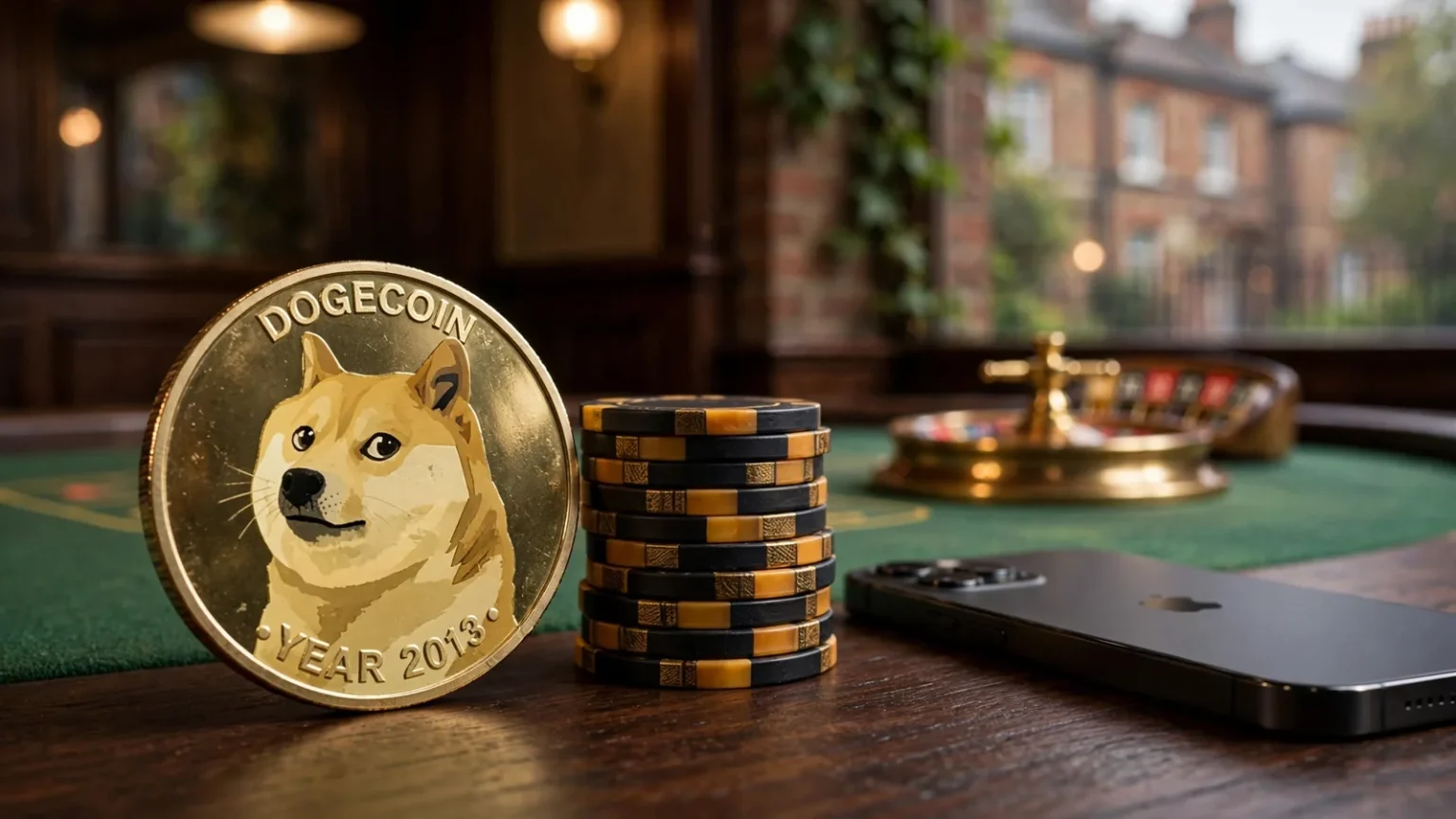
A practical look at payment-page claims, cashier routes, withdrawals, bonuses and the limits of what payment evidence can prove.
Dogecoin at UK Casinos: What Can Actually Be Confirmed
A casino page that mentions cryptocurrency is not necessarily a Dogecoin cashier. The distinction is small in wording and large in consequence: “crypto accepted” may refer to several different coins, while a deposit depends on the particular asset being offered and the route the cashier actually provides.
A specialist review of casino payment pages describes a mix of Visa, Mastercard, bank transfer, e-wallets and several cryptocurrencies among the methods mentioned by the sites it examines. That is evidence of a broad category, not confirmation that Dogecoin is available at any named UK-facing casino. Nor does it establish that the same payment options remain active when an account is opened. A list of crypto-friendly sites, however confidently presented, cannot turn a general reference into proof of a specific coin.
The practical distinction is between a site’s description and its live cashier. A page may use “cryptocurrency” as a general label; a cashier, if it offers crypto, needs to identify the actual currency and the transaction route. Dogecoin should be named explicitly. Bitcoin is a separate payment method, not a substitute for Dogecoin simply because both are cryptocurrencies. A reader looking for a Dogecoin deposit therefore needs more than a site that advertises digital-asset payments.
This is why claims about the best Dogecoin casino, a new Dogecoin casino, or an all-inclusive list of Dogecoin casinos in the UK should be treated cautiously. A ranking implies that each entry has been checked against the same test: UK-facing availability, an explicit Dogecoin option and a working deposit route. Without those elements, a directory may gather operators that accept other coins, sites operating in different markets, or old descriptions that no longer match the cashier. The neatness of a list is not evidence of its accuracy.
The same applies to mobile searches. An Android casino can be a casino site accessed on an Android device; that description says nothing by itself about which payment methods its account cashier supports. The device, the games and the payment rail are separate parts of the arrangement. A mobile interface displaying a crypto logo would still need to identify Dogecoin specifically before it could establish that the coin is accepted.
Casinos That Accept eCheck in the UK
“Still available” also asks a narrower question than whether casinos have ever discussed cryptocurrency. Availability is tied to the operator’s current terms and the payment choices presented to the account. A former mention, a third-party summary or a general crypto label cannot settle the present status. The cashier is the relevant place to check, but even a displayed option should be read alongside the operator’s terms, since those define the conditions attached to that route.
There is a regulatory boundary as well. In Great Britain, remote gambling operators serving customers must hold the relevant UK Gambling Commission licence; online gambling is legal for adults at licensed and regulated sites. A cryptocurrency payment claim does not establish that an operator holds that licence, and a licence does not establish that Dogecoin is accepted. Those are separate questions. The Gambling Act 2005 governs gambling in England, Wales and Scotland, while Northern Ireland has a distinct legal position; a payment label cannot resolve that jurisdictional difference either.
Casinos That Accept Boku in the UK: Payment Guide
Bonuses and games are often folded into claims about the best Dogecoin sites, but neither follows from a payment-method description. A casino may mention cryptocurrencies without specifying Dogecoin, and that mention says nothing about a Dogecoin welcome offer or games funded by Dogecoin. Each claim requires its own confirmation. A coin name is not a bonus term, and a bonus headline is not proof of a deposit route.
The soundest conclusion is deliberately narrow: some specialist coverage of casino payment pages refers to several cryptocurrencies, but that broad wording does not verify a particular UK-facing cashier’s acceptance of Dogecoin. A reliable listing would need to name the coin, identify the operator’s UK status and reflect the cashier’s current options. Without all three, “Dogecoin casino” remains a label in search of particulars. A label is not a transaction.
Best casino sites in the UK
- BritsinoBonus: Welcome Package – Get your £2,200 + 2,000 FS · Payout speed: 1-3 business days
- BeOnBetBonus: 100% up to €500 + 100 FS · Payout speed: 1-3 business days
- Revery PlayBonus: 100% up to€1,000+ 100 FS · Payout speed: 1-3 business days
- EvoSpinBonus: 125% up to €2500 + 125 Free Spins · Payout speed: 1-3 business days
- WinBeastBonus: €5000 + 500 FS + €650 Freebet · Payout speed: 1-3 business days
- SpinFormulaBonus: 550% Up To £15,000 + 550 FS · Payout speed: 1-3 business days
- JetsetspinsBonus: 200% Bonus + 100 Free Spins + Free Royal Wheel · Payout speed: 1-3 business days
- NightWinBonus: £900 + 400 free spins · Payout speed: 1-3 business days
- NightLuckBonus: Welcome Pack + 805% Up To 6400€ + 280 FS · Payout speed: 1-3 business days
When a Casino Cashier Offers Another Route
When Dogecoin is not shown as a deposit option, the practical alternatives are the familiar routes through a bank card, a bank account or an e-wallet. They are not interchangeable simply because each can move money into a casino balance. The cashier decides which methods are available to a particular account, and the route shown there matters more than a general payment logo elsewhere on a site.
Debit Cards
Visa and Mastercard are common, linking transactions to a bank account for familiarity without managing a separate wallet.
Bank Transfers
Funds move via transfer services or open banking, potentially providing instant deposits and fast withdrawals.
E-wallets
Services like Skrill and Neteller provide a separate balance to isolate casino transactions from main bank accounts.
Debit cards remain a recognisable option at UK casinos. Visa and Mastercard are commonly accepted, though the presence of a brand name on an information page does not establish that every card product will work at every cashier. A card deposit links the casino transaction to a bank account and a payment network already used for ordinary purchases. For many players, that familiarity is the point: no separate wallet balance or cryptocurrency transfer has to be managed.
The distinction between a debit card and other card products matters in the UK. Credit-card payments for gambling are prohibited at UK-licensed casinos. A cashier’s reference to cards should therefore not be read as an invitation to fund gambling with credit. The route has to be permitted, and the product has to be eligible. A payment option is not made suitable by being technically visible.
Bank transfers take a different path. Rather than passing through a card network, money moves from the customer’s bank through a transfer service or open-banking connection. A specialist review describes open banking and bank transfers as capable of providing instant deposits and fast withdrawals at many sites; that is a report about the sites it examined, not a promise that every transfer will move at the same pace. The cashier’s available options and the bank’s own handling both shape the experience.
Casinos That Accept Litecoin in the UK: What to Check
Open banking may look less like a separate payment product than a direct bridge between a casino cashier and a bank account. The appeal is its plainness: the funds begin and end in an account held in the customer’s name, rather than passing through a crypto wallet or a prepaid instrument. The route also makes clear that the modern cashier is not merely a menu of logos. It is a set of connections, each with its own rules.
E-wallets sit between those two worlds. Skrill and Neteller are offered at some casino sites, according to specialist casino reviews, but that finding should not be mistaken for universal availability. An e-wallet has its own account and balance, so it can separate a casino transaction from the main bank account in the everyday view of spending. That separation is convenient for some and another account to maintain for others.
The contrast with Dogecoin is not simply old money against new. A cryptocurrency route depends on the casino explicitly supporting that asset and on the deposit instructions matching the wallet transaction. A bank card or bank transfer may be more recognisable, but recognition alone does not settle whether it appears in a particular cashier or suits a particular account. Payment menus are local things, even when the brands are international.
This is why a list of supposed “best” Dogecoin casinos can be less useful than it looks. A site that mentions cryptocurrencies in general has not thereby confirmed Dogecoin; a cashier that displays a payment route is more concrete. The same discipline applies to the alternatives. Visa, Mastercard, a bank transfer, Skrill or Neteller should be treated as available only where the relevant cashier presents that method for the account in question.
Do
- Check the live cashier for explicit Dogecoin support
- Verify if a method is available for both deposits and withdrawals
- Read the specific terms for bonus eligibility
Don’t
- Assume “crypto accepted” means Dogecoin is available
- Use credit cards for gambling at UK-licensed casinos
- Rely on general payment logos as proof of account availability
There is also a human difference between routes. A card belongs to the ordinary landscape of household payments. A bank transfer makes the source account explicit. An e-wallet introduces a separate layer, with its own login and balance. Dogecoin belongs to a more specialised vocabulary of addresses and digital assets. None of these arrangements is inherently the right one for every player; each asks for a different degree of familiarity and attention.
The UK cashier, then, is less a universal catalogue than a narrow doorway. Its options depend on the operator and the account, while general descriptions can only orient the comparison. For someone looking beyond Dogecoin, debit cards, bank transfers and e-wallets are the principal conventional routes to recognise—not guarantees, and not a ranking. The menu decides.
Deposits, Withdrawals and the Small Print on Offers
A deposit is only the first direction in a payment relationship. The more consequential question often comes later: how winnings can be paid out, and whether the method used to fund an account can receive money back. A cashier may make depositing look like a single choice, but the transaction has a return journey too.
Casino Payments & Withdrawals in the UK
That distinction matters when a payment method is deposit-only. Paysafecard, for instance, is a prepaid voucher for adding funds; it is not a route for withdrawing them. A player who uses it may therefore need another approved method for a payout. The voucher can serve its narrow purpose, but it does not complete the circuit.
UK anti-money laundering rules generally require a casino to return payouts to the original payment source. This closed-loop approach helps operators establish where funds came from and where they go. In practice, a mismatch between the deposit route and the intended withdrawal route can mean extra steps rather than a neat reversal. If another method is needed, the operator may request further checks before releasing funds.
Account ownership is part of that administrative picture. When the casino account and payment method belong to the same person, basic ownership details are less likely to obstruct a transaction. It is a modest point, but payment systems have little patience for ambiguity. A deposit that arrives does not, by itself, settle every question about a later withdrawal.
The same separation applies to promotional offers. A casino can accept a payment method for deposits without treating deposits made through it as eligible for a bonus. A specialist review notes that PayPal may be excluded from bonus eligibility; that is a report about a possible offer condition, not a rule that can safely be assumed to apply everywhere. The relevant terms need to be checked for the particular promotion and cashier.
This is why a search for a Dogecoin-funded casino bonus cannot be answered by combining two attractive phrases. A deposit route and a promotion are separate features, and neither proves the other. Even if a casino advertises free spins, a no-deposit offer or a bonus without wagering requirements, the label alone does not establish which customers qualify or what payment conditions apply. Those details belong to the offer’s terms.
UK anti-money laundering rules generally require casinos to return payouts to the original payment source to establish the flow of funds.
“No deposit” also describes the basis of an offer, not a withdrawal method. If an offer does not require an initial payment, that says nothing on its own about how any resulting balance could be withdrawn. The same is true of free spins: the promotional format does not remove the need to understand payout and payment rules. An offer’s headline is not the whole arrangement.
For Dogecoin in particular, the useful distinction is between a payment method being mentioned and a casino confirming that it accepts that method for deposits, withdrawals, or both. A mention of cryptocurrency does not establish that Dogecoin is supported, and a deposit route alone would not establish a matching withdrawal route. Nor does it establish eligibility for a no-deposit offer, free spins or another promotion.
The practical order is therefore plain: establish which methods the cashier accepts, identify whether each is deposit-only or also supports withdrawals, then read the offer terms for payment exclusions. For a payout, the original source may matter; for a bonus, the chosen deposit route may matter. These are related checks, not interchangeable ones.
There is no shortcut in the wording of an offer. “Free” still has conditions.
Mobile Slots and Payment Compatibility
A slot does not normally determine how an account is funded. The cashier does. That distinction matters when a mobile game appears to offer a Dogecoin option: the game screen may be ready to play, while the casino account has no matching deposit route. Payment compatibility belongs to the operator’s cashier, not to a particular slot title.
Casinos That Accept POLi in the UK: What to Check
The same applies on a phone. A mobile site or app may display the casino’s games, but that does not establish which payment methods the account can use. The useful check is whether Dogecoin appears as a deposit option in the cashier for the relevant account, and whether the operator’s terms describe how that route works. A cryptocurrency logo elsewhere on a site is not the same thing. Nor does a general claim about crypto establish that Dogecoin can fund real-money slots.
This is why searches for Dogecoin mobile slots can lead to a misleadingly simple answer. “Mobile” describes the device or interface; “Dogecoin” describes a proposed payment route. Neither says anything by itself about whether a given casino supports the combination. A game catalogue and a cashier are separate parts of the service.
A specialist review lists Visa and Mastercard among the payment methods associated with the sites it discusses, but current UK availability and eligible card products still need confirmation in the casino cashier. The cashier is the operational detail: it shows what that account can actually select, rather than what a general payment list may suggest. The same discipline applies to Dogecoin. If it is not presented there as an available route, a slot’s mobile compatibility cannot supply the missing payment function.
There is also a difference between a game being accessible without a deposit and a game being funded with cryptocurrency. Free-play access, where offered, does not demonstrate that Dogecoin is accepted for real-money play. A game can load on a phone without any payment method being involved at all. The label “free” and the label “crypto” answer different questions.
Attention A game’s mobile compatibility or the presence of a cryptocurrency logo does not guarantee that Dogecoin is a supported deposit route in the account cashier.
The practical test is therefore modest: confirm the payment method in the account cashier, then check that the mobile version uses the same supported account facilities. If the operator offers both a desktop site and a mobile interface, the presence of a game in both places does not prove that every funding method appears in both. The payment route needs its own confirmation.
This is less glamorous than a list of coins beside a row of spinning reels. It is also more useful. Slot compatibility concerns the game; Dogecoin compatibility concerns the account’s cashier. One cannot be inferred from the other.
Real-Money Slots Under UK Rules
A slot played for money is not defined by the coin used to fund the account. A Dogecoin label on a game or site, by itself, says nothing about whether a remote gambling licensee serving Great Britain can lawfully offer it, or whether that operator’s cashier supports the cryptocurrency. The game, the operator and the payment route are separate things; treating them as one promise makes for poor scrutiny.
In Great Britain, a remote gambling licensee offering real-money play must hold a UK Gambling Commission licence. Online gambling is legal for adults aged 18 and over when it takes place through a licensed and regulated site. That framework applies whether the game appears on a desktop screen or inside an app. A mobile format does not create a separate set of rules, and a slot’s availability does not establish that Dogecoin can be used to play it.
Casinos That Accept USDC in the UK: Payment Guide
Age checks come before access to deposited funds: operators must verify a customer’s age before allowing a deposit. New customers must also be prompted to set a financial limit before their first deposit, with account-level controls available afterwards. These are not decorative settings tucked behind the game lobby. They are part of the regulated account, placed before gambling money enters it.
There are rules inside the slot as well. Online slot autoplay is banned in Britain, so a sequence of unattended spins is not a permitted feature. Each spin must last at least 2.5 seconds. The maximum stake per game cycle is £5 for customers aged 25 and over, while it is £2 for customers aged 18 to 24. The lower ceiling reflects the regulator’s particular concern for younger adults; the same screen, but not the same allowance.
That matters to searches for real-money Dogecoin slots, including claims about a Dogecoin-funded app or games that pay out in the same coin. A title’s presence in a catalogue cannot settle the currency question, and a cryptocurrency logo cannot settle whether the game is offered under the UK regulatory system. The practical check is whether the operator is licensed for the British market and whether its account and game rules are presented clearly before play begins.
The UK Gambling Commission’s public register provides a way to check an operator’s licence. Licensed remote operators must also offer an internal complaints process and access to an approved Alternative Dispute Resolution service. Those protections belong to the operator’s regulatory status, not to a particular slot, app or payment token. A reassuring game name is not a safeguard. A licence is.
Credit Card Ban
Credit-card payments for gambling are strictly prohibited at UK-licensed casinos, including routes through digital wallets.
What a Deposit Costs—and What a Card Cannot Do
The amount leaving an account is not always the amount a casino balance receives. A specialist payment review identifies several possible layers of cost: a casino charge, a payment-provider fee, a fee from the card issuer or bank, currency conversion and, where relevant, a network fee. Which apply depends on the route and transaction; a fee-free label at one stage does not settle the total.
Currency conversion deserves particular attention. A provider may build its charge into the exchange rate rather than show it as a separate line. A specialist review notes that this spread can outweigh a visible flat fee. The arithmetic is less dramatic than a headline charge, but it can be harder to see. Quiet costs.
Dogecoin prompts a related question: whether a deposit can be made directly from a crypto wallet, or whether a casino offers another route. Neither the word “crypto” nor a payment symbol establishes the cost of a particular transaction. A network charge, where one applies, is distinct from any casino or provider fee; conversion into the account’s currency may introduce another cost. The cashier’s displayed terms are what matter, not an assumption that a digital coin moves without expense.
A card has a firmer boundary. The UK regulator banned credit-card gambling on 14 April 2020, and the prohibition remains in force. A UK-licensed casino cannot accept credit-card payments for gambling, including a credit-card payment routed through a money service business. Nor can the restriction be sidestepped by using a digital wallet that permits credit-card funds to be used for gambling.
Casinos That Accept iDEAL in the UK: How to Check
That does not make all cards interchangeable. Debit cards are a separate payment route, and the product and current cashier availability still matter. A card deposit might be described as immediate, but that says nothing by itself about the cost of funding it or the eventual route for a payout. The transaction has more than one clock—and more than one possible fee.
The same discipline applies to Dogecoin claims about direct deposits, card-linked funding or withdrawals. A casino’s general payment information cannot establish that a particular coin is accepted, that it can be paired with a card, or that funds can be withdrawn through the same route. Costs and permissions belong to the actual method shown in the cashier. Credit cards are not a workaround.
Bonuses Depend on the Payment Route
A welcome bonus is not simply attached to a casino account. Its terms may make eligibility depend on how the first deposit is made, so a promotion displayed beside a payment option does not establish that the two can be combined. The cashier and the offer rules answer different questions: whether a route is available, and whether using it qualifies for the promotion.
That distinction matters for anyone looking for a Dogecoin-funded welcome offer, a slots bonus or a code to enter at registration. A bonus advertised by a site does not, by itself, confirm that Dogecoin is accepted for deposits or that a deposit in Dogecoin would count towards the offer. Those details need to be stated in the operator’s current payment and promotion terms. A code is not a substitute for those terms.
Common E-wallet Restrictions
Specialist reviews indicate that popular e-wallets like PayPal, Skrill, and Neteller are often excluded from bonus eligibility at some casino sites.
E-wallet eligibility can be particularly easy to assume incorrectly. A specialist casino review reports that PayPal, valued for speed and convenience, may be excluded from bonus eligibility. The wording matters: this is a possible restriction, not a rule that applies to every casino. Skrill and Neteller are offered at some sites, while a specialist casino review also describes them as often excluded from promotions. Availability at the cashier therefore does not settle the bonus question.
There is a small administrative lesson in this. Payment menus tend to present methods as conveniences; promotion rules treat them as conditions. The same method can be accepted for ordinary deposits yet fail to qualify for a particular offer. Conversely, an offer’s headline may say little about which deposit routes are eligible. The detail is in the terms, not the banner.
For a real-money slots offer, the relevant checks are whether the promotion is active, which deposit methods qualify, and whether the chosen method is named among any exclusions. If Dogecoin is involved, both its acceptance and its bonus eligibility need explicit confirmation; neither follows from the presence of the other. No welcome label can bridge that gap.
Promotions are commercial invitations, not payment confirmations. Where an e-wallet or cryptocurrency is part of the plan, its status should be checked against the specific offer rather than inferred from the casino’s general list of payment options. A modest distinction, with practical consequences.
Minimum Deposits, Limits and Account Currency
A low advertised minimum can look like the whole story, but it is only one setting in a cashier. A specialist review places common starting deposits in the £10–£20 range, with the amount changing according to the payment method. That is a general guide, not a promise that every cashier offers those thresholds, or that Dogecoin is among its listed routes.
Casinos that accept Monzo in the UK: what to check
The distinction matters for searches for a £5 Dogecoin deposit. A minimum shown for a card, bank transfer or e-wallet cannot be carried across to cryptocurrency by assumption. Nor does a casino’s general mention of crypto establish that its UK-facing cashier accepts Dogecoin, or that a small Dogecoin deposit is possible. The available amount, if any, belongs to the specific payment option displayed at the point of deposit.
Limits can also govern the size of a transaction beyond its minimum. A specialist review notes that maximum deposits may be set per transaction, per day or per month, and can differ with the payment method and account status. These are separate constraints: a route may permit a small initial payment while applying a different ceiling to later activity. The cashier’s current terms, rather than a generic description of a casino, determine which apply.
Currency is another quiet source of friction. Specialist review pages list GBP as supported, but the account currency still needs to be checked before the first transaction. If an account is denominated in another currency, a deposit may involve conversion; the displayed balance then reflects more than the amount sent. Small deposits make that distinction especially visible.
An instant-looking payment label does not settle the minimum, the account currency or the applicable limit. Those details can depend on the selected route and the account itself. A cashier that displays Dogecoin would still need to show its own minimum and limits; a mobile payment label alone establishes neither. For a UK account, the useful comparison is between the payment option actually offered, its displayed terms and the currency in which the balance will be held. A small figure in a headline is not the same as a usable deposit route.
Payment Route Comparison
- Total cost includes casino charges, provider fees, network costs, and currency conversion spreads
- Withdrawal speed depends on both the payment method and the operator’s internal verification process
- Minimum deposits and transaction limits vary by payment method and account status
- Account currency must be verified to avoid unexpected conversion costs during deposits
Comparing Payment Routes Without a Universal Winner
The appeal of Dogecoin as a casino payment route can look straightforward until the full cost of moving money is considered. A method with no obvious charge at the cashier may still involve provider fees, currency conversion or network costs. Conversely, a visible flat fee does not necessarily make another route more expensive overall.
A specialist payment comparison notes that there is no single method with the lowest fees in every case. The meaningful comparison is between the casino’s charge, the payment provider’s fee, any exchange-rate spread and, for cryptocurrency, the network cost, all measured against the amount being transferred. A conversion spread can outweigh a stated fee, so the displayed charge is not always the whole price.
The same care applies to delivery. A deposit and a withdrawal are separate journeys, even when they use the same route. A specialist casino review says withdrawal timing can include the operator’s internal approval, with an initial payout potentially taking longer while verification is completed. It also notes that speed depends on both that approval process and whether the account has been verified. The payment label alone cannot settle the question.
For someone comparing Dogecoin with familiar alternatives, the practical choice is therefore not simply “crypto or bank.” It is a comparison of total cost, supported account currency, provider terms and the steps needed before money is released. A route that requires conversion may lose some value in the exchange, while a route that needs additional verification may add friction to a withdrawal. Neither feature automatically makes a method unsuitable; both belong in the calculation.
There is also a distinction between a cryptocurrency remaining in circulation and a casino cashier accepting it. The former does not establish the latter. A Dogecoin balance, network transfer and UK-facing casino account are separate parts of the transaction, each with its own terms. The useful alternative is whichever available route has clear charges and a workable withdrawal path at the particular operator—not a payment method crowned “best” in the abstract.
Casinos That Accept Solana in the UK: Evidence
No universal winner.
Dogecoin, GamStop and the Limits of What Payment Evidence Shows
A casino’s payment options and its relationship with GamStop are separate questions. A site that mentions Dogecoin does not thereby establish that it accepts the cryptocurrency from UK customers, and that mention says nothing about whether the site is connected to GamStop. The same distinction applies to slot games: a game’s availability does not prove that Dogecoin can fund play or indicate anything about the operator’s status.
That matters because labels such as “not on GamStop” can blur very different claims. One concerns a site’s relationship with a self-exclusion scheme; another concerns its cashier. Evidence for one is not evidence for the other. A list of payment methods, even one that includes cryptocurrencies, cannot settle the GamStop question.
For customers in Great Britain, the legal framework is a separate boundary. Remote gambling licensees serving the market must hold the relevant UK Gambling Commission licence. An offshore casino outside that system is not made a UK-licensed operator by accepting a familiar payment method, nor does a Dogecoin option establish that a site is suitable for UK play. The cashier is not a regulatory credential.
UK-licensed operators also have account-level duties. Before a new customer makes a first deposit, the operator must prompt them to set a financial limit and make limit controls accessible within the account. These controls address how much can be deposited; they should not be confused with GamStop or treated as proof that an operator participates in it. Different safeguards, different purposes.
The distinction is less dramatic than a cryptocurrency logo, but more useful. Payment claims need checking at the cashier; licensing and scheme status require their own confirmation. Neither can be safely inferred from the other.
What is the fastest withdrawal method for UK casinos?
PayPal, open banking and debit cards linked to fast-payout systems are generally among the quickest options. The casino’s approval process and your account verification also affect how quickly funds arrive.
Why must withdrawals return to the deposit method?
Returning funds to the original payment source is a common anti-fraud and anti-money-laundering control. Using another route may require extra verification.
Are Visa and Mastercard deposits definitely debit cards?
No. Visa and Mastercard are commonly used for debit-card deposits, but a brand logo alone does not confirm that every card product is eligible; check the cashier.
Can I use a credit card at 333 Casino in Great Britain?
No, credit-card gambling is prohibited at UK-licensed casinos in Great Britain.
Why can a fast payout casino still delay my withdrawal?
The casino must approve the withdrawal, and first payouts can take longer while verification is completed. An account that is not fully verified can also slow processing.
Material created by the team Pure Casino UK Guide


