

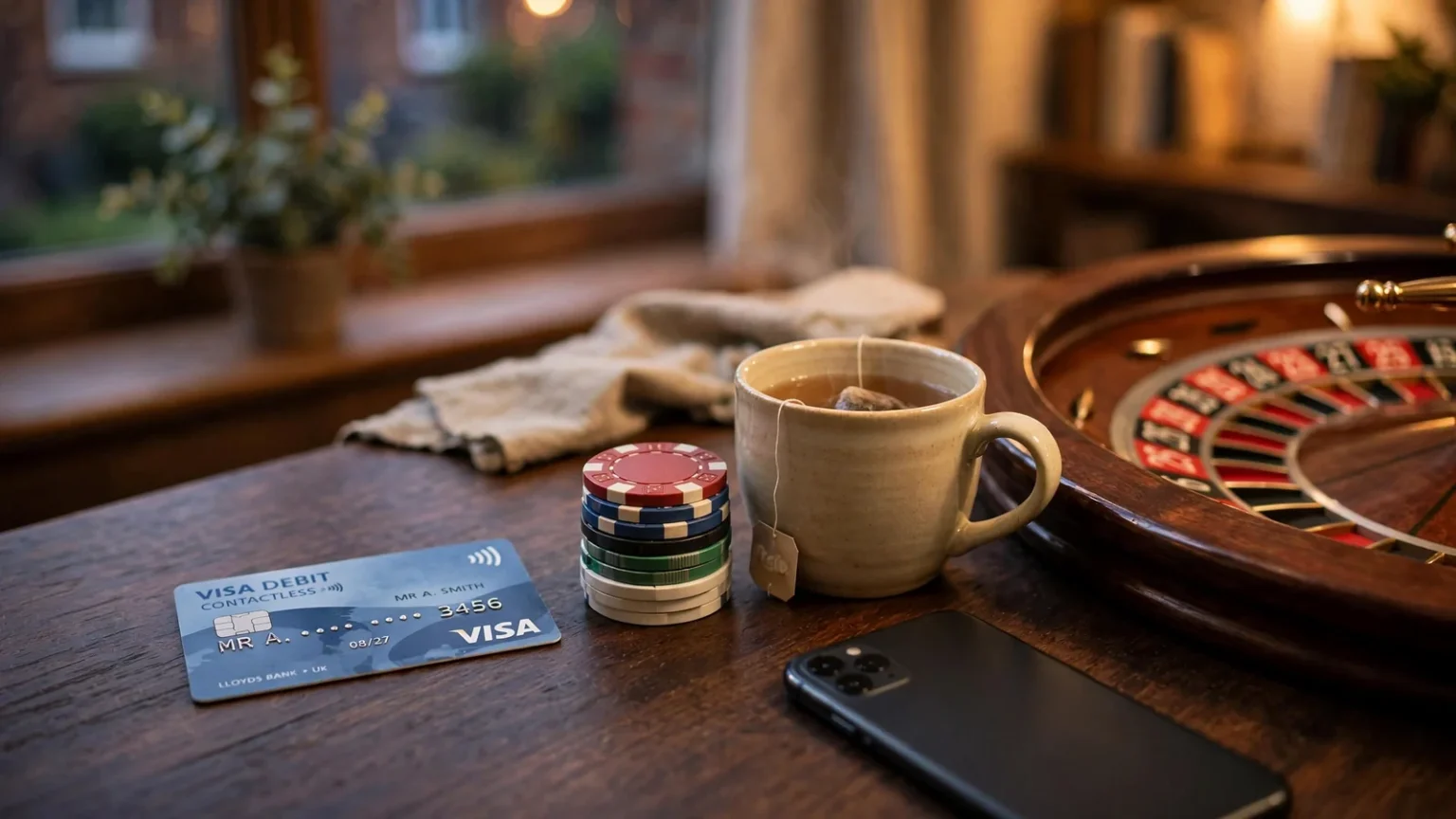
Payment availability can vary by jurisdiction, account and device, while deposit and withdrawal rules may depend on the original payment route.
Click2Pay’s UK Availability Is the First Question
That is a narrow but important distinction: a payment service may be familiar, or may appear in material about casinos in another market, without being available to a UK account.
The question is not whether Click2Pay sounds like a plausible way to fund a gambling account. It is whether a particular remote gambling licensee offers it to customers in the UK now, and whether it appears for the customer’s account and device. Those details can differ by jurisdiction and change over time. A casino’s brand name alone cannot settle them.
Android adds another layer, not a shortcut. A payment method might be offered through a casino’s website, an app, both, or neither; the fact that an app is available on Android does not establish that every cashier function is available inside it. Nor does a payment option seen on a desktop page prove that it will appear after signing in on a phone. The device, account and location all matter to the practical question.
That is why broad claims about “all” Click2Pay casinos in the UK are especially fragile. An all-casinos list would need to distinguish UK-facing sites from casinos serving other markets, and current acceptance from an old mention that may no longer reflect the cashier. Without that distinction, a list can look comprehensive while answering a different question.
The same caution applies to rankings built around “best” Click2Pay casinos, their games or bonuses. A ranking presumes there are confirmed eligible casinos to compare. No dependable recommendation follows from a payment-method label alone. Games are selected by the casino, not unlocked by the deposit route; a promotion, where one exists, has its own terms. Neither can be inferred from the name Click2Pay.
For British gambling, the operator’s legal status is a separate matter from its payment menu. Remote gambling licensees serving customers in Great Britain must hold the relevant UK Gambling Commission licence. The licence establishes the regulatory framework; it does not certify that a particular payment service is currently available. Conversely, a payment logo or a mention on a third-party page is not proof that a UK-licensed cashier will offer the method.
Casinos That Accept ClickandBuy UK: What Can Be Verified
The useful check is therefore specific and modest: whether Click2Pay is displayed in the signed-in cashier for the UK account before any payment is attempted. A general page listing payment brands may be out of date or may describe availability in another country. A live cashier is closer to the actual transaction, though the displayed methods can still depend on account eligibility and operator controls. The UKGC public register can establish whether the operator holds a current licence; it cannot answer the cashier question.
One specialist review of casino payment options lists Visa and Mastercard among methods associated with the sites it examines, but that kind of listing does not establish current UK availability or eligibility for every card product. The distinction matters here because payment information is often gathered into neat tables, while the real decision is made at account level. A name on a page is not the same as an option offered at checkout.
A similar gap separates “new Click2Pay casinos” from newly opened casinos that happen to accept the service. The former claim requires current confirmation of the method as well as the casino’s UK status. Age, novelty and payment acceptance are three different attributes; one does not prove the others.
For now, Click2Pay’s UK position should be treated as unconfirmed rather than assumed. That does not establish that the service is impossible to use in every circumstance. The cashier must settle the practical question. The name alone cannot.
Best casino sites in the UK
- BritsinoBonus: Welcome Package – Get your £2,200 + 2,000 FS · Payout speed: 1-3 business days
- BeOnBetBonus: 100% up to €500 + 100 FS · Payout speed: 1-3 business days
- Revery PlayBonus: 100% up to€1,000+ 100 FS · Payout speed: 1-3 business days
- EvoSpinBonus: 125% up to €2500 + 125 Free Spins · Payout speed: 1-3 business days
- WinBeastBonus: €5000 + 500 FS + €650 Freebet · Payout speed: 1-3 business days
- SpinFormulaBonus: 550% Up To £15,000 + 550 FS · Payout speed: 1-3 business days
- JetsetspinsBonus: 200% Bonus + 100 Free Spins + Free Royal Wheel · Payout speed: 1-3 business days
- NightWinBonus: £900 + 400 free spins · Payout speed: 1-3 business days
- NightLuckBonus: Welcome Pack + 805% Up To 6400€ + 280 FS · Payout speed: 1-3 business days
When Click2Pay Is Not an Option, Other Routes Remain
A payment method is not a passport to a particular casino or game catalogue. Where Click2Pay is unavailable, the practical alternatives belong to familiar categories: debit cards, bank-based payments, digital wallets and prepaid vouchers. Their presence varies between UK casino cashiers, and a name recognised from one site should not be taken as evidence that another offers it.
Debit Cards
Commonly accepted via Visa and Mastercard, connecting deposits directly to a bank account without a separate wallet balance.
Bank-Based Options
Includes open banking and transfers for direct account connection, potentially supporting instant deposits and fast withdrawals.
Digital Wallets
Services like PayPal, Skrill, and Neteller that provide a middle ground between the bank and the casino.
Prepaid Vouchers
Deposit-only options like Paysafecard designed for those wanting a defined amount of prepaid funds.
Debit cards are the most recognisable route. UK casinos commonly accept Visa and Mastercard debit cards, which connect a deposit to a bank account without introducing a separate wallet balance. That familiarity does not make acceptance automatic: a cashier’s current payment list is the useful evidence for a particular account. Nor does the presence of a card logo establish that every card product or transaction will work. The UK distinction is firm: credit-card payments for gambling are prohibited at UK-licensed casinos.
Bank-based options can take a different form. Open banking services and bank transfers connect the transaction directly to a bank account, rather than placing funds first in a separate payment balance. A specialist review describes these routes as capable of supporting instant deposits and fast withdrawals at many sites; that is a report about the services it considered, not a promise that every casino or bank will behave alike. The attraction is plain enough: fewer intermediate accounts, and a payment journey tied to ordinary banking.
Digital wallets occupy the middle ground between the bank and the casino. PayPal is popular for speed and convenience, though a specialist review notes that it may be excluded from bonus eligibility. That caveat belongs to the promotion’s terms, not to the basic question of whether a cashier lists PayPal. Wallet services can make transactions feel neatly detached from the bank account beneath them, but they do not erase the need to check the operator’s rules or the payment provider’s own conditions.
Casinos that accept Giropay in the UK: cashier checks
Skrill and Neteller are offered at some sites, according to a specialist review, which also notes that they are often excluded from promotions. Their usefulness therefore depends on more than whether the cashier accepts them: the terms attached to a particular offer may treat a wallet deposit differently from a card or bank payment. This is one of those small distinctions that turns out not to be small at all when a promotion is involved.
Prepaid vouchers serve a narrower purpose. Paysafecard is a voucher designed for deposits, not a complete route for moving money both into and out of a gambling account. That makes it unlike a bank-linked option or a wallet intended for broader payment use. A deposit-only voucher may suit someone who wants a defined amount of prepaid funds, but the direction of travel matters: a deposit method should not be mistaken for a withdrawal method.
These categories answer different needs. A debit card is directly linked to banking; open banking and transfers use the bank channel itself; a wallet holds or routes funds through a separate service; a prepaid voucher offers a deposit route without functioning as a payout channel. The distinction is more useful than a simple ranking, because the best fit depends on whether the priority is familiarity, separating balances, or using a deposit-only product.
There is no single alternative that can be assumed to appear everywhere. A method may be absent from a site, unavailable for a particular account, or subject to conditions not visible until the cashier or its terms are checked. Payment logos on a general information page are a starting point, not a transaction confirmation. The cashier is the place where the live options become specific.
Credit Card Ban
UK-licensed casinos are prohibited from accepting credit-card payments for gambling, including funds routed through money service businesses.
For UK players, the surrounding rules also shape which routes are legitimate. Remote gambling operators serving the British market must hold a Gambling Commission licence, and licensed casinos cannot accept credit-card payments for gambling. A payment service does not change that boundary merely because it sits between a bank and a casino. Wallet payments funded by credit cards for gambling are also barred. Payment convenience has limits.
Depositing by Card: Acceptance Has Conditions
Debit cards remain a familiar way to fund a UK casino account. Visa and Mastercard are commonly accepted, but a logo on a payment page is not a promise that every card carrying it will work. The relevant distinction is between a network being listed and a particular card being available for a particular transaction.
A specialist casino payment review lists Visa and Mastercard among the methods shown by the sites it examined. That is useful as a snapshot, not a standing guarantee of present UK availability. The cashier is the practical test: its current options indicate which payment routes the operator is offering for that account. Even then, the card product matters. A debit card may belong to a listed network yet be ineligible, or a payment attempt may be declined by the issuer.
This is why a search for casinos accepting Click2Pay debit cards can blur two different things. A debit card’s network and Click2Pay are not interchangeable labels. Seeing Visa or Mastercard in a cashier does not establish that Click2Pay is accepted, nor does the presence of a card option show that a Click2Pay-linked transaction will be processed. The payment method displayed at the point of deposit is the more specific evidence.
Casinos That Accept eCheck in the UK
There is also a hard boundary around card types. The UK regulator prohibited credit-card gambling on 14 April 2020, and the rule remains in force. UK-licensed remote gambling operators cannot accept credit-card payments for gambling; the restriction also covers credit-card funds routed through a money service business. A familiar card brand therefore says nothing by itself about whether the underlying card is permissible. The distinction is between debit and credit, not between one logo and another.
That line reflects a particular view of risk. A debit card draws on money already held in an account; credit allows gambling against borrowed funds. The rule does not make every debit transaction certain to succeed, but it does mean credit cards are not an acceptable workaround when a debit option is unavailable. Nor can a digital wallet be used to disguise credit-card funds for gambling where the wallet permits those funds to be used that way.
A cashier check should therefore be precise rather than ceremonial. It can show whether Visa or Mastercard is currently offered, whether the selection is described as debit-card funding, and whether the available route matches the card being used. It cannot turn a network name into proof of eligibility for every card product. If a card does not appear, or a transaction is refused, the logo elsewhere on the site does not override that result.
The same distinction matters when the name Click2Pay appears beside a card-related description. A card deposit and a named payment service may involve different processing arrangements. Acceptance of one does not prove acceptance of the other. For a claim about a specific service, the relevant evidence would be that service itself appearing as an active cashier option—not merely Visa or Mastercard appearing on a general payment page.
Do
- Check the signed-in cashier for live options
- Verify the specific card product is eligible
- Match the payment route to the card used
Don’t
- Rely on general payment logos on a page
- Assume network listing guarantees acceptance
- Use credit cards as a workaround for debit
The cashier is less glamorous than a payment logo, but more informative. It reflects the operator’s current setup, while a general list may only describe a network the operator has supported or reviewed. That difference is small on a screen and substantial in practice. A listed card brand is a starting point, not a verdict.
Online Slots and the Pace of Play
A payment method and a game catalogue answer different questions. A casino’s cashier determines which deposit routes it accepts; its games section determines which slots it offers. Searching for online slots associated with Click2Pay therefore does not establish that a particular game requires that method, or that using it unlocks a separate set of machines. The payment label belongs to the transaction, not the reels.
That distinction matters because “slots” can mean several things in ordinary conversation: a game played for money, a demonstration mode, or simply a category in a casino’s lobby. Those are not interchangeable. A game displayed for free play does not, by itself, say anything about whether Click2Pay is accepted for deposits or whether real-money play is available through that payment route. Nor does a payment logo settle whether the casino is authorised to serve people in Britain.
For real-money online slots, the legal setting is specific. Remote gambling licensees selling into Great Britain must hold the relevant UK Gambling Commission licence. The Gambling Act 2005 governs gambling in England, Wales and Scotland; Northern Ireland has a different legal framework. A UKGC licence is not decoration on a website. It places the operator within a local system of rules and supervision.
Casinos That Accept POLi in the UK: What to Check
Those rules shape the rhythm of play as well as the operator’s obligations. Online slot autoplay is banned in Britain, so spins cannot simply be set to continue unattended. Each spin must last at least two and a half seconds. The pause is not a courtesy added by a game designer; it is part of the regulated experience. In a product built around repetition, even a small interval changes the pace.
Stake limits also apply per game cycle. For customers aged twenty-five and over, the maximum is five pounds. For those aged eighteen to twenty-four, it is two pounds. The lower ceiling for younger adults reflects a policy judgement about exposure to risk, not a difference in the slot itself. The same game may sit under different limits according to the player’s age.
These restrictions make British slots less like an unrestricted stream of spins and more like a defined activity inside a regulated service. That does not make every slot harmless, nor does a slower pace remove the possibility of loss. It does mean that claims about “fast” play or unlimited spins should be treated cautiously when they conflict with the rules governing licensed sites.
The phrase “Click2Pay slots” can suggest a special class of game, but payment technology does not determine a slot’s mechanics, stake ceiling or legal status. A legitimate real-money casino serving Great Britain needs the appropriate licence; the slot experience then operates within British rules, whatever payment route appears in the cashier. The reels keep their own rules.
UK Slot Regulations
Online slot autoplay is banned in Britain, and each spin must last at least two and a half seconds.
Real-Money Slots Still Sit Inside Account Controls
A slot played for money is not a separate kind of account. The reels may occupy the screen, and a payment name may occupy the cashier, but both sit within the same relationship between a player and a remote gambling licensee. A particular method cannot replace the account controls that apply to gambling, nor does it create an exemption from them.
In Great Britain, UK Gambling Commission rules require remote operators to invite new customers to set a financial limit before they make their first deposit. They must also provide accessible controls for managing limits at account level. The order matters: the prompt comes before the first deposit, rather than being left until gambling is already under way. This makes the limit part of opening the account for play, not an optional note tucked away in the small print.
That requirement applies whether the intended activity is online slots, another casino game or a search for a site associated with Click2Pay. It does not establish that any particular casino accepts Click2Pay, or that a payment service changes the safeguards attached to real-money play. Payment and play are different parts of the arrangement. The method concerns how funds might enter an account; the limit concerns the financial boundary set for activity in it.
A limit also has a different purpose from a cashier’s transaction threshold. The cashier governs what a particular payment route will process. An account-level financial limit is a control made available by the operator for the customer’s gambling account. Treating these as interchangeable would confuse the machinery of payment with the rules around play. One is not a substitute for the other.
Casinos That Accept Apple Pay in the UK
This is a distinctly British approach to online gambling: not a claim that risk can be removed, but an obligation to put a control in front of the customer before money is deposited, and to keep account-level controls accessible. The rule does not make a slot harmless. It places a formal boundary inside an activity designed to hold attention, where the screen itself is otherwise very good at making each moment seem like the whole story.
For anyone looking into real-money slots connected with Click2Pay, the sensible distinction is therefore between the game, the payment method and the account safeguards. A phrase such as “slots that accept Click2Pay” can blur those categories, but only the casino’s actual cashier can show which payment methods it offers. Whatever appears there, the operator’s financial-limit prompt and account controls remain part of the framework for real-money gambling.
The control belongs to the account. Not the reel.
Deposits, Withdrawals and the Original Payment Route
A deposit and a withdrawal are separate stages of a casino transaction, even when the same payment service appears in both menus. A method shown at the cashier for adding money does not, by itself, establish that winnings can be sent back through it. The route out may be governed by the operator’s payout options and by checks on who supplied the funds.
Attention: Anti-money-laundering rules generally require payouts to return to the original payment source, meaning the withdrawal route may not always be symmetrical to the deposit route.
UK anti-money-laundering rules generally require a payout to return to the original payment source. This closed-loop approach helps connect the withdrawal to the deposit and makes it harder for a gambling account to become an unexamined passage for money. In practice, that can mean a payment route works for deposits but a different arrangement is needed for any balance that cannot be returned to the original source. The cashier’s labels are not a promise of symmetry.
That distinction matters to anyone looking for a direct withdrawal through Click2Pay or a fast payout after depositing with it. Neither speed nor withdrawal eligibility follows automatically from a deposit option. A casino may need to approve the request internally, and a first withdrawal can take longer while verification is completed. A specialist casino review describes those checks as part of the payout process; the exact timing depends on the operator and the account.
There is a quiet administrative logic to keeping the same named account for both directions. When the casino account and payment route belong to the same customer, basic ownership details are less likely to create avoidable friction. Consistent use does not remove verification or override closed-loop rules, but it can make the transaction trail easier to follow.
For a Click2Pay deposit, then, the practical question is not simply whether the payment button appears. The terms should say whether the service is deposit-only or can also receive withdrawals, and what happens if funds must be returned by another route. If a different payout method is permitted, further verification may be needed before the casino releases the money. This is transaction plumbing, not a feature of the slots themselves.
Casinos That Accept UKash in the UK: How to Check
The phrase “instant banking” can also blur two different events: money reaching the casino and money reaching a player. A deposit may be recorded promptly while a withdrawal still waits for approval and account checks. Those are separate clocks, and the second is not settled by the first.
The cleanest route is often one payment account used consistently for deposits and withdrawals, subject to the casino’s rules and the required checks. A tidy trail helps. It does not guarantee speed.
Bonuses May Exclude Some Payment Methods
A promotion and a payment method are often treated as one offer, but they are separate parts of the transaction. A casino can make a bonus available while excluding deposits made through particular services. The payment route may work perfectly well for ordinary play and still fail to qualify for a promotion.
A specialist review describes PayPal as popular for speed and convenience, while noting that it may be excluded from bonus eligibility. That is a caveat, not a rule that applies to every casino: promotional terms can differ between operators and offers. The practical distinction is simple. Payment acceptance does not, by itself, establish that a deposit counts towards a bonus.
The same issue arises with Skrill and Neteller. Both are available at some sites, and a specialist review reports that they are often excluded from promotions. That account should not be turned into a universal claim. Eligibility depends on the terms attached to the specific offer, and those terms may identify excluded payment methods even when the cashier lists them as available.
Bonus Eligibility Caveats
Certain payment methods may be excluded from promotions. For example, a specialist review notes that PayPal, Skrill, and Neteller are often excluded from bonus eligibility depending on the operator’s terms.
This matters especially where a bonus is tied to a first deposit. A deposit made through an excluded service may not trigger the offer or contribute to its conditions. A promotion’s headline is therefore only part of the arrangement; the payment exclusions and qualifying rules carry the rest. Dry print, but consequential.
For anyone looking for a Click2Pay welcome offer or a bonus linked to real-money slots, the same distinction applies: the presence of a payment method in a cashier would not automatically make it eligible for a promotion. Nor does the wording of a bonus establish that it applies to every deposit route. Click2Pay-specific welcome offers, bonus codes and no-deposit promotions should not be assumed.
The terms should be read as part of the offer, not as decoration beneath it. If a payment service is excluded, choosing it can leave the deposit intact while the promotional benefit does not attach. A casino’s payment menu answers whether a route is accepted; the promotion rules answer whether it qualifies. Those are different questions.
Minimum Deposits and the Cashier Check
A search for a five-pound Click2Pay deposit does not establish that a casino will accept that amount, or Click2Pay itself. The method’s availability and the minimum accepted deposit are separate questions. A specialist review places reported casino minimums in the £10–£20 range, with the figure depending on the payment method. That is a guide from a type of publication, not a promise about any particular cashier.
Casinos That Accept Google Pay in the UK
The amount shown before a transaction is the practical test. A casino may display a payment option but require a different minimum for it than for another route. The cashier can also change what is available according to the account’s status. A number presented on a general information page may therefore be less useful than the amount shown after signing in, when the operator can apply account-specific conditions.
Minimums are only one edge of the transaction. Maximum deposits may be set per payment, across a day, or across a month, and those ceilings can also depend on the method and account status. These are not necessarily the same as account-level gambling limits: one governs what the cashier will process, while the other concerns controls on spending. Both matter, but they answer different questions.
For a mobile deposit, the same distinction applies. A payment option being visible on a phone does not confirm that it is supported for that account, nor does it reveal the minimum or maximum amount. An “instant” label, where present, says nothing by itself about the permitted deposit size. The cashier’s displayed terms are the relevant detail.
The arithmetic is plain; the conditions are not. Before committing to a transaction, the amount, currency and applicable limits should be read together in the cashier. A low figure in a search result cannot substitute for those terms, and a minimum does not indicate that a larger deposit will be accepted. If Click2Pay is not listed among the available methods, its advertised or remembered minimum is beside the point.
Transaction Essentials
- The live cashier is the only reliable evidence of payment availability
- Minimum and maximum deposit limits can vary by payment method
- Account-level gambling limits are separate from cashier transaction thresholds
- Mobile visibility does not guarantee account-specific support
Alternative Payment Names and What Their Presence Proves
A cashier can display familiar names without answering the question that brought someone there. Payz, Jeton and Skrill are useful points of comparison for anyone looking at alternatives to Click2Pay, but a casino’s support for one of them says nothing about whether it accepts another. Payment systems are separate arrangements, not interchangeable labels.
Payz is the name now used by the service formerly called EcoPayz; the rebrand took place in 2022. That change matters when older casino pages, account records or saved payment details still use the previous name. It does not mean that a casino listing EcoPayz has necessarily added every service associated with Payz, or that the method is available to every customer. The cashier is the relevant record for a particular account.
Jeton has a much narrower reported footprint. A specialist casino review describes it as available at a handful of UK online casinos in 2026. That is a limited finding, not evidence of broad acceptance, and certainly not evidence of Click2Pay support. The practical distinction is between a payment name appearing in a general discussion and that method actually being offered at the point of deposit.
Skrill has a wider profile: specialist casino reviews describe it as among the more commonly listed deposit methods at UK-facing sites in 2026. Even so, prevalence is not universality. A casino’s payment menu can vary, and a method’s general recognition cannot establish its presence at an individual operator.
This is where the phrase “best Click2Pay alternative” can mislead. There is no single substitute proved best for every account. Payz, Jeton and Skrill are different services, and their appearance in casino payment information proves only that those names are discussed or, where confirmed, accepted in specific settings. It cannot establish that Click2Pay is active for UK casino deposits, nor that a site offering an alternative also offers Click2Pay.
Casinos That Accept AstroPay in the UK
The same boundary applies to slots. A payment method does not determine which games a casino makes available; the cashier and the games catalogue answer different questions. A familiar logo is evidence of one route, not a passport for another.
Click2Pay and GamStop: No Verified Connection
Click2Pay and GamStop describe different aspects of a gambling site. A payment logo says nothing by itself about whether an operator is connected to GamStop, while a site’s position on self-exclusion says nothing about whether Click2Pay appears in its cashier. The two labels do not establish a shared status.
“Not on GamStop” is not a substitute for checking an operator’s legal standing in Britain. Remote gambling licensees serving the British market must hold a UK Gambling Commission licence. An operator’s location or payment options do not replace that requirement. Nor does a payment method make an unlicensed site equivalent to one regulated under British rules.
The distinction matters because searches for non-GamStop casinos with Click2Pay can make the combination sound like a recognised category. It is not. A site may be described by a payment service, a self-exclusion arrangement or its regulatory status, but each claim concerns something separate. Treating one as proof of another can obscure the protections that apply at a UK-licensed casino.
Those protections include financial controls at account level. UKGC rules require remote operators to prompt new customers to set a financial limit before making a first deposit, and to make account-level limit controls accessible. These are not optional decorations beside the cashier. They belong to the operator’s obligations, whatever payment label is displayed.
The UK’s approach is procedural: a licence carries duties, and those duties are meant to shape the account before money is played. A brand pairing cannot do that work. Neither can a phrase on a landing page.
For anyone assessing a casino described as outside GamStop, the relevant questions remain distinct: whether the operator holds the required UKGC licence, what protections it provides, and whether Click2Pay is actually offered. One answer cannot stand in for the others. The distinction is plain.
What is the fastest withdrawal method for UK casinos?
PayPal, open banking and debit cards linked to fast payout systems are generally among the quickest options. The payout still depends on the casino’s approval process and whether your account is verified.
Is Skrill available?
Yes, Skrill is offered at some UK-friendly casino sites. Check the cashier, and review the promotion terms because Skrill deposits are often excluded from bonuses.
Why must withdrawals return to the deposit method?
Returning funds to the original payment source is a common anti-fraud and anti-money-laundering control. Using another route may require additional verification.
Do UK casino withdrawals require verification?
Verification can affect withdrawals: first payouts may take longer while checks are completed, and an unverified account can slow processing.
Material created by the team Pure Casino UK Guide


