

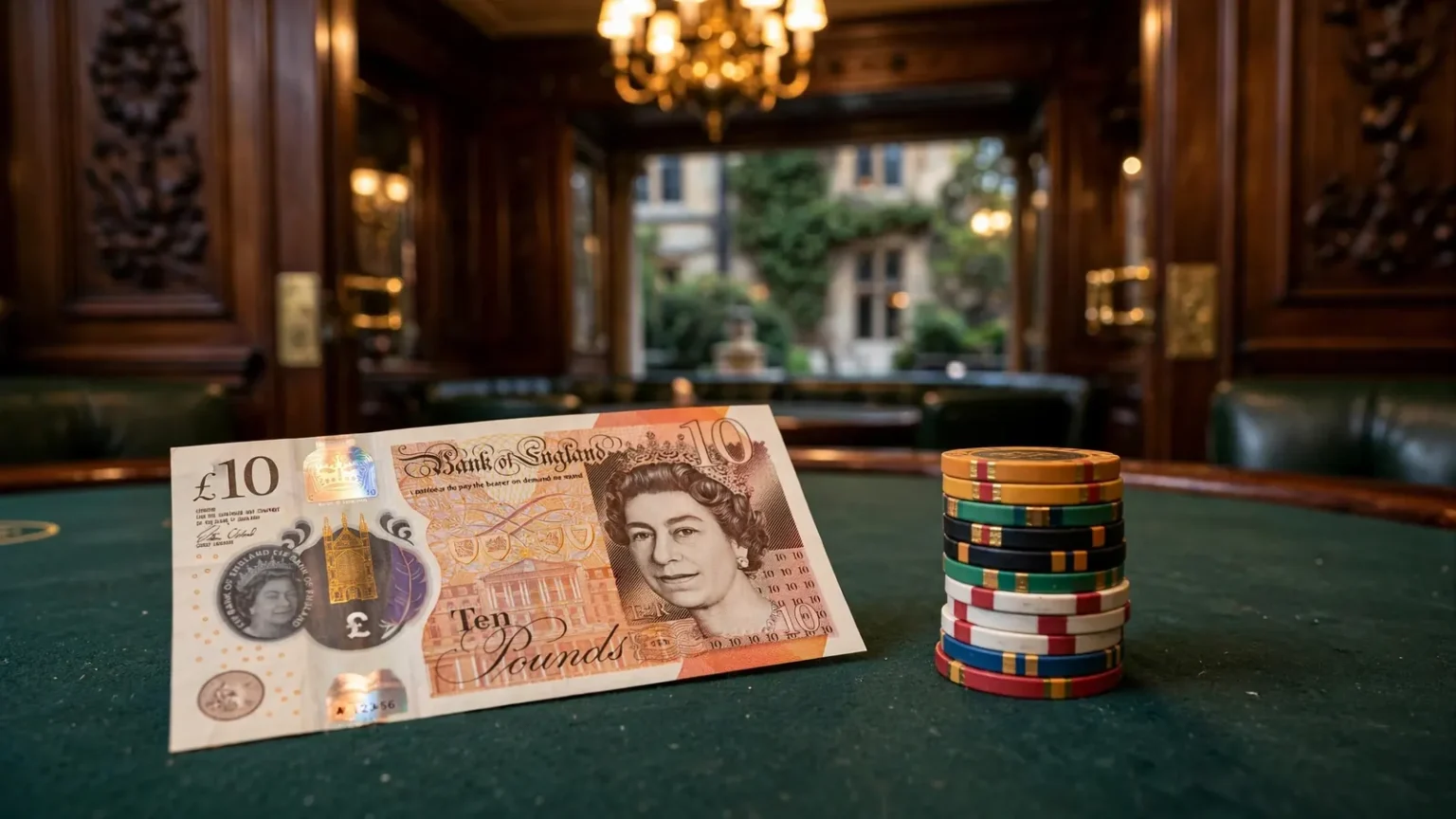
A £10 cashier threshold sets the entry point, while bonuses, payment methods and withdrawals follow separate terms.
What a £10 Minimum Means in Practice
A £10 cashier minimum is a boundary on entry, not a measure of what a casino session will cost. It means that an account cannot be funded with less than that amount through the relevant route or under the operator’s general deposit rules. For someone comparing UK casinos, the figure sits between lower entry points and higher ones; it is neither the smallest possible starting sum nor a universal standard.
The distinction matters because the minimum deposit is often treated as if it described the whole financial arrangement. It does not. It says what must be paid in to open the door to play, but says nothing by itself about how the balance may be used, whether an offer applies, or how easily funds can later be withdrawn. Those are separate terms, and the cashier figure cannot stand in for them.
A specialist review of UK casino payment terms describes £10 as the typical minimum for operators accepting direct banking, while recording some operators at £5 and others at £20. That is a snapshot of the range reported in that kind of review, not a rule binding every casino or payment route. The same amount can look like a standard at one operator and an obstacle at another. A cashier’s own displayed terms are the practical reference point.
£5 Minimum Deposit Casinos in the UK: What It Means
There are also UK casinos that accept deposits as low as £1. Their existence places a £10 minimum in perspective: it is a moderate threshold rather than the floor of the market. Yet a lower entry point does not automatically make a casino more useful. The amount required to begin is only one part of the arrangement, and a smaller first deposit can still meet conditions that make it awkward to use. That is why the comparison is better understood as a question of fit than a contest to find the smallest figure.
A ten-pound starting balance also has a particular kind of smallness. It is enough to make the act of depositing feel deliberate, but not enough to absorb many surprises in the terms. If the minimum itself takes up the whole amount set aside, there is no spare margin between the threshold and the intended budget. The distinction is simple, and easy to overlook: the casino sets its entry price; the player’s own budget sets the boundary of what is affordable.
This is where the £10 figure becomes more than a number in a cashier menu. A minimum deposit can influence which operators are even considered, especially for someone who wants to begin with a fixed, modest sum. But a casino that permits a £10 deposit is not necessarily offering a £10 experience in any broader sense. The balance remains subject to the operator’s rules and the ordinary uncertainty of gambling. A minimum is a gate, not a forecast.
£2 Minimum Deposit Casinos in the UK
Withdrawal terms show why those rules matter. A specialist review reports minimum withdrawal thresholds of £10 to £20 at many UK casinos. That range should be read as a description from a review, not as a settled market-wide norm: operators can change their terms, and an individual account’s cashier conditions take precedence. Still, it illustrates a practical point. A starting deposit and a withdrawal threshold are separate figures, and the latter can affect whether a small balance is readily payable out. The two thresholds may meet; they may not.
The neatness of a round ten-pound figure can suggest that the whole arrangement is equally simple. It is not. A deposit level is only one line in a broader set of conditions, and its meaning changes depending on what the player expects from the account. Someone seeking a modest entry point may regard it as a clear limit. Someone comparing it with a lower cashier minimum may see it as an unnecessary barrier. Neither interpretation can be settled by the number alone.
The UK market therefore has several entry levels rather than one shared standard. Some casinos permit deposits from £1; a specialist review places direct-banking minimums around the £10 mark while noting £5 and £20 alternatives. For a £10-minimum casino, the figure marks the least that can be put into the account under the applicable terms. It does not establish that the account is cheaper, more generous, or better suited to a small budget. A modest threshold, plainly stated.
A £10 minimum deposit is a moderate threshold in the UK market, sitting between lower entry points (such as £1 or £5) and higher ones (such as £20).
Best casino sites in the UK
- BritsinoBonus: Welcome Package – Get your £2,200 + 2,000 FS · Payout speed: 1-3 business days
- BeOnBetBonus: 100% up to €500 + 100 FS · Payout speed: 1-3 business days
- Revery PlayBonus: 100% up to€1,000+ 100 FS · Payout speed: 1-3 business days
- EvoSpinBonus: 125% up to €2500 + 125 Free Spins · Payout speed: 1-3 business days
- WinBeastBonus: €5000 + 500 FS + €650 Freebet · Payout speed: 1-3 business days
- SpinFormulaBonus: 550% Up To £15,000 + 550 FS · Payout speed: 1-3 business days
- JetsetspinsBonus: 200% Bonus + 100 Free Spins + Free Royal Wheel · Payout speed: 1-3 business days
- NightWinBonus: £900 + 400 free spins · Payout speed: 1-3 business days
- NightLuckBonus: Welcome Pack + 805% Up To 6400€ + 280 FS · Payout speed: 1-3 business days
Playing Online on a Ten-Pound Balance
A £10 deposit becomes a playing balance, not a measure of how long an online session will last. In slots, that distinction matters: the amount placed on each spin determines how quickly the balance is exposed to chance. Many games accept stakes from 10p to 20p per spin, so a player choosing the lower end could make 100 spins from £10 if every spin lost and the stake stayed unchanged. At 20p, the same arithmetic gives 50. These are illustrations of the balance divided by the stake, not predictions of the number of spins a session will deliver.
Wins alter the calculation, as do changes in stake. A returned prize may add money to the balance; a losing run reduces it. A player may also decide to stop before the balance is gone. The same starting deposit can therefore lead to very different sessions, even when the game and opening stake are identical. A cashier minimum sets the amount needed to fund an account. It cannot settle what happens after play begins.
That is easy to lose sight of when a small balance is presented as a neat unit of entertainment. A screen shows a number, and each spin removes or returns part of it. Yet the balance is not a row of guaranteed turns. It is a sum exposed repeatedly to outcomes that cannot be inferred from the deposit amount. Ten pounds may be divided into many small stakes on paper; it may also shrink quickly if stakes rise or losses arrive early. The arithmetic is plain. The outcome is not.
£3 Minimum Deposit Casinos in the UK: What It Means
The stake is the working unit
A slot’s displayed stake is more useful for planning than the deposit figure alone. At 10p a spin, each wager represents one hundredth of a £10 starting balance. At 20p, it represents one fiftieth. That relationship helps explain why two people can make quite different choices with the same deposit: one may keep each stake small, while another may use a larger stake that consumes the available balance more quickly if results are unfavourable.
The calculation does not make one approach safer or more profitable. It simply describes the rate at which money is put at risk. A sequence of spins can include returns, but no single return can be assumed in advance, and an apparent run of wins does not turn the next spin into a certainty. A modest deposit limits the amount initially placed in the account; it does not place a limit on how quickly the balance may be used once play starts.
There is also a difference between the stake selected and the cost of a whole session. A player may alter the stake, pause, or stop, so the opening setting is not a binding plan. Even a low stake can accumulate across repeated play. The smallness of each click can make the total less visible than a single larger wager would be. Digital play has made the transaction frictionless; it has not made repeated spending weightless.
Mobile play, same arithmetic
On a phone, a £10 minimum deposit works in much the same way as it does on a computer: once the balance is available, the game uses it according to the selected stake and the outcomes of play. The smaller screen changes the surroundings, not the underlying arithmetic. A quick session on a mobile device can still involve repeated wagers, and the convenience of having a game close at hand does not extend the balance.
Balance Arithmetic
Step 1: Set the balance
A player deposits the minimum of £10 into their account.
Step 2: Choose the stake
The player selects a stake per spin, for example, 10p or 20p.
Step 3: Calculate the potential spins
At 10p per spin, the balance allows for 100 spins; at 20p, it allows for 50 spins, assuming all spins lose and the stake remains unchanged.
That portability has a social history of its own. Gambling once required a visit to a place set aside for it; online play folds the casino into ordinary spaces and spare moments. The boundary between a session and the rest of the day can become less visible. The balance remains measurable, but attention is not always as tidy as the account display suggests.
A sensible reading of a ten-pound balance is therefore neither “many spins guaranteed” nor “barely enough to play”. It is a fixed starting sum whose reach depends on stake size, results and the decision to continue. The common 10p–20p stake range gives a concrete scale for the arithmetic, but not a forecast. A deposit threshold opens the door. It does not write the evening’s script.
The £10 Threshold, and the Smaller Deposits Beneath It
A £10 cashier minimum marks a clear entry point: an account cannot be funded with less through the available route, even if the casino’s games and account pages are visible beforehand. Below that threshold, some UK-licensed casinos accept smaller deposits, including £1. The difference is not simply a choice between spending more and spending less. It is a distinction between the amount needed to put funds into an account and the conditions that determine what those funds can do once there.
A specialist casino review reported six UKGC-licensed casinos accepting a genuine £1 minimum deposit in its checked snapshot. That is a count from a particular review, not a permanent catalogue of the market. Cashier terms can change, and an advertised low threshold may apply only to selected payment routes. At some casinos, a £1 transaction is possible through one method while another route carries a higher minimum. The figure beside the deposit button is therefore meaningful only alongside the method selected.
£4 Minimum Deposit Casinos in the UK
The £10 tier is less ambiguous in one respect: a deposit below it will not meet the cashier’s stated minimum. But the label alone does not describe every route the operator supports, nor does a low threshold establish that every amount above it receives the same treatment. The actual cashier terms matter. A minimum deposit is an entry condition, not a general promise about promotions, withdrawals or the availability of every payment option.
The lower tier can be attractive because it lets a player commit less money at the outset. Yet a £1 deposit may be too small to meet a separate promotional condition. A specialist review described welcome offers requiring deposits in the £5-to-£10 range; it also noted that a £1 payment could fund the account without activating an offer. Some UK casinos may exclude the lowest deposit bracket from welcome promotions altogether. These are distinct rules: the cashier can accept a deposit while the promotion declines to recognise it.
That distinction is easy to miss when the headline minimum is treated as the whole offer. A casino can accept £1 as a cash deposit and set a higher qualifying amount for a welcome promotion. It can also make eligibility depend on the payment route or on the offer’s own terms. For a smaller deposit, the practical question is not merely whether the cashier accepts it, but whether any separate condition changes what happens next. The promotional terms are a separate ledger.
A low cashier minimum does not guarantee that a deposit will meet separate promotional conditions or be easily withdrawable if it is below the operator’s withdrawal threshold.
The same gap appears at withdrawal. A specialist review reported that many casinos set a withdrawal minimum above £1, while also noting that some payment methods may not be available at the lowest deposit level. A small deposit can therefore be accepted without creating an equally small route back out. If the balance is below the operator’s withdrawal threshold, it may have to remain in the account until the stated minimum is reached, subject to the casino’s rules.
This does not make a £1 minimum meaningless. It does make it narrower than it first sounds. It describes what can enter, not necessarily what can leave, and it does not guarantee access to a bonus. Someone comparing a £10-minimum casino with a lower-tier alternative is comparing different entry conditions, but not necessarily different overall value. The lower figure matters only in combination with the rules attached to that account.
There is a small social history in these thresholds. A fixed minimum turns a private choice about spending into an administrative category: below the line, a transaction may not qualify; above it, it may. The line can be set by the casino, shaped by a payment provider, and then supplemented by a separate promotional rule. A neat number at the cashier does not simplify the arrangement. It merely makes the first boundary visible.
For that reason, the phrase “£10 minimum deposit casino” should be read literally and narrowly. It means that £10 is the minimum accepted deposit under the stated cashier conditions; it does not say that lower deposits are unavailable everywhere, or that a casino accepting less will make a £1 payment useful for every purpose. The exact threshold and the practical value of a deposit are related, but they are not the same thing.
Online Casinos with No Sister Sites in the UK
A lower threshold can reduce the amount needed to open the account balance. It cannot, by itself, erase the separate boundaries around offer eligibility or withdrawals. Nor does a £10 minimum automatically make an operator less flexible: it may simply define the amount its cashier accepts. The useful comparison is between the stated entry amount and the rules that apply after it has been accepted. A minimum is a door, not the whole building.
What Makes a £10 Casino a Better Fit
A £10 cashier minimum is only one part of the decision. It describes the amount needed to fund an account, not how straightforward it will be to use the balance afterwards. A better fit is an operator whose terms make that distinction clear: the cashier explains what can be deposited, the withdrawal rules explain when funds can leave, and any promotion states precisely who qualifies.
The cashier should identify the minimum before a deposit is confirmed. That sounds elementary, but a £10 threshold can be presented as though it settles the whole question of affordability. It does not. Separate conditions may apply to taking money out or claiming an offer, and those conditions belong beside the headline figure, not hidden behind it. Clarity is a practical feature, not decoration.
Withdrawal terms deserve particular attention. A specialist review reported thresholds of £10 to £20 at many UK casinos, but that is a dated snapshot, not a dependable rule for every operator. The relevant threshold is the one stated in the casino’s own current terms. If it exceeds the amount in the account, a player may have to continue playing before a withdrawal can be requested; that can change the meaning of a small starting balance. A low entry point can coexist with a less flexible exit.
Do
- Check current withdrawal thresholds in the casino’s own terms
- Verify if the deposit amount qualifies for the welcome promotion
Don’t
- Assume a £10 entry point means a flexible exit
- Rely on dated snapshots of market-wide norms
The useful question is therefore not simply whether a casino accepts £10, but whether its withdrawal conditions are legible and workable alongside that deposit. Terms should explain any minimum withdrawal and any conditions that affect the funds. If the answer is difficult to locate or expressed ambiguously, the advertised cashier minimum offers little reassurance. The exit matters.
Promotions need the same scrutiny, even when a casino presents a welcome offer prominently. A specialist review has reported that some UK casinos exclude the lowest deposit bracket from welcome promotions. That observation should not be treated as a rule across the market; the operator’s own offer terms decide whether a particular deposit qualifies. A clear offer distinguishes the amount needed to open and fund an account from the amount needed to claim a promotion, and spells out the conditions attached to it.
A casino may also make an explicit choice not to offer a sign-up bonus. A specialist review described Zodiac, Luxury Casino and UK Casino Club as having a £10 minimum on UK accounts and no sign-up bonus. Such details are time-sensitive, not a lasting verdict on those operators. More importantly, an absent offer is not automatically a defect: it simply makes the deposit terms, withdrawal rules and ordinary account conditions more central to the comparison. A bonus can be a poor substitute for clarity.
Anjouan casino licence in the UK: legal position
That is why a single “best” label cannot settle the choice. One player may care most about a transparent cashier; another may place greater weight on a withdrawal threshold that does not make a modest balance awkward. A newly encountered casino is not a better fit merely because its offer looks fresh, and a familiar name does not make unclear terms harmless. The useful comparison is between conditions, not adjectives.
A careful assessment keeps the claims in proportion. A £10 minimum tells how much is needed to start, while the surrounding rules show what that start actually permits. Read together, those details give a more reliable basis for judging whether an online casino suits a small deposit than a ranking or a promotional headline. A modest threshold is only the beginning.
When a £10 Deposit Qualifies for a Bonus
A cashier minimum and a bonus threshold answer different questions. The first determines how much must be deposited to put funds into an account; the second determines whether a particular promotion is available. A casino may therefore accept a smaller deposit for ordinary play while requiring £10 to activate a welcome offer. A specialist casino review reports this distinction for some offers: the platform accepts deposits of £5, but its qualifying amount for the promotion is £10. The terms of the individual offer decide the matter.
That difference can make a £10 deposit look more decisive than it is. Reaching the qualifying amount does not automatically mean every welcome promotion applies. The offer may need to be selected or claimed, and its conditions govern what happens next. A deposit that falls short can still enter the account as cash, but it does not become bonus-eligible merely because the site’s cashier accepted it.
Under current UK rules as of 19 January 2026, wagering requirements attached to bonus funds cannot exceed ten times their value.
The phrase “no-deposit bonus” describes a different arrangement: the offer is not activated by making a £10 deposit. It should not be confused with a welcome offer that requires a deposit, even where both appear beside the same registration process. Nor does the label alone explain what a promotion permits; its specific terms remain important.
Wagering conditions are one reason the wording matters. Older casino terms and promotional descriptions may still show higher requirements, including figures that were once common in bonus offers. For bonuses offered under current UK rules, however, the relevant ceiling changed on 19 January 2026: wagering attached to bonus funds cannot exceed ten times their value. An older figure in a page or archived promotion does not override that limit.
The cap concerns wagering, not the amount needed to qualify. A £10 qualifying deposit does not mean that the bonus is worth £10, nor does it make the bonus immediately withdrawable. The deposit threshold and the wagering rule govern separate stages: one controls entry to the offer, the other sets how much play can be required against bonus funds before winnings become withdrawable under the applicable terms.
Promotion pages can compress these distinctions into a single headline, where “minimum deposit” may refer either to funding the account or to claiming the offer. The detailed terms should identify the qualifying deposit and the wagering condition separately. That separation is more useful than the headline. A number in large type is not the whole bargain.
Not on GamStop: A Boundary, Not a Shortcut
“Not on GamStop” describes a relationship to a self-exclusion service; it does not, by itself, establish who runs a casino, which rules govern it or whether it is suitable for British players. Adding a £10 minimum deposit to the description changes none of that. A cashier threshold is a price of entry, not evidence of protection.
The distinction matters because operators selling remote gambling to customers in Great Britain must hold a Gambling Commission licence, wherever they are based. Offshore casinos without that licence sit outside the UK regulatory system. The label “not on GamStop” cannot replace checking the operator’s regulatory status, and it should not be treated as a reassuring alternative to it. A familiar payment screen and a clearly stated deposit amount are not substitutes for oversight.
There is also a human reason to treat the phrase carefully. GamStop is a responsible-gambling service, and searches for casinos outside it may come from people trying to get around a boundary they previously chose. In that situation, access is not a neutral convenience. A route that makes it easier to gamble can undermine the purpose of exclusion rather than solve a problem.
The same caution applies to claims about a £10 minimum deposit casino in the UK that is not on GamStop. The wording alone cannot show that a particular operator accepts British customers lawfully, offers a £10 cashier minimum, or provides safeguards comparable to a UK-licensed casino. Those are separate questions, not details that can safely be inferred from a search phrase.
Requests for mobile casino payments by SMS belong to a different category again. Mention of SMS funding does not confirm that a casino accepts it, that it can be used for a £10 deposit, or that the operator is appropriately licensed. Payment convenience tells little about the rules governing the account.
Regulatory Status
Operators serving customers in Great Britain must hold a Gambling Commission licence; the label "not on GamStop" is not a substitute for legal oversight.
A useful boundary, then, is not the deposit amount but the operator’s status. For British customers, remote gambling operators serving the market must hold the relevant UK Gambling Commission licence. “Not on GamStop” is a label, not a shortcut around that requirement—and certainly not a quality mark.
Payment Routes and Their Minimums
A £10 cashier minimum does not necessarily mean every payment route behaves alike. At a given UK casino, the minimum is commonly shared across the cashier’s listed methods, although some operators set a higher threshold for bank transfers than for cards or e-wallets. The payment screen, rather than the headline deposit figure, determines whether a particular route can fund the account at that level.
Visa and Mastercard debit cards are accepted at almost every UK casino and support low deposits. They are therefore a straightforward way to meet a £10 minimum, provided the card is a debit card: credit cards cannot be used for gambling deposits in the UK. A cashier may still impose its own minimum or decline a transaction for account-specific reasons.
Direct banking can involve a higher entry point than card payments at some casinos. A specialist review has reported flat transaction fees of £1 to £3 from some payment providers. That is not a universal charge, but it matters more on a small deposit: a fixed fee takes the same amount regardless of the sum being transferred. Checking the provider’s fee before confirming avoids mistaking the amount debited for the amount credited.
Prepaid vouchers work differently because the amount is bought in advance. Paysafecard is sold in fixed denominations of £5, £10, £25, £50 and £100, and one voucher can fund several smaller deposits. A £10 voucher matches a £10 minimum neatly, while a larger voucher need not be spent in one go. Whether a casino accepts the voucher, and how it processes any unused balance, depends on that operator’s cashier terms.
The method is not merely a matter of preference. It can shape the smallest practical transaction, the possibility of a provider fee and whether a voucher’s face value fits the account threshold. A clear cashier should display accepted routes and their conditions before money is sent. Small print has a price.
Depositing £10 to Play for Real Money
A £10 deposit places funds in a casino account as real-money balance. It does not, by itself, promise a bonus, guarantee a particular amount of play or make the balance immediately withdrawable. Those are separate questions, governed by the operator’s terms and the cashier rules.
The distinction matters because a deposit and a withdrawal are not mirror images. A specialist review has reported withdrawal thresholds ranging from £10 to £20 at many UK casinos; that is a reported range, not a fixed market rule. If a site sets its cash-out minimum above the balance available, the money may remain in the account until the threshold is met. A small balance can therefore be real money while still being impractical to withdraw on its own.
Promotion terms create another boundary. A real-money deposit does not automatically become bonus funds, and accepting an offer can place additional conditions on the promotional amount. Where a bonus is involved, wagering requirements, eligible games and any maximum withdrawal cap apply to the bonus amount rather than to the payment method used to fund the account. The cashier transaction and the promotion are distinct parts of the arrangement.
Summary of Real Money Play
- A £10 deposit is real-money balance but may be subject to withdrawal thresholds
- Real-money deposits do not automatically become bonus funds
- Bonus funds carry separate restrictions such as wagering requirements and maximum withdrawal caps
That distinction can be easy to miss when a deposit is described as a route to “real money” play. The phrase identifies the kind of funds involved, not the ease of taking them back out. A balance may be available for play but subject to a withdrawal threshold; bonus funds may carry separate restrictions. The account’s balance display alone does not explain either condition.
For a £10 minimum deposit casino in the UK, the practical value of a cash deposit therefore depends on what happens after the payment is credited: whether a promotion has been accepted, what rules attach to it, and what minimum applies to a withdrawal. Cash in the account is not the same as cash already returned to a bank account.
PayPal and the E-Wallet Question
A £10 minimum deposit casino that accepts PayPal sounds like a simple pairing: choose the e-wallet, send the money and begin. The difficulty is that a casino’s cashier rules and its list of available payment methods are separate matters. A £10 threshold does not establish that PayPal is offered, and a PayPal option would not, by itself, establish that the cashier minimum is £10.
At a given UK operator, the minimum deposit is generally shared across payment methods. There are exceptions: some casinos set a higher threshold for direct banking than for cards or e-wallets. That difference can matter when the intended deposit is modest. A method displayed in the cashier may still be unavailable for a transaction of that size, or may carry its own conditions.
PayPal is an e-wallet, not a promise of uniform access between casinos. Its appearance in a payment list should be checked against the operator’s own cashier terms, alongside the stated minimum and any conditions attached to that method. The name of a familiar service cannot substitute for those details. Payment rules are made at the operator level.
There is also a regulatory boundary around how gambling accounts are funded in Britain. Debit cards, bank accounts and e-wallets funded by debit are permitted routes; credit cards cannot be used for gambling deposits, including through a wallet that allows credit-card funds to be spent on gambling. A payment logo does not erase the source-of-funds rule.
The practical question, then, is not simply whether PayPal appears somewhere on a casino’s site. It is whether that operator currently offers it for deposits, whether the cashier accepts the intended amount through it, and whether its rules differ from those for direct banking. Small print, but consequential.
Legitimacy Starts with the Rules
A £10 cashier minimum says nothing, by itself, about whether a casino is legitimate. For online gambling serving people in Great Britain, the essential distinction is regulatory: an operator must hold the relevant licence from the UK Gambling Commission. A polished cashier or familiar brand name cannot stand in for that permission. The rules are less decorative than they sound.
Legal access is restricted to adults aged 18 and over, and an operator must verify a customer’s age before allowing a deposit. That safeguard is not a formality to be postponed until winnings are requested; it belongs at the entrance. A legitimate £10 minimum deposit casino in the UK is therefore defined first by its legal status and checks, not by the size of its opening transaction.
The funding route matters too. Since the UK’s credit-card gambling ban took effect in 2020, gambling deposits must come from a debit card, an e-wallet funded by debit, or a bank account. Credit cards are not a compliant way to fund casino play, including through a money service that passes the payment along. A wallet is not a loophole.
There is also a small but consequential pause before the first deposit: new customers must be prompted to set a financial limit, with account-level controls available afterwards. That makes the opening decision more than a choice of amount. A £10 deposit can be modest; a limit gives the spending a boundary. The distinction is plain, and important.
Material created by the team Pure Casino UK Guide


