

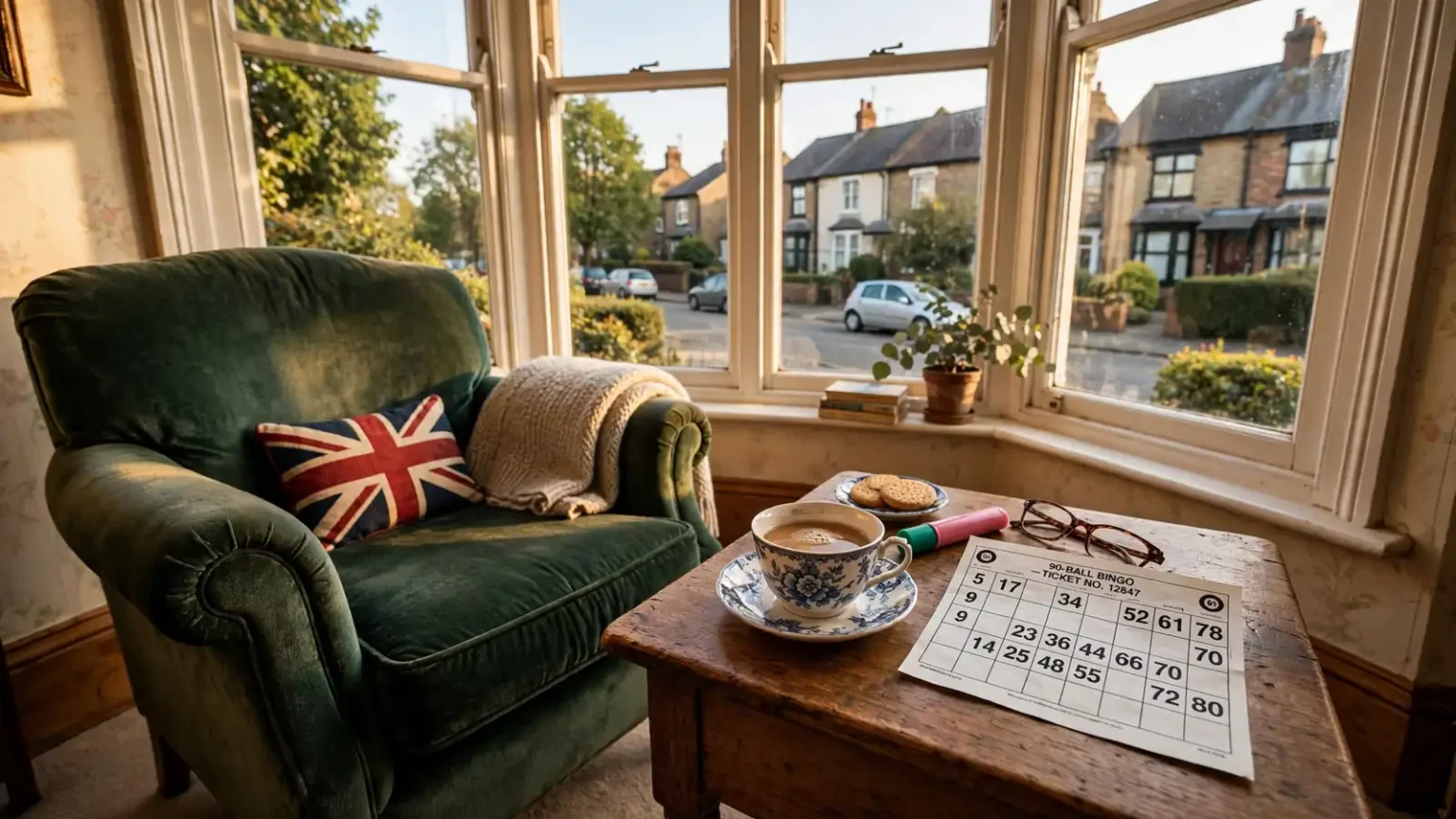
The guide follows bingo patterns from 90-ball tickets into slots, stakes, mobile play and the rules shaping UK bingo sites.
Bingo’s Patterns, and the Company They Keep
A bingo ticket is a small piece of organised expectation. Numbers arrive one by one; the player follows them across a marked layout, waiting for a pattern to emerge. The rules are simple enough to travel between rooms and generations, yet each format gives the waiting a different shape. In online bingo and casino settings, the game’s identity still begins here: with the ticket and the pattern that counts as a win.
In 90-ball bingo, the ticket has three rows and nine columns. Its shape makes the eye move horizontally, across lines that fill at different rates. A prize can be awarded for completing one line, then two lines, and finally a full house, when every number on the ticket has been marked. The sequence gives the round a set of distinct milestones. A player may be close to one line while another ticket is still waiting for its first completed row; the same draw can hold several different kinds of suspense.
That progression is part of the format’s particular social character. The line is not merely an incomplete version of the full house. It is a recognised achievement in its own right, and so the game has more than one point at which attention gathers. In a bingo room, players follow the same draw while reading their own tickets; the shared event is the call, but each ticket tells a slightly different story. A full house is the final punctuation. The earlier lines are commas.
The 80-ball game changes the visual grammar. Its ticket is arranged as an 8-by-4 grid, and wins depend on coloured patterns. Four corners might be the target; another round may call for a letter shape or a full card. Rather than watching rows complete in sequence, players look for a design to take form across the grid. The ticket becomes a little more like a picture being assembled, with marked numbers serving as pieces.
Online casino without ID in the UK: what checks apply
That shift matters. A line is easy to recognise because it follows the ticket’s own structure. A pattern may ask the eye to jump between separated places, then return to the whole. Four corners are distinct from a letter shape, and both differ from filling the card. The calls may be shared, but the task of seeing progress changes with the target. In online casino bingo games, where tickets are displayed on a screen, colour and arrangement can make that pattern legible without changing the underlying bargain: numbers are drawn, and a completed design decides the win.
The 75-ball format uses a 5-by-5 grid and makes patterns the central rule. A cross, an X, a diamond, a letter T or a picture frame can each define the winning shape. The ticket is not simply a route towards a full card; it is a surface on which the required figure has to be traced. A number can matter greatly in one round and be of little help in another, depending on where it sits in the pattern.
Online American Roulette in the UK: How It Works
This is one reason the word “bingo” covers experiences that feel related without being identical. The 90-ball ticket encourages attention to rows and stages. The 80-ball grid invites the eye to pick out coloured forms. The 75-ball card turns the target into a specific figure. The number draw supplies the common machinery; the layout tells players what to watch for. A bingo game online in a casino setting is not defined by the screen alone, but by this older arrangement between chance, a marked card and a public rule for winning.
There is something revealing in the persistence of these layouts. They make a private act of watching—the quiet scan from number to number—part of a communal event. Everyone hears the same calls, but no two tickets necessarily produce the same moment of recognition. A completed line, a sudden X, four corners at last: each is a different way for chance to become visible. The pattern is the proof.
That is also why the formats should not be treated as interchangeable labels. Someone moving from 90-ball to 75-ball bingo carries the habit of tracking numbers, but not quite the same habit of looking. In one, the rows set the order of attention; in another, the target shape does. Online bingo casino games may gather these traditions under one roof, but the ticket remains the rulebook in miniature. Its grid determines where the eye goes, and its winning pattern determines when the room can celebrate.
90-Ball Bingo
Features a three-row, nine-column ticket where players aim for a line, two lines, and finally a full house.
80-Ball Bingo
Uses an 8-by-4 grid where wins are based on coloured patterns, such as four corners or letter shapes.
75-Ball Bingo
Utilises a 5-by-5 grid where the central rule is completing specific figures like a cross, X, or diamond.
The arithmetic is plain. The customs are not. A line, a frame, a full house: each turns a random draw into a contest with a shape people can recognise together.
When the Bingo Room Opens into Slots
On a casino-style site, bingo and slots may sit under neighbouring headings, but they ask for different kinds of attention. A bingo room gathers players around a shared event: tickets are bought, numbers are drawn, and the prize depends on completing a pattern before anyone else does. A slot game is not part of that contest. Its reels turn on their own schedule, without a roomful of people waiting for the same number.
Putting both in one place changes the shape of an evening without changing the games themselves. The bingo room has a social clock: a round begins, numbers arrive, and the chat can follow the fortunes of the group. Slots offer a more solitary rhythm, even when they appear on the same screen or in the same catalogue. One is organised around a common draw; the other around repeated individual plays. The shared account may make the transition feel seamless. The underlying experiences are not.
That distinction matters because “bingo and slots” can sound like a single hybrid product. In practice, the combination is more often a doorway between separate activities. A player might enter a bingo room, take part in a round, then open a slot game while waiting for another draw—or move between the two for no particular reason beyond having both available. The site’s design can place them side by side, but proximity is not a new set of rules. A slot spin does not complete a bingo pattern, and a bingo ticket does not turn the slot game into a room-based contest.
European Roulette at UK Online Casinos: A Guide
There can, however, be a link between the two. A specialist review describes some bingo rooms as attaching a free slot spin to each ticket bought. That is a particular kind of crossover: the ticket belongs to the bingo round, while the spin belongs to a separate slot game. The connection is a promotional bridge, not a shared outcome. A ticket may be called, marked and judged against other players; a spin has its own result. Treating them as interchangeable would confuse the invitation with the activity.
This is one reason the combined offer deserves a little scrutiny. The bingo side is legible in public: numbers are called and the room’s progress is visible. A slot game can seem similarly transparent because its animation is immediate, but it is a different form of play, with its own return-to-player figure and mechanics. Side games can return a smaller proportion over time than the bingo room does. That comparison does not predict the result of an individual round or spin; it is a reminder that games sharing a lobby need not share the same underlying terms.
The lobby itself is a small piece of social architecture. It sorts games into doors, often making the change of mood look like a simple click. Bingo’s room culture has historically depended on being in the same place at the same moment: the draw provides a common subject, and other players make the wait visible. Slots do not require that gathering. Their inclusion beside bingo reflects a broader entertainment arrangement, one in which the room is no longer the whole destination but one stop among several.
While some bingo rooms may attach a free slot spin to each ticket bought, this is a promotional bridge and not a shared game outcome.
There is an irony in this arrangement. Bingo’s communal quality can sit beside a game designed for individual play without either absorbing the other. The interface may encourage movement between them, but the player’s attention has to move too: from watching a shared sequence unfold to following a private game. The change is not merely visual. It changes who—or what—the player is waiting with.
For people who enjoy both, the appeal may be variety rather than fusion. A bingo round has pauses built into its structure; a slot game can fill a gap, while the room remains available for the next draw. Yet the two activities should not be mistaken for one continuous game. A ticket-linked spin, where offered, is an example of how a site can connect them commercially while leaving their play mechanics separate.
The modern online bingo room therefore has a companion, not a successor. Slots may broaden what sits around the room, and ticket-linked spins can make the connection explicit, but the central bingo ritual remains intact: a ticket, a draw, and a pattern completed in company. The doors are adjacent. The games are not the same.
From Penny Rooms to Real-Money Stakes
A bingo ticket is a small purchase with a clear purpose: it enters a player into a particular round. Online prices can begin at 1p, with low-stakes rooms also offering tickets at 5p, while premium games may charge £1 or more. Another description of the market puts penny-room tickets at 2p and high-stakes games at £5 or more. The exact range depends on the room; “bingo” is not one fixed price.
Live Casino Lightning Roulette in the UK
The low entry cost can make a room feel casual, but it does not turn repeated purchases into an abstraction. Each ticket is a separate stake. Buying more tickets for a round means spending more, while the possible return depends on the prize attached to that game and on its rules. That basic arithmetic deserves more attention than the bright language surrounding a jackpot.
Prizes can differ sharply even where the ticket price seems close. A specialist review, describing particular games rather than setting a market standard, cited a 1p ticket game with a £10 full-house prize and a £1 game with a jackpot in the hundreds or thousands. Those illustrations show why ticket cost alone cannot tell the whole story. They are not a promise that any room will offer those prizes, nor evidence that a higher-priced ticket will return more to an individual player. A prize pool belongs to its specific game, and its value may change.
The relationship between price and prize is therefore not a simple ladder. A dearer ticket may be attached to a larger advertised pool, but the cost is certain once the ticket is bought; a win is not. In a bingo-and-casino setting, this distinction matters because real-money play can place different products side by side. A bingo ticket buys entry to a draw, while a slot spin is a different paid game. The common currency does not make their costs or outcomes interchangeable.
A sensible way to read a room’s price is to ask what the ticket buys, how many tickets are being purchased, and what prize applies to that round. The headline figure can otherwise disguise the practical scale of spending. One inexpensive ticket may look negligible; a series of purchases is still a series of real payments. The room does not change that fact.
Attention A low ticket price does not guarantee a specific return, and a large jackpot is only a possible outcome, not a certainty.
There is also a difference between spending and winnings when it comes to tax. Recreational players in the United Kingdom do not pay tax on online bingo winnings. That treatment does not make a prize certain or cancel the cost of tickets already bought; it simply means a recreational player’s bingo winnings are not treated as taxable income. It is a useful point to keep separate from the game’s own arithmetic.
For anyone comparing real-money bingo with other casino play, the central question is not whether the room calls itself low-stakes or premium. It is whether the ticket price fits the amount intended for play, and whether the stated prize belongs to the precise game being entered. A cheap ticket is still a stake. A large jackpot is still only a possible outcome.
There is no reliable shortcut from price to value. Rooms set their own ticket costs and prizes, and the connection between the two is specific to each game. The careful reading is the unromantic one: identify the spend first, then regard the prize as uncertain.
What a Bingo-and-Slots Site Actually Offers
A bingo-and-slots site is not defined by the number of game tiles on its lobby screen. Its character is clearer in the rooms it makes available, the limits attached to each game and the way it distributes attention across the day. A long catalogue can still feel narrow if the same small set of rooms carries the activity; a more modest selection may offer a clearer choice of pace and scale.
Mines Casino Game in the UK: Demo, Risk and Play
Ticket limits are one useful detail. Bingo rooms commonly restrict how many tickets one player can buy in a game, with caps reported in the range of 10 to 50. The applicable limit can depend on ticket price, so it is not necessarily the same across a site’s rooms. That shapes the room as much as its headline prize: a cap determines how many entries an individual can hold, while also setting a boundary on how far ticket buying can expand within that game.
It is worth reading the limit beside the room’s other terms, rather than treating it as a footnote. A stated cap does not say how many tickets other players will buy, how many people will join, or what any one ticket is likely to return. It does, however, show that the operator has set a ceiling for participation by an individual. That is a practical distinction between rooms, not a verdict on which one is best.
The schedule also gives a site its shape. A specialist review reports that bingo rooms see their busiest traffic from 7pm to 11pm, when operators schedule their largest prize pools. This is a reported pattern, not a promise that every room follows it or that a particular game will have a particular number of players. The useful point is that prize schedules and player activity may be concentrated at certain hours; the room list is only a snapshot unless the timetable is considered too.
This concentration has a social dimension. Bingo is organised around simultaneous participation: numbers are drawn for a roomful of players, and the prize structure gives that shared moment a focus. A larger advertised pool can draw attention, but the scale of a prize alone does not describe the experience. Timing, ticket limits and the people who turn up are part of the same picture. A busy room is not simply a larger number on a banner.
Bingo Site Assessment
- Evaluate the variety of available rooms rather than just the number of game tiles.
- Check for stated ticket caps to understand individual participation limits.
- Review the prize schedule to identify when the largest pools are planned.
For anyone comparing sites that pair bingo with slots, the sensible comparison is therefore about range and organisation, rather than a universal ranking. Are there different rooms, or does the offer depend on a narrow cluster? Are ticket caps stated for each game? Is the schedule visible enough to show when larger pools are planned? These details describe the offer without pretending that one operator is objectively superior for every player.
The slots may occupy much of the same lobby, but their presence does not answer these questions about bingo. A site can display both kinds of game and still present its bingo rooms in very different ways: by their limits, their scheduled prize pools and how clearly those arrangements are set out. The distinction is easy to miss when the lobby is designed as a wall of bright choices. The room tells more.
A useful assessment is less like counting icons and more like reading a timetable. Ticket caps indicate the boundary placed on individual participation; scheduled pools show when an operator expects a room to matter most. Neither detail predicts a result. Together, they give a more grounded account of what a bingo-and-slots site actually offers than a label such as “best” ever could.
Free Play Has Conditions
A free bingo ticket looks simple because its price is absent. Its terms are not. The ticket may be valid only in a named room or for a particular ball format, so it cannot necessarily be used wherever a game is running. A specialist review describes offers in which tickets are tied to particular rooms or ball types and may expire after 24 hours. That is a reported condition, not a timetable that applies to every offer; the terms attached to the ticket determine whether it remains usable.
Plinko casino UK: how the online experience works
This matters because a free ticket is not merely a cheaper way into an ordinary game. It can steer play towards a room the operator has chosen, or a format that might not have been the player’s first choice. The restriction is part of the offer, not an incidental detail. A ticket left unused may simply lapse.
The more consequential condition appears if the ticket wins. The ticket itself cannot be withdrawn as money. Instead, winnings are credited as cash, and that balance may still be subject to a wagering requirement, sometimes on terms matching those attached to a deposit bonus. So a win can appear in an account without being ready to leave it.
The scale of that requirement deserves attention before play begins. One specialist review reports wagering requirements for free-ticket winnings in a range from 20x to 65x. That range should not be read as a fixed industry rule: individual offers can differ, and the applicable terms decide what counts towards completion. The important distinction is between a credited balance and a withdrawable one. They are not necessarily the same thing.
Promotional play can also blur the boundary between bingo and the wider entertainment surrounding it. A free offer may sit beside other games on a site, but the ticket’s own restrictions still govern where it can be used and what happens to any resulting balance. Searching for free bingo or slot games does not make every game free, nor does a free ticket automatically create unrestricted cash.
Evaluating Free Tickets
Step 1: Verify eligibility
Identify the eligible room and the required ball type for the ticket.
Step 2: Check expiration
Note the expiry date or time limit, as some tickets may lapse after 24 hours.
Step 3: Review wagering
Find the wagering requirement attached to any winnings to determine if they are immediately withdrawable.
The useful reading order is therefore plain: identify the eligible room and ball type, note the expiry, then find the wagering requirement attached to winnings. If the offer says that winnings are credited as cash, the next question is whether that cash is subject to further play before withdrawal. A free ticket can be genuine and still carry conditions that shape its value. Free, with an asterisk.
The UK Rules Behind Online Bingo
Online bingo is legal in the United Kingdom, but a website’s availability does not, by itself, establish that it is authorised to serve British players. Remote operators offering gambling to customers in England, Scotland and Wales must hold the relevant licence from the UK Gambling Commission (UKGC), wherever the business is based. A licence for another country is not a substitute.
The Gambling Act 2005 provides the main framework for gambling in England, Wales and Scotland; it does not apply in Northern Ireland. The rules are not merely a matter of naming a game correctly. The Act defines a casino in terms of arrangements that give people the opportunity to take part in casino games, while remote operators serving Great Britain are subject to UKGC oversight. Online bingo sits within that regulated market.
A UKGC licence brings obligations intended to make the operator’s conduct accountable. They include standards for fairness, measures against money laundering and requirements relating to responsible gambling. Operators must also verify a customer’s age before allowing a deposit, and every player must be at least 18. Identity checks are part of the licensing regime, not an optional courtesy added by a website.
Keno Online Casinos in the UK: Rules, Payouts and Evidence
There are visible signs of that framework. A gambling site should prominently display its UKGC licence number in the footer; if it does not, close the tab. The number can be checked against the Commission’s public register before any deposit is made. The regulator’s register is more useful than a confident badge designed by the site itself.
Licensed operators must provide an internal complaints process and access to an approved Alternative Dispute Resolution service. They must also offer responsible-gambling tools, including self-exclusion. These arrangements matter because regulation is not a guarantee that every dispute will be simple or that every game will produce a favourable result. It establishes duties, routes for challenge and a body with oversight.
The distinction is plain, if easily blurred by polished websites: legal online bingo for British customers belongs within the UKGC licensing system. A foreign address or an overseas licence does not remove the requirement to hold the relevant UKGC licence when serving the British market. The paperwork is part of the product.
Best casino sites in the UK
- BritsinoBonus: Welcome Package – Get your £2,200 + 2,000 FS · Payout speed: 1-3 business days
- BeOnBetBonus: 100% up to €500 + 100 FS · Payout speed: 1-3 business days
- Revery PlayBonus: 100% up to€1,000+ 100 FS · Payout speed: 1-3 business days
- EvoSpinBonus: 125% up to €2500 + 125 Free Spins · Payout speed: 1-3 business days
- WinBeastBonus: €5000 + 500 FS + €650 Freebet · Payout speed: 1-3 business days
- SpinFormulaBonus: 550% Up To £15,000 + 550 FS · Payout speed: 1-3 business days
- JetsetspinsBonus: 200% Bonus + 100 Free Spins + Free Royal Wheel · Payout speed: 1-3 business days
- NightWinBonus: £900 + 400 free spins · Payout speed: 1-3 business days
- NightLuckBonus: Welcome Pack + 805% Up To 6400€ + 280 FS · Payout speed: 1-3 business days
Bingo Slot Machines, Without the Bingo Ticket
A bingo-themed slot may borrow familiar words, colours or symbols, but its play is not a bingo round. There is no ticket to mark as numbers are drawn and no shared pattern to complete before other players. A slot spin is a separate game cycle, with its own outcome. The resemblance is decorative; the rules belong to a different branch of gambling.
That distinction matters because the regulations governing online slots reach into the pace and size of play. In Britain, autoplay is banned: a player cannot set a machine to run through spins unattended. Each spin must last at least 2.5 seconds. The pause is brief, but deliberate. It prevents a sequence of outcomes from being compressed into a blur controlled by a single button.
Legal Requirement
Remote operators serving Great Britain must hold a valid licence from the UK Gambling Commission; a licence from another country is not a substitute.
A maximum stake also applies per game cycle. Since 9 April 2025, the limit has been £5 for adults. A cap does not turn a slot into a low-risk pastime, nor does it say anything about what a particular spin will return. It sets a boundary around the amount that can be staked in one cycle.
The word “bingo” in a game’s name does not change those mechanics. A bingo slot machine online remains a slot if it uses spins rather than numbered tickets and a room-wide draw. That classification matters in a country where online gambling is permitted through locally regulated operators, and where rules are attached to the product itself rather than its theme.
There is a small cultural irony here. Bingo’s social structure gathers players around a common draw; a slot borrows the imagery but makes the outcome individual. The room disappears. The spin remains.
For operators serving Great Britain, the UK Gambling Commission’s rules set the relevant boundaries. A theme cannot exempt a game from them, and a familiar word cannot make one form of gambling another. A label is not a rulebook.
Can a Bingo Site Include Slot Games?
Yes. A bingo site can offer slot games alongside its rooms, so the two activities may sit under one account without becoming the same game. A bingo ticket enters a player into a draw; a slot spin is a separate play. Their presence on one site is a matter of how the operator has arranged its offer, not a change to the rules of bingo.
Monopoly Live Casino UK: What to Check
The pairing can also be made more direct through an offer attached to a ticket purchase. A specialist review reports an example in which a player receives a free slot spin for each bingo ticket bought. That is a particular arrangement, not a feature to assume every bingo room provides. The wording of any offer matters: the ticket may be the qualifying purchase, while the spin is a separate reward with its own stated terms.
This sort of cross-promotion tells a small story about online gambling. Bingo has long depended on a shared room and a common draw; slot play is more solitary, even when it appears beside the same room in a digital menu. Joining them on one site lets an operator place a communal game and an individual one within the same commercial setting. The ticket becomes a bridge between the two, but not a reason to treat a spin as part of the bingo round.
For anyone weighing whether the combination suits them, the useful distinction is simple: buying a bingo ticket does not itself turn the bingo game into slots, and a slot offer should not be confused with a bingo prize. If a free spin is attached to a ticket, its availability depends on the offer in force. The exact terms—not the general idea of a bingo-and-slots site—determine what is included.
In Great Britain, an operator offering remote gambling to customers must hold the relevant UK Gambling Commission licence. That applies to the overall service, whether its menu includes bingo, slots, or both. A combined site is not a loophole between products. It remains gambling, under the same local licensing framework.
Mobile Play and the Limits That Travel with It
A bingo room or slot game may be opened on a phone, but the account behind it remains subject to the same safeguards as play on a larger screen. The smaller display does not make identity checks optional, nor does it turn a spending limit into a device setting.
Mobile Account Setup
- Complete age verification (must be 18 or older)
- Provide photo identification and proof of address
- Set a financial limit for daily, weekly, or monthly deposits
- Verify the UKGC licence number in the site footer
Before allowing a deposit, a UKGC-licensed operator must verify a customer’s age; all players must be 18 or older. Identity verification is also required and commonly involves providing photo identification and proof of address. These checks belong to the account, not to the handset. Switching devices does not create a separate route around them.
Deposit controls matter for the same reason. A specialist review describes operators as offering limits for daily, weekly or monthly deposits; the exact controls should be checked in the account before money is added. Remote operators must prompt new customers to set a financial limit before their first deposit and make account-level limit controls accessible. A limit is not a prediction of what will be spent. It is a boundary entered in advance, while the more tempting design of gambling remains the game itself.
Payment rules travel with the account, too. Credit card gambling is banned in the UK, including credit-card funding routed through a money service business. A wallet cannot be used for gambling payments if it allows credit-card funds to pay for play. These restrictions apply whether a deposit is made from a phone or elsewhere.
The licence is another detail that should survive the change of screen. A site serving British customers must hold the appropriate UKGC licence, and its licence number should be displayed prominently in the footer. If it is absent, close the tab; before depositing, the number can be checked against the UKGC public register. Licensed operators must also provide responsible-gambling tools, including self-exclusion, and an internal complaints process with access to approved Alternative Dispute Resolution.
A mobile screen can make an account feel private and self-contained. The protections are deliberately less intimate: they attach to the operator and the account, wherever either is accessed. No pocket-sized exemption.
Online Casino Tournaments UK: Rules and Play
The Small Print on Bingo-and-Slots Bonuses
A welcome package can combine cash credited after a qualifying deposit with bingo tickets, but the headline value is only the beginning of its terms. One specialist review describes an example containing a £10 cash bonus and 30 free bingo tickets. That is a snapshot, not a promise that every operator offers the same package. A no-deposit offer is a different proposition: its conditions still matter, and the label alone does not establish that winnings can be withdrawn straight away.
The central condition is the wagering requirement: the amount of eligible play needed before bonus funds or winnings become withdrawable. Figures reported in a specialist review put deposit-based bingo offers between 20x and 65x, with some offers applying the multiplier only to bonus funds. Those are materially different calculations. If the requirement covers the deposit as well as the bonus, the amount to be played is larger; if it covers bonus funds alone, the deposit may be excluded. The offer’s own wording determines which applies.
Cash bonuses have a separate reported range. A specialist review describes requirements of 30x to 40x before withdrawal. The multiplier is not a decorative detail: it turns a sum that looks immediately available into a condition that must be met through qualifying play. Whether bingo tickets, slot play, or both count depends on the stated terms. A mixed bingo-and-slots package does not, by itself, mean every game contributes equally.
Time matters too. A specialist review reports a 30-day wagering window, with the clock starting when the bonus is credited. That deadline can make an otherwise attractive offer impractical, especially where eligible play is limited to particular games or funds. The start point and expiry rule deserve the same attention as the headline amount.
The practical distinction is between receiving a bonus and clearing it. A balance can appear in an account while remaining subject to conditions that bar withdrawal. The terms should state which funds are covered, what play qualifies, and when the requirement expires. If those points are unclear, the advertised figure tells little about the money that can ultimately leave the account.
Small print, then, is the offer.
Can I play bingo without buying a ticket?
Yes, some offers include free bingo tickets. They may be limited to particular rooms or game types, expire after 24 to 72 hours, and any winnings may have wagering requirements.
Are online bingo winnings taxable in the UK?
No, recreational players in the UK do not pay tax on online bingo winnings.
How do I know if an online bingo site is safe?
Check that the operator holds a UK Gambling Commission licence for its UK services. Licensed operators must meet standards covering fairness, anti-money laundering and responsible gambling.
Material created by the team Pure Casino UK Guide


