

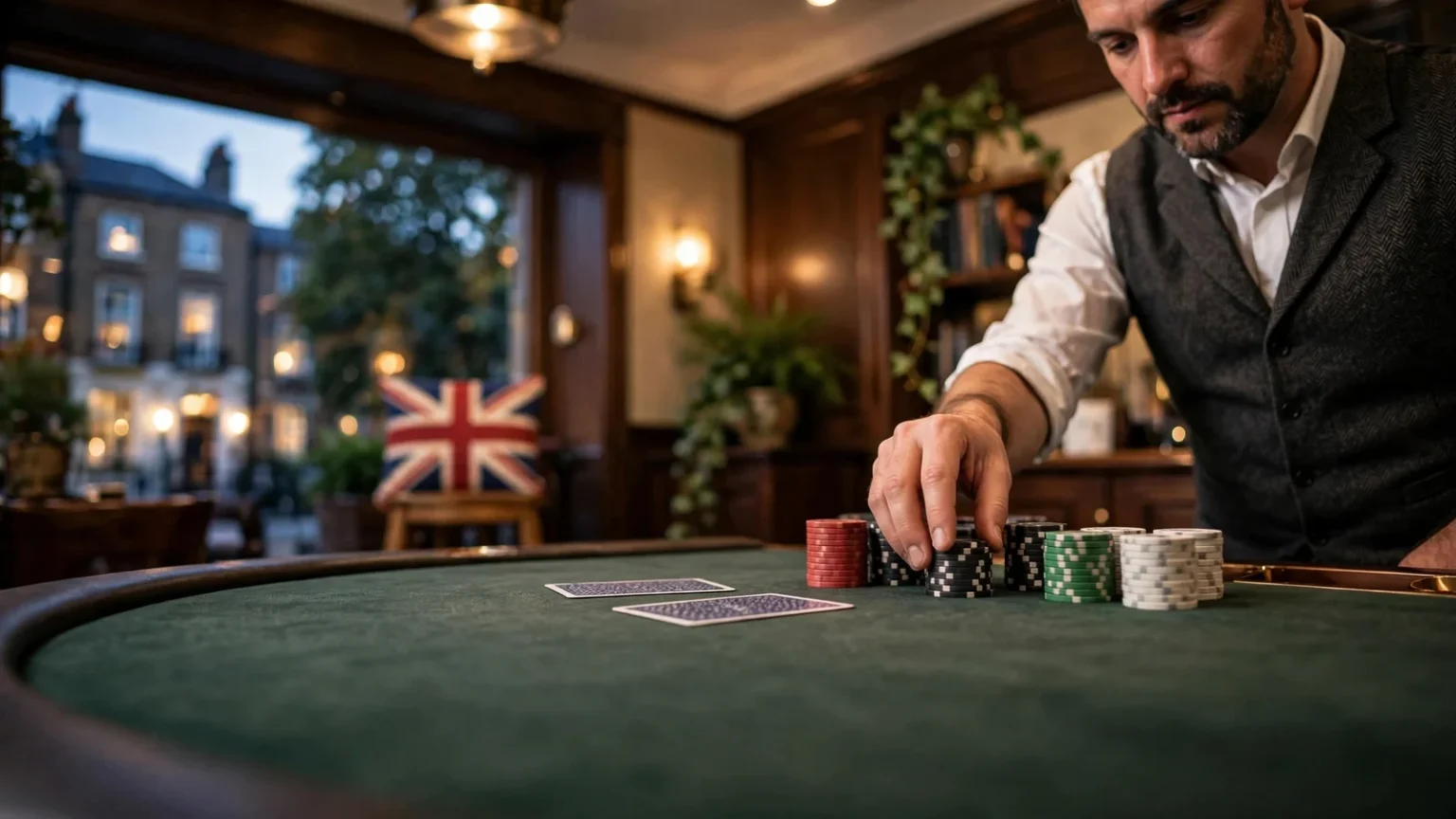
A guide to UK casino licensing, live dealer play, table rules, strategy limits and the safeguards that matter when playing blackjack online.
UK Blackjack Casinos and the Rules Behind Their Licences
A blackjack table can look much the same on a screen wherever its dealer is seated. The legal position changes with the market the casino serves. For people in Great Britain, a remote operator cannot avoid domestic oversight by locating its offices, servers or other key equipment elsewhere. The relevant question is whether it holds the licence required to offer gambling to consumers there.
The UK Gambling Commission oversees gambling activity in the United Kingdom, including online casinos. In Great Britain, it is the authority responsible for commercial gambling regulation. Its reach over remote gambling follows the customer-facing service, not the geography of the machinery behind it. An online casino serving people in Great Britain must therefore answer to the Commission even if its equipment is based abroad.
That principle gives the phrase “UK blackjack casino” a legal meaning beyond the currency shown at the cashier or the language on a site. A casino’s presentation may look local while its regulatory status is not. A licensed operator is accountable within the British framework; an operator outside it does not offer the same protection. The distinction is less theatrical than a live table, but more consequential.
What a licence covers
The Commission grants operating licences to gambling businesses and personal licences to individuals involved in operating gambling in Great Britain. These are different permissions: one concerns the company providing the service, the other the people carrying out specified roles. A casino’s claim to be regulated should therefore be tied to the business and the gambling activity it offers, rather than treated as a general badge attached to a name.
For remote operators serving Great Britain, the required licence is not optional simply because the casino is online or based beyond the country. The principle is part of the domestic system for commercial gambling. It places responsibility on the operator, rather than asking a player to work out where a server sits or which country’s laws might otherwise be invoked.
Live Baccarat Online Casinos in the UK: What to Check
The broader statutory frame is the Gambling Act 2005, which governs gambling in England, Wales and Scotland. Northern Ireland is outside that Act’s scope, so “UK” and “Great Britain” should not be treated as interchangeable in every legal sentence. In practice, the central point for a Great Britain-facing online casino remains clear: the operator needs the relevant Gambling Commission licence.
Checking the public register
Before depositing, the licence number should be checked against the Gambling Commission’s public register. This is a small piece of due diligence with a more solid footing than a logo or a line of marketing copy. The register can be used to confirm that the business named by the casino is associated with the claimed licence; details such as the stated trading name and domain matter when matching an entry to the site being considered.
A mismatch deserves attention. A company name that differs from the brand is not, by itself, proof of wrongdoing, but the relationship should be intelligible in the public record. Likewise, a licence reference printed on a website is a claim to verify, not verification in itself. Where a casino’s identity or permission cannot be reconciled with the register, depositing would mean proceeding without the reassurance the licensed framework is intended to provide.
This check is not a guarantee about every aspect of an operator’s service, nor does it predict how a blackjack session will go. Its purpose is narrower and more important: to establish whether the business is authorised to offer remote gambling to consumers in Great Britain. Regulation begins with that threshold. The rest is not supplied by a persuasive homepage.
The meaning of oversight
Licensing makes an operator part of a system with a named public regulator and defined responsibilities. It also makes clear who is accountable for the commercial service: the licensed business, with relevant individuals subject to their own licensing requirements. That structure matters in a market where the customer may never see the premises, staff or equipment behind an online casino.
The Commission’s authority is tied to gambling regulation, not to the peculiarities of blackjack as a card game. A casino offering blackjack online is still a remote gambling operator, and the same licensing requirement applies. The game’s familiar rules do not create a separate regulatory category, any more than a virtual table becomes exempt because it imitates a physical one.
A casino’s presentation may look local while its regulatory status is not; an operator outside the British framework does not offer the same protection as a licensed one.
For anyone comparing blackjack casinos in Britain, the public register is therefore a better starting point than the polish of a lobby. A licensed casino has to operate within the country’s regulatory framework; a casino without the relevant permission does not acquire that status through local-sounding branding, sterling prices or a British-facing website. The Commission’s register is where the claim can be checked.
It is an unglamorous safeguard. Which is rather the point.
Best casino sites in the UK
- BritsinoBonus: Welcome Package – Get your £2,200 + 2,000 FS · Payout speed: 1-3 business days
- BeOnBetBonus: 100% up to €500 + 100 FS · Payout speed: 1-3 business days
- Revery PlayBonus: 100% up to€1,000+ 100 FS · Payout speed: 1-3 business days
- EvoSpinBonus: 125% up to €2500 + 125 Free Spins · Payout speed: 1-3 business days
- WinBeastBonus: €5000 + 500 FS + €650 Freebet · Payout speed: 1-3 business days
- SpinFormulaBonus: 550% Up To £15,000 + 550 FS · Payout speed: 1-3 business days
- JetsetspinsBonus: 200% Bonus + 100 Free Spins + Free Royal Wheel · Payout speed: 1-3 business days
- NightWinBonus: £900 + 400 free spins · Payout speed: 1-3 business days
- NightLuckBonus: Welcome Pack + 805% Up To 6400€ + 280 FS · Payout speed: 1-3 business days
What Makes a Blackjack Casino a Fit for Its Players
A casino can look polished and still be a poor fit. The useful question is not which name can be crowned “best”, but whether the operator’s arrangements suit the people expected to use them. That means looking beyond a familiar logo or a confident claim about quality. A sound assessment begins with what can be checked: the licence, the account controls and the way the site presents its terms.
For a UK-facing real-money casino, licensing is a practical threshold, not a decorative badge. The Gambling Commission’s public register allows a prospective customer to check whether the operator holds the relevant licence and whether the details correspond with the casino’s stated business and domain. The licence number should be verified there before any deposit. A logo on a page is a claim; the register is the place to test it.
That distinction matters because the legal obligation rests with the operator, while the player is left to judge whether the site in front of them belongs to the licensed business. A matching name alone is not enough if the domain or company details do not line up. The check is not a guarantee of an enjoyable session, nor a prediction of how a casino will behave in every circumstance. It is a way to establish that the operator is within the British regulatory system, where rules and routes for redress apply.
Keno Online Casinos in the UK: Rules, Payouts and Evidence
After that threshold, account design becomes part of the assessment. A responsible operator should make financial controls accessible rather than burying them in a maze of menus. New customers must be prompted to set a financial limit before their first deposit, and account-level limit controls must remain available. Their presence does not tell anyone what limit is suitable; it does show whether the site treats restraint as a working part of account management rather than a paragraph in small print.
Safer-gambling tools deserve the same scrutiny as the games themselves. UK-licensed casinos must provide responsible gambling tools, including self-exclusion. The useful measure is not how reassuringly a site describes responsibility, but whether the relevant controls are clear and reachable within the account. A tool that exists only in legal language, while remaining hard to locate in practice, serves a thinner purpose.
The fit also depends on how plainly the operator explains its own arrangements. Terms should be readable enough to distinguish a binding condition from a sales flourish. Pages about limits, account controls and responsible gambling should be consistent with the options presented after sign-in. Clarity is not an ornament: it lets a customer understand what the casino expects and what choices remain available. When the language is vague, confidence has to do work that the wording should have done.
There is, however, a limit to what a checklist can settle. A licence and visible controls establish important features of an operator; they do not prove that every player will find the site comfortable, that every interaction will be smooth, or that a particular casino is objectively superior to its competitors. Those are broader claims, and a ranking assembled without comparable, reliable measures can make preference look like measurement.
Do
- Verify the licence number on the Gambling Commission’s public register
- Set financial limits before the first deposit
- Ensure self-exclusion tools are clear and reachable
Don’t
- Rely on a logo or marketing copy as proof of regulation
- Assume a matching brand name alone confirms a licensed business
- Use vague terms to understand account obligations
The phrase “best blackjack casino” therefore has no universal answer. One player may place most weight on clear account controls; another may care more about how easily the site’s information can be understood. Neither preference turns a casino into the best choice for everyone. The more defensible standard is narrower: whether the operator is licensed, whether safeguards are accessible, and whether its claims can be checked against what it actually presents.
That standard also keeps evaluation separate from promotion. A large menu, an attractive welcome message or polished design can make an impression, but none substitutes for a verifiable licence or usable account controls. Nor does the presence of safeguards mean that gambling becomes harmless. A responsible casino can provide protections; it cannot remove the uncertainty inherent in gambling or make a session financially safe for every customer.
A careful assessment is less glamorous than a league table. It is also more useful. The licensed operator, the accessible limit settings and the visible self-exclusion option are concrete points to examine; adjectives such as “trusted” or “leading” are not. The distinction is modest, but important. A casino earns confidence through arrangements that can be checked, not through the volume of confidence it claims. Gambling should remain limited to what can be afforded to lose.
The Live Dealer Table: Cards, Cameras and Company
A live dealer blackjack table occupies an unusual middle ground: the game is played online, but its central action is presented as a real table rather than generated entirely on a screen. A dealer handles the cards in a studio, while cameras carry the scene to players watching from separate devices. The interface supplies the digital betting area; the streamed table supplies the human presence.
That presence changes the atmosphere, even when it does not change the basic nature of online play. The dealer’s gestures, the pause before a card is dealt and the quiet choreography of a table give the session a visible rhythm. Instead of watching symbols resolve on a display, players see a person conducting a familiar casino ritual. The camera turns procedure into performance.
Live Dream Catcher Casino in the UK: A Guide
There is company, though not quite the company of a physical casino. Players may share a table stream and, where a chat function is available, exchange brief messages with the dealer or one another. The interaction is mediated and necessarily thinner than conversation across a real table. Nobody has to travel, find a seat or interpret the room before joining in. The distance is part of the design. So is the suggestion of proximity.
For some, that blend is the appeal: the privacy of playing at home with a trace of the public setting that casinos have long cultivated. A live dealer blackjack casino is not simply a video of a game. It is a staged social space, arranged so that a person on screen can address many participants at once. The table has an audience, even when its members cannot see one another.
The format also carries a small piece of British casino history. Grosvenor unveiled live casino games in 2013, with Blackjack among the offerings alongside Texas Hold’em and Roulette. That launch placed streamed, dealer-led play within the country’s established casino culture at a time when the screen was becoming a place not just to choose a game, but to watch one unfold.
There is a quiet cultural adjustment in that shift. The traditional casino made presence physical: the room, the table, the dealer and the other players all belonged to one location. Online live play separates those elements and reconnects them through a broadcast. The dealer remains visible; the room becomes a studio; the audience is dispersed. The social setting survives, but in edited form.
That does not make the experience identical to sitting at a casino table. The stream frames what can be seen, and the interface governs how participants take part. Nor does the human dealer make online play less mediated. The cameras are not a window without a frame; they are the frame. Still, a visible person can lend a table a quality that an automated display cannot reproduce: the sense that events are being handled in real time by someone present in the scene.
For players seeking Blackjack online with a live dealer, that distinction is often the point. The attraction is not only the cards, but the ceremony around them: a greeting, a measured pace, the shared attention of a table. A small public. Through a screen.
Fast Payout Online Casinos in the UK: What Can Be Verified
How Casino Blackjack Works—and What Winning Can Mean
Blackjack is a contest between each player’s hand and the dealer’s, measured against a target total of twenty-one. The aim is not simply to collect as many cards as possible: a hand that passes the target is a bust, and loses its chance to beat the dealer. That narrow arithmetic gives the game its particular tension. Each new card may improve a hand, or end it.
A hand begins with cards dealt to the player and the dealer. Card values are straightforward for most of the deck: numbered cards count at face value, while kings, queens and jacks count as ten. An ace can count as either one or eleven, depending on which value keeps the hand from going bust. The ace is therefore less a fixed value than a small piece of arithmetic with a useful escape route.
The player acts first. Taking another card is commonly called hitting; keeping the current total is standing. A player may continue to draw or stop, subject to the table’s rules. If the total goes above twenty-one, the hand busts and loses without needing a comparison with the dealer’s final total. If the player stands, the dealer completes the hand under the rules of that table. The two totals are then compared: the higher one wins, provided it has not exceeded twenty-one.
A hand reaching twenty-one with its first two cards is generally called a natural blackjack. It is distinct from making the same total after drawing additional cards, though the precise treatment of a natural depends on the table’s rules. A tie between player and dealer is commonly called a push, meaning the hand is neither a win nor a loss. These familiar terms describe the shape of the outcome; they do not make the outcome predictable.
The dealer’s role creates a useful contrast. A player chooses whether to draw or stand, while the dealer follows the table’s prescribed procedure. That difference is why the same cards can feel like a decision for one side and a rule-bound sequence for the other. It is also why a hand cannot be understood merely by looking at its current total: the dealer’s eventual hand remains part of the result.
In blackjack, a natural blackjack occurs when a hand reaches twenty-one with its first two cards, while a push is a tie between the player and the dealer.
Winning a hand is not the same as winning over a session. A successful round can be followed by a losing one, and a sound reading of the rules cannot determine which cards will appear next. Casino blackjack has a clear objective, but no method can promise a win. “How to win” has a precise answer only at the scale of an individual hand: finish closer to twenty-one than the dealer without going over. Beyond that, it becomes a question the cards do not agree to answer in advance.
Table rules matter. They set out how the dealer completes a hand, how particular outcomes are settled and what happens in less familiar situations. Those details can differ between tables, so the displayed rules are part of the game rather than small print outside it. Understanding them helps explain a result; it does not turn chance into certainty.
Live Blackjack Variants and the Wider Table Selection
A live casino’s table selection can be read as a small map of its priorities. Blackjack may sit beside roulette and other familiar casino games, while named titles give the catalogue a more specific shape. The labels are useful for finding a table; they do not, by themselves, explain how it plays.
Some menus present blackjack as a general category, with individual tables carrying their own titles. Infinite Blackjack is one such named product. Its name places it within the blackjack family, but a title alone is not a substitute for the table’s published rules. Where several tables appear under one heading, the differences worth checking are the ones stated by the casino itself, rather than details inferred from branding.
The wider selection may include roulette. Lightning Roulette is a named roulette product, while the game itself belongs to a different family from blackjack. That distinction matters more than the theatricality of a title: a casino table menu can bring unlike games together without making their rules or decisions interchangeable.
Other named products may broaden the sense of what a live casino offers. Common Draw, Crazy Time and Dream Catcher are titles that can appear in a casino-game catalogue. Their presence alongside blackjack does not make them blackjack variants. A table list is a collection, not a taxonomy.
Fastest payout online casino UK: how to assess claims
This is where the word “variant” can mislead. Sometimes it refers to a blackjack-labelled product; elsewhere it may be used loosely for any alternative in a casino’s table range. The clearest approach is to separate three things: blackjack tables, other live table games, and additional named casino products. That simple distinction keeps a search through a crowded menu from turning into a comparison of things that do not share the same format.
Selection also varies between casinos, and a title available at one does not establish its presence elsewhere. A UK player considering a particular blackjack casino game can therefore treat the catalogue as a snapshot of that operator’s offering, not a promise about the wider market. Names can help narrow the field, but the information attached to each table is what defines the actual offer.
There is a cultural habit behind these expanding menus: casinos give games distinct names because a catalogue is also a shop window. Some titles announce a familiar game; others suggest a more specialised product. The naming may make browsing livelier, but it should not be mistaken for a description of rules or a measure of suitability.
For anyone comparing casino blackjack games in the UK, the useful question is not how many labels a menu can display. It is whether the available descriptions make clear which entries are blackjack and which belong to another game. The wider table selection can be varied without being confusing. It only needs to be read carefully.
Starting a Live Blackjack Session
A live table may be the visible destination, but an account comes first. The usual route is to choose a UK-facing casino, register with accurate personal details, complete its age and identity checks, and then review the account settings before considering a deposit. The checks are not a formality to be postponed until money is involved: operators must verify a customer’s age before permitting a deposit. Online gambling in the UK is for adults aged eighteen and over, and an operator serving the British market must hold the relevant Gambling Commission licence.
Before depositing, the licence number should be checked against the Commission’s public register. A familiar logo on a homepage is not a substitute for a register entry; the number and the operator’s details need to correspond. That small piece of administration belongs at the threshold, not after a problem has begun.
French Roulette Online Casinos in the UK
New customers must be prompted to set a financial limit before making their first deposit. Account-level controls should remain accessible afterwards, so a limit can be reviewed or changed without searching through obscure corners of a site. These controls are part of the account, not a strategy for blackjack. They set boundaries around gambling activity rather than improving the odds at a table.
Once the account is ready, the live-casino lobby provides the route to blackjack. A table’s listed stake range, rules and any entry conditions should be read before joining; these can differ between tables, and the lobby is where those details belong. The dealer’s stream and betting interface then appear together, turning a browser or app into a small, carefully staged room. The account setup is less theatrical. It is also more consequential.
Some casinos may offer a free-play or practice mode, while others may not. Where it is available, it can familiarise a player with the layout and controls without making it equivalent to wagering real money. Availability and terms should be checked on the casino itself; the name of a mode alone says little about its conditions.
A live blackjack session need not begin with a deposit. Registration, verification, limit settings and a look at the table information can all precede that decision. Any money later placed at risk should be money that can be afforded to lose. The table can wait.
Blackjack Strategy Without the Promise of a System
A blackjack strategy is not a machine for producing a favourable ending. It is a way to make decisions with some consistency, rather than letting each hand become a fresh negotiation with nerves, hunches or the table’s mood. That distinction matters: a considered choice can still lose, and a run of wins does not prove that a method has mastered chance.
The first discipline is to understand the rules of the particular table before treating any general advice as applicable. Blackjack is not a single, perfectly uniform arrangement. Table rules can affect which decisions are available and how a hand is settled, so advice detached from those conditions may be less useful than it sounds. A strategy learned elsewhere should be treated as a guide to examine, not a command to follow blindly.
A strategy can organise choices, but it cannot guarantee profit or reliably recover money already lost.
It can also help to decide in advance what kind of reasoning will govern play. Some players study decision charts; others prefer to keep their choices simple and avoid improvising under pressure. Either way, the aim is not to discover a secret sequence that makes losses impossible. It is to reduce decisions made in a rush, especially after an uncomfortable hand or a tempting win. The mind is good at finding patterns after the fact. Chance is under no obligation to honour them.
At a live table, the pace and presence of a dealer may make play feel more social than solitary. That atmosphere can make a pause seem conspicuous, or make another player’s confidence look like evidence. Neither is a sound basis for a decision. A calm routine can create space to think, but it cannot change what the cards will do. The company is real; its influence on probability is not.
Claims about a “winning system” deserve particular caution. A strategy can organise choices, not guarantee profit or reliably recover money already lost. Switching methods after every setback may feel like taking control, but it can simply add more decisions when judgement is under strain. Consistency is not magic. It is only consistency.
Money boundaries belong to the same discipline as table choices. Gambling should be limited to what can be afforded to lose; money needed for ordinary commitments is not a playing resource. If play stops being entertainment and starts to feel compulsory, stepping away matters more than finding a cleverer strategy.
Live Roulette UK: Dealers, Licensing and Trust
Blackjack in 2026: Where Slot Limits Do—and Do Not—Apply
A specialist review describes Great Britain’s online slot stake limits as age-dependent: for adults aged twenty-five and over, the ceiling is £5 in a game cycle; for those aged eighteen to twenty-four, it is £2. These figures concern online slots. They are not a general stake rule for every game in a UK blackjack casino.
The distinction matters because casino menus place games side by side, while their rules and regulatory treatment need not be identical. The same review says the slot limits do not cover blackjack or roulette. A blackjack table therefore should not be assessed by transferring the slot cap to it. Nor does that distinction, by itself, establish a table’s minimum or maximum wager: those are separate conditions, and no particular table terms follow from the slot rule.
For someone comparing a live blackjack online casino in the UK in 2026, the useful point is narrow but practical. The age-based figures relate to slot play, not to the amount that can be wagered on a hand of blackjack. The word “limit” can otherwise suggest a single ceiling across an entire casino, when here it describes a specific category of game.
That boundary also cautions against treating the absence of the slot cap as evidence that a blackjack wager is unrestricted in every other sense. It says only that this particular rule does not apply to blackjack or roulette. Table conditions remain table conditions.
The distinction reflects how regulation tends to work: rules are attached to defined forms of gambling, not simply to every activity offered under one casino brand. A slot and a live blackjack table may share a lobby, but that does not make them the same product for the purpose of this limit. Categories matter.
Online Slot Stake Limits
For adults aged twenty-five and over, the ceiling is £5 in a game cycle; for those aged eighteen to twenty-four, it is £2. These figures apply specifically to online slots and do not cover blackjack or roulette.
The figures should be read in that specific context, rather than as a promise about what any operator permits at a table. And no stake rule changes the basic financial reality of gambling: it should be limited to what can be afforded to lose.
Bonuses, Bitcoin and the Limits of Payment Claims
A blackjack promotion can sound straightforward: a welcome reward, perhaps, or a no-deposit bonus attached to an online casino account. The phrase is less simple than the offer. A bonus may have conditions governing which games count, how winnings can be withdrawn and how long the offer remains available. Without the terms of a specific promotion, its value cannot be judged from the headline alone.
The same restraint applies to claims about a blackjack casino bonus in the UK. A banner or summary may describe an offer, but the full terms determine what it means in practice. A bonus is not cash in the ordinary sense, and an attractive figure does not establish that blackjack play qualifies on favourable terms. No promotion should be treated as universal across casinos or tables.
“No deposit” sounds like a particularly generous exception, but the label itself explains little. It does not say what the player must do to claim an offer, whether blackjack is included, or what restrictions apply to any resulting winnings. Those details belong to the operator’s published terms. Without them, a no-deposit offer is a name, not a reliable measure of value.
Bitcoin raises a separate question: how an account can be funded. It should not be assumed that a UK-facing casino accepts cryptocurrency simply because the subject appears alongside casino bonuses in online discussion. Funding methods need to be confirmed through the operator’s own current information. In Britain, licensed remote operators cannot accept credit-card payments for gambling, including credit-card funding routed through a money service business; they also cannot accept wallet payments where credit-card funds can be used for gambling. A payment label does not erase the source of the money.
Online Bingo in the UK: Games, Rules and Stakes
Promotions and payment methods are often presented as part of the same welcome package, though they are different claims. A bonus concerns the conditions attached to play; a funding method concerns how money reaches an account. Both deserve precise wording. Where the terms are unclear, caution is more useful than an imagined value.
A headline is not a contract.
Table Rules, Account Safeguards and Complaints
Blackjack table rules govern the hand in progress; account safeguards govern the wider relationship between a player and a casino. They are related, but they are not interchangeable. A table’s rules set out how its particular game is played, including the options available during a hand and how outcomes are settled. Those details can differ between tables, so the displayed rules matter more than assumptions carried over from another game.
The account-level protections sit elsewhere. UK-licensed casinos must provide tools such as self-exclusion and accessible controls for setting limits. These are not blackjack rules and do not alter how a hand is dealt. They are safeguards intended to give customers ways to restrict or stop their gambling. GAMSTOP offers a route to self-exclusion across participating gambling businesses; it is distinct from a casino’s own account controls.
The difference is practical. A table rule answers what happens within the game. A safeguard concerns whether gambling can be limited or paused across an account or service. Neither makes gambling risk-free. Gambling should be limited to what can be afforded to lose.
Complaints have their own process, too. UKGC-licensed casinos must provide an internal route for complaints and access to an approved Alternative Dispute Resolution service. A complaint can first be raised with the operator through its stated process; if the matter remains unresolved, the operator must provide access to the relevant approved ADR service. That route concerns a dispute with the gambling business, not a disagreement about a card outcome simply because it was unwelcome.
Keeping these categories separate prevents a common confusion: table rules are about the game, while account protections and complaint procedures are about the operator’s responsibilities and the customer’s options. The distinction is less theatrical than the cards. It is more consequential.
What are the online slot stake limits in Great Britain?
The limit is £5 per game cycle for adults aged 25 and over, and £2 for adults aged 18 to 24. These limits do not apply to roulette or blackjack.
Are online casino games licensed and regulated?
Yes. The UK Gambling Commission regulates online gambling, and operators serving consumers in Great Britain must hold the relevant licence.
Is LuckyPays licensed by the UK Gambling Commission?
The Commission’s public register dated 26 September 2026 does not show an entry for LuckyPays or its stated domain, luckypays.io.
What licensing and regulations apply to online casinos in the UK?
The UK Gambling Commission regulates commercial gambling in Great Britain, and remote operators serving consumers there must hold the relevant operating licence. The Gambling Act 2005 governs gambling in England, Wales and Scotland; Northern Ireland is outside its scope.
Material created by the team Pure Casino UK Guide


