

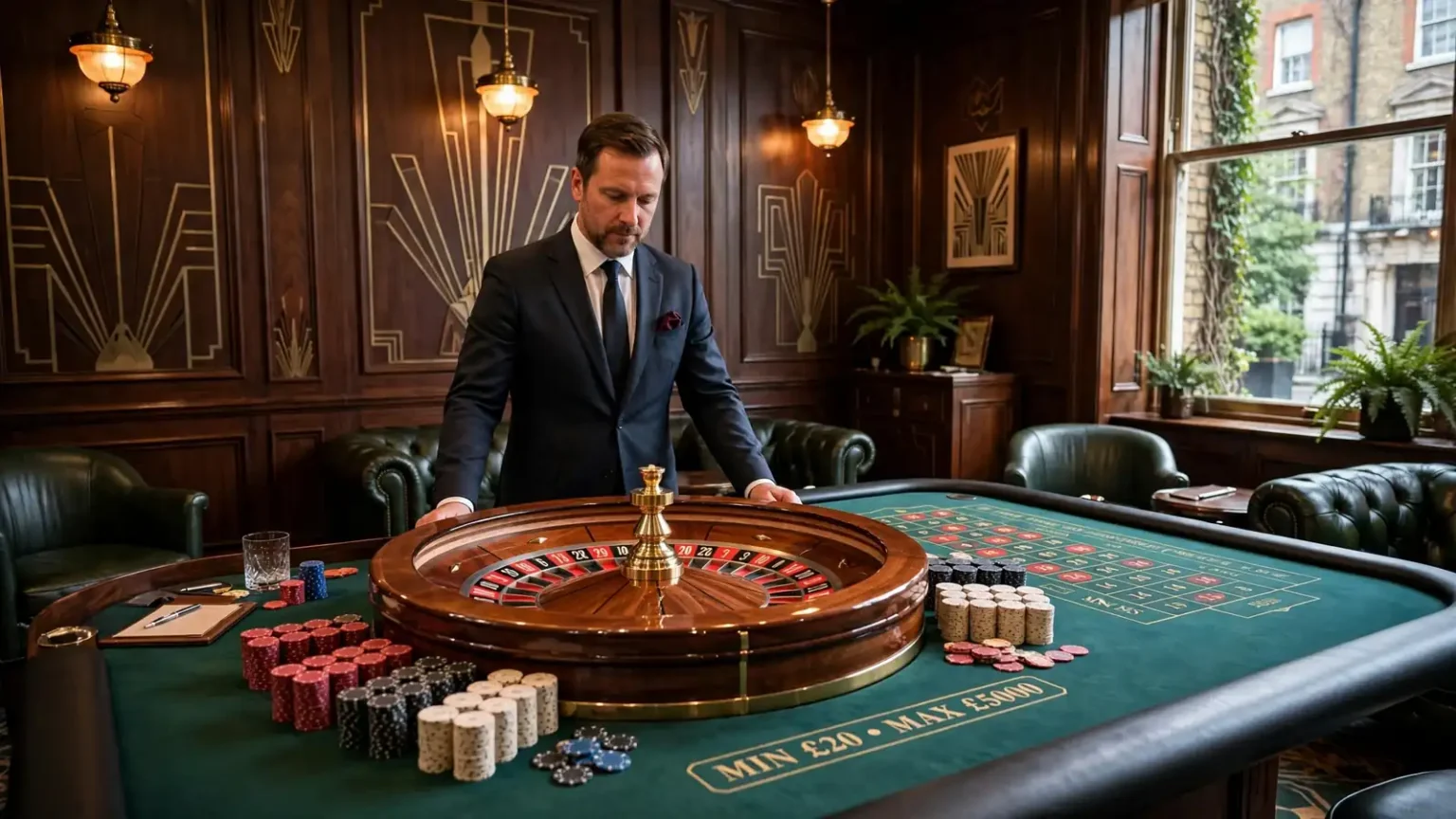
A practical look at the live format, casino selection, British rules and the limits of what a first-person account can verify.
Live Casino Games, and the Companies Behind Them
Lightning Roulette belongs to a larger idea: a casino game presented live online, rather than a digital recreation that runs entirely through software. That distinction helps explain why live casino menus can bring together familiar table games and newer titles under one heading. The games may differ in pace, format and appeal, but the category gives them a shared setting.
The history of that setting is not simply a story of one game arriving and taking over. Operators have assembled live selections from games with long casino histories, including roulette and blackjack, alongside card games such as poker. Grosvenor offers a dated example of this broader development. In 2013, it unveiled live casino games that included Blackjack, Texas Hold’em and Roulette, among a wider range of card and casino games.
That launch matters less as a claim of invention than as evidence of how the online casino was widening its definition of itself. A casino menu no longer had to mean a collection of games displayed on a screen and operated only through software. Live games could sit within the same online environment while preserving a different relationship to the underlying table-game tradition. The format changed; the names on the felt, so to speak, remained recognisable.
Roulette has a particularly durable place in that family. Its presence in Grosvenor’s live offering alongside blackjack and Texas Hold’em shows how the live-casino category can gather games that do not share the same mechanics. One turns around a wheel, another deals cards, and another belongs to the poker table. What joins them here is not a single style of play but their place within a live casino selection.
Lightning Roulette can be understood against that backdrop. Its name places it in the roulette branch of the live-casino landscape, while the broader category gives context for the way such a title is encountered: among other casino games, rather than as an isolated product. The distinction is useful. A game title may attract attention on its own, but an operator’s live menu is also a statement about the range of experiences it chooses to bring together.
Online American Roulette in the UK: How It Works
There is a quiet institutional story in that choice. Operators are not merely displaying games; they are arranging a catalogue for an online audience. A menu can place traditional card and casino games side by side, making the online casino resemble a single venue even when its selection spans different kinds of play. The grouping is practical, but it also shapes what the word “casino” means on a screen.
Grosvenor’s 2013 launch gives that development a concrete point in time. Blackjack, Texas Hold’em and Roulette were part of the offering, and the range extended beyond those named games. The selection therefore reflects breadth rather than a narrow focus on one table or one genre. The online casino was presenting live games as a category in its own right.
That category also makes room for titles whose names are more distinctive than the traditional game they evoke. Lightning Roulette sits within a landscape where roulette is already an established casino game, while the live-casino label signals the wider format in which the title is offered. The surrounding catalogue matters because it shows that live casino is not a synonym for roulette alone. It is a grouping of games, with different histories, gathered into one online setting.
The companies behind a live-casino menu occupy different roles in this picture. An operator presents a selection to its customers; the games themselves are the titles that populate it. Those roles should not be collapsed into one. Grosvenor’s example concerns an operator introducing a live offering, not a claim that every operator’s catalogue is the same or that every title belongs to the same company. The distinction is ordinary, but important.
European Roulette at UK Online Casinos: A Guide
A broader menu can carry both continuity and change. Roulette, blackjack and Texas Hold’em have recognizable roots in casino culture, while the online format gives them a place within a digital service. Lightning Roulette is best placed within that larger arrangement: one named roulette title amid the wider live-casino field. The historical example from Grosvenor shows how that field had already embraced a range of card and casino games by 2013.
The result is a category defined by variety, not by one headline game. Roulette may be the point of interest, but live casino’s story is also about how operators bring different games together and present them as part of one offering. That is the wider frame in which Lightning Roulette belongs.
Finding an Online Casino That Offers Lightning Roulette
A casino’s game catalogue can make an operator look like a match before the practical details have been checked. Lightning Roulette may appear in a promotional banner, a live-games menu or a page devoted to roulette, but those references are not all equally useful. The central questions are whether the game is actually available to the account in question and whether the operator is authorised to serve customers in Great Britain.
The distinction matters because a title shown in an advertisement is not the same as a playable listing. An operator’s own catalogue is a more direct place to check, although a catalogue can still change. Searching within the live-casino area, if there is one, can help establish whether Lightning Roulette is listed as a current option rather than merely mentioned in general promotional copy. Where the listing is unclear, customer support can be asked whether the game is available to Great Britain customers.
That check concerns availability, not quality. A game’s presence does not establish how it works, what its interface looks like or whether it suits a particular player. Those are separate questions. For the immediate task, the useful point is narrower: confirm that the exact title appears as an available game, and not just among general casino products or in a search result outside the operator’s own site.
French Roulette Online Casinos in the UK
The operator’s identity deserves equal attention. A familiar brand name may not make clear which business provides the gambling service, and a website’s appearance cannot settle whether that business holds the required authorisation. The Gambling Commission requires remote operators serving consumers in Great Britain to hold the relevant licence. That obligation applies to the operator, not to a game title or a software label.
A serious check therefore begins with the business responsible for the account and the gambling service. The operator’s terms and legal information should identify the company behind the site and describe its regulatory position. Those details can then be compared with the Gambling Commission’s public information. A logo or a sentence claiming that a casino is licensed is not a substitute for checking the underlying operator. Paperwork is less decorative, but more useful.
It is also worth keeping the brand, domain and legal entity distinct. A casino may present itself under a consumer-facing name while its contractual documents identify a company with another name. That does not by itself prove a problem, but it does mean that the names should be reconcilable. If the operator’s identity is difficult to establish, or the licensing information is vague, there is no reason to treat a polished game lobby as reassurance.
Availability can depend on the operator’s catalogue and the customer’s location, so an old review or an archived promotion may not answer whether Lightning Roulette can be played there now. Current information from the operator is more relevant than a third-party page that may describe a past offering. Even then, an operator’s statement about availability and its authority to serve Great Britain consumers are separate matters; both require attention.
The phrase “online casino with Lightning Roulette” can sound like a simple product search, but it joins two different checks. One is about the game: is the named title actually offered? The other is about the service: is the company permitted to provide remote gambling to consumers in Great Britain? A positive answer to the first does not supply the second.
Verifying an Operator
- Identify the business providing the gambling service
- Locate the operator’s licensing information
- Compare the licence number with the Gambling Commission’s public register
- Confirm the authorisation applies to the service in Great Britain
- Check the game catalogue or contact support for Lightning Roulette availability
This is why the search for an online casino offering Lightning Roulette should not end at a game tile. A sensible process is to identify the operator behind the site, locate its licensing information, and confirm that the relevant authorisation applies to its service in Great Britain. Then the game listing can be checked directly, with customer support used to clear up any ambiguity. The order is not ceremonial. It separates a catalogue claim from the legal basis on which the account is offered.
Promotional language tends to make the game the whole story. Regulation makes the operator part of it. The distinction is less exciting than a flashing game tile, but it is the one that determines whether the service belongs within the British regulatory framework.
Any gambling carries a risk of loss, so only money that can be afforded to lose should be wagered.
Lightning Roulette in the Live Casino
Lightning Roulette sits at the meeting point of two familiar casino ideas: roulette as a table game, and the live casino as an online setting built around games presented in real time. Its name is specific; its place in the wider casino vocabulary is not. Roulette has long belonged to the category of casino games, while “live” describes the form in which a game is offered. The distinction matters because the label alone does not explain how a particular version works.
Online Bingo in the UK: Games, Rules and Stakes
The live-casino format has become part of the way online casinos organise their menus. Card games and table games appear beside one another, giving the category a broader character than a single roulette table. Grosvenor’s launch of live casino games in 2013 is one dated British example: its offering included Blackjack, Texas Hold’em and Roulette. It is a useful reminder that live roulette belongs to a wider family of games, rather than existing as an isolated novelty.
Lightning Roulette is the subject here, but the name should not be mistaken for a rulebook. It identifies a particular product; it does not, by itself, establish the rules, odds, table layout or any special feature. Those details cannot responsibly be inferred from the title. A reader considering the game needs information tied to the actual version being offered, not a confident description assembled from the suggestive word “Lightning”.
That restraint also helps place the game among other casino titles without pretending that they are interchangeable. Crazy Time, Dream Catcher, Common Draw and Infinite Blackjack are names found in the same broad field of casino products. Their titles point in different directions: some suggest a format, others a familiar table game. But a list of names is not a description of their mechanics, nor evidence that every casino groups or presents them in the same way. A catalogue is a map, not the territory.
In a live casino, the word “live” carries an expectation of immediacy. It distinguishes this part of online gambling from games that are generated entirely on screen, while leaving the details of the particular product to its own rules and presentation. The human and technical arrangements behind a live table are a separate subject from what can be safely said about Lightning Roulette itself. The label is a starting point, not a full account.
Lightning Roulette is a specific product within the live-casino category; its title does not establish the rules, odds, or table layout, which must be verified through the game’s own published information.
This is why the game is best approached first as a named roulette title within the live-casino category. The surrounding menu may contain blackjack, card games and other casino products, but their presence does not tell anyone what Lightning Roulette offers. Nor does a shared setting mean that one game’s instructions or conditions can be carried over to another. Each title stands on its own terms.
There is a small cultural shift in that menu. The casino table, once encountered in a physical room, now appears as one item in a digital catalogue, placed beside products with very different names and formats. The old category persists; the setting changes. Roulette remains legible as a casino game, while the “live” label marks its place in an online environment.
For anyone encountering Lightning Roulette in a live casino, that is the reliable frame: a specific roulette product presented within the broader live-game category. What its title seems to promise is not a substitute for the game’s own published information. Names attract attention. Rules do the harder work.
Best casino sites in the UK
- BritsinoBonus: Welcome Package – Get your £2,200 + 2,000 FS · Payout speed: 1-3 business days
- BeOnBetBonus: 100% up to €500 + 100 FS · Payout speed: 1-3 business days
- Revery PlayBonus: 100% up to€1,000+ 100 FS · Payout speed: 1-3 business days
- EvoSpinBonus: 125% up to €2500 + 125 Free Spins · Payout speed: 1-3 business days
- WinBeastBonus: €5000 + 500 FS + €650 Freebet · Payout speed: 1-3 business days
- SpinFormulaBonus: 550% Up To £15,000 + 550 FS · Payout speed: 1-3 business days
- JetsetspinsBonus: 200% Bonus + 100 Free Spins + Free Royal Wheel · Payout speed: 1-3 business days
- NightWinBonus: £900 + 400 free spins · Payout speed: 1-3 business days
- NightLuckBonus: Welcome Pack + 805% Up To 6400€ + 280 FS · Payout speed: 1-3 business days
First-Person Play: A Viewpoint, Not a Verified Feature
The phrase “first-person” carries a clear visual promise: the scene appears from the position of someone within it, rather than from a detached viewpoint. That promise is easy to attach to a casino game name. It is harder to establish from the name alone. Lightning Roulette identifies a particular game; it does not, by itself, describe how its screen is framed or whether a first-person perspective is available.
Online casino without ID in the UK: what checks apply
This distinction matters because viewpoint is not merely decoration. A camera angle can change the feeling of being present, the distance between a player and a table, and the sense of watching or participating. In a physical casino, position is part of the experience: a person stands near the wheel, sees other players, hears the room. A screen has to make choices about what to show and from where. The label “first-person” expresses an expectation about those choices, not proof that a particular game fulfils it.
For Lightning Roulette, a first-person version should therefore be understood as a request for a particular way of seeing the game, rather than as a separate edition confirmed by the title. The same applies to references to a first-person casino game or a first-person casino experience. Those descriptions may communicate what someone hopes to find, but they do not establish that the game offers a player-controlled camera, a view from a seat, or any other specific interface. Such details should not be inferred from terminology alone.
There is a small cultural history inside the distinction. Casino games have long been staged for spectators as well as participants: the table, the wheel and the dealer form a scene whose conventions tell people where to look. Online presentation inherits that problem. A camera can suggest proximity without granting control, while an interface can place information on screen without making the player feel physically present. “First-person” is consequently a description of perspective, not a reliable synonym for immersion, control or a particular set of features.
For anyone considering first-person Lightning Roulette in the UK, the useful question is not whether the phrase sounds like a product category, but whether the particular game display is actually described that way by the operator. A title or promotional label should not be stretched into a technical specification. Where the presentation is not clearly explained, the safest reading is modest: the wording signals an intended viewpoint, while the exact experience remains a matter of what is offered on screen.
Attention: The term "first-person" describes an intended viewpoint and is not a technical guarantee of a player-controlled camera or a distinct game version.
That restraint is not pedantry. Interface language often borrows the authority of a feature list while remaining suggestive rather than precise. In gambling, where presentation can shape the sense of closeness and pace, the difference deserves notice. A perspective may make a game feel more immediate; it does not change what the name alone can substantiate.
The British setting also does not turn a viewpoint label into a guarantee about the game’s presentation. The phrase can be useful when describing what someone is seeking, but it should not be mistaken for confirmation of a distinct version. The screen, not the wording, would have to settle that.
Gambling remains a financial risk, whatever the viewpoint. Only money that can be afforded to lose should be gambled.
What Makes a Casino a Sound Choice?
A casino’s presence in a game catalogue is not, by itself, evidence that the operator is a sound place to play. A search for the best place to play Lightning Roulette can produce confident rankings, but a ranking is an opinion shaped by its own criteria. A more useful assessment begins with matters that can be checked: who operates the site, whether the relevant licence covers its service to Great Britain customers, and whether the operator’s identity matches the information on the public register.
The Gambling Commission requires remote operators serving consumers in Great Britain to hold the relevant licence. Before depositing, the practical check is to find the operator’s licence number and compare it with the Commission’s register. The brand name matters, but so does the relationship between that brand, the legal operator and the website being used. A familiar logo or a polished page cannot settle that question. Paperwork has the advantage of being less impressed by design.
Highest RTP Slots in the UK: Understanding RTP
The register is a record to check at a particular time, not a permanent endorsement of every claim made by a casino. A specialist casino review reports that the public Gambling Commission register dated 26 September 2026 did not identify a LuckyPays entry under that brand or its stated domain, including luckypays.io. That is a reason to pause and verify the operator’s identity and licence status, not a verdict about every service using a similar name. A name match alone is not enough; a mismatch deserves attention.
Other signs of a credible operator are also documentary rather than theatrical. The site should make clear which business provides the gambling service and offer a route to its licensing information. The terms governing an account should be readable before money is deposited, with no need to infer the operator’s identity from a game screen or a payment page. If the company, licence details and domain do not line up, the uncertainty itself is relevant.
The word “best” tends to turn a practical decision into a contest, although different players may care about different things. One may look for a particular game; another may care more about whether the operator’s identity is transparent and its licence can be confirmed. Those are not interchangeable tests. Availability of Lightning Roulette answers whether a game appears to be offered; it does not answer whether the business behind the site is properly authorised.
Do
- Compare licence numbers with the public register
- Verify that the legal operator matches the domain
- Read terms and conditions before depositing
Don’t
- Rely on a polished game lobby for reassurance
- Trust a logo as a substitute for licensing checks
- Use rankings as a replacement for practical verification
A sound choice is therefore less a crown awarded to one casino than a sequence of checks. Confirm the licence number on the Gambling Commission’s public register before depositing, and make sure the entry relates to the operator and site in question. If that link cannot be established, the sensible response is not to fill the gap with a ranking or a promise. Only gamble what can be afforded to lose.
Playing the Game Under British Rules
A Lightning Roulette casino game sits in a category that can be easy to confuse with online slots: both appear in casino menus, but they do not necessarily share the same rules. In Britain, the stake limits discussed for online slots are specific to slots, not a general ceiling for every casino game.
One specialist casino review reports that the Great Britain online-slot cap is £5 per game cycle for players aged 25 and over, and £2 for those aged 18 to 24. The same review says those limits do not cover roulette or blackjack. That distinction matters when considering how a roulette wager is treated: a slot rule should not be carried across to a different game simply because both are played online. The figures describe the review’s account of slot limits, not a roulette limit.
Roulette remains roulette in this respect, whether the table is presented as Lightning Roulette or another version. The name identifies the game; it does not turn it into a slot. Anyone looking to play Lightning Roulette in a British casino setting should therefore keep the categories separate, rather than assuming that a rule applying to one automatically governs the other. The boundary is regulatory, not cosmetic.
Online Casino Tournaments UK: Rules and Play
That does not make roulette free of limits or conditions. It means only that the particular online-slot stake caps cited above should not be treated as the rule for roulette. A casino’s own table terms and the controls available for an account are separate matters; they do not change the classification of the game. Categories do useful work. They also invite confusion.
The distinction reflects a wider habit of gambling regulation: rules are often attached to the form of play, not merely to the building—or website—in which it appears. A slot spins through a game cycle; roulette is organised around a different sequence of play. Treating them as interchangeable would flatten a difference the rules preserve.
For a British player weighing a roulette wager, the sensible reading is narrow: do not apply an online-slot cap to roulette on the strength of its being an online casino game. And, whatever the game or its format, only gamble what can be afforded to lose.
The Demo Question
A request to try Lightning Roulette without staking money raises a straightforward question: is a demonstration version available, and what does it allow? The answer cannot be assumed from the game’s name or from a page that merely mentions it. Whether a demo is offered, and the conditions attached to it, need to be stated by the casino or game provider.
That distinction matters because “demo” can describe different arrangements. A page might provide information about a game without offering a playable version; a playable version might also come with conditions that are not apparent from its label. Without explicit terms, there is no sound basis for claiming that a particular version is free to use, works in a particular way, or reproduces every aspect of real-money play. A neat button is not a contract.
Demonstration Mode
A demo version is available only when the operator explicitly identifies one and explains its terms. A playable demo may have different conditions than real-money play and does not guarantee the presence of the game in a cash format.
The same caution applies to availability in Britain. A casino’s general catalogue may name Lightning Roulette, but that alone does not establish that it provides a demonstration mode. Nor does a reference to a demo explain whether access requires an account or whether any other conditions apply. Those details belong to the specific offer and should be clear before use.
A demonstration, where one is explicitly offered, should also be kept distinct from wagering real money. A practice setting does not itself establish the terms of a cash game, and the presence of a game in a casino does not prove that a no-stake version exists. Treating the two as interchangeable would turn a useful distinction into an assumption.
For real-money gambling, the surrounding safeguards remain relevant regardless of whether a demo has been explored. In Britain, an operator must verify a customer’s age before allowing a deposit. And any move from practice to wagering carries the ordinary financial risk of gambling: only money that can be afforded to lose should be put at stake. That is not a feature of the game. It is the boundary around the decision.
The practical answer is therefore deliberately narrow: a Lightning Roulette demonstration should be treated as available only when the operator clearly identifies one and explains its terms. No broader promise follows from the word “demo.”
Licensing Is the Baseline, Not a Ranking
A search for the best place to play Lightning Roulette in the UK can suggest that there is a single answer waiting to be found. Licensing offers a more useful starting point than a league table. It establishes who is responsible for commercial gambling in Great Britain; it does not decide which casino suits every player or certify one as the best.
Live Baccarat Online Casinos in the UK: What to Check
The UK Gambling Commission oversees gambling activity across the United Kingdom, including online casinos. In Great Britain, it is the sole regulator for commercial gambling. Its remit over remote gambling depends on whom the service is offered to, not on where the operator’s key equipment sits. A company cannot put its systems elsewhere and thereby step outside the rules for serving customers in Great Britain.
That is a matter of public responsibility as much as administration. A gambling service crosses borders easily; accountability needs a defined home. The Commission’s licensing system separates the obligations of a business from those of people who carry out regulated roles. Businesses receive operating licences, while individuals working in relevant capacities may need personal licences. Different responsibilities, one regulatory framework.
A licence is therefore a threshold for assessing a casino, not evidence that it is uniquely suited to a particular game. The phrase “best Lightning Roulette casino in the UK” bundles together questions that regulation alone cannot answer: whether the game is available, how an operator presents its service and what matters to an individual. Those are not settled by a regulator’s jurisdiction. Nor does a ranking become authoritative simply because it is neatly arranged.
The legal framework matters before comparisons begin. Commercial remote gambling offered to people in Great Britain falls within the Commission’s remit regardless of the location of the equipment behind it. That principle makes the operator’s responsibility harder to obscure. The machinery may be distant; the obligation is not.
Financial Risk
Any gambling carries a risk of loss; only money that can be afforded to lose should be wagered.
Any assessment of casinos should begin with that baseline and keep its limits in view. Regulation establishes oversight, rather than a prize for excellence or a guarantee of a particular experience. A short list may look decisive. The licence is the more consequential detail.
Gambling also carries financial risk, even when a game is presented as entertainment. Only gamble with money that can be afforded to lose.
The Live Dealer and the Live-Casino Tradition
“Live dealer” suggests more than a game title. It points towards a casino tradition in which play is associated with a person conducting a table game, rather than only with software presenting its outcomes. That distinction can shape what the label means to players, but it should not be used to fill gaps about a particular game’s studio, staff or presentation.
Grosvenor’s history offers a British example of how live casino became part of an established operator’s offering. In 2013, the company unveiled live casino games that included Blackjack, Texas Hold’em and Roulette. The selection crossed familiar boundaries between card games and casino games; live play was not confined to one table or one style of gambling.
That history gives context to interest in a Lightning Roulette live dealer casino in the UK, without establishing how Lightning Roulette itself is staged. The presence of roulette in Grosvenor’s launch does not prove that its version included Lightning Roulette, nor does the word “live” settle questions about a specific game’s dealer or studio. Names can travel further than evidence.
There is also a social dimension to the dealer-facing idea. A table game carries the image of a shared ritual: rules are enacted, turns are marked, and a human role is legible within the proceedings. Online, that image can remain part of the appeal even when the precise format varies. The tradition is older than any one product name.
For a particular title, the responsible distinction is between the broad live-casino setting and details confirmed by the operator’s own game information. A familiar category is not a production credit. Nor does a historical example from Grosvenor establish a present-day feature elsewhere.
Online Slot Payout Percentages: Limits of Comparison
Casino culture likes continuity: old table names, modern screens, and the suggestion that a familiar ritual survives the change of room. Sometimes it does. The label alone cannot prove how.
Any gambling carries financial risk; only wager money that can be afforded to lose.
Playing Online Without Confusing the Rules
Playing Lightning Roulette online involves more than the game screen. A casino account sits within a set of rules about who may deposit, how gambling can be funded and what controls must be available. These conditions apply to the account and payment process; they are not special features of roulette.
An operator must verify a customer’s age before allowing a deposit. This is a condition of access, not a box to be treated as a formality after play has begun. Payment rules also draw a clear boundary: remote gambling operators cannot accept credit-card payments for gambling. That includes credit-card funds routed through a money service business, and wallets that allow a credit card to fund gambling. A payment route does not become acceptable merely because it has an extra step.
Account controls matter too. Remote operators must prompt new customers to set a financial limit before their first deposit and make account-level limit controls accessible. UK-licensed casinos must also provide responsible-gambling tools, including self-exclusion. These provisions place some practical boundaries around online play; they do not remove the need to decide what can be afforded.
The rules on account controls should not be confused with stake limits for particular games. A specialist review states that Great Britain’s online-slot stake limits do not apply to roulette or blackjack. That distinction concerns the scope of slot rules, not permission to ignore an account’s financial controls or to treat roulette as risk-free.
The British approach is revealing in its own way: regulation reaches the point of deposit, the route taken by the money and the controls available after an account is opened. The game may be the visible part; the account is where many of the less visible obligations sit.
Any session can move beyond its intended cost. Only gamble what can be afforded to lose.
Are online casino games licensed and regulated?
Yes. The UK Gambling Commission regulates online gambling offered to consumers in Great Britain, and remote operators serving them must hold the relevant licence.
What are the online slot stake limits in Great Britain?
The limit is £5 per game cycle for adults aged 25 and over, and £2 for adults aged 18 to 24. These limits do not apply to roulette or blackjack.
Is LuckyPays licensed by the UK Gambling Commission?
The Gambling Commission’s public register dated 26 September 2026 does not show a LuckyPays entry under its brand or stated domain, including luckypays.io, so its UKGC licence is not confirmed by that register.
Material created by the team Pure Casino UK Guide


