

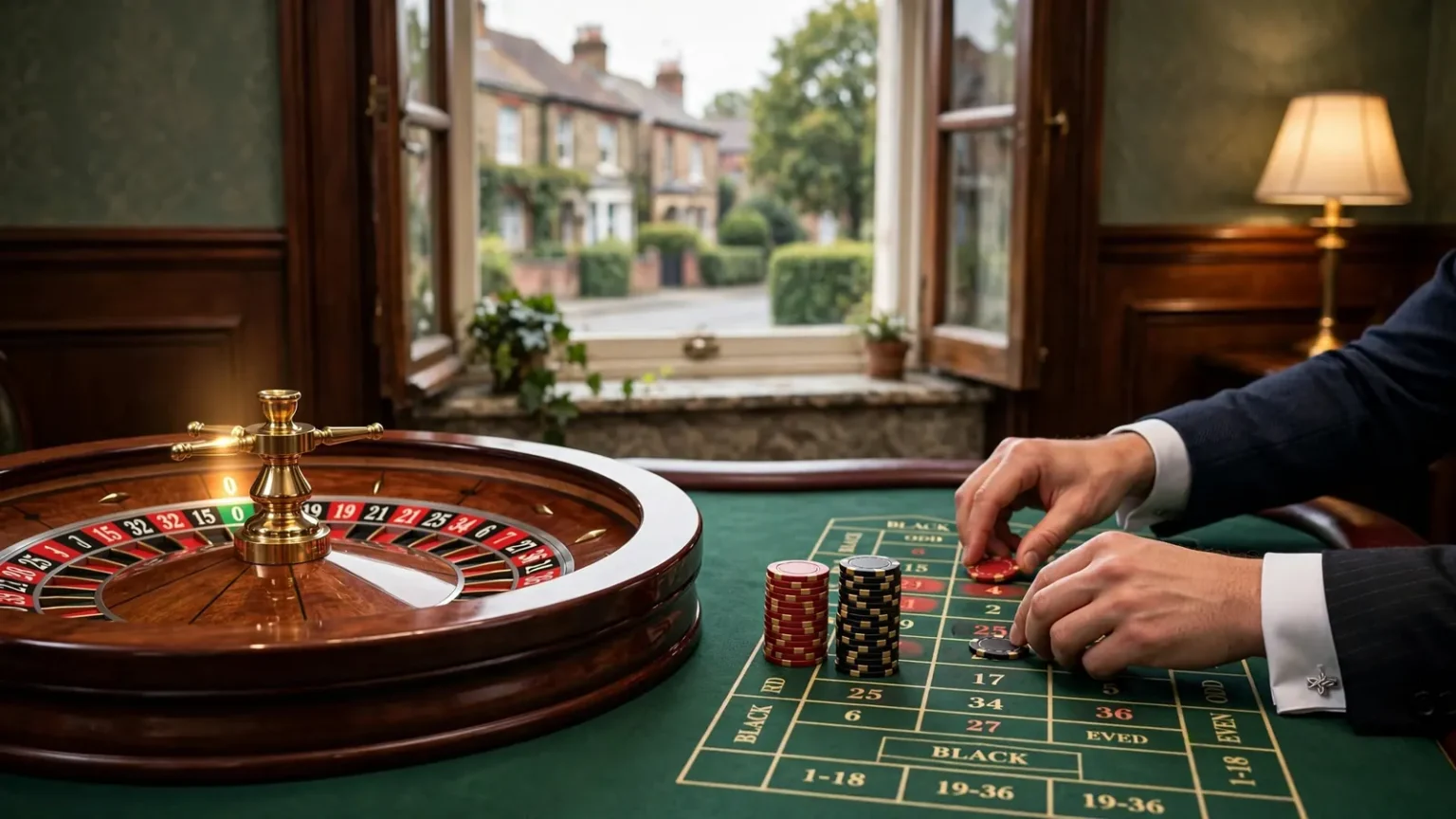
French roulette softens a zero on even-money bets, but the rules do not apply equally to every wager.
The French Difference: Zero Has a Price
In roulette, zero is not merely another pocket. It is the point at which a table’s rules reveal who bears the cost of chance. On an ordinary even-money bet, a player backs red or black, odd or even, or a low or high range. A zero is neither side of those choices, so the usual result is that the stake is lost. French roulette softens that outcome through two rules: La Partage and En Prison.
La Partage means “sharing”, and its name describes the compromise. If the ball lands on zero while an even-money bet is in play, half the stake is returned. The other half is lost. The rule does not turn the bet into a safe one; it makes the zero less expensive. On these bets, La Partage reduces the house edge to 1.35%.
That is a particular benefit, not a general refund on every wager. It applies to even-money bets, whose appeal lies in the apparent simplicity of choosing between two broad outcomes. A bet on a single number, for instance, is not an even-money bet and does not receive the same treatment under La Partage. The distinction matters: a rule can make one class of wager fairer without changing the rest of the table.
En Prison takes a different route. When zero appears against an eligible even-money bet, the stake is not immediately divided or returned. It is held, or “imprisoned”, for the next spin. If that spin settles in the player’s favour, the stake is returned; if it does not, the stake is lost. The money remains tied to the table for another decision, rather than being partly returned at once.
The difference is as much about time as arithmetic. La Partage settles the zero result immediately, with half the stake back. En Prison leaves the bet unresolved and carries it forward. One rule shares the loss; the other suspends the verdict. Neither makes a winning result more likely, and neither changes the fact that the ball’s destination is uncertain. They change what happens to a qualifying bet when it lands on the green.
Online American Roulette in the UK: How It Works
This is why the phrase “French roulette” is more than a decorative label on an online table. The defining feature is the treatment of zero, especially for even-money wagers. A table that looks similar but does not apply La Partage or En Prison may not offer the same practical terms. The name alone is not the rule; the table’s stated rules are.
Historically, the French form of roulette acquired a reputation for giving players a more considerate settlement on zero. There is a small social history in that gesture. Games of chance often present themselves as pure mathematics, but their rules are also human decisions about how a loss is apportioned. Here, the house does not surrender its advantage. It agrees that, in a narrow circumstance, zero need not take the whole stake.
Together, La Partage and En Prison give French roulette the lowest house edge among standard variants. That description needs its boundaries. It does not mean every wager at a French table carries the same advantage, or that a player is likely to finish ahead. It means the rules reduce the house’s mathematical advantage in the relevant circumstances, most notably when zero interrupts an even-money bet. The distinction is less dramatic than a promise of winning, and more useful.
For anyone comparing French roulette online, the practical check is therefore not whether a page uses a French flag, French styling or a familiar table name. It is whether the rules identify La Partage, En Prison, or both, and which bets qualify. The terminology can be easy to skim past, particularly when the table interface gives more room to the wheel than to the small print. Yet that short rules panel determines whether zero takes the whole stake, half of it, or leaves it waiting for another spin.
French roulette is distinguished by the La Partage and En Prison rules, which reduce the house edge to 1.35% on even-money bets when the ball lands on zero.
The appeal of French roulette rests on this limited but meaningful concession. Zero remains part of the game, and the house retains an edge. The player is not protected from losing; the loss is simply treated differently under specified rules. In a game built around a ball that refuses to recognise anyone’s preferred colour or number, that is a modest adjustment. It is also the reason the variant stands apart.
A Wheel’s Pockets, and the Odds They Set
A roulette wheel is a small piece of arithmetic dressed as ceremony. Its numbered pockets determine how often a particular result can occur; the layout on the betting table merely gives players ways to group those results. Before a French roulette game can be understood as a variant, its underlying wheel has to be distinguished from the standard European and American versions.
European roulette has 37 pockets: the numbers from 1 to 36 and one green zero. American roulette adds another green pocket, the double zero, bringing the total to 38. That extra space is not decorative. It creates another outcome on which ordinary numbered bets lose, while the payouts remain set against the original range of numbers. The house edge is 2.70% on European roulette and 5.26% on American roulette.
European Roulette at UK Online Casinos: A Guide
The difference is not a matter of a dealer’s style or a table’s appearance. It is built into the wheel. With the same stake and the same published payout, a bet on a number faces more possible losing pockets on the American layout. The house edge expresses the resulting long-run advantage for the casino, rather than predicting what will happen in any single spin. A short run can favour a player; the arithmetic concerns the repeated game.
That is why the pocket count is the first useful detail when comparing roulette versions. A table labelled simply “roulette” may not make the distinction prominent, but the wheel itself does. European roulette keeps the single-zero structure; American roulette has both zero and double zero. The labels are plain. The consequences are not.
For a player considering an online French roulette game, these standard wheels provide a baseline rather than a complete description of the French variant. The number of pockets tells how the wheel is built, while special rules can change how particular bets are treated. Those are separate parts of the game: one concerns the available outcomes, the other what happens to a wager under specified conditions.
The contrast also explains why a green pocket deserves attention even when it appears only once. Zero is counted alongside the numbered outcomes, not outside the calculation. Add a second green pocket and the ordinary European arithmetic no longer applies. A small alteration in the wheel, with a lasting mathematical cost.
Hi-Lo Casino UK: Rules, Searches and Regulation
Finding French Roulette in a UK Casino
French roulette can be harder to locate than a familiar European table, and seeing the name in a casino lobby does not settle how the game is treated under a bonus. Availability, the version offered and its game weighting are separate questions. Each depends on the operator’s current catalogue and terms.
A lobby search may bring up a French table directly, while another casino may group roulette under a live or table-games heading. Titles can also be less informative than their rules pages: a game’s name alone may not make clear whether it follows the French format being sought. The useful check is the game information attached to the individual table, followed by the operator’s bonus terms. A catalogue entry is not a promise that every version is available to every account or in every promotion.
That distinction matters because wagering requirements do not necessarily treat every roulette game alike. The relevant figure is the contribution assigned to a wager: the share that counts towards completing a bonus wagering requirement. A bet can be accepted at the table and still make only a limited contribution to that requirement. Casino language has a way of making these two facts look like one.
Attention: Roulette wagers often have limited bonus contributions, typically ranging from 10% to 20%, and some operators may exclude live roulette from certain bonuses entirely.
Across UK operators, roulette wagers are often assigned a contribution in the 10% to 20% range, but that broad pattern is not a rule applying to every casino or offer. A specialist review reports a sharper difference by format: live roulette may be weighted at 10% or 20%, while RNG roulette may receive 100% weighting. These figures describe reported operator practice, not a fixed tariff for French roulette. The promotion’s own terms are what determine the treatment in a particular case.
French roulette may be supplied as a live table or as an automated game, and a casino can apply different weighting to those formats even when both appear in the same roulette lobby. Nor does a game’s French label establish its contribution rate. Bonus rules commonly distinguish by game category or delivery format; the title shown in the lobby may not spell out which category the operator has assigned. Where the terms name only “roulette”, the table’s own information or the operator’s clarification may be needed to resolve the ambiguity.
There is no dependable catalogue of UK casinos with French roulette that can be treated as permanent. Games are added, removed or presented differently, and a table available in one operator’s lobby may not appear in another’s. The same caution applies to claims about the best or premium French roulette casinos: those labels do not demonstrate either current availability or favourable bonus treatment. A useful comparison begins with the actual table listing and the terms attached to the offer, not a ranking that assumes the two will match.
For anyone considering bonus funds, the decisive detail is not merely whether roulette counts, but how much of each qualifying wager counts and whether the named game is included at all. A contribution below full weighting means the wagering requirement progresses more slowly than the stake placed might suggest. If a game is excluded, its wagers do not advance the requirement. This is why the exact wording for live roulette, automated roulette and named games deserves attention before play begins. The lobby and the promotion page answer different questions.
Checking Bonus Eligibility
- Locate the French roulette table in the casino lobby
- Open the game information to verify the rules
- Review the active offer’s game-weighting terms
- Confirm if French roulette falls under the qualifying categories
- Clarify any ambiguities with the operator
The practical order is simple: find the French table, open its information, then read the active offer’s game-weighting terms. If the offer uses broad categories, check whether French roulette falls within them; if the wording is unclear, ask the operator rather than infer an answer from another casino’s policy. Terms can differ between promotions at the same operator, so a figure remembered from an earlier offer may no longer apply.
A casino may therefore offer French roulette without making it a useful choice for bonus wagering, or give a particular roulette format more weight than another. Neither outcome changes the game itself; it changes only how a promotional requirement is calculated. The distinction is small in the interface and large in the arithmetic. A visible table is not the same thing as a qualifying wager.
Best casino sites in the UK
- BritsinoBonus: Welcome Package – Get your £2,200 + 2,000 FS · Payout speed: 1-3 business days
- BeOnBetBonus: 100% up to €500 + 100 FS · Payout speed: 1-3 business days
- Revery PlayBonus: 100% up to€1,000+ 100 FS · Payout speed: 1-3 business days
- EvoSpinBonus: 125% up to €2500 + 125 Free Spins · Payout speed: 1-3 business days
- WinBeastBonus: €5000 + 500 FS + €650 Freebet · Payout speed: 1-3 business days
- SpinFormulaBonus: 550% Up To £15,000 + 550 FS · Payout speed: 1-3 business days
- JetsetspinsBonus: 200% Bonus + 100 Free Spins + Free Royal Wheel · Payout speed: 1-3 business days
- NightWinBonus: £900 + 400 free spins · Payout speed: 1-3 business days
- NightLuckBonus: Welcome Pack + 805% Up To 6400€ + 280 FS · Payout speed: 1-3 business days
What Makes a Casino Suitable for French Roulette
There is no honest universal answer to which casino is best for French roulette. A table’s name and polished graphics reveal little about the quality of the operation around it. A more useful test is whether the important details can be checked before money is deposited: the game’s published return information, the account controls, the operator’s regulatory status and the route available when something goes wrong.
Fastest payout online casino UK: how to assess claims
RTP information should be accessible, rather than hidden behind a chain of menus or left to be inferred from the game’s appearance. The return to player figure describes a theoretical long-run return, not a prediction for an individual session. Its value as a selection criterion lies partly in the fact that it is disclosed and can be compared with the rules of the particular game. A casino that makes this information difficult to locate offers less basis for an informed choice, however elegant its table design.
This is not a demand for a glossy explanation. Clear game information should identify the version being offered and make its published return details available before play. Where several tables appear under similar names, the difference between them should not have to be guessed from a thumbnail. French roulette carries a particular set of rules; the label alone is not proof that a listed table applies them.
The same principle applies to account controls. A well-run account should make its limits and safer-gambling tools easy to find, not treat them as administrative furniture. UKGC licensees must prompt new customers to set a financial limit before their first deposit and provide accessible account-level controls. These are practical tests of how an operator treats the boundary between entertainment and money. If controls are present but hard to locate, their nominal existence is not much of a comfort.
Operators must verify a customer’s age before allowing a deposit into a gambling account. That check is part of the threshold for participation, not an optional courtesy. A casino’s account procedures therefore matter as much as its game lobby: the rules governing entry, deposits and continued play shape the experience before a roulette wheel appears.
Live casino operators regulated in Great Britain must also provide a defined set of tools: deposit limits, loss limits, session time reminders, reality checks, cool-off periods and GamStop self-exclusion. Their presence should be verifiable in the account area or help information. A list buried in a policy document is not as useful as controls that can be reached and understood when needed. Here, design is not merely decoration. It determines whether a safeguard is usable.
Do
- Verify the UKGC licence number on the public register
- Check that RTP information is easily accessible
- Set financial limits before the first deposit
- Use defined tools like GamStop for self-exclusion
Don’t
- Trust a UKGC logo without checking the register
- Assume a table is French based on the name alone
- Overlook the internal complaints process
- Rely on hidden or hard-to-locate account controls
Regulatory status is another basic check, not a badge to take on trust. The UK Gambling Commission is the sole regulator of online casino activity in Great Britain. Remote operators offering gambling to people in the British market need the relevant UKGC licence, wherever the business itself is based. A platform without a valid UKGC licence cannot legally offer real-money live roulette to British residents. The licence number can be checked against the Commission’s public register before depositing; a logo on a page is not a substitute for that record.
There is a civic difference here, as well as a practical one. A UKGC-licensed operator is answerable within a system that sets obligations for the business, rather than asking customers to rely on a company’s own account of its standards. This does not guarantee a faultless service. Regulation is not magic. It does provide a framework against which conduct can be assessed.
That framework includes a route for complaints. UKGC licensees must offer an internal complaints process and access to an approved Alternative Dispute Resolution service. The operator should explain how to raise a complaint and what happens if its own response does not resolve the matter. A vague assurance that customer support is available is not the same thing as a clear escalation route. Good service is most visible when something has gone wrong.
Fast Payout Online Casinos in the UK: What Can Be Verified
A careful comparison, then, need not become a ranking of supposed winners. It can ask whether a casino identifies its UKGC licence clearly; whether its game information, including RTP, is accessible; whether account limits and self-exclusion are usable; and whether complaints have a stated path beyond the first reply. The French table may be the attraction, but the surrounding terms of participation tell more about the institution providing it.
The green felt is only the visible part.
Low Stakes, Faster Tables and the Cost of Waiting
A low minimum stake can make a roulette table feel more accessible, but it does not tell the whole story. The pace matters too. A small wager repeated through a rapid run of spins can use a bankroll differently from the same wager at a slower table. For French roulette, as for other variants, the limit and the tempo belong to the specific table, not simply to the name of the game.
RNG roulette, in which software simulates the spins, is associated with lower minimum stakes and faster play. Stakes can be as low as 10p. That can suit someone who wants to keep each individual bet small, though speed changes how quickly decisions recur. There is less time between one result and the next than at a conventional live table, and the small size of a stake does not slow the sequence down.
RNG Roulette
Software-simulated spins with stakes as low as 10p and faster gameplay.
Live Roulette
Streamed tables with human dealers and minimum stakes starting from 10p.
Speed Roulette
High-tempo formats that can exceed 150 spins per hour with minimums as low as 5p.
Live roulette can also begin at a low stake. A specialist review reports UK live-table minimums starting at 10p. That is a reported starting point, not a promise that every operator or table will offer it. The minimum shown before play is the useful figure: a table’s label may be familiar, while its limit is set for that particular version.
Auto-roulette and speed roulette are reported at lower entry points in some cases. A specialist review places their minimums as low as 5p. The qualification matters: “can start” is not the same as “will be available” at every casino, and the lowest table limit may not apply to French roulette. A low-stakes French table therefore has to be identified by its displayed rules and limit, rather than inferred from the variant’s name.
The difference between a minimum and a comfortable pace is easy to miss. A 5p or 10p entry point tells how little a single bet may be; it says nothing about how many decisions arrive in an hour. Speed roulette can exceed 150 spins per hour, compared with 80–100 at a standard table, according to a specialist review. Those figures describe formats, not a guaranteed schedule at every table. Still, the contrast is plain: a faster table offers less waiting, and makes the succession of betting decisions denser.
The cost of waiting is not only time. At a slower table, pauses between spins are part of the experience; a live dealer’s routine gives each round a visible interval. Faster formats reduce that interval. For a player trying to keep spending measured, the practical question is therefore not merely whether the minimum is low, but whether the pace leaves room to pause. Small stakes can soften each decision without changing how quickly decisions accumulate.
Keno Online Casinos in the UK: Rules, Payouts and Evidence
“Low limit” is also relative. A table with a modest minimum may have a maximum that does not suit every budget, while a standard-limit table can feel restrictive to someone seeking a smaller entry point. A high-limit or VIP table belongs to the opposite end of that range, but its status does not make it a faster or better-paced choice. Limits and tempo are separate features, and neither should be guessed from a table’s title.
French roulette may appear in different formats, but the label alone cannot establish a table’s minimum, maximum or speed. The figures attached to low-stake formats are starting points reported for UK tables, not a catalogue or a guarantee of availability. Before choosing a table, its displayed limit and the time allowed for each round are more informative than a broad promise of “low stakes” or “fast play”.
The pause is part of the price.
Live Dealers or an Automated Spin
A live roulette table and an automated one may show the same green layout, but the spin comes from a different place. In live dealer roulette, a camera streams a real wheel from a studio. A human dealer sets the ball in motion, and the result arrives as a physical drop into a pocket. The screen is not merely illustrating a calculation; it is carrying an event from one room to another.
RNG vs Live Dealer Tempo
In American roulette, RNG games typically produce 150 to 200 or more spins per hour, whereas live dealer play runs at approximately 50 to 60 spins per hour.
RNG roulette works without that room. A random number generator determines the result and simulates the spin on screen. There is no physical ball to follow and no dealer’s movement between bets and outcomes. The animation gives the result a visible form, but the source of the result is software.
That distinction can matter even when the rules displayed on the table are French. A listing for live French roulette points to a streamed table, while an automated French table would use a generated result. The label alone does not settle how the game is produced: the table description is where the format should be clear. The phrase “live auto” can blur two different arrangements, since “live” refers to a studio stream and “auto” to an automated spin.
The human presence changes the interval between outcomes. A dealer must carry out the physical sequence, while RNG play can move directly from one simulated result to the next. The contrast is measurable in American roulette: RNG games typically produce 150 to 200 or more spins an hour, while live dealer play runs at 50 to 60. Those figures describe a broad difference in tempo, not a promise about every French roulette table. A particular game can run at its own pace.
More spins are not a different kind of luck. They are simply more results arriving within the same stretch of time. The faster format compresses the pauses that belong to a streamed wheel; the live format makes those pauses part of the presentation. One is more immediate, the other more visibly physical. Neither changes the fact that each result is a roulette outcome.
Live Casino Lightning Roulette in the UK
There is a small social history in the preference. The wheel was once a public object, watched in company; online, the studio preserves a version of that spectacle, with a dealer and ball performing the familiar ritual for distant screens. RNG removes the ceremony and keeps the decision at its centre. Neither arrangement is more authentic in every sense. One shows the mechanism; the other makes the result arrive without it.
For anyone searching for a live French roulette casino, the useful distinction is therefore not just the word “live” in a title. It is whether the game streams a real wheel and human dealer, or renders a result generated by software. An online live French roulette table belongs to the first category; an automated French game belongs to the second, even if its graphics imitate a wheel. In a live auto French roulette listing, the wording deserves particular care, because the two formats are opposites in how the spin is produced.
The difference is visible, and audible, but its chief consequence is time. A streamed ball takes its course. An algorithm does not need to wait for one.
The Licence Behind the Green Felt
In Great Britain, the UK Gambling Commission (UKGC) is the sole regulator of online casino gambling. The legal framework rests on a straightforward distinction: an operator taking British customers for real-money play must hold the relevant UKGC licence, wherever the company itself is based. A site without a valid licence cannot legally offer real-money live roulette to British residents. The screen may look much the same; the rules behind it do not.
Illegal Operators
A platform without a valid UKGC licence cannot legally offer real-money live roulette to British residents.
The Gambling Act 2005 governs gambling in England, Wales and Scotland, but not Northern Ireland. Online gambling is legal for adults aged 18 and over when it takes place with a UKGC-licensed operator. Before an account can be funded, the operator must verify the customer’s age. This is not a formality postponed until winnings are requested; it is a condition of access.
Financial controls are built into the account as well. New customers must be prompted to set a financial limit before making their first deposit, and account-level limit controls must remain accessible afterwards. For a casino offering French roulette, those safeguards belong to the operator, not to the game. The wheel carries its own uncertainties; the account should not.
UKGC-licensed live casino operators must also provide deposit and loss limits, session time reminders, reality checks, cool-off periods and GamStop self-exclusion. They must offer an internal complaints process and access to an approved Alternative Dispute Resolution service. These provisions give disputes and deliberate pauses a defined route, rather than leaving them to the small print of a game page.
A UKGC logo alone is not the record. The licence number can be checked against the Commission’s public register before depositing. That is a modest piece of due diligence, but regulation is only meaningful when the operator can be matched to it. Green felt is decoration. The licence is the jurisdiction.
Live Baccarat Online Casinos in the UK: What to Check
Premium Tables Do Not Change the Mathematics
A premium label can make a roulette table look like a different class of room. The bets, however, are still measured by their stated payouts, not by the colour of the interface or the status attached to the table. In French roulette, as elsewhere, the key question is what the selected numbers pay when they win.
A straight-up bet covers one number and pays 35:1 on both European and American roulette. A split covers two adjacent numbers and pays 17:1. A street bet, placed on a horizontal row of three numbers, pays 11:1. These are different ways of distributing a stake across the layout; the payout reflects the type of bet, not a premium designation.
Outside bets cover broader groups. Red or black, odd or even, and low or high each pay 1:1. Their simplicity does not make them a special premium-table feature, any more than a single-number bet becomes more generous because it is placed at a grander virtual table.
That distinction matters when a casino presents French roulette as a premium experience. A polished design or an elevated table title may change the atmosphere, but it does not, by itself, revise the published payout for a straight-up bet or a split. The arithmetic remains visible on the layout.
There is a separate question about French rules when zero appears, but that concerns how certain bets are treated in that circumstance, not a general uplift to every winning payout. The label and the mathematics are not the same thing.
Payouts and Tiers
Premium labels change the atmosphere and design, but they do not alter the mathematical payouts of the bets.
A table’s stated payouts are therefore a better guide than its tier. In roulette, ceremony is plentiful. It does not pay extra.
Betting Systems Meet the Losing Streak
The Martingale is built on a simple instruction: after every loss, double the next bet. Its appeal lies in the imagined neatness of the sequence. A win, when it comes, is supposed to recover the earlier losses and leave a gain equal to the original wager. The arithmetic looks orderly; the table is not obliged to cooperate.
Each loss makes the next required stake larger. A losing streak can therefore press hard on a player’s bankroll, turning a modest starting bet into a demand for funds the player may not have set aside. The system does not remove risk; it shifts it forward, concentrating more money in the next attempt. That is a severe bargain for a method often presented as discipline.
French roulette may soften the house edge on certain bets through its rules, but that does not make a sequence of spins predictable. A favourable rule changes the game’s long-run mathematics; it does not tell the ball where to fall next. The distinction matters. A lower edge is not a promise of a win, and a previous loss does not make a particular result due.
The Martingale also depends on the idea that a player can keep doubling for as long as losses continue. Real bankrolls are finite. The method’s apparent certainty lasts only while the sequence remains affordable, and losing streaks are precisely where that assumption is tested.
Roulette outcomes are determined by chance. No betting system can forecast the final result, whether the next stake is small or enlarged after a loss. Systems can organise decisions, and sometimes make a player feel that chance has acquired a timetable. It has not.
Live Blackjack Online Casinos in the UK: Rules
Bonus Wagering: The Small Print Around Roulette
A roulette spin can look identical whether it is played with cash or bonus funds; its treatment in wagering terms may be quite different. The game-weighting rate determines how much of a qualifying stake counts towards the requirement. A specialist review of UK operator terms reports that roulette wagers may count at the full rate on RNG games, while live roulette can be credited at a lower rate, such as 10% or 20%. Those are operator-specific terms, not a rule of French roulette.
The distinction matters when an offer names a particular game or format. A specialist comparison of casino offers reports that some operators leave live roulette out of wagering on no-deposit bonuses altogether; where it is counted, the stated contribution can range from 0% to 10%. The same review reports live roulette contributions of 10–20% for PartyCasino and Gala Casino. These figures describe the terms reviewed, not a promise that an offer will retain them. Bonus conditions can differ between promotions and change over time.
French roulette does not, by its name alone, settle how a wager counts. A bonus may treat it as roulette generally, distinguish live from RNG play, or exclude a format under its own conditions. The wording attached to the specific bonus is therefore more consequential than the game label. Small print, doing large work.
A regulatory update summary reports that, from January 2026, licensed operators are subject to a maximum bonus wagering requirement of 10 times. That cap limits the stated wagering multiple; it does not make every game contribute equally or turn an excluded roulette wager into an eligible one. Contribution rates and exclusions still need to be read alongside the offer’s other conditions. For anyone considering casino French roulette with bonus funds, the practical calculation begins there: what counts, at what rate, and whether live play counts at all.
Material created by the team Pure Casino UK Guide


